

Tarzan Trilogy by Thomas Zachek, page 1
part #3 of The Wild Adventures of Edgar Rice Burroughs Series


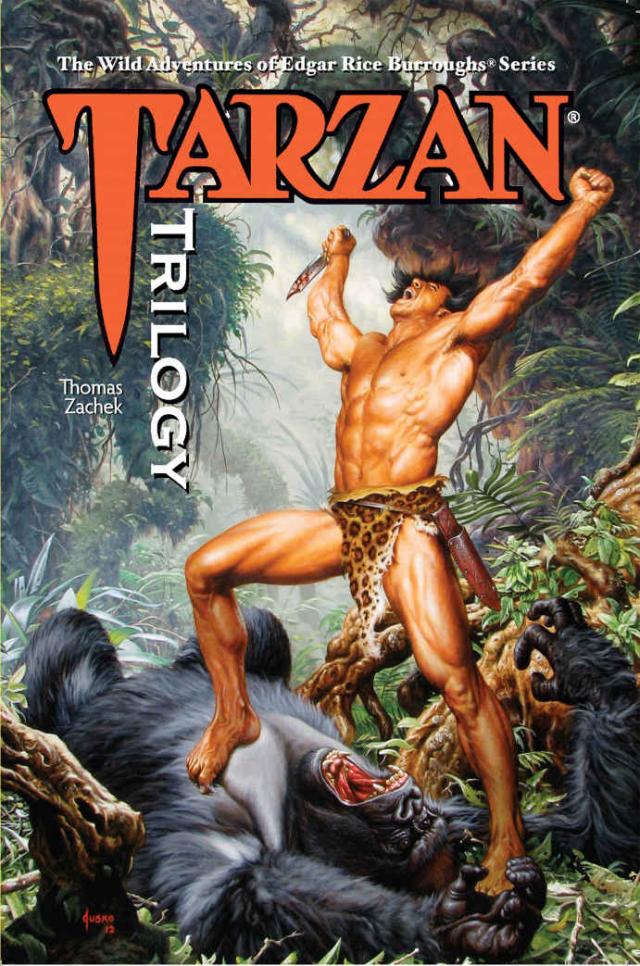
TARZAN® TRILOGY
By
Thomas Zachek
Tarzana, California 2016
Copyright Information
© 2016 by Edgar Rice Burroughs, Inc.
All rights reserved. No part of this book may be reproduced, stored in a retrieval system, or transmitted in any form or by any means, electronic, mechanical, photocopying, recording or otherwise, without written permission of the publisher, except for brief passages quoted in review Trademarks including Edgar Rice Burroughs ® and Tarzan ® owned by Edgar Rice Burroughs, Inc.
Front Cover by Joe Jusko
Interior illustrations by Douglas Klauba © 2016 Edgar Rice Burroughs, Inc.
Special thanks to Bob Garcia, Jim Gerlach, John Gerlach, and Gary Buckingham for their valuable assistance in producing this novel
1936
Tarzan and the “Fountain of Youth”
Chapter One
T H E B O T A N I S T
"Isn’t it beautiful?” asked Professor Alistair Winslow.
The rumpled botanist with the tousled graying hair, mustache and stubbly growth of beard stared through his large magnifying glass. “The Ghana daylily,” he said. He pronounced the Latin scientific name, which the man next to him could not fathom, and then added, “A simple, unassuming flower in many ways. It grows in a variety of climates and soils, though all tropical.”
Holding the stem between the fingers of his left hand, he slowly turned the flower, steadying the glass with his right hand to focus on one petal, then another surface detail. “Look at it,” he continued, “its elegant curved petals, yellow as the sun when they are mature, with lovely striations along the inner surface, the anther and filament bright orange, so attractive to insects….”
The man standing over him, a tanned fellow with squared face and graying brown hair, dressed in a dusty brown shirt and khaki pants, and wearing a holstered sidearm, was less impressed. “But what have you found out about it?”
“Well, that’s even more interesting. It’s not the lovely flower, but its stem. The secretions of its stem apparently have a degree of curative power. They improve muscle tone, lower the blood pressure, and even—apparently—enhance the natural healing and regenerative powers of the body. We discovered it almost by accident. It isn’t in any of the journals. In fact, one of the native bearers put us on to it.”
“So what does that mean exactly?”
“Well, we can’t be sure yet, you understand,” Winslow answered. “It must be tested much more thoroughly, and we need greater quantities of it. But it may help people heal more quickly, feel more vigorous, resist disease better. The one problem we’ve discovered so far is that it doesn’t last long. It needs a stabilizer to extend its useful potency.”
“And that’s where the bark comes in?”
“Yes. The bark of the jakaba tree. It might be possible to make an extract from it which, when processed and powdered, and blended with the stem secretions, will allow the mixture to have a longer shelf life, so that it can be put in pill or potion form and taken as needed.”
“And that grows here, too?”
“Yes, both of these species thrive in this tropical climate. They grow wild, but you could cultivate them both, together,” said the botanist.
“So that’s what we need, then, Winslow?” the man asked, his brow furrowing. “We can begin production? These will do the trick?”
The botanist put down his glass and gently returned the flower sample to its container. “Well, yes, provided you can harvest them in sufficient quantity and in good condition.”
“I’ll have the manpower for that.”
“I don’t know about the type of men I’ve seen arriving here lately.” Winslow nodded toward the window, where he had been hearing the sounds of trucks, shouts of arriving men, and increasing commotion in the yard of the compound for days. “They don’t seem exactly like botany assistants to me.”
“You let me worry about that. Just tell me if we’re getting what we need. Do your part, Professor, and you and your college boys’ll come out all right. You will all be safe and protected.”
The professor looked up at him, hesitantly. “From what?”
“From whatever misfortune might happen to befall you…at
the hands of those men.”
Winslow turned back to examining the flower samples. “But you do realize that you’ll need considerable quantities of both the plant root and the tree bark to process.”
“Again, you let me take care of that. We’ll get enough. You just make sure that it’s the right stuff.”
“That’s the point. We can’t know whether it’s the ‘right stuff ’ unless it’s processed properly, and tested, and the results will have to be replicated, and you will need the approval of government drug agencies.”
The other man held up his hand in a dismissive gesture. “My company can deal with all of that. I just need to know what we have the makings of here.”
“Well,” Winslow said tentatively, “what we have is the possibility of a medicine which can make people feel, at best…”—the botanist chose his words carefully, despite the apparent impatience with which the other man waited for him to say what he wanted to hear—“…more vigorous, more energized, healthier.”
“No, Professor.” The other man allowed a cynical smile to cross his face. “What we have here is the Fountain of Youth!”
Chapter Two
G E O RG E F RED RI C K S O N
John Clayton, Lord Greystoke, pulled open the leaded glass door of the London pub and stepped in. As he strode past the long mahogany bar with the tap handles of painted wood and gleaming brass, he turned more than a few patrons’ heads. Though he was impeccably dressed with a waistcoat, topcoat, conservative tie and even a long umbrella, his tall frame, his elegant stride, his bronzed skin and his rather long shock of black hair suggested that this was no ordinary British peer.
Passing through the elongated bar area, he paused in the dark wooden archway trimmed with stained glass and looked around the back parlor until he spotted the familiar balding, ruddy face and graying temples.
“John!” said the man in the corner booth.
Clayton grinned at the sight of his friend George Fredrickson, then strolled over and slid in across the supple leather upholstery. It had been a while since he had seen George, who was an official in the Ministry and one of the few Europeans who knew his secret. Clayton did not normally frequent pubs, but he knew that George, never one to stick to social conventions, liked to get away from the office in mid-day, and this meeting was at George’s request. That also told Clayton that the reason for this meeting was personal, not business.
“Let me get you an ale. Boddingtons?” Clayton nodded. Fredrickson eased out of the booth and ambled over to the bar. Clayton took a moment to enjoy the early afternoon sunlight illuminating the coat of arms on the stained glass window before Fredrickson returned with two pints of amber ale.
“Ah, here we are.” They raised their glasses to each other and took a sip. Fredrickson wiped a bit of foam from his lip, almost in a smack, and ventured, “Good, isn’t it?” Clayton acknowledged with a neutral nod, though he was reminded of how he preferred the hearty brew that his African friends made.
“So,” Fredrickson began. “How’ve you been?”
“Good.”
“Well, a lot’s been going on since you last visited…a new king in Edward VIII, Olympic Games in Berlin, Spain’s Civil War….”
“Yes,” Clayton acknowledged neutrally.
“Are you going back to Africa soon?”
“Yes, soon. Why?”
Fredrickson put down his pint, looked down, and hesitantly pursed his lips before saying, “It’s about my son.”
“Jack? How is he?” Clayton asked. “I haven’t seen him since he graduated from Oxford two years ago.”
“He’s missing. At least I think he is.”
“What happened?”
Fredrickson took another sip of ale, as if to fortify himself. “My son is in the Belgian Congo, and I haven’t heard a word from him. He used to send me letters regularly, almost weekly, but I haven’t heard a thing for seven weeks, almost eight now.”
“What would you like me to do?” asked Clayton, suspecting the answer.
“Well, the site where he was working is about fifty miles from your”—he hesitated, realizing that “home” wasn’t the right word— “… your area….”
“Yes,” ventured Clayton, filling in the space where Fredrickson searched for words. Fredrickson had put on a jolly expression to greet him, but Clayton, a perceptive judge of character, felt that his friend seemed to be uncharacteristically hesitant, as if he was not sure how to bring up what he wanted to discuss. “You wish me to find him?”
“I don’t want to put you at risk. I just wonder whether you could… make inquiries….”
“You want me to ask whether anyone has seen him?” Clayton had not meant it to sound as dense as it apparently came out.
“Well, you do have certain…acquaintances down there who might have sources of information. Perhaps they have heard something…word gets around….” The expression in Fredrickson’s eyes widened hopefully. Clayton wondered why Fredrickson felt he needed to be so indirect in asking a favor.
Then Fredrickson extended his hands palm upward on the table and said, more directly, “I’m worried. His mother’s worried. Can you help us?” The bit of perspiration on Fredricksonâ
“I’ll look for him,” Clayton stated.
“He might not even be there. I…I don’t know,” Fredrickson went on.
“I’ll do what I can,” Clayton assured him.
“Oh, thank you,” Fredrickson replied, relieved. “I hoped I could count on you. I am in your debt. Can I buy you lunch? They have a terrific beef pie under pastry here.”
“No, thank you. I’m not really hungry,” said Clayton, almost the truth. He was indeed a little hungry, but British chefs cooked their meat too much for his tastes. He would later get some fruit and stop by a little shop whose trusted proprietor would provide him with meat he preferred, which he would then enjoy his usual way.
“What was Jack working on?” Clayton asked.
“He went down there with a contingent of botanists and other scientists to study and catalogue species of plant and herbs. When he was doing his postgraduate work he told me he had become fascinated with some new developments in medicine coming out of the Belgian Congo region, something about herbs or some such that were powerful against certain strains of disease. When an opportunity to go down there came along, he signed on with Professor Alistair Winslow, who was apparently in charge of a research team investigating these new developments. As I say, he wrote me every week. His letters didn’t say much about this professor’s research, just that Jack was enthusiastic about all the work of Winslow’s team. Most of his letters were filled with personal matters about how he was getting along…you know, the kind of thing his mother would want to know about. Here are his last two….”
From the breast pocket of his coat he produced two envelopes and handed them to Clayton. Inside were handwritten letters on cream-colored stationery, their corners and creases supple from having been opened and read and refolded repeatedly. “They don’t give you much to go on, but I’m afraid that’s all I’ve got. That’s why I’m worried. He should have been back by now, or I should have heard something.”
“Have you contacted the university?” Clayton asked, skimming over the letters.
“None of the party has returned or been heard from in the last month. The Botany Department says that is not a long time to go without word. They are not worried, because they say these things happen. Letters out of the Congo are often delayed, phone lines fail, and so on. Seems frightfully casual of them. But I’m not satisfied.”
“Have you tried the Foreign Office?”
“They are involved with larger matters. Plus they need some proof, and that’s the point—I haven’t any, have I?” His brow furrowed a little and his face became more flushed with worry. “This is not like Jack,” he continued. “I don’t want to wait any longer and that’s why I thought I’d ask you… you know…whether you will be going back soon.”
“May I study the letters?”
“Of course. Take them with you.” Fredrickson sipped his ale,
feigning a casual reserve, and then after a moment said, “When might you be leaving?”
Clayton had intended to remain in London for at least another two weeks, but he knew that Fredrickson was trying to ask him to leave as soon as possible, without saying as much.
“I have a few details to wrap up here. I can leave in two days.”
George Fredrickson’s bushy brow relaxed and the corners of his mouth turned upward in relief that was almost palpable. He proffered, “I know that you will not accept money, but let me get you a plane ticket. It’s the least I can do.”
“Thank you.”
“And let me give you a rifle and ammunition. I think it’d be a lot better than that bow you use.”
“George, you know that the way I travel, a rifle is too heavy and cumbersome,” Clayton began with a smile, not wishing to be condescending to his concerned friend. “And if the rifle breaks or I run out of cartridges, I cannot fashion more from the materials around me.” He need not have added what Fredrickson already realized: “You have chosen to ask me to do this. Let me do it my way.”
Clayton finished his pint and rose to take his leave.
Fredrickson added, “Any information…anything you could tell me…would be appreciated.”
Looking his old friend in the eye, Clayton assured him, “I’ll find him.”
Chapter Three
T H E C H G A L A
The village of the Chgala tribe lay deep in the interior of central Africa. It was a small village, primitive and isolated even from many other tribes. The Chgala were a simple people who had hunted, fished, and lived off the land for generations.
The village bustled with activity much the way it did every day, but this day brought something new. It started as a great rumble off in the distance. The heads of villagers bent over their midday chores began to pop up one after another as they turned to look off into the jungle toward the main trail approaching the village. They all stood up, still and silent, watching two dusty brown trucks come to a stop at the outskirts of the village.
No one in the village had ever seen the great elephant-sized vehicles before, nor heard the roar of engines and the squeal of brakes. Their hands that a moment ago had been weaving baskets or skinning pelts or tending cooking fires now hung at their sides as they all stared at the strangers emerging from the vehicles.
Into their camp walked a half-dozen white men, a motley assortment of Europeans, their brows grim and their faces stubbly with several days’ growth of beard. Some wore field jackets, mostly stained, and others wore remnants of various military uniforms, rifles slung on their shoulders, hunting knives and machetes hanging from their belts. The white men stared steely-eyed at the African village, some of them smoking cigarettes and some chewing tobacco.
From among this lot an African man, dressed in garb similar to that of the strangers, stepped forward and spoke in a dialect the Chgala understood. He identified himself as Matu. This man the Chgala knew. Indeed, their chief approached and, with a grin, extended the traditional tribal greeting to him. The two conversed for several moments, with considerable nodding and gesticulating.
Matu turned to the leader of the white men, who advanced to meet the chief. He had a more clean-shaven, squared face and graying brown hair. His clothing was cleaner and crisper than the others, his pith helmet unstained. Matu spoke to the leader in English, and the leader responded. Most of the Chgala had never heard English before, and they all, even the children, watched the strangers intently.
“These are the representatives of the white tribe who contacted you,” Matu then said to the chief in his language. The chief nodded and smiled.
The white leader said, “Greetings to you and your people. We have come to visit with your old ones. Are they ready, as promised?”
Upon hearing Matu’s translation, the Chgala chief turned to call to some of the villagers. Four men and two women emerged from one of the grass huts and were presented to the white strangers. They were all very old, gray-headed and gaunt, their faces sallow, the flesh hanging loosely around their necks and torsos. Their posture was stooped. They walked unsteadily on spindly legs, and two limped. They wore breechcloths or tunics of grimy, coarsely woven fabric.
The leader asked, “And these are your oldest villagers?” The chief produced the tribal healer, who attested that they were indeed the oldest people in the village. They certainly look old, the leader of the visitors thought, looking at the wrinkly skin and the thin, gangly arms and legs.
The leader looked at one of them, a stooped and wizened man and asked, “How old are you?” The question was translated. The tribesman looked at the white leader with heavy-lidded, milky eyes and said, “I have seen a hundred rainy seasons.”
“And you?” he asked of the next man.
“I have seen more.”
“And you?” he asked of a frail woman.
“I have seen ninety-six.”
“That’s amazing,” the leader said. “They’re just what we want. Get them onto the truck.”
Several of the white men escorted the old villagers to the trucks and assisted them in getting up and inside the canopied cargo areas in the rear.


