The Ottoman Conspiracy, page 5
part #3 of Jeff Bradley Series
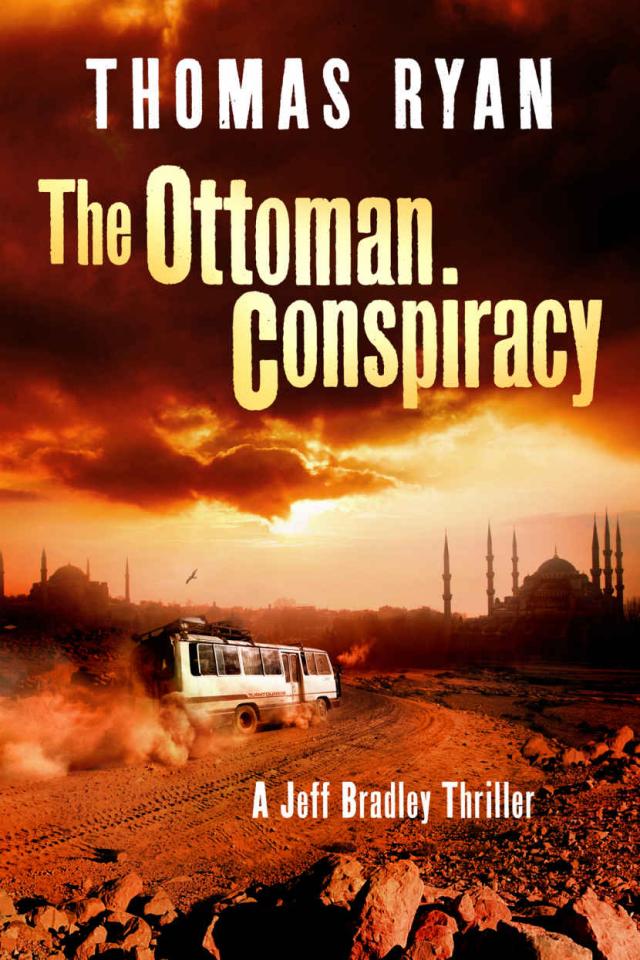


“In a few minutes, you will leave the bus,” The Sheriff said. “My men will show you to the temporary accommodation. There is seating, beds, toilet facilities, food and coffee or water. Make yourselves comfortable. Please bring your passports – one of my men will take them from you.” Hands of passengers rose, as if in school ready to ask the teacher an important question. The Sheriff raised his own hand, a stop sign. “I know some of you will have left your passports at the hotel; any form of ID will do. You can take your carry-on luggage. Bags stowed in the baggage compartment underneath the bus will stay where they are.” Someone closer to the front raised a hand. “No questions for the moment. Please, for everyone’s sakes, do as you are asked. The men outside are armed and they have orders to shoot.” He turned to get off the bus, then stopped. “A reminder, but not of the friendly kind. Please don’t misinterpret my accommodating manner as weakness. Remember the bus driver. If you step out of line or upset me in any way, you will be shot.” The Sheriff paused to allow his captured audience time to fully grasp his message. “Talking is allowed. And until you disembark, walk about, comfort each other.”
The Sheriff stepped down from the bus.
“What do you think, Barry?” Bethany asked.
“I think that asshole is a certifiable nut job.” Barry took hold of Bethany’s hand and kissed her fingers. “Outside of that, I don’t know what to think.”
She always believed in him. Who knew why she stayed with him, but she did, and he counted himself a lucky guy. Her birthday was the day before his, and he had her gift in his bag in the baggage compartment. He had organised a party for tomorrow night.
He turned his mind to the older members of his group. He did not know for certain, but he assumed some of them must be on medication. He would talk to everyone and find out if anyone had tablets they might need from the baggage compartment. If so, he would need to speak with The Sheriff and ask him to let them have their bags.
Images of the fat man in the waistcoat whirled around in his head, mixing with images from different moments of his life. Then the images settled, and he remembered where he had seen the big man.
And his heart sank.
CHAPTER EIGHT
Jeff settled into the back seat of the taxi. For the first fifteen minutes of the drive from the airport to Istanbul, little had changed. Green fields, high-rise apartments and industrial estates, and more green fields, trees, flowers, parks. But once across the bridge over the Golden Horn, traffic increased, footpaths became more crowded and his eardrums vibrated from the cacophony of car horns blaring from all directions. There were road rules, but Turkish drivers rarely obeyed them. The more maniacal attacked intersections as if red and green lights were the same. He asked his cabbie, after he ran a red light, if the citizens of Istanbul had a death wish.
The man behind the wheel, who introduced himself as Fati, said, “Allah decides on everything. If he wants me to die today, it is God’s will. What can I do? My fate is decided.”
The comment was a reminder to Jeff that he was back in the Islamic world. Istanbul as a city was more chaotic than he remembered. The metropolis was now ahead of Moscow and London as the largest city in the European region. It would always buzz with activity. More than fourteen million Turkish citizens lived within the city limits, and each year further millions of tourists helped cram the streets and sidewalks.
Before Jeff flew out of Bari to Rome, he phoned the New Zealand Embassy in Turkey even though he was reluctant to do so. His dealings with government departments in the past had not instilled in him a great deal of confidence. No one was ever prepared to make a decision that did not require fobbing off responsibility to someone else. When it involved an international incident, diplomacy would take precedence over concern for a New Zealand citizen. Not that this lack of governmental initiative was solely the domain of New Zealand; it was the same with all countries. Diplomats were diplomats. And there were always hidden agendas.
At any rate, he was unsure how helpful the embassy could be and decided, not a lot. A small nation such as New Zealand could hardly make demands on a country the size of Turkey. And if he was to help Barry and Bethany, he needed a lot more muscle than his own embassy could ever provide. From now on he needed to rely on his SAS training. In his head, he had become operational and, in the field, judgement calls went with the territory. Special Forces soldiers never considered themselves retired, and nor did the government. Because of this, his sense of duty overrode his reluctance to involve diplomats. He had an obligation to at least notify the embassy a kidnapping had taken place. Also, Barry’s text said that, along with the Australians and New Zealanders, there were Americans on the bus. Once Jeff had alerted the diplomats, and while they bumbled about, he would follow his own course of action.
The New Zealand Embassy was in Ankara. Only a consulate office existed in Istanbul. Jeff got lucky. The Ambassador and his security officer were in Istanbul attending the Gallipoli commemorations. The woman working the phones in Ankara put him through to the security officer. Jeff told the civil servant he was an ex-SAS soldier and he was on his way to Istanbul. He needed an urgent meeting with the Ambassador.
“Yes, well, that is not going to happen, is it?” the security officer said. “The Ambassador is on leave for the next few days and I’m not dragging him off the golf course unless you can convince me the matter has extreme importance, and I’m highlighting extreme. Do you understand where I’m coming from?” He let the message sink in. Jeff waited. He’d been through military basic training courses. The training had given him the experience he needed to not react when treated like an idiot. “The Ambassador would be pissed off,” the security officer continued, “if all that was wrong is a bloody Kiwi losing a passport.”
Jeff didn’t like the man’s attitude, but understood it. He decided to keep the hijacking to himself. At the airport there had been no news items about a hijacked bus in Turkey. If it were known, it would be headline news around the world. Barry may have sent the text without the hijackers knowing. For the moment, his friend’s safety might be reliant on keeping this secret.
Jeff’s instinct told him no one was going to find the bus until the hijackers wanted it found. And that was not going to happen until they were ready to make their demands known. It concerned him there had been no more contact from Barry. It would have been helpful to have licence plate details, the model or manufacturer of the bus, or even the name of the bus company. If he had that information, how would he use it? He had to protect Barry’s ability to continue to make contact. If the hijackers suspected information was coming from the bus, lives might be at risk. Of course, this was all conjecture, but he needed to make a plan, and he would build his plan on his best-guess scenario. Also, the hijackers had forty people. It might not concern them to kill a passenger or two if they thought someone on the bus was leaking information.
“I have reliable information that New Zealanders have been kidnapped,” Jeff said to the security officer. That was enough for now.
“Do you have names?”
“I will provide details when I meet with the Ambassador.”
A pause. Jeff had an image of a pissed-off security officer staring at his phone and thinking, ‘Who the hell did this guy think he was to be stuffing him around?’
“It will take thirty minutes to contact the Ambassador. Call me back in an hour.”
“Too long. I’m flying out of Bari to Rome in a few minutes. When I get to Fiumicino Airport, I’ll have a couple of hours before my flight to Turkey. I’ll phone between flights for a meeting time.”
“How do you know about this alleged kidnapping?”
“You have enough information for now. I’ll phone from Rome.”
Jeff had hung up before the security officer could reply. News of a kidnapped New Zealand citizen should be enough to get him a seat at the Ambassador’s dinner table.
Now, he was in Istanbul and had an hour to kill before his meeting. He wasn’t expecting to get much sleep, but he needed a base, and booking into a hotel would fill some time. The Beyoglu district on the European side of the city would suit him best. He had stayed in the area before and was familiar with the streets. From what he remembered, the nightlife and cafés were open twenty-four hours. Jeff had spent more than one night while on leave from special ops drinking shots of raki in a late-night café on Istiklal Avenue. Not that there would be any heavy drinking on this trip, but he did his best thinking walking busy streets and sitting in late-night cafés. Beyoglu was in the vicinity of the Galata Tower, where his meeting with the security officer was to take place.
“Driver, I need a hotel near Beyoglu,” Jeff said.
“Please, call me Fati.”
“Okay, Fati, I need a hotel.”
“I know a good place. And only a short walk to Istiklal Avenue. This street is very famous in Istanbul. Do you know it?”
“I know it,” Jeff answered.
“Then you will like very much this hotel.”
Jeff agreed to take a look. He held no fears for the quality of the hotel. Most Istanbul hotels were of a good standard.
Fifteen more minutes of heavy traffic and Fati said, “Here is the hotel.” He stopped outside the entrance.
The English words above the Turkish on the brass plate to the side of the entrance read, THE OLD HOTEL. Good name, was Jeff’s first reaction. The building looked as if it had been built in the time of the Ottomans. When it came to architecture, Jeff didn’t have a clue and could not name the style or design of the five-storey building, but he did know it dated back to the nineteenth century. A taxi driver from a previous trip had told him this was the average age of buildings in the Beyoglu district. At street level, the hotel had its own café. From where he sat it appeared full. The patrons did not look like tourists. Locals, for sure. That could mean the state of the interior of the hotel might reflect the exterior’s neglected façade. Did he want to rough it? He decided he didn’t.
He was about to lean forward to tap Fati on the shoulder and tell him he wanted to be taken to the Marriott. Fati must have sensed his hesitation.
He said, “You will enjoy your stay. The owner and his wife and their daughter will look after you.”
Jeff made to argue, then decided against it. He did not have the time.
“Is there a phone in the room?”
The cabbie nodded. “Of course. The hotel has five stars. Well, three official, but it should be five.”
A man and two women approached the car. The boot popped, and his suitcase disappeared through the doorway. Fati the cabbie twisted in his seat and offered a grin. “Please, follow the manager. He will show you to your room.”
It seemed Jeff was staying at The Old Hotel.
“Go nowhere,” Jeff said. “Once I’ve unpacked, I have to go to a meeting. I need you to take me.”
Fati nodded and turned off the motor. “I will wait in the café.”
CHAPTER NINE
The New Zealand Embassy security officer had said, when Jeff called back from Rome airport, that he would meet him outside the Galata Guney Restaurant. The eatery skirted the plaza that surrounded the Galata Tower. He said it was easy enough to find. A black awning stretched out across the outdoor seating, and the name of the restaurant and the word GUINNESS were written in white lettering along the awning flap. The security man said to wait there for him. It was less than a two-kilometre drive from The Old Hotel to the plaza. Fati took a round-about route and drove it in three. He dropped Jeff and said he was not allowed to park in the area. He wrote his mobile number on a piece of paper.
“When you are ready to leave, phone that number,” Fati instructed. “I will not be far.”
Jeff had never been to the Galata Tower, but he had seen it from a distance. Close to seventy metres high, the six-hundred-year-old structure could be seen from many parts of the city. From a distance, it looked intriguing and worth a visit; close up, it was impressive. That it had been constructed that long ago made it more so. Jeff took a photo with his phone.
The restaurant was easy enough to spot. Jeff saw no one standing about. He checked his watch. He was early. In front of the tower, a small crowd had gathered to listen to a young female singer. A man playing an acoustic guitar accompanied her. She sang in Turkish, or it could have been another language for all Jeff knew, but it sounded okay, so he listened while keeping one eye on the restaurant. After fifteen minutes, and still no sign of anyone standing under the Guinness beer sign, he decided the security man might not step forward until he saw Jeff. Jeff couldn’t think why that might be, but the men and women of the intelligence services were a quirky group, and most of them paranoid.
He elbowed his way through the busker’s audience, then made his way across the grey paving stones. Thin lines of red stones mixed in with the grey jutted out from round the base of the tower, and the design made it look as though they were spokes on a wheel, with the Galata Tower the hub. There was a mini-market next to the restaurant. The shopkeeper in an apron stood beside a rack of newspapers. Plastic trays of bottled water sat on the pavement next to an outside refrigerator. Jeff was thirsty and bought a small bottle of water.
He had the cap part-way screwed off when a man in a navy suit, white shirt with blue stripes and a deep-red tie walked towards him. The neatness of the attire and his polished shoes suggested a man used to wearing a uniform. He had a solid look to him. Ex-forces, and not long out, if in fact he was out. Close to his own age, Jeff guessed; early thirties. When he stopped in front of Jeff, he stood shoulders back and hands clasped behind him. A soldier’s at-ease position.
“Jeff Bradley,” Jeff said.
He held out his hand. The security officer shook it, but did not offer his name. Instead, he asked to see Jeff’s passport. He held the travel document at arm’s length. Satisfied the photo and face matched, he passed it back.
“Follow me.”
An order. Not an invitation. Jeff ignored the unsubtle stamp of superiority and obliged. What did he care if the guy had a carrot up his arse? Besides, he was the one who had asked for the meeting. After a five-minute walk they entered a small hotel.
“I have a room I use,” the security officer said by way of explanation.
He waved to the concierge as he led Jeff through the foyer, and received a smile of recognition in return. It seemed the security officer was telling the truth and had been here more than once, not playing I’m-a-big-shot games to keep Jeff on the back foot. Why the hell would he do that anyway? Jeff admonished himself. He had to stop thinking the worst of everyone. But he had experienced the run-around from diplomats in the past and it prejudiced his attitude.
The room had once been a hotel bedroom and was now converted to a small interview or meeting room. Today, Jeff guessed it was an interview room. It had a kitchen and bathroom facilities, and a rectangular table and six chairs. One chair at each end and two either side in the middle. The security officer gestured Jeff towards a middle chair. He still had not introduced himself, and did not bother to do so now. Jeff perceived this guy was confusing him with the whiney Kiwi who had lost his passport he had accused him of being earlier.
“Can I offer you a drink? Coffee, water, fruit juice?”
Jeff raised his bottle of water. The security man sat opposite.
“Right then, Mr Bradley. Let’s get started. You say there is an urgent matter for discussion; a matter of life and death, you said. A kidnapping has taken place. Okay, I’m all ears. Why don’t you tell me why you think this might have happened and what evidence, if any, you have to support your claim? Let’s hope to hell you’re not wasting my time. The Ambassador is most concerned. He spoke with the police and they told him they have had no advisement of any kidnapping. The Ambassador was taken aback of course and is not happy.”
Jeff tightened his lips, but controlled his emotions. The guy was pissing him off.
“I expected the Ambassador to be here,” Jeff said.
The security man said nothing. He focussed on Jeff. Kept his mouth shut. Jeff knew the routine. Standard interrogation technique. Ask a question and then shut up. Sooner or later, the interviewee will open their mouth and fill the silence. Jeff wasn’t here for an arm wrestle. Round one to the security man.
Jeff said, “Less than twenty-four hours ago a group of men hijacked a bus, loaded with New Zealanders, Australians and two American women travelling back to Istanbul from the Gallipoli commemorations.”
The security officer stiffened. “You know this how?”
“A friend of mine is on the bus and sent me a text telling me so.”
“And you’ve kept this to yourself why?”
“I was in Italy. It concerned me if this information got out before the hijackers want it known, they might figure someone on the bus is in contact with the outside world. My friend would be in danger. I kept the message to myself until I could deliver it in person.”
The security man smiled.
“You have balls, Bradley.”
The security man stood, walked round the table to the fridge and removed a bottle of mineral water. Jeff watched. The security man was taking a moment to assess the information and prepare how best to continue. A thinker, Jeff observed; he might have underestimated the man from the Embassy.
“Here is the deal,” the security man started. “As you might imagine, we have little muscle in Turkey. Not any, to be honest. I have little choice but to hand this matter over to the Turkish authorities and let them handle it. I will need to tell the Australians and the Americans.”
Jeff frowned.