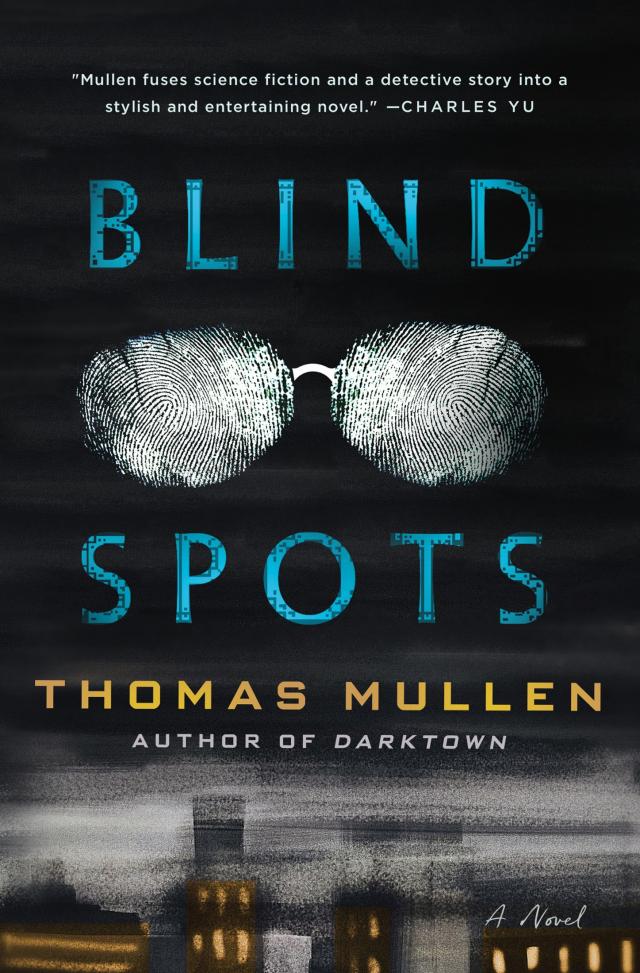
Blind Spots, page 1


Begin Reading
Table of Contents
About the Author
Copyright Page
Thank you for buying this
St. Martin’s Publishing Group ebook.
To receive special offers, bonus content,
and info on new releases and other great reads,
sign up for our newsletters.
Or visit us online at
us.macmillan.com/newslettersignup
For email updates on the author, click here.
The author and publisher have provided this e-book to you for your personal use only. You may not make this e-book publicly available in any way. Copyright infringement is against the law. If you believe the copy of this e-book you are reading infringes on the author’s copyright, please notify the publisher at: us.macmillanusa.com/piracy.
For Jenny
PART ONE
VISIONS
CHAPTER 1
Owens still remembers what it was like to trust. Trust his eyes, his friends, his employer. Trust his own mind, the signals firing inside his brain, the response of his body to the world around him.
Trust is something you don’t think about. When it exists, it’s invisible.
Like gravity. When something you let go of falls to the ground, you might be annoyed but never surprised, because that’s just how it works.
Until it stops working, and everything’s floating in the air, and nothing makes sense.
And for the rest of your life—even if things get fixed later, even if the earth regains its gravitational pull and the world returns to “normal”—you will never again feel as certain as you once did, no matter how many things you see fall.
* * *
Owens sits in his squad car and he trusts what he sees. Because that’s how it’s supposed to work.
Beside him, Peterson only half stifles a belch. Salami breath, fragrant and thick.
In the back seat, Khouri too plays her role by shaking her head in disgust. Owens can’t see behind himself, but he can feel her shaking her head; that’s how well he knows her. She says, “Thanks, Jimmy.”
“At least you can’t smell it back there,” Owens says.
“Oh, but I can.”
They’re parked in the River District, the deceptively picturesque name of this shithole. A river does indeed snake through here, somewhere. Not that anyone strolls along its banks or kayaks it or God forbid fishes out of it. Empty warehouses decay around them. Once upon a time this neighborhood was high on some developers’ lists, inspiring fever dreams of gentrification and easy money from postindustrial urban redevelopment, but The Blinding put an end to such plans.
The few nightclubs in the area trade on their proximity to crime and danger. Adventurous young professionals come out to dance and party and get high, catch rides to their safer communities to fuck and cuddle and sleep. If something goes wrong for them here, they’ll call for people like Owens to help out.
Years ago pranksters or artists or some combination had thrown paint in wild colors over many of the derelict buildings. Not so much graffiti as orgasms of color. Swatches of yellow here, orange there, violet. Formerly quiet, gray and brown surfaces now proclaiming themselves in loud hues. Owens isn’t sure if it had been during the early stages of The Blinding, when everyone liked vibrant colors because that was about all people could see, or the early stages of the vidders, when people were so relieved to be able to “see” again that they threw colors everywhere. Clothing during those days was wild, neon or shiny and reflective, everyone reveling once again in the once-lost pleasures of sight.
Well, almost everyone.
Owens watches the street, looking for anything unusual. He sees the normal line of clubgoers waiting to get into Slade’s, the bouncers checking IDs. Down the street, a pop-up ad on his display informs him that a run-down garage called Cranky Joe’s is now offering specials on lithium and solar batteries. Another pop-up at sky level notes a temperature of 56 with a 5 mph southwesterly wind and a 60 percent chance of rain after midnight.
And the time, of course, in the info bar that always lingers at the lowest point of his field of vision, tells him it’s 11:15 P.M. The fact that it is night is meaningless, visually, as Owens, like everyone else, sees equally well in darkness. A whole planet of vampire bats.
Except he misses sunlight. Glare. Even misses squinting.
Finally his phone buzzes in his pocket. He holds it to his ear. Dispatch gives the green light.
He kills the call and tells them, “Warrant went through. We’re on for X-ray.”
He adjusts a dial on his vidder, the small, 1-inch-diameter metal disc implanted on his right temple. On nearly everyone’s right temple. The vidder relays radar, GPS, and every variety of visual data to his occipital lobe’s visual cortex, compensating for his permanently blinded eyes.
“Bureaucratic nonsense,” Peterson says. “Could have closed this case weeks ago if we’d had X-ray then.”
“Right to privacy’s a bitch,” Khouri says. Unclear if she’s agreeing or not.
The good news is that the powers that be within the municipal government, given the okay from a judge, are now transmitting code to Owens’s vidder to unlock, temporarily, its ability to interpret even 3D radar that normal vision wouldn’t be able to access.
In other words, to see through walls.
He focuses on the brick exterior of the club down the street. With his court-approved enhancement, he can now “see” through the brick wall of the old factory building. The ability is limited to a short range, but still, every time he’s used it he’s felt like a superhero, a god. Adrenaline spikes as he peruses the building’s secrets.
“Full house, two guards inside the door,” he tells them. “They’re carrying.” He aims his view upstairs, peels away one wall, then another. “That’s our man on the second floor. Matches his heat readout.”
Peterson touches his earpiece. “Your mike’s good.”
Owens opens the door.
“Good luck,” Khouri blesses him.
Peterson translates: “Don’t fuck up.”
* * *
Christ Almighty, the bass. If pop music had leaned on the crutch of bass a bit too much back in the good ol’ sighted days, things have gotten down to a whole new octave of heavy since The Blinding. When you lose a sense, the others crave extra stimulus. The introduction of vidders six years ago hasn’t seemed to push music on a more trebly track. Owens’s feet vibrate, his chest vibrates. He could have a heart attack in here and not know it until everything went black. Again.
Dance floors are mobbed, the bars three deep. Bartenders hustle yet disappoint. Despite the cold outside, the coat check girl must be busy, as some serious flesh is on display. Owens figures maybe 10 to 25 percent of the people here are on opsin, a derivation of X that’s become a scourge in recent years. A drug that can make you hear colors and see music, at a time when eyes on their own don’t work at all? Yes, please. Even his wife used to take it, when she thought he wouldn’t notice, insisting it helped her see correctly. Like before.
Owens misses being young. Misses not knowing what’s behind the curtain. The many curtains.
He hates being in crowds like this. When he was a teenager, a fire broke out at a nearby rock club, killing dozens. People had been crushed to death trying to squeeze out of the few doors they could find. Some of his friends had been there. They’d lived, but they were emotionally scarred. So even before earning his badge, he’s always carried a certain amount of near-paranoia, the need to be aware of escape routes at all times.
So goddamn loud in here, he could say into his earpiece, Abort, I’m blown, they’re going to kill me, help, and Peterson and Khouri might not hear a thing. So hopefully it won’t come to that.
* * *
Four clubgoers (two male, two female) move from the main floor to a second, smaller dance room. No-bullshit bouncer approaches them. He looks displeased and points to the sign, “FOUR SENSES ONLY.”
His mouth moves, but who can hear him? They read lips: “No vidders in this room.”
The four kids wear the grins of people trying something illicit for the first time. Practically giggling as they walk to a small window and detach their vidders by rotating them until they come free. They hand them to the heavily mascaraed, Goth-dressed vidder-check girl, who tags and files them like so many jackets.
The four now-blind clubgoers get crazy on the Four Senses dance floor, ears working overtime, touch working double overtime, hands everywhere, caressing and tapping and rubbing, no one stopping, synapses afire. Damn near everyone in this room on something.
Owens takes the merest glimpse into that borderline orgy. Feels even older. Looks back at one of the bars, spots the undercover. Eye contact for less than a second.
He finds the bouncer he’s been looking for, yells in the guy’s ear. Deafness is a serious occupational hazard here. The bouncer nods, leads Owens to and then through a black door.
Back at the bar, the undercover’s lips move. Tells her mike, and therefore Peterson, that Owens is in.
* * *
Owens stands in a large, loftlike living room on the second floor. Surprisingly swank, the furniture somehow both sleek and comfortable. Windows everywhere. As if it’s just another rich guy’s bachelor pad that happens to have an earthquake roaring beneath it.
Enter the man himself, Slade. Tall, long hair, phony smile. Many tattoos, the raised kind, evidence of a past searing of flesh. He wears a faux-metallic suit that (Owens’s vidder informs him) reflects w
Handshake, no how’s-life bullshit. Sits down and gets to business.
On the glass coffee table sits a tablet, which Slade picks up. He “reads” the display of numbers thanks to the tiny scanner in his vidder.
Owens sees no one else in the very large room. Which is weird. Either it’s a sign of inordinate trust, or Slade has plenty of men just outside.
“It’s all transferred into the account, instantaneous,” Owens explains. He scans the walls and perceives movement behind one of them. Tries not to be obvious about it.
Slade nods at the numbers, puts down the tablet. “You’re good at this.”
“Took more than a month to cover my tracks. C’mon, if we’re gonna do this, I don’t have all night.”
Do this meaning move black-market firearms.
“All right, all right. My boy’s getting it. Calm down.”
Slade gets up to pour a drink. Owens stands, too, though he wasn’t offered one.
“Sorry,” Owens says. “It’s not every night I do this.”
“No shit.”
Owens scans the walls again. Big dude on the other side of the near one. Not the bouncer from before. Someone new.
“What?” Slade’s eyes scream suspicion. Owens was too obvious. His gut muscles constrict.
“Nothing. Lovely place.”
Slade’s expression like a human polygraph. Awaiting results. “I didn’t know any better, I’d think you were looking through the walls.”
Fuck.
Owens makes himself laugh. Tries to project calm. “That’d be cool.”
Slade’s polygraph going beep beep beep.
“Of course,” Slade says, dead calm, “the only people who can do that are cops with warrants.”
* * *
In the car, Khouri is silently cursing the fact that she forgot to bring her own headset and instead has to sit here dumb and clueless and staring at Peterson’s fugly face awaiting signs.
Until Peterson’s face falls and he looks sick and says, “He’s blown. Let’s go.”
Car doors are thrown open, sidearms leap out of holsters.
* * *
Owens feigns mere annoyance. Keeps still, like he’s prey that a predator won’t spot without motion.
He says, “We’ve had this conversation, man.”
Slade puts his glass on the bar. Moves his hands to his hips.
“If you were a cop with a warrant, you’d be able to tell if I had a gun in this jacket.”
“Cut the paranoia, okay?”
Yet that’s exactly what Owens does. Visually frisks Slade, the layers peeling away X-ray style. And yes, that would be a pistol in Slade’s jacket.
They eye each other for a moment. Even though everyone’s eyes are now sightless, and visual data is sent to their brains via devices, people still aim their gazes the way they always have, need a place within their visual field to focus their attention. Stare-downs, evil eyes, wicked looks—they all still exist.
Slade makes a motion like he’s going to reach into his jacket. Owens backs up instinctively. Slade laughs, not drawing the gun, merely taking his empty hand back out.
“Damn, you looked scared!” Slade’s laugh reaches a new pitch. Owens never liked guys with that high of a laugh. Too performative. Like they’re laughing at themselves laughing at you. “You’re no cop.”
Owens exhales in relief but tries not to look like it. “Hilarious.”
Shaking his head, he turns and scans the wall behind him. And that’s when he sees it, that a man in that other room is picking up a large gun.
Coincidence or danger?
Tries to think.
While Owens is facing that way, he hears Slade un-holster a gun and say, “Keep your hands where I can see them.”
Not coincidence. Shit.
Owens half turns, so he’s profile to Slade, who’s only three feet away and training a gun on him. He keeps his hands in front of him.
“There are a dozen cops entering this building right now,” Owens says. Calm voice, just the facts. “Don’t make this worse on yourself.”
Also a fact: Slade could shoot him now and then try to escape.
Behind Owens, a door opens and in comes Nayles, Slade’s deputy. Long dreads and braids, muscles that have muscles. He’s brandishing an automatic rifle that would look massive in a mere mortal’s hands.
“Cops at the front door,” Nayles says.
Slade says, “Son of a bitch.”
The good news is they don’t shoot Owens. The bad news is Slade swings his gun into Owens’s temple, square into his vidder. Hurts like hell.
Owens hits the floor. He sees a flash of black, then gray-screen pixelations. They seem to vibrate and thrum (or maybe that’s just the pain?) but don’t go away. As he begins to pull himself up he thinks, Fuck fuck fuck. His vidder’s been damaged. He can’t see.
He hears Slade say, “Upstairs.”
Footsteps. Owens turns toward the sound and launches himself. Maybe lucky, maybe not, but he feels impact, wraps his arms around someone, tackles him to the ground.
Something heavy and metal lands on the ground too. The rifle. Which means he’s tackled big Nayles. Footsteps recede, Slade escaping up the stairs.
Owens wrestles atop Nayles. He uses one hand to make sure he knows where Nayles’s face is, then punches him with the other. Twice. The back of Nayles’s head hits the floor both times, and he’s out.
Lucky, hell yes.
Owens fiddles with his vidder, but he feels broken pieces and still can’t see. Waste of time. He crawls on the ground, finds the rifle. One he isn’t terribly familiar with. Has a thought, puts the rifle down. Crawls back to Nayles and searches him. Voila—a semiautomatic pistol.
Has to hope it’s loaded. Flicks off the safety. Cocks it.
Assuming his mike wasn’t damaged during the wrestling match, he says, “Jimmy, my vidder’s out. I think Slade ran up to the top floor.”
He stands unsteadily, reaching forward until he finds the wall. His hands trace it to the doorway.
The feeling vertiginous, familiar in all the worst ways. Wills himself forward: Move now, experience awful flashbacks later.
Hand on the railing, he climbs the first step.
* * *
Giving chase to an armed suspect while blind would rank high on anyone’s list of Things Not to Do. Surely they covered this in officer training. But Owens was a rookie way back before The Blinding, when such concerns were unthinkable.
At the top of the stairs, he steps into an unfamiliar room, blind, with a gun in his hands. He focuses on his other senses.
Smell tells him damp, mortar dust, metal pipes. If the second floor was a warehouse space retrofitted as a trendy urban loft, the third floor seems to be the same, minus the retrofitting.
Sound. The music from the ground floor is slightly less loud up here. Sound waves and echoes tell him the walls are widely spaced and bare.
Touch. He reaches forward and finds a metal pipe. Heat. Pain. He pulls his scalded hand away and shakes it.
Taste. Acid in the back of his throat. Fear and energy and a metallic tang, along with a hunger for more.
He steps slowly, left hand out, and concentrates on putting his feet down silently. He realizes he got turned around in the stairway, he rushed, so he lost track of which direction he’s now facing, his place within the geometry of the building. He’s in a large rectangular room but unsure if he’s near the long walls or the short ones.
His foot hits something, but his left hand tells him Empty space. A half wall, then. Brick up to his knees. He navigates around it.
This is a mistake.
Keeps hoping he’ll hear footsteps pounding up the stairs, the cops in force. Where are they?
He hears Slade’s voice.
“Get a car at the corner of 17th and Wilson, now.” Talking to someone on a phone. Far enough away that he hasn’t spotted Owens.
The darkness vast, impenetrable. It allows passage through it only grudgingly, and it takes more than it gives. The only thing Owens hates more than darkness is death, and of course the two are inextricably bound in his mind. The adrenaline and the chase are probably the only reason he isn’t curled up in a ball, screaming.