Punktown: Shades of Grey, page 1


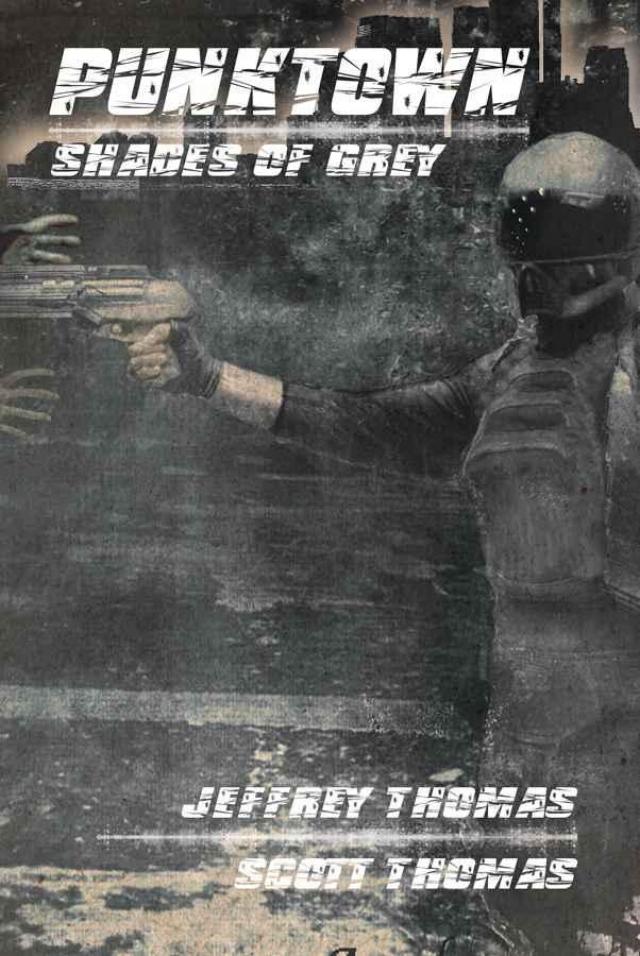
PUNKTOWN:
Shades of Grey
by
Jeffrey Thomas
&
Scott Thomas
KINDLE EDITION
Bedlam Press
2011
— | — | —
PUNKTOWN: Shades of Grey
© 2005 by Jeffrey Thomas and Scott Thomas
Cover & interior art ©2005 Travis Anthony Soumis
DIGITAL EDITION
ISBN: 978-1-4524-7315-4
Assistant editors:
John Everson, Jeff Funk, C. Dennis Moore, Amanda Baird
Cover, Book Design & Typesetting:
David G. Barnett
Fat Cat Graphic Design
http://www.fatcatgraphicdesign.com
a Necro Publication
5139 Maxon Terrace • Sanford, FL 32771
http://www.necropublications.com
This ebook is licensed for your personal enjoyment only. This ebook may not be re-sold or given away to other people. If you would like to share this book with another person, please purchase an additional copy for each person you share it with. If you’re reading this book and did not purchase it, or it was not purchased for your use only, then please return to Amazon.com and purchase your own copy. Thank you for respecting the hard work of this author.
— | — | —
JEFFREY THOMAS:
For Jeff VanderMeer
(and with thanks to Nancy and Rose for their dancing digits).
SCOTT THOMAS:
For Jeffrey—Thanks for inviting me to join you in Punktown those years ago and now.
TRAVIS ANTHONY SOUMIS:
Travis would like to thank the following deviant artists for their photography:
www.miette.deviantart.com
goldfishdreams-stock.deviantart.com
dream-traveler-stock.deviantart.com
— | — | —
“That City’s atmosphere is dark and dense,
Although not many exiles wander there,
With many a potent evil influence,
Each adding poison to the poisoned air;
Infections of unutterable sadness,
Infections of incalculable madness,
Infections of incurable despair.”
— The City of Dreadful Night, James Thomson
— | — | —
Part I: Jeffrey Thomas
The Unbearable Being of Light
The Hate Machines
Sweaty Betty, Termite Queen of the Danged
Purple Wings
Perfectly Beastly
Adrift on the Sea of Milk
Hydra
Willow Tree
Part II: Scott Thomas
Pulse
Frankenstein’s Reflection
A Shade of Grey
I Have Killed Millions
Under the Cherub
Veterans
The Merciful Universe
Grey Area:
Biographical Data Compiled by Jeffrey Thomas
— | — | —
PART I
JEFFREY THOMAS
— | — | —
THE UNBEARABLE LIGHT OF BEING
“Who can open the doors of his face?”
—Chapter 41, Book of Job
The scarecrow was twenty feet tall, seemed to loom even taller for having been erected atop the roof of the derelict factory. Its torso was a gutted hovercar, its arms and legs twisted rails, and its head a razored metal pinwheel—a fan blade from some factory machine which spiraled lazily or became a blur when the winds picked up. The monster windmill was spray-painted black with green streaks and patches that glowed in the dark, and around its wrists were lashed long red ribbons that snapped in the air. Zandra felt these were meant to look like streaming blood; perhaps the demon had slashed its wrists in bringing its spidery metal hands to its vortex of a face.
It was some god or devil of N’r’j folklore, but whether it was meant to overlook its erectors as a kind of guardian idol, or to ward/warn off outsiders from entering the factory grounds, Zandra didn’t know. She did not speak the N’r’j tongue, and though she wore a translator headset in her work, it was of little avail if the N’r’j did not talk to her. They were nearly silent as a people—even amongst themselves, from her experience thus far.
Even the infant before her didn’t squall as Aileen, Zandra’s more experienced partner, inoculated it. It already had the tangled, glossy black N’r’j hair down past its shoulders. Zandra found the N’r’j sexes indistinguishable from each other, and the children were merely smaller versions of the adults without (from her perspective at least) the “cute” factor which prompted everything from humans to dogs to feel affection for their young. That is, the infant’s eyes were no larger; they were the same crusty white slitted lids contrasted within black sockets like oil stains. Its skin was the same grayish brown color, with a look and texture like layers of mummifying bandages sealed with a glistening varnish, the nostrils black dots and the lips a scabby black, ever peeled back from gray teeth half the size of human teeth. The adults were very slender but a head taller than humans, like ghastly scarecrows themselves. Zandra was sure their appearance accounted for a lot of the negative feelings the adjacent neighborhoods felt for the beings. Even in a colony city like Paxton, teeming with transplanted life forms in a day-to-day Mardi Gras, they were considered repellent.
Aileen smiled up at the creature’s mother. “He’s a good patient…nice and quiet!” Zandra heard Aileen’s words turned to disjointed growls over her mike.
The mother said nothing into their headsets. She gathered her child in her arms, turned, and walked back toward the gaping loading dock caverns, her long hair and long black robe rippling in the chill breeze.
Aileen looked to her new partner. “They’re a proud people—but I know they appreciate our efforts.”
“How old do you think that mother is?” asked Zandra, squinting as the breeze picked up. Grit was blown in her eyes and she glanced up to see the giant’s rotor whizzing like a primitive propeller. She shivered.
“None of them here are past their teens. She was eighteen at the very oldest. I wish I could tell them apart more easily…they dress alike. If they were animals I might tag them!” she joked.
They moved on, stepping over strewn debris, moving between machines the N’r’j had dragged out of the factory shell so as to make more room for habitation; scorched ovens with shattered monitors piled on them. Between some of the larger ovens canopies had been draped to make tents, and N’r’j sat on chairs under them. Zandra smiled at some of these tent sitters as she passed, wondering what they were doing, if anything. If they had been talking they’d stopped. A boy, perhaps, already taller than a human man, traced a black metal rod in the dust. Its point had been sharpened to a silvery spike.
“Hey there,” Aileen said to a knot of small children, clustered in the old parking lot just beyond shipping/receiving. She extended a basket of foil-wrapped bars, nutritional but sweet. The children waited until she had come to them, then reached into the basket and grabbed like starving trick-or-treaters. “Just one, just one,” Aileen told them, “save enough for others.” The children scurried away, most vanishing into the factory through a broken window but several scampering up to the roofs.
The two women resumed their stroll of the old factory grounds. They were not as long-abandoned as they appeared; it had only been eight years since the Demakes Corporation had closed this plant and relocated. A fourth of its work force had been illegal beam skippers, teleportation stowaways seeking asylum in this melting pot colony. They had been a very inexpensive source of labor. But as the work had moved on, so had the N’r’j laborers, and Aileen estimated that half of their children had been left behind. As this area had been the only home they’d known (the N’r’j had dwelt in company barracks), the children had not strayed far. Except to beg in the surrounding neighborhoods.
Zandra saw a half-grown child kicking a can back and forth with two other children. He had but one arm. Aileen had informed her that the older children had severed limbs from some of the younger children so that they might illicit more sympathy when begging…but that this hadn’t availed them much and thankfully the practice seemed to have ended. In fact, she said, begging had almost ceased altogether, and she felt the intervention of herself and others of the Mission had done much to help these people in the six short months since their project there had begun.
The can skittered off, missed by the child with one arm. While he dashed to chase it, a blastula drifted out of the air and alighted on the back of one of the other children’s heads, where it pulsed like some external organ. Zandra made a small sound of alarm, started forward as if to move to the child’s aid, but he/she seemed to sense the small translucent creature at last and brushed at his/her head. The primitive animal, spherical with a fluttering gill-like ring at its base, rose up into the sky again, the late afternoon light showing through its dark purple membranes.
“They don’t seem to do any harm to people,” Aileen said. “That’s right…I haven’t shown you the Monster yet.”
“What do the N’r’j think of it?”
“They’ve never told me. But they keep away from it, so I think it scares them. They’re very superstitious, so I wouldn’t doubt they’d see it as a demon or god. I did see some kids try spray-painting it once but the paint went right through. Come on…”
A high wall of glossy black tile sur
“Don’t worry,” Aileen reassured her, “they’ve landed on me before, but I didn’t feel a thing. They don’t have the effect the Monster has.”
“Will we feel anything, getting close to it?” Zandra asked, finding herself whispering.
“You won’t suddenly step into a wall of depression. Working here, you might realize after a while that you’re depressed, extremely tired, fatigued. You might not even realize the source of it at first, until you remember the Monster is back here.” Aileen stopped short of the alley’s end and faced her younger companion. “I’m on a prescription for antidepressants, so I don’t have a problem. But unfortunately, half the people in the surrounding neighborhoods have to take drugs for the Monster’s effects, too. They aren’t happy about it. Until the authorities discovered it back here, from the air, it was thought to be residual waste from the factory. People were suffering lassitude, something like narcolepsy; there were even several comas. And three suicides. The Monster disturbs the electrochemical activity of the brain.”
“What about the kids?”
“The N’r’j don’t appear to be affected, themselves, but we haven’t been able to convince them to let us do a more comprehensive examination of them. Some have opened up enough to mention bad dreams to me, when I pressed them, but…” She shrugged.
“What is it the Monster’s doing that makes this happen?”
“Biologists have been out here to study it. A lot of people want to kill it, and I think the neighbors would have done it already if they could find a way how. They’re hoping, now, that the blastulas will kill it for them.” Aileen glanced over her shoulder nervously, but Zandra couldn’t tell at what. “The biologists think the electrochemical disturbance is a kind of telepathic cry of pain.”
“Pain?” Zandra breathed.
“Come on.” And Aileen stepped into an open area beyond.
It was an irregular courtyard of sorts made from the backs of several of the low factory structures. There were some drums, heaps of rubble, piles of autumn leaves with their color washed out of them, but no N’r’j. Whether the creature before them did affect the squatters, or just frightened them, or simply left them indifferent, the hidden courtyard was empty of life except for that from another dimension.
The Monster would be as large as a good-sized whale, Zandra estimated, were it to be seen in its entirety…and it was somewhat whale-like in its general form. But she could only see the forward half of the vast animal. It hovered in the air, translucent and a glowing ultraviolet color, like a cloud taking on life. The light seemed to pulsate subtly, and it was the creature’s bioluminescence which had given it away to investigators in the air. At the mid-point of the creature, it abruptly ended, as if neatly cut away.
Aileen circled the immense life form, keeping back a bit perhaps more out of reverence and awe than fear. Zandra followed, and saw the cut-off point from the rear. Hard as it was for her to believe she was looking at an extradimensional animal hovering just above her in the air, it was harder still to imagine its tail end extending back into an utterly alien dimension her kind could not even glimpse. Was it a creature of the seas, judging from its flipper-like unfinished limbs, which waved in the air in slow motion, as though paddling? In its own realm, was it just as ethereal, or solid as she was in her world?
Its blunt head held no eyes, no mouth, she noted as they circled around its other flank. At the front of its aerodynamic body there was only a kind of checkerboard, an area of alternating squares of raised and depressed flesh. A sensory organ, but of what nature? That was all. As she watched, the great head lifted very slowly, then lowered again.
“They think it was several months just to get this far through,” Aileen told her. “And it’s still coming, very slowly. But whether it will make it all the way through alive or not…” She trailed off.
The source of the Monster’s suffering was apparent. To its ghostly flesh were affixed dozens, if not a hundred, blastulas…mostly congregated around a humped bulge on its back, which might be some vital area, some extra tasty source of whatever it was the parasites fed upon. The Monster showed no wounds, but the leech-like smaller creatures were feasting nonetheless. They were also from its plane, but seemed to move and fare much better here than the Monster did.
“What does it want to come here for?” Zandra whispered. She realized she was hugging her own arms to her chest.
“Who knows? It may be trying to get away from something. The blastulas, I would think, chased it here. Whether it made the rift itself or if something about the factory is somehow responsible, the biologists haven’t figured out.”
“Poor thing,” Zandra muttered.
Aileen looked at her, and smiled. “Well, the blastulas have to live, too, right? Come on, we should really be leaving. It will be dark soon. It’s…not really a good idea to be here at night.”
Zandra met the other woman’s eyes. “Why? The blastulas…”
“The children. They know me…it’s just…they’ve been so mistrusted, so misunderstood. They’re nervous about outsiders, and I don’t blame them. They used to work the night shifts because they’re much more active at night, and I notice they get restless and the younger ones get…agitated, excited. That’s when they go out into the neighborhoods. But like I say, they’ve been so badly treated…especially with the killings, and the police not properly investigating. They’re still children, all of them, and children are wild. They get more daring at night, bolder. But they’re children…”
Zandra nodded at Aileen’s emphatic reassurance, but found herself shooting a look up at the dark roof tops around them, as if she expected to see lean silhouettes hunched there, with streamers of black hair flowing in the evening breeze.
Aileen began picking her way back to the alley opening. For a lingering few moments, Zandra took in the bisected, nameless creature. With every darkening moment it became more luminous. The head was lifting again. The blastulas, a more concentrated purple, looking like dark barnacles upon it but more like lampreys, throbbed as they sucked at its essence.
As Zandra turned at last to follow the older volunteer, she heard a stifled cry from the gloomy alleyway. It was something of a muffled gurgle, a terribly watery gurgle, as though someone were suffocating on vomit. Or choking on blood.
Then, three short sharp cracks, like dry sticks breaking. A gun, she realized, rooted in numbed terror.
“Aileen!” she whimpered, and a peripheral movement made her jerk her head to the right as a tall murky figure dropped from a low roof top a mere several yards from her.
It was a typical N’r’j, though not yet of adult height. The unruly black hair, parted in the center and stirring in the air. The lacquered mummified face—as impassive, utterly unreadable as the scarecrow’s whirling smudge of a face—the peeled grin, the eyes that never seemed to open, crusted shut. Dressed all in black, its coat long and lapels turned up. But in its fist, something she had never seen a N’r’j with before. A large, expensive pistol of obsidian black ceramic.