Mercenary Salvage Company, page 1


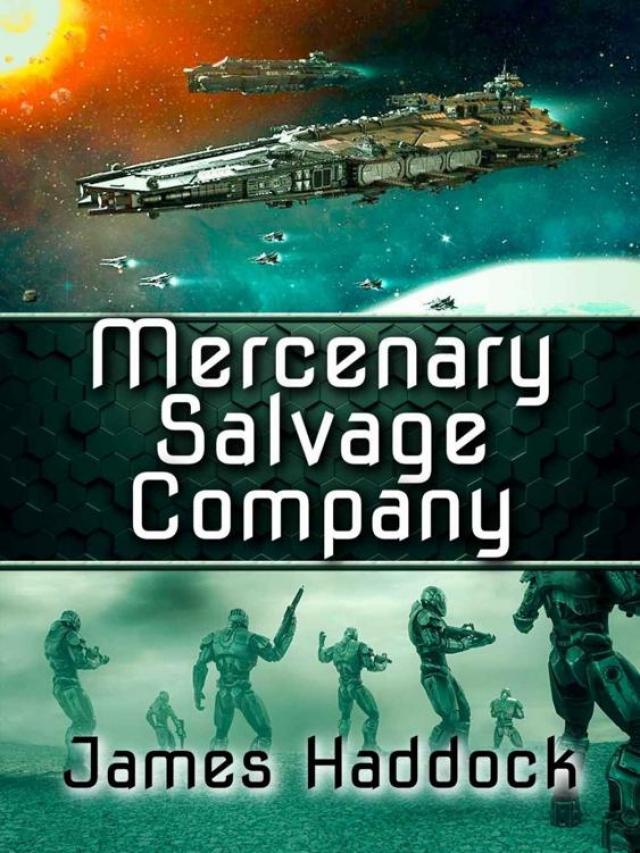
Mercenary Salvage Company
By: James A. Haddock III
Copyright © 2022 all rights reserved
Website: Jameshaddock.us
No part of this book may be used or reproduced in any manner whatsoever without written permission except in the case of brief quotations embodied in critical articles or reviews.
This is a work of fiction. Names, characters, businesses, places, events, locales, and incidents are either the products of the author’s imagination or used in a fictitious manner. Any resemblance to actual persons, living or dead, or actual events is purely coincidental.
Mercenary Salvage Company
Countries then worlds no longer kept large standing armies. They preferred to hire mercenaries, spending their citizens’ money rather than their citizens’ lives. Governments found it more cost-effective to keep their populations working, continuing to pay taxes rather than dying on some battlefield. War became a business. As in times of old, owning a mercenary company became a way for the ordinary man to become wealthy . . . if he survived.
Dad and I own the Cain Salvage Company. Some call us carrion living off the carcass of war. Buzzards picking the bones of the war machines left behind on cold battlefields. I suppose that’s one way to look at it, but they still bought our salvage.
No one is immune to the effects of war. Except maybe the rich or corrupt, who are often are the same people. Liquid fuel is expensive and hard to get, so local farmers contracted us to salvage a nuclear-pellet-powered electric vehicle that would run for years before needing to be refueled. It was a good deal; rather than cash, we’d receive a percentage of the farmer’s crops for ten years to sell or eat as we needed.
Nowhere is completely safe, especially around the battlefield, cold or not. I felt the proof as I wiped the sweat from my face, starting the wound to bleed again. I’d already been blown up once today and didn’t feel like repeating it again.
Dad called that “gallows humor.” I started to smile, but my smile faded remembering the fresh grave not twenty feet away. I had sealed dad’s body in a body bag and buried him.
I’d wanted to cry, but I’d had no tears left. In the last five years, I’d buried my mother, then my sister, and now my father. This war had taken all my tears. You’d think an eighteen-year-old would have had more. This was supposed to be an easy salvage job, but in the business of war, nothing is ever easy.
I knew I’d have to fight through hyenas, people who steal and scavenge from other people, to fulfill the contract with the farmers. I looked over the battlefield and saw in my mind’s eye a vision of my future. I would start a mercenary salvage company. I had no problem killing hyenas or anyone else who got in my way. This battlefield had left me weapons, ammunition, and equipment to get the job done with plenty left over to start my company.
Chapter 1
I wiped the sweat from my face, starting the wound to bleed again. It was hot, close work, and having a tarp covering the electric motor compartment to hide the light from the work lamp didn’t help. I’d already been blown up once today and didn’t feel like repeating that anytime soon.
Dad called that “gallows humor.” I started to smile, but my smile faded remembering the fresh grave not twenty feet away. I gritted my teeth and continued working. I had sealed dad’s body in a body bag and buried him. I’d wanted to cry, but I’d had no tears left. In the last five years, I’d buried my mother, then my sister, and now my father. This war had taken all my tears. You’d think an eighteen-year-old would have had more.
“I know, Dad, work now, mourn later,” I said, pulling the wrench. “But this was supposed to be an easy run. We’d a known location, and the battlefield was “cold.” All we had to do was load this tracked ammo hauler on the lowboy and take it home. The town farmers were paying good money and a portion of their crops for the next ten years for this job.
Liquid fuel was getting harder to come by and seemed more expensive by the day. Newer equipment had a nuclear pellet-fueled powerplant that provided electricity to the electric motors. In comparison to liquid fuel, the pellets were relatively cheap; a handful of pellets would power a vehicle for years. It was a good deal . . . easy money. “So much for easy,” I said, spitting blood out of my mouth.
I froze, listening. Wiping the blood from my ears, I listened closely. I heard the distant hum of a small plane or drone and turned off the work lamp. The tarp I was under would hide my heat signature . . . I hoped. The sound came closer, flying right over me, continuing, never slowing.
I released the breath I didn’t realize I was holding. Shaking my head I got back to work. Fortunately, the tracked hauler wasn’t too badly damaged, mechanically anyway. Its cargo trailer took the brunt: a direct rocket hit blew up the trailer, damaging the hauler. The hauler’s powerplant was still intact, but its batteries were dead. I’d replaced its batteries with the ones from our truck. It needed only minor repairs and its safety relays reset. That done, I climbed out of the motor compartment and opened what was left of the hauler’s cab’s door. I pulled the driver’s body out of the way, letting it fall to the ground. I’d seen so many dead bodies, they seemed more like equipment parts than people.
Looking over the gauges, I saw they were a standard set; I went through the start-up procedure and brought the tracked hauler online. Setting back, I nodded to myself, looking over the gauges. Looking through the front armor glass, I saw the remains of our lowboy and salvage truck.
I shook my head; the truck had all our salvage tools and equipment on it. I couldn’t leave that here. Without it, we’d be out of business, if we weren’t already. My salvager’s mind went to work figuring out how to get everything home. I’d load our truck on their lowboy and use the tracked hauler to pull the lowboy.
“Why bother?” I asked myself, gripping the steering wheel. I felt depression creeping into my mind. I shook my head as if shaking off the depression. “Because that’s what we are; we’re salvagers, that’s our business, and that salvage ain’t going to load itself,” I answered my question.
I saw my face’s reflection in the truck’s side mirror. It was a mask of blood. The gash ran across my forehead, down my right cheek, stopping at my jawline. “As Dad would say, ‘That’s gonna leave a mark.’” I laughed, instantly regretting it. My wound split open along my cheek, and my jaw started to bleed again. Shutting the hauler down, I got out of the cab and went to our salvage truck to find the first aid kit.
We’d been stratified. One round went through the oxy-acetylene tanks, which caused them to explode. The powerplant was shrapnel, but the first aid kit survived. I pushed my hair back, cleaned my wound as best I could, and smeared wound seal on it. That would hold until I got back to town and had Doc look at it.
I opened a salvaged combat ration, ate, and lay down to sleep. I’d start recovering the salvage truck when I woke up. Besides, I couldn’t leave until nightfall anyway. It’d be safer to travel then.
* * *
I winched the salvage truck onto the lowboy, using the repaired hauler. The lowboy was a salvaged standard military model and attached to the tracked hauler with no problems. When I finished securing the salvage truck to the lowboy, I parked it under the trees in their shadows. Hopefully, that would hide it from any random flyovers. That done, I stopped for lunch. Military rations weren’t the best, but they beat nothing . . . usually.
Every once in a while, I would hear the popping of ammo cooking off from the cold battlefield on the other side of the hill. After I finished eating, curiosity got the better of me. I took my binos and climbed the hill to see what I could see. Who knows, there may be some easy salvage there. There’s that word again . . . “easy” . . . no such thing.
I eased up to the top of the hill, then crawled to the crest, keeping to the brush. Scanning the field below, I saw no movement, only smoking ruin. This had been no small engagement. There looked to be at least sixty tanks. Maybe two tank companies on each side with support troops and vehicles. It looked like both sides had fought to the last man.
Both sides had medium and light tanks, self-propelled arty, infantry fighting vehicles, and a couple of ADA tracks. Which was unusual; tanks rarely fought with their arty and ADA with them. If I had to guess, I’d say these two groups unexpectedly stumbled upon each other. They were probably en route to another area, and neither side could break contact.
As I lay there, two fighters went screaming by only a few hundred feet overhead. I continued watching. Nothing below moved, and the jets didn’t return. I didn’t see anything below worth risking my life for, so I started easing back.
I stopped . . . thinking a moment . . . then moved back for another look. Something didn’t look right, but I couldn’t say what. Using my binos, taking my time, I looked again. The bodies of soldiers were strewn around like forgotten toys. I shrugged, and I was about to leave when I saw what was bothering me. In front of one of the medium tanks, an open batch was sticking up out of the ground. I stared at it, trying to figure out what it was. A soldier’s body lay halfway out of it.
“Underground entrance maybe?” I asked myself. “A piece of blown-off tank?” The longer I stared at it, the more I wanted to know what it was. If it was an underground entrance . . . we could be rich. Well, I could be rich . . .
I kept watching for any activity below. Our town, a bombed-out airfield, had a large underground bunker. They used it for the town hall and municipal complex. If this was an underground complex, it could be pretty sweet.
No one ever gave my old revolver a second look. Of course, they rarely enforced the rule. Most everyone carried a military weapon. There was a war on, after all. Our town was pretty far out, and you had to enforce your own law and keep your own peace. The police, the few there were, were only there to pick up the pieces, fill out the paperwork, and usually didn’t even do that.
Dad could’ve bought a military arms salvage stamp, but it was expensive, and he’d said he didn’t want to deal with the additional headaches. I reholstered my pistol, put my binos away, and started down the hill using what cover there was.
I watched from cover, reassuring myself I was alone. Drawing my pistol, I started toward the hatch, using the dead tanks as cover. Being cautious, I looked at each body as I passed, ensuring they were dead. You can never be too careful salvaging a battlefield.
Arriving at the tank just before the batch, I stopped. There were several dead soldiers, from both sides, on the off side of the tank I had not been able to see from the hilltop. Judging by their uniforms and equipment, they were a mix of infantry and support troops, but all were mercenary.
I could now clearly see that the hatch was not a piece of wreckage but an entrance to something underground. Before I moved the officer hanging from the hatch, I took out a chem light, cracked it, shook it, and dropped it below. Getting no reaction, I used the officer’s body as cover and looked inside. The chem light didn’t help a lot. All I could see was six feet of tube and ladder.
Considering a moment, I pushed the body back into the hatch and let it fall. The body half covered the chem light, but there was still no reaction. I holstered my pistol and climbed down the hatch’s ladder. Halfway down the ladder, the interior lights came on. I froze, drawing my pistol. After a second, I climbed the rest of the way down.
As far as I could see I was alone. “What the?” I said, not believing what I saw. I was looking at the controls for some kind of vehicle. “Why would you bury a . . . whatever this is.” The area at the rear was the weapons compartment, where they stored the ammo for and loaded whatever weapons were on the vehicle. A sink folded down from the wall, and a toilet seat folded down below the sink.
Before I made a more thorough search, I went back, close, and locked the top hatch. It was not the only exit, but as we were underground, I doubted anyone was going to use the side door just now. Besides, it was already locked.
I noticed the small-arms rack was empty; the weapons were probably lying on the ground above, beside the crew’s bodies. Looking around, I still couldn’t understand why the vehicle was buried. I sat down in the driver’s seat and turned on the info screens. They showed all the statuses, including the powerplant, were green except the potable water, which showed yellow. Oddly the screen also indicated there was a trailer attached. Which was probably an error, not that I could get out and check at the moment.
I shrugged and got up to check the other stations. As I passed the stations along the walls, I recognized a weapons console, electronic warfare and countermeasures console, radar and tracking console, and comms console.
I noticed the data plate on the wall that gave the nomenclature of the vehicle. It read: “Electric Motor Driven - Sonic Ground Boring - Autonomous Command and Control Tracked Vehicle; EMD-SGB-ACCTV; GroundHog. Model Number: blaa-blaa-blaa; Serial Number: blaa-blaa-blaa.”
I felt my eyebrows raise. “Sonic boring? Maybe they didn’t bury it. Maybe it buried itself.” I stepped back to the driver’s dash and found the boring engagement controls. “Well, that would be one way to hide your command post.”
There was a large center, C&C map, and planning console, with the controls on the off-door side of the vehicle. I tried to activate the touch screen, “Unauthorized user,” the speaker said. Searching the dead officer on the floor, I found and took his key card and command bracelet. They called it a bracelet, but it was actually an arm computer-comm unit. I hung captain Hoyt Steagall’s key card around my neck and put the arm comp on my arm.
Taking the key card, I started to plug it into the slot and saw that he had written his password on the back of the card. I smiled, slotted the card into the reader, entered his password, and placed his hand on the palm reading screen. The screen turned green and allowed me access. I went through the command prompts and installed myself as the new commanding officer, with full authorization. I scanned my palm into the reader, and my arm comp synchronized. I of course changed the password.
I now had unfettered access to everything and activated the map and planning console. When I did, all the stations came online. I watched as the map showed the surrounding terrain and vehicles, labeling what type they were and marking them as Inactive. It also showed my tracked hauler and lowboy, as well as another group of vehicles on the back side of an opposite hill. The map had them labeled as Maintenance and Recovery. They were also labeled as Inactive. I’d definitely need to check those.
I scanned the monitors at each station. They mirrored the info on the main map. I heard no comms chatter, but it did show a radar signature roughly one hundred miles away.
I pulled a chair out from underneath the map console and sat down to think. I swilled the chair around, looking at everything and considering options. “Definitely from off-world, expensive, and too good to pass up.” One thing was for sure; someone was eventually going to find and claim this. Military arms salvage stamp or not, that someone might as well be me.
If I was going to go that far, I might as well go whole hog . . . or whole groundhog. I had a lot of work to do.
Chapter 2
I striped Captain Steagall of his equipment and carried his body up the ladder. It was harder than I thought it would be. I began stripping the dead around the closest tank of their weapons and equipment. Each troop carried a chrysalis on his belt. When I finished searching and stripping the equipment of each troop, I activated it. The chrysalis formed a protective cocoon around the dead body, preserving it until it could be recovered and processed.
I took the gathered weapons and placed them in the small-arms weapons rack down in the hog. I checked the hog’s ammo storage area to see what type of munitions I should be looking for. I was surprised at what I found. Apparently, the hog had quite the weapons array. Missiles, 30mm auto-cannon, 10 and 12mm machine guns, and 40mm grenade launchers. I was going to need some help.
As I walked to the other side of the battlefield, I searched, stripped equipment, and activated the chrysalis of the bodies I passed, leaving the stripped items lying for now. The infantrymen wore heavy body armor and battle helmets, and most everyone wore comm units. Looking at the battle armor, I thought, “Why not?” I put on an upper armor rig, buckling the chest piece in place, and put on a combat helmet. I was surprised at how light everything was. The batteries in the helmet were dead, so nothing worked. I kept the chest piece on but left the helmet with the rest of the equipment; I’d gather everything later.
I climbed the hill and had a look-see at what the C&C map had labeled Maintenance and Recovery vehicles. Easing up on the crest of the hill, I looked down on exactly that, Maintenance and Recovery vehicles. The vehicles looked in decent condition, but the troops not so much. The support troops never stood a chance against the heavier armed and armored infantry.
I went straight to the TR88 tracked heavy recovery vehicle to check it first. She was a recovery workshop on tracks. Her batteries were dead, so I was going to need the hauler to jump-start it.
I went back and got the hauler and drove to the 88. I jump-started her; all the systems showed green. I left her running so the batteries would charge.
Looking among the other vehicles, I found what I’d come looking for . . . a mule. It looked like a pallet with a steering wheel mounted on four wheels. It was made for hauling parts and small equipment around worksites. It, too, needed to be jump-started.