On Spine of Death, page 1


Thank you for downloading this Sourcebooks eBook!
You are just one click away from…
• Being the first to hear about author happenings
• VIP deals and steals
• Exclusive giveaways
• Free bonus content
• Early access to interactive activities
• Sneak peeks at our newest titles
Happy reading!
CLICK HERE TO SIGN UP
Books. Change. Lives.
Copyright © 2022 by Tamara Berry
Cover and internal design © 2022 by Sourcebooks
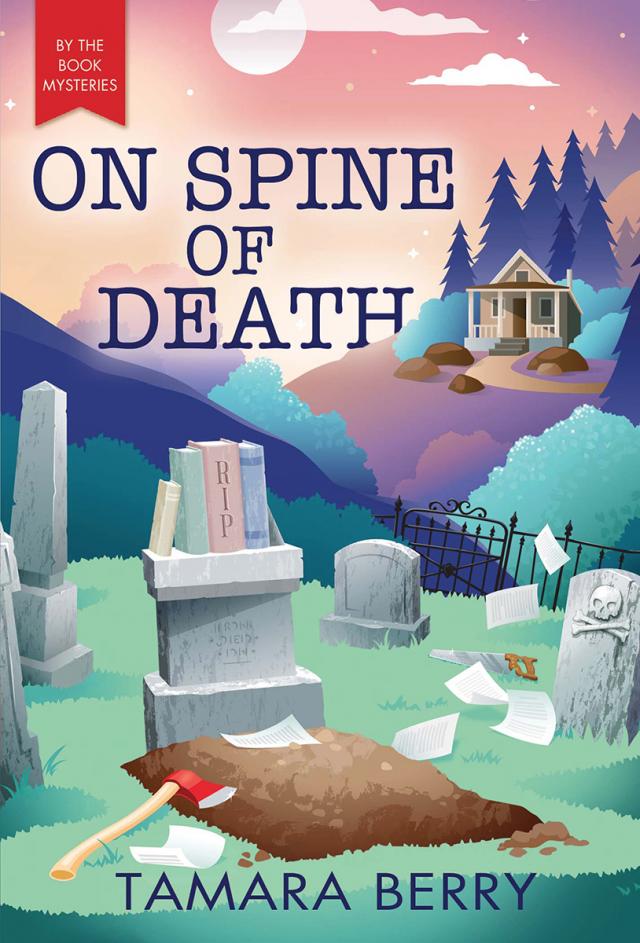
Cover design and illustration by Monika Roe/Shannon Associates
Sourcebooks, Poisoned Pen Press, and the colophon are registered trademarks of Sourcebooks.
All rights reserved. No part of this book may be reproduced in any form or by any electronic or mechanical means including information storage and retrieval systems—except in the case of brief quotations embodied in critical articles or reviews—without permission in writing from its publisher, Sourcebooks.
The characters and events portrayed in this book are fictitious or are used fictitiously. Any similarity to real persons, living or dead, is purely coincidental and not intended by the author.
All brand names and product names used in this book are trademarks, registered trademarks, or trade names of their respective holders. Sourcebooks is not associated with any product or vendor in this book.
Published by Poisoned Pen Press, an imprint of Sourcebooks
P.O. Box 4410, Naperville, Illinois 60567-4410
(630) 961-3900
sourcebooks.com
Contents
Front Cover
Title Page
Copyright
Chapter One
Chapter Two
Chapter Three
Chapter Four
Chapter Five
Chapter Six
Chapter Seven
Chapter Eight
Chapter Nine
Chapter Ten
Chapter Eleven
Chapter Twelve
Chapter Thirteen
Chapter Fourteen
Chapter Fifteen
Chapter Sixteen
Chapter Seventeen
Chapter Eighteen
Chapter Nineteen
Chapter Twenty
Chapter Twenty-One
Chapter Twenty-Two
Chapter Twenty-Three
Chapter Twenty-Four
Chapter Twenty-Five
Chapter Twenty-Six
Chapter Twenty-Seven
Chapter Twenty-Eight
Chapter Twenty-Nine
Chapter Thirty
Chapter Thirty-One
Chapter Thirty-Two
Chapter Thirty-Three
Excerpt from Murder Off the Books
About the Author
Back Cover
Chapter One
Tess knew the exact moment the blood started dripping down her hands.
The frigid air of the cellar where she was trapped had long since caused her skin to grow numb. She couldn’t feel the sharp slices of the zip ties digging into her wrists or the thick trickle of blood moving down her fingers, but that didn’t matter. As soon as her veins opened up, the enormous, mangy rat in the corner would lift his nose, twitch his whiskers, and come in for a taste.
“Rats!” Tess cried. “I’m going to get eaten by rats!”
Since she’d long since slobbered her way out of the duct tape across her lips, her shout came through loud and clear.
“I’m not kidding,” she added, her voice wavering frantically. “He’s the size of a terrier. Let me out of here!”
The rustle of approaching footsteps was accompanied by a thump as the cellar door above her head swung open. Tess winced at the sudden brightness of the outside world, which didn’t abate even when a head popped down through the hole to block most of the light.
“Ohmigod, Mom. People on the street are starting to ask questions. What’s wrong with you?”
Tess felt no relief at the sound of her daughter’s voice—or at the sight of the pitch-black, chin-length bob hanging down over her head. “What’s wrong with me is that I’m about to be attacked by a rabid animal with a taste for my blood.”
“How do you know he’s rabid?”
“I don’t. But that won’t matter to the people at the hospital. Unless we manage to catch him and bring him in to be tested, they’ll make me get all thirty rabies shots either way. It’s protocol.”
Gertrude, who was fifteen going on fifty, wasn’t moved by this picture. “Then say it.”
Tess screwed up her face and did her best to ignore the squeal of her rodential nemesis crawling closer. “No.”
“Mom, you made me promise. I can’t let you go you unless you say it.”
“I won’t.”
“Fine. Then I’m getting back to work. Herb is letting me use the sledgehammer.”
“A sledgehammer?” she echoed. “To do what?”
From upside down, Gertrude’s grin looked like a grimace. “We’re taking out that old brick wall near the back of the store. You never told me that demolition could be so much fun. He says if we can’t get the bricks out this way, we’ll have to bring out the big guns.”
The head started to disappear before Tess could decide whether or not to ask what big guns entailed. In the two weeks since renovations on her grandfather’s old hardware store had started, she’d learned it was best not to ask too many questions. Questions led to long-winded tales of asbestos, lead, radon, and other construction horrors that would cost—by Herb’s estimation—tens of thousands of dollars to repair.
“Make sure you wear a construction hat,” Tess warned.
“Yes, Mom.”
“And those cute steel-tipped boots we bought you.”
“Stop calling them cute. They’re not cute. They’re functional.”
“Fine. Wear your ugly and useful boots. And if you get anywhere near a rusty nail—”
“I’m leaving now,” Gertrude interrupted with a snort of disgust. “These bricks aren’t going to smash themselves.”
In a moment of panic—and, she was willing to admit, desperation—Tess called out once more.
“No! Wait. Leave the trapdoor open a crack. It smells damp down here. I think I can taste mold spores starting to take root on my tongue.”
This didn’t move Tess’s daughter any more than the threat of rat attacks or rabies had. “That’s not how mold spores work.” Gertrude said and paused. “Well?”
Tess heaved a sigh. “Fine. Go ahead and abandon me. I’ll just stay down here to make a meal for the creepy-crawlies of the world.”
“Okay,” Gertrude said cheerfully. “Let me know if you change your mind, Magdalene.”
Tess watched as her daughter closed the trapdoor, once again plunging her into a world of darkness and mold. Magdalene was Tess’s safe word, but there was no way she was saying it. By her estimation, she’d only been down in the cellar below the hardware store for about an hour. To call it quits after such a lackluster attempt at escape would only prove her daughter right. And Ivy and Sheriff Boyd and everyone else who’d said there was no way Tess could do it.
Take one woman, bound at the wrists by zip ties, and attach her to a chair. Duct tape her mouth, leave her without any tools, and shove her into a convenient hole. Mix and let rest.
“But I wasn’t counting on rats,” Tess muttered as she started to once again saw her wrists against a sharp edge at the back of the chair. “No one said anything about rats.”
Even as she spoke, she knew that the woman in her book—code name Magdalene—would be encountering rats inside her prison. Tess Harrow, renowned thriller writer, was something of a legend when it came to using real-life incidents to fuel her fiction. Her last book, Fury in the Forest, had been based on her own experience of finding a dead body in the pond behind the rustic cabin she now called home. The book was already in its sixth printing and showed no signs of flagging.
As she continued sawing, more frantically now, the first band of the zip tie gave way. Tess shouted in triumph, even though the action caused the second band to dig deeper into her flesh. She was going to have some serious zip-tie burn after this, and there was still a good chance that rat would take a bite from one of her fingers, but it was worth it. She’d been sure it was possible for a fortysomething, slightly overweight divorcée to escape from the deep underbelly of the criminal world. Not quickly, obviously, and not with anything approaching finesse, but those things could be glossed over in the retelling.
“That’ll show my editor,” Tess said as she began sawing at her hands anew. “You don’t have to be Keanu Reeves to escape from a tight spot. With a little persistence, anyone can—”
BOOM!
At the sudden rattling of her prison walls, Tess gave a start of surprise, but she refused to let it derail her. If she knew her daughter—and she did—Gertrude was taking to the sledgehammer like a teenager to, well, a sledgehammer. The steady trickle of dirt from above her head was vaguely alarming, but no more so than any of the other horrors down here.
Tess had no idea what her grandfather had used this cellar for, but there was no denying the creep factor. W
Which, when you thought about it, was just as good.
“Keep it quiet up there!” she called, but without any expectation of being answered. Her shoulders were starting to burn, and the trickle of dirt was starting to turn into a torrent, but she could feel the last of the plastic giving way.
Or rather, she would have, if the world hadn’t suddenly started shaking around her.
BOOM! BOOM!
“Seriously, you guys! If you’re not careful, I’m going to be—”
Her next words died—and were buried—on her lips. So was the rest of her. Amid the avalanche of debris, rocks, and dirt that opened up on top of her, Tess lost her ability to do anything but scream.
And even that was taken away from her before too long.
Being buried alive would do that to a woman. Especially once she realized that dirt wasn’t the only thing falling from the ceiling. With a last, desperate gasp of air, Tess found herself being showered with what looked—and felt—like human bones.
She didn’t know whether it worse to die of a femur to the head or a lungful of damp, loamy soil, but it didn’t matter. As her chair tipped and fell—with her arms still strapped to it—she lost all track of everything except how it felt to be six feet under.
Chapter Two
“I think we should leave her tied up.”
Tess glared from her position on the ground, her hands still bound behind her and the taste of earthworms in her mouth. “Very funny, Sheriff Boyd. If you don’t get me out of this cellar right now—”
“You’re right.” The tall, well-built frame of the sheriff’s head deputy, Ivy Bell, crouched next to Tess. “We need to photograph and catalog this evidence before we move her. Hold still, Tess. It’ll only take half an hour.”
“Half an hour?” Tess echoed, but she might as well have not spoken for all the attention the two officers paid her. They were loving this, she knew—she could tell from the slow, methodical way they moved through the rubble that used to be the cellar. And from the way Ivy kept telling Tess to smile and say cheese for the camera.
“Relax. These bones are at least thirty years old,” Sheriff Boyd drawled. “They can’t hurt you.”
From her angle on the ground, Tess could only make out the sheriff’s scuffed cowboy boots and jeans-clad lower legs, but that didn’t matter. She knew down to the dark, silken strands of his hair and the quirk of a cleft palate scar above his lip how he looked. And not, as some people might think, because she was particularly interested in him as a person. It was just that he happened to be the spitting image of the fictional detective who’d gotten Magdalene trapped in a cellar in the first place.
Detective Gonzales, who only existed inside the imagination of Tess Harrow and the several million people who’d read her books, would never leave a woman tied up so he could collect evidence. He might be a hard-boiled man of the law, but he was also a gentleman.
“They’re human, that’s for sure,” Ivy said as the camera flashed. “I’m guessing they were buried underneath the floorboards, but all that sledgehammering must have dislodged them.”
“You say that like I wanted this to happen,” Tess said. She tried to wriggle her way out from underneath a humerus, but Ivy commanded her to lie still. Tess continued, “It might surprise the two of you to discover that I don’t like finding dead bodies everywhere I turn. Nor do I enjoy having several feet of dirt fall on top of me. I could have suffocated.”
Since she’d been nowhere near suffocation—and since both Ivy and Sheriff Boyd knew it—her protests were largely ignored.
“I told you it was too dangerous to start construction on the hardware store without first checking the foundation,” Sheriff Boyd said. “My exact words were, and I quote, ‘You’re likely to bring the whole roof down.’”
“The roof is fine. It’s the floor that didn’t make it,” said Tess.
Ivy released a low whistle as she dropped the last of her evidence markers and snapped a few shots. “And a good thing, too, or we might never have found this poor sap.” She paused. “Check out the marks on this rib, Victor. That’s a hatchet job if I ever saw one.”
Tess called on the last of her strength and thrust her bound wrists against the splintered edge of her chair. To her surprise—and relief—it worked. The plastic, already strained and ground down, gave way. With a cry of thanks, she yanked her hands out of their bonds and twisted her body to examine the bones in question.
Since the bones were literally on top of her, it didn’t take long for Tess to see what the sheriff and Ivy were talking about. The bones had been entombed in the floor of her grandfather’s hardware store for so long that they no longer held any horror—or any flesh. Tess reached for a scapula only to have her hand smacked away.
“Don’t you dare.” Ivy spoke with a sharp reprimand that reminded Tess of a schoolteacher. “Those aren’t for you.”
“I wasn’t going to stick it in my pocket and take it home,” Tess protested, but she was careful to give Ivy a wide berth as she flexed her fingers to get the circulation flowing back to them. As she’d suspected, her wrists were raw, and there was dried blood crusted on her fingernails like nail polish. Those were small considerations when compared to the fact that she was standing in the scattered remains of an actual human being. “Who do you think it is? And why was he buried in the floor?”
When neither Sheriff Boyd nor Ivy answered right away, Tess held up both hands.
“Nuh uh. I know what you’re thinking, but my grandfather didn’t do this. He was a curmudgeonly hermit, but he wasn’t a murderer.” Since it seemed important to point out, she added, “And even if he was, he’d know better than to bury his victim in his own hardware store. That’s the fastest way to a jail sentence that I’ve ever heard of.”
“Who’s going to jail, and how often can I come visit?” a voice called from above.
All of Tess’s interest in the mortal remains of their mystery skeleton vanished at once. Gertrude had been through enough murder and intrigue to last a lifetime; the last thing Tess wanted to do was provide more fodder for her therapist.
“Sheriff Boyd and Ivy are just being dramatic,” she called up. “No one is going to jail.”
“Not yet, anyway,” Ivy murmured. Tess glared so hard that Ivy had to cover whatever else she planned to say with a cough.
“Don’t come down, Gertie. I’m heading up.” Tess reached for the cellar ladder and was surprised to find Sheriff Boyd waiting to help her. He held the wooden frame with one hand, his other extended to give her a boost.
“Get her out of here, if you can,” he said, his voice low. “Even with bones this old, we’ll have to call the coroner in.”
Tess felt her chest grow tight. No one knew better than Sheriff Boyd how a discovery like this could impact an impressionable teenager. There was a good chance Gertrude would treat it with the cavalier disdain she showed for pretty much anything that revolved around adults, but there was also a chance she’d take it deeply to heart.
“I’ll do my best,” Tess promised. When the sheriff didn’t let go of her hand right away, she hesitated. In the eight months she’d lived in the small, remote town of Winthrop—population of 466—she’d only touched this man a handful of times. They’d solved a murder together and faced immediate peril in each other’s arms, but Sheriff Victor Boyd was a man who did things by the book.
In this case, the book said that a recently divorced thriller writer with a penchant for getting herself in trouble was not to be touched—or trusted—lightly.
“What is it?” she asked. “What’s wrong?”
His glance fixed on the raw patch of skin around her wrists. “The next time you want to research kidnapping escape methods, I’d appreciate it if you didn’t do it underneath a construction site.”
Her heart gave a small stutter. “Why, Victor. Are you worried about me?”
He released her hand as quickly as he’d taken it. “Don’t be ridiculous. I just don’t want to have to deal with the media outcry. The last time you were involved in attempted murder, it took me six weeks to get rid of the reporters.”