

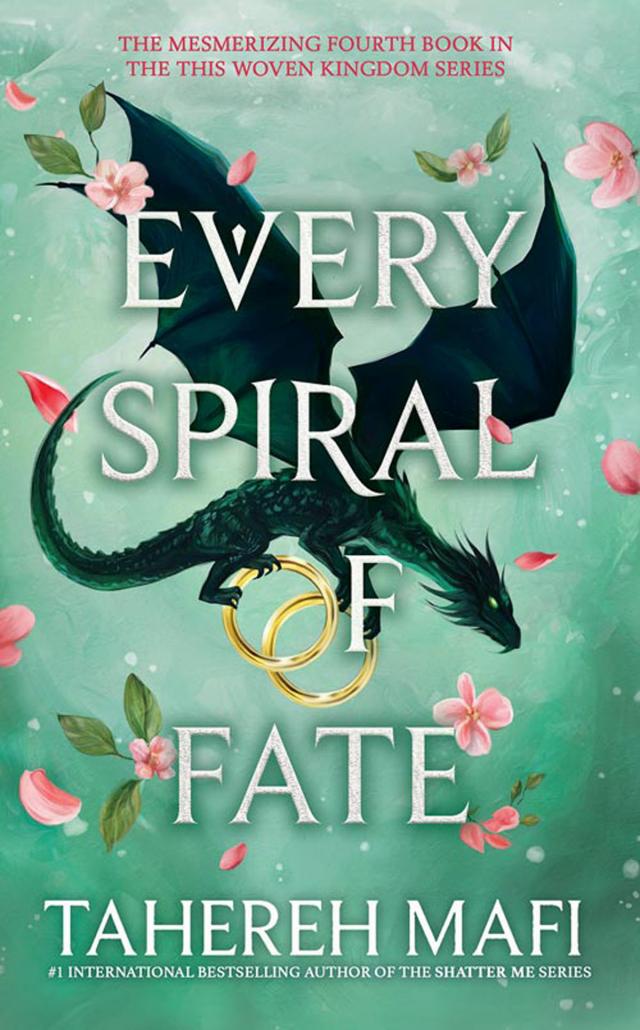
Every Spiral of Fate, page 1


Copyright
First published in 2025 by Electric Monkey, part of Farshore
an imprint of HarperCollinsPublishers
1 London Bridge Street, London SE1 9GF
farshore.co.uk
HarperCollinsPublishers
Macken House, 39/40 Mayor Street Upper,
Dublin 1, D01 C9W8, Ireland
Text copyright © 2025 Tahereh Mafi
The moral rights of the author have been asserted.
HB ISBN 9780008629151
Ebook ISBN 9780008629229
Version: 2025-08-27
A CIP catalogue record for this title is available from the British Library.
All rights reserved. No part of this publication may be reproduced, stored in a retrieval system, or transmitted, in any form or by any means, electronic, mechanical, photocopying, recording or otherwise, without the prior permission of the publisher and copyright owner.
Without limiting the exclusive rights of any author, contributor or the publisher of this publication, any unauthorised use of this publication to train generative artificial intelligence (AI) technologies is expressly prohibited. HarperCollins also exercise their rights under Article 4(3) of the Digital Single Market Directive 2019/790 and expressly reserve this publication from the text and data mining exception.
Note to Readers
This ebook contains the following accessibility features which, if supported by your device, can be accessed via your ereader/accessibility settings:
Change of font size and line height
Change of background and font colours
Change of font
Change justification
Text to speech
Page numbers taken from the following print edition: ISBN 9780008629151
Dedication
For Ransom
Epigraph
They asked, “Do you love her to death?” I said, “Speak of her over my grave and watch how she brings me back to life.”
—attributed to Mahmoud Darwish
How shall a man escape from that which is written?
How shall he flee from his destiny?
—Abolghasem Ferdowsi
Do a good deed and throw it in the river. One day it will come back to you in the desert.
—Saadi Shirazi
Contents
Title Page
Copyright
Note to Readers
Dedication
Epigraph
Let Us Remember
One
Two
Three
Four
Five
Six
Seven
Eight
Nine
Ten
Eleven
Twelve
Thirteen
Fourteen
Fifteen
Sixteen
Seventeen
Eighteen
Nineteen
Twenty
Twenty-One
Twenty-Two
Twenty-Three
Twenty-Four
Twenty-Five
Twenty-Six
Twenty-Seven
Twenty-Eight
Twenty-Nine
Thirty
Thirty-One
Thirty-Two
Thirty-Three
Thirty-Four
Thirty-Five
Thirty-Six
Thirty-Seven
Thirty-Eight
In the Beginning
Thirty-Nine
Forty
Forty-One
Forty-Two
Forty-Three
Forty-Four
Forty-Five
Forty-Six
Forty-Seven
Forty-Eight
Forty-Nine
Fifty
Fifty-One
Fifty-Two
Fifty-Three
Fifty-Four
Fifty-Five
Fifty-Six
Other Books By
About the Publisher
Let Us Remember
CYRUS WAS IN HELL.
He had no notion of consciousness; he couldn’t tell which realm he wandered. He felt only that he was being slowly suffused in darkness; smoke exhaling into his airways, sinister sensation curling around his bones.
The devil was close.
Shadows shifted all around him, encroaching; black whorls lapped at the edges of his perception like foul tongues. Bone-chilling, chittering sounds echoed between his ears as the stench of death encompassed everything; shafts of light fell across the dark of his mind, disorienting him further. His head was heavy, delirious; he was parched; half-blind. Pain spasmed steadily through his limbs, a sharp ache pulsing behind his eyes, his pupils quickly dilating. He felt as if his mind and body were separate entities, as if his physical self had been planted elsewhere, perhaps across the room. It occurred to him, faintly, that he was incompletely dressed.
He knew not where he was.
He was hardly aware of who he was.
“Cyrus?”
He startled badly at the sound of his name, backing away on instinct, his legs catching in soft sheets as his head met hard resistance, pain flaring against skull.
Her voice.
He felt her more than he could see her, a silhouette blurred before him as if through warped glass. She wasn’t supposed to be here. His eyesight was uncertain, heat crowding his thoughts. He struggled to breathe.
Was he dreaming?
He could no longer tease apart day and night; he felt out of his head with fever. Cyrus knew well the distinctive signs of the devil; he’d learned to anticipate the horrifying moments before Iblees arrived; before the bloodshed and brutality began. This hallucination was doubtless some abomination of reality, or else some new and terrible approach to torture. Cyrus didn’t want to sully the essence of her with the smear of him, didn’t want her anywhere near the rotted breath pressing up against his senses, diffusing across his skin—
He stiffened. His stomach heaved; revulsion rose inside him as the familiar horror crescendoed—
“No,” he cried. “NO—”
“We took your soul and stained it,” the devil whispered, “rinsed it with blood and debt. We took your mind and claimed it, chained it with regret—”
“Get out,” Cyrus said desperately. “Get away from me—”
“Your heart we broke for pleasure,” Iblees went on, “our reasons remain our own. All these years of rage and silence, all these centuries alone—”
“But I don’t want to leave you—”
His breath caught. It was her voice, again.
God, her voice.
He thought he could see her now, could see her rising before him in a prismatic vision, her edges blurring, blasted with light. He blinked and the windows flared behind her, giving her the impression of wings, and he knew then, his heart pounding desperately in his chest, that he could no longer trust his own eyes.
“We possess you now and always,” Iblees whispered.
Was this a dream?
Cyrus’s blind eyes darted around the room in acute panic, but the voices wouldn’t stop—
“We possess you now and always,” said the devil, “our schemes are rarely fair—”
“Please,” she said, “let me stay—”
“Still, we offer congratulations; to the overlooked, unwilling heir—”
“I want nothing from you,” he cried. “Get out—get out—”
“Cyrus—”
He backed up again violently, cracking his head once more against a hard surface, pain sparking behind his eyes.
“I only want to help you,” said the angel, moving suddenly toward him.
Cyrus drew a ragged breath.
She looked as if she were a disembodied halo, a detachment of radiance, and he understood then that his dreams were bleeding into reality—that he’d come unraveled from reason—
He’d gone mad.
“Never have we lost a match, we swear it by the stars. Never shall you have the girl, her fate is twined with ours—”
“NO,” he cried. He felt manic; feverish. “Get away from me— Leave me alone—”
“Still we offer congratulations; to the overlooked, unwilling heir. We possess you now and always; our schemes are sometimes fair—”
“I won’t abandon you,” she said, though he knew not from where. Her face was entirely illegible, erased by the flare of light. “I won’t neglect you in this state—”
Cyrus was shaking; he’d lost control of his body.
“Oh, the jester is delighted, to see you so distressed! In exchange you are entitled, to this splendid bequest—”
“I want nothing from you but what I’m owed!” he exploded, his chest heaving. A bead of sweat rolled down his throat, breaking against his collarbone. “Get away from me—”
The devil inched closer, and Cyrus went taut, roiling with disgust as the dark susurrations sunk deeper inside him. “To make the journey simpler,” Iblees said softly, “to seek out her fabled power; we’ll allow the girl to have her book, which she’ll filch within the hour—”
“What’s happening?” said the angel. “Tell me what’s wrong—”
She drew yet closer and Cyrus tore away from the searing haze of her, falling off some kind of ledge and hitting the ground badly.
“Stop,” he shouted, his voice strangled. “Stop—”
His body was tangled up in cloth, and he tore at this fabric with a madness he couldn’t explain.
“Cyrus—”
“You offer me nothing,” he gasped, fighting his sheets. “I want nothing from you except what I’m owed—”
“Please—”
“We offer congratulations; to the overlooked, unwilling heir; your heart we broke for pleasure; our reasons remain unfair—”
“GET—OUT—” he screamed.
One
ALIZEH STITCHED IN THE KITCHEN by the light of star and fire, sitting, as she often did, curled up inside the hearth. Moonbeams slanted through the diamond-cut windows, bathing her in silver as she deftly embroidered goldwork roses, the metallic threads glimmering against a backdrop of flame. Her movements were deceptively efficient, these practiced motions elevating the excruciating work to a venture so effortless that many a gaping idiot had felt emboldened to suggest that they, too, might stitch together a wedding ensemble in a sequence of hours, if only they had the time.
“It don’t seem hard at all,” announced a stable boy to the coachman, his face squashed against the windowpane. The boy blinked, glass smearing against one widened eye. “Quick and easy, see? Don’t know why everyone is yappin’ ’bout it.”
The coachman, a grizzled fellow who’d once earned a smile from Alizeh in broad daylight, gave the boy a shove before dragging him back toward the stables. “Feckless ingrate,” he muttered, tossing a dark look at the clutch of incomers shoving into the vacated positions by the window. The new arrivals were by trade a blacksmith, a shepherd, and a fletcher, respectively, yet just then the trio took up the common work of squashing their cheeks and noses against royal glass. The warm breath of gossip occasionally fogged from view the very subject of all their discussion; one could almost hear the squeak of a sleeve rubbing circles upon the window.
Alizeh managed to smile.
She might be encouraged to find the situation funny if it weren’t for the fact that every window she encountered depicted the same scene: faces pressed like dough in a frame, teeth knocking against the casement as lips moved, fingers searching for purchase as legs pushed up on toes for a better look. Curtains had proven useless against the relentlessly curious, who saw the draperies as an obstacle to be overcome with etiquette: they simply knocked at the darkened windows until someone came to draw the shades. Invisibility was futile, as Alizeh’s onlookers were a healthy mix of Jinn and Clay; and though she might’ve sought refuge in a room higher up in the castle, she was afraid to stray too far from Cyrus, who, after surviving the gruesome blood oath, had been delivered to an accessible guest room on a lower floor. Her preference, of course, had been to take shelter beside him—but as this was no longer an option, she’d been forced to take refuge in the familiar.
Alizeh shifted away from the flames, less inclined to pitch her typically frozen body into the fire now that Cyrus’s steaming blood ran through her veins. In fact, recently she’d been experiencing an altogether novel sensation: sometimes she ran quite hot.
She took a breath, paused her needle, smoothed the fabric, and reminded herself to look up at her audience.
Cook was sitting at the long wooden table bisecting the kitchen, face propped up in her hands, forgetting to blink as she stared. A gaggle of snodas had been extruded into the room over the course of an hour; now, a neat dozen stood gawping before her. Footmen gilded the walls; a house cat shot her an arch look as she slunk past; the butler stood frozen, parcels in hand, before the pantry door.
Alizeh rolled her shoulders back and brazened through these indignities. She lifted a hand to acknowledge the many eyes aimed in her direction, and even attempted a smile at the fogging windows; but with three pins between her teeth, the impact was uneven.
Still, at her salutation, the murmur of unintelligible voices grew suddenly more chaotic. Fists pounded at sashes; knuckles pecked at glass. Cook sat back in her seat, wood screeching. The snodas recoiled and sprang apart, like startled birds. The cat took a cautious step closer, poised to nick her position near the fire.
Alizeh cleared her throat, then lowered her eyes.
Having spent so many years as a servant, she’d come to think of the hearth as an extension of herself. Unconsciously, she’d formed positive associations with the sundry sounds of a kitchen: knives slicing and kettles boiling and bristles brushing. Even now she could smell dried herbs; the spritz of lemon; the bite of copper polish. She loved the whiff of milk soap; the crackle of a good fire; the clouds of flour. A quiet, clean kitchen at the end of a difficult day had long been a place of refuge for a snoda without a home of her own.
And heavens, but these had been difficult days.
The trouble was, these habits of hers were familiar to no one else. Certainly no one could understand her need to be braced by something—anything—familiar, no matter the impropriety. Then again, they might be forgiven for finding the actions of a prophesied Jinn queen confounding, for the royal household had only recently been introduced to Alizeh, as she’d been heretofore hidden away at the Diviners Quarters for nearly a month without word.
Now the wedding was nearly upon them, and the impending queen of Tulan had finally stepped into full view of the royal household, exposing herself, at long last, to a breathlessly awaited inspection.
The results were so far inconclusive.
While most everyone agreed that the bride-to-be was possessed of a devastating beauty, there was no consensus yet as to whether she was in possession of a sound mind.
Or the king’s heart, for that matter.
Alizeh exhaled sharply at the thought, the action unsettling whorls of ash into the air.
Perhaps, she considered, it was time to retire.
With great care she gathered up her needles and notions, snapping everything into an ornate sewing case that had appeared just minutes after she’d asked the housekeeper for supplies. Gently, she folded into her arms the shimmering heft of a silk-lined cape, which was all but finished. She’d been working tirelessly these past few days, and this article was the last of the ensemble; any loose threads could be snipped in the morning.
Alizeh stood and shook out her skirts.
Cook jumped up so quickly she knocked over her chair. “Your Majesty,” she said, and curtsied. Then bowed. Then, after a moment’s consideration, saluted.
“Please, do sit down,” said Alizeh gently. “You need not trouble yourself.”
At the sound of her voice, the snodas shrieked; the footmen all but ran from the room; the butler clasped his aging heart, dropped his parcels, then bent in half at the waist.
Alizeh tried to hold her smile with all the graciousness of a queen.
“I’m so grateful for all you’ve done in preparation for tomorrow,” she said to the assembled staff, taking care to lift her eyes to the windows, too, as she spoke. “I’m terribly sorry for all the delays. I know I’ve said this many times already, but I hope you know how happy I am to be joining your household. I’m looking forward to getting to know everyone better, in time.”
“Certainly, Your Majesty,” said the butler, still bent in half.
Then, hesitantly, his eyes on the ground, he said, “Are you quite confident the king will appear tomorrow?”
Alizeh’s cheeks heated.
She was preparing a diplomatic answer to this question when the housekeeper, a Mrs. Zaynab, strode into the room carrying an armful of linens. The woman gasped at the sight of her, then shied against the wall.
“Your Majesty,” she breathed. “I beg your pardon, I wasn’t expecting—”
“I apologize,” said Alizeh, who’d gone rigid with self-loathing. “I never meant to make the staff uncomfortable.” She lowered her voice even as her head remained high. “Forgive me.”
And she quit the room with as much dignity as she could muster.
Two
ALIZEH WAS FEELING TERRIBLY FOOLISH.
She was propelled down the hall by an anger that had lately become her constant companion, fed each day by a frustration the flavor of which she’d never savored. These feelings were new and therefore incomprehensible to her; she was unaccustomed to this breathless tremble—to this genre of ache and anguish that disturbed her always. It was no one’s fault but her own that the staff didn’t know what to make of her; she hadn’t meant to upset the order of things. It was just that—


