

A Bond of Broken Glass, page 1


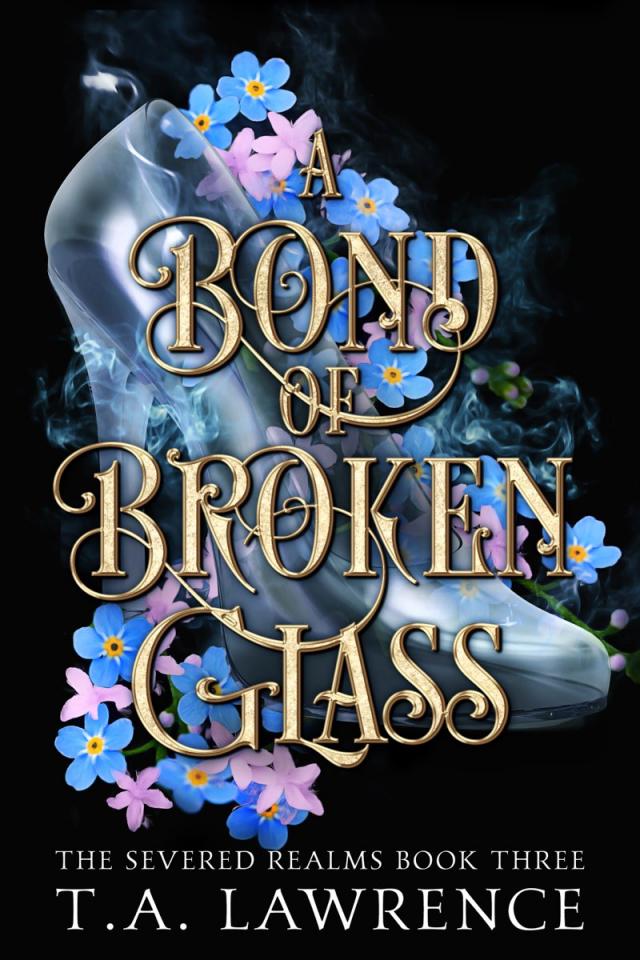
A BOND OF BROKEN GLASS
THE SEVERED REALMS
T.A. LAWRENCE
Copyright © 2023 by T.A. Lawrence
All rights reserved.
No part of this book may be reproduced in any form or by any electronic or mechanical means, including information storage and retrieval systems, without written permission from the author, except for the use of brief quotations in a book review.
Cover Copyright © 2022 Karri Klawiter
Created with Vellum
To Rachel Bobo,
For finally making me understand how some girls can become instant best friends
CONTENTS
Prologue
Chapter 1
Chapter 2
Chapter 3
Chapter 4
Chapter 5
Chapter 6
Chapter 7
Chapter 8
Chapter 9
Chapter 10
Chapter 11
Chapter 12
Chapter 13
Chapter 14
Chapter 15
Chapter 16
Chapter 17
Chapter 18
Chapter 19
Chapter 20
Chapter 21
Chapter 22
Chapter 23
Chapter 24
Chapter 25
Chapter 26
Chapter 27
Chapter 28
Chapter 29
Chapter 30
Chapter 31
Chapter 32
Chapter 33
Chapter 34
Chapter 35
Chapter 36
Chapter 37
Chapter 38
Chapter 39
Chapter 40
Chapter 41
Chapter 42
Chapter 43
Chapter 44
Chapter 45
Chapter 46
Chapter 47
Chapter 48
Chapter 49
Chapter 50
Chapter 51
Chapter 52
Chapter 53
Chapter 54
Chapter 55
Chapter 56
Chapter 57
Chapter 58
Epilogue
Acknowledgments
Free Prequel Novella
About the Author
Also by T.A. Lawrence
PROLOGUE
The parasite had worn many bodies over the centuries.
The frantic girl who shuffled into Madame LeFleur’s Cosmetics Boutique: Your One-Stop Shop for All Things Alluring would be her next.
The pyrite bell dangling above the shop entrance jingled, alerting the Madame to the girl’s arrival. The shop owner jerked, spilling her last bottle of LeFleur’s Specialty Vanishing Ink across the counter, causing it to soak into the previously pristine wood and drip onto the floor.
The ink did not vanish as advertised.
Madame LeFleur spun the bottle to hide its label lest her lone customer take notice. But the young girl wasn’t paying attention. Instead, she lingered by a shelf of products that claimed to alleviate sudden bursts of heat in aging women.
The shop owner narrowed her eyes. She hadn’t been expecting a customer tonight. In fact, she’d closed up an hour early for a handful of reasons.
One, Prince Evander’s ball was to be held at Othian Castle tonight. As the Madame’s business model revolved around preying upon the insecurities and groundless hopes of women wishing to make themselves prettier than nature had blessed them with the capability of being, it made no sense to keep the shop open past sundown.
Every human girl in the city of Othian would attend the ball, vying for the chance to snag the handsome fae prince. The Madame estimated not one of them would chance spending fewer than three hours preparing their skin with fragrant oils, arranging their hair in ornate braids, and stuffing their corsets with her bestselling LeFleur’s Miracle Endowment Enhancer—which was really just dyed cotton and the Madame’s most lucrative idea yet.
It didn’t matter how much the entire kingdom detested the Heir to the Throne of Dwellen.
The opportunity to become a princess had presented itself, and there wasn’t a woman in Dwellen who wouldn’t grasp at it.
Except, perhaps, for Ellie Payne. If all went according to plan, the parasite would be seeking her out later.
In the past few hours, the traffic in the shop had dwindled to almost nothing, and the Madame had purchased too expensive a porcelain tub and too exotic a collection of foreign soaps not to be soaking in lavender bubbles. All for the sake of a stray sale here and there.
At least, that was what the Madame told herself.
Then there was the real reason—one from which the parasite lurking in the corners of the Madame’s consciousness derived no small amount of satisfaction.
Tonight was a full moon, and the Madame was superstitious about this heavenly occurrence above all others. All her neighbors knew as much.
Rather, everyone thought they knew as much.
That was the thing about humans, the parasite mused; they always assumed they knew more than they did.
The parasite, of course, knew perfectly well that Madame LeFleur’s superstitions regarding the monthly celestial event were more than well-founded, the parasite herself having planted the gnarled roots by which these superstitions fed.
Madame LeFleur paid little attention to the girl as she tried and failed to wipe the spilled non-vanishing ink with a nearby terrycloth. “Silly me, forgetting to lock up. We’re closed, dearie.”
If the parasite could have rolled her eyes, she would have. Madame LeFleur had the irksome habit of floundering about, using the same sort of language one might hear from an elderly woman whose only concerns were that of who had accidentally dyed their hair blue recently when attempting to go silver-plated, or whose grandchild had disgraced their family by eloping with a farmhand.
The parasite knew better than to be fooled by her host’s carefully crafted facade.
Underneath the cheery disposition and altogether silly demeanor, the Madame’s mind was sharp as an adder’s fang.
Madame LeFleur was like many living beings in this strange and wonderful realm, disguising deadly venom under an array of vibrant colors.
That was part of the reason the parasite had picked Madame LeFleur. Typically, the parasite went for weaker-minded hosts, ones whose consciousnesses were more readily overcome. But with each body, each mind, came a price, and the parasite had grown weary of inhabiting the unintelligent.
Madame LeFleur sometimes used brains in the many potions she concocted—the ones that actually worked, the ones she sold in the underground market rather than the watered down briarseed oil she bottled in cheap crystal and peddled to desperate women. The parasite had now witnessed quite the assortment of brains. Lizard brains, rat brains, human brains. It fascinated the parasite to observe the differences—the smooth silky film that coated the outer layer of the rodents’ brains versus the cascading folds and the plunging shadows that carved texture into the human brains.
The parasite sometimes wished Madame LeFleur could use that glinting scalpel of hers to slice out the brains of the parasite’s previous human hosts; she was fairly certain what she would find: a glaring absence of hills and valleys cresting the wet, juicy membranes.
But the parasite’s previous hosts would all be decayed beyond recognition by this point. Most of them had returned to dust and were likely being chewed up by livestock at this very moment, so the parasite could only dream of such things.
“Did you hear me, child?” Madame LeFleur asked, her pitch heightening in what most would have mistaken for agitation when the girl remained planted in front of the counter. “We’re closed.”
Madame LeFleur finally looked up from her incessant scrubbing, allowing the parasite to get a good look at the girl through the Madame’s eyes.
Plain and unadorned as a mouse’s tail, the girl was the kind who often fell prey to the beauty elixirs the Madame fashioned from the leftover lard that sloshed off her morning bacon.
That was, of course, all the Madame noticed about her.
The Madame couldn’t sense what the parasite could.
Desperation, raw and crude and completely unrefined, emanated from the girl, radiating from her soul and pulsing in noxious waves.
The parasite could get drunk on that sort of energy.
“I…” The girl’s gaze flitted back toward the door, and the parasite’s hope threatened to wither. No, the girl couldn’t leave now. Not when the parasite had endured so many unsuitable women with unsuitable auras today. Not when she’d almost given up hope of finding anyone fit for her intentions. But then the girl’s back straightened, and she plastered a look of determination on that unremarkable face of hers and said, “I’m told you sell potions that alter one’s appearance.”
Predictable, the parasite thought. But useful all the same.
“You’re a bit too late for that, I’m afraid.” Madame LeFleur lowered her spectacles, as she often did when she was looking to get a particular thrill from asserting her dominance—disguised as disapproval, of course—upon a youngster. “Sold out of those a week ago, the hour the prince announced he’d be throwing a ball.”
The girl frowned, which didn’t help to soften her less desirable features. Tethered to the Madame for now, the parasite had only recently become able to discriminate the slight differences between the faces of the humans. The variation in their features was so slim already, and the Madame had never been all that good at it. It was as if the Madame could see faces as a whole—pretty or, more importantly, ugly—but her brain couldn’t quite grasp onto the details. The parasite was almost positive this had not been the case in previous hosts, and it often had her wondering what sort of pattern the curves on the Madame’s brain made.
Perhaps one day the parasite would find out.
“Surely you have something.” The girl tapped her fingers against the counter, the beat off-kilter with the dripping of the spilled ink still slowly splattering the floor.
The Madame shook her head, her curls bouncing against her ears. “Nothing at all.”
It seemed that whatever courage or insanity it had taken the girl to come here expired as her shoulders deflated and she turned to go.
No, no, no. The parasite tried to remember the position of the sun a few moments ago when the Madame had glanced out the window, for the Madame kept scrubbing, and the window was nowhere in sight. The parasite was certain it had been just about to slip over the horizon, and if that was the case, she needed only a few more moments…
If only she could be free of the shackles that bound her, the magical barrier between the Madame’s faculties and her own…
“But dearie?” the Madame asked just as the girl reached the door. The parasite wasn’t sure that she’d ever felt relief, not like her human hosts did, but the weight that pulled away from her consciousness when the girl turned back around was a striking replica.
“Yes?”
The curiosity in Madame’s brain warred with the anxiety welling in her stomach.
Once again, the parasite was thankful to her past self for her choice of host.
As far as the Madame was concerned, curiosity would always win.
“I must ask, why are you not attending the ball?”
The plain girl swallowed and bit her lip, embarrassment flushing her cheeks. “I thought I might, but I’m no fool. There’s no use going like this.” She gestured to herself as if that explained everything.
In the Madame’s opinion, it did.
Something pungent wafted through the Madame’s consciousness. The parasite fought back the sudden urge to recoil. Over the years, she’d come to recognize the useless emotion, but its scent never failed to make her queasy.
Pity was the most unpleasant of human emotions. It smelled like rotting flowers and settled in the Madame’s stomach about as well as soured milk.
The Madame sighed. “Well, perhaps I might have something stored in the back. But have your payment ready. It’ll cost you forty coppers and I haven’t time for you to be finagling through your coin purse. I really don’t have time to be doing this at all.”
The girl nodded and rummaged through her coin purse while the Madame slipped behind a red velvet curtain into the storeroom and did some rummaging herself.
The parasite never understood why the Madame did this, if not for the sale. She was a clever human—about as clever as they came. And during the full moon, her hands could craft poisons specific enough to kill only the intended target, leaving buyers free to distribute the poison into entire vats of wine rather than a specific glass, without threat of murdering an entire party. She could brew love potions that needn’t be drunk, only inhaled, and the victim would fancy themselves obsessed with the original wearer of the scent. That was the parasite’s gift to the Madame, another reason she’d chosen her above all others.
The parasite had been around for a long time. Long enough to have gotten good at knowing just what kind of gift a host might manifest.
It was all in their aura, which the parasite could taste in the air as potential candidates soiled it with their breath, with their fears and hopes and dreams. Sometimes it was a skill—one they were already predisposed toward—and all the parasite did was enhance that skill.
Other times, it was a desire.
And from the sweet, intoxicating desperation sluicing off the plain girl in sheets, the parasite had a sneaking suspicion of how the girl’s gift might manifest were the parasite to take her on as a host.
It was the kind of potential gift the parasite had been sniffing for all week, ever since the Madame had heard the news.
Did you hear? The prince is throwing a ball. He intends to take a human as a wife!
Oh, the parasite had heard all right.
And better yet…
He’s hosting it the night of the full moon. Isn’t that romantic?
These humans of Dwellen and their fascination with the moon. It was part of the reason the parasite had migrated here.
In fact…
I was just dreaming of you, sweet friend, the parasite thought as the sun slipped over the horizon and the crest of the moon took its place. It didn’t matter that the storeroom contained no windows. The parasite didn’t need to glance outside to know what shift had just occurred.
Cool, intoxicating pleasure washed over Madame LeFleur’s body, and when she stepped out from behind the curtain, the hands into which the girl pressed forty copper coins no longer belonged to Madame LeFleur.
Slipping from Madame LeFleur’s fingertips into the plain girl’s body was as easy as letting go. As simple as the thudding of Madame LeFleur’s dead body against the cold ground.
That had a tendency to happen when the parasite abandoned a host.
She wasn’t entirely sure why, but she liked to imagine that when she joined herself to a human, she slipped her ethereal tendrils into the crevices of their brain, caressing the silky membrane and attaching herself to them so deeply that when she eventually rent herself from them, she ripped out a chunk of their mind in the process.
The parasite’s eldest sibling hadn’t cared for her habit of discarding her hosts before their life came to a natural end. That was how the parasite had gotten into this mess to begin with.
Still, she had no regrets as she stared down at Madame LeFleur’s pale face.
For starters, the plain girl’s brain actually possessed the capability of processing the Madame’s facial features. Her empty eyes were the color of moss and she had a mole on her upper lip. Her skin was pale rather than tanned.
But one could never tell in pale-skinned humans whether that was a byproduct of their complexion or just being dead.
The parasite would miss certain aspects of her former host, of course. She doubted she’d ever find a mind like hers. One that, when enhanced, proved there was nothing quite impossible as far as chemistry was concerned.
It had been an enjoyable pastime. But pastimes were aptly named. The opportunity to achieve something greater had shuffled through the shop doors, and the parasite wasn’t keen on missing out on it.
The parasite stretched out her new host’s limbs like a cat might unsheathe its claws as it woke from a nap in the sun.
And like a cat, it was time to go strolling in the moonlight.
The parasite stumbled to the door, grabbing first at the counter, then at shelves, to steady herself. It was always a bit of a pain—getting used to a new body, the lankiness or stoutness of the new host’s limbs, the length of their stride, even the rate of their breath as their lungs coordinated with the rest of their body.
The plain girl was of average build. But that wasn’t surprising, since the girl was practically average in everything. Not ugly. Not pretty.
Totally unremarkable, just as the Madame had thought.
But the parasite had known better.


