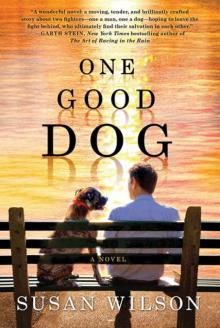
The Dog Who Saved Me, page 4


I am afraid to go back out there. There is a darkness, a hole, where my self-confidence used to be.
* * *
I spot my father as I turn the corner onto Maple Street. The old man is pedaling slowly, keeping neatly to the side of the road, so it will be impossible not to pass him. My Suburban wears the town seal on its side and he’ll know it’s me, maybe wonder why I’m passing without stopping.
* * *
It’s the last game of the regular season and Cooper Harrison is on the bench, swiping a towel over his face and head, sucking in the fuggy, overheated air of the gymnasium. He’s just hit a three-pointer. Lev is on the court now. In the way of best friends, he knows that Lev’s hoping to best his three points and bring the exceptionally close game to a successful conclusion. There’s a minute left on the clock. It’s close, 81–83, but Cooper’s pretty certain that the points that he and Lev have scored will hand the Harmony Farms Patriots a win and a spot in the play-offs. It’s up to defense now.
Above the frenzied sound of screaming fans and bellowing coaches, the relentless chanting of cheerleaders, and the squeaking of basketball sneakers on polished hardwood, there is the awful sound of one man falling off the bleachers. Not a slip, a misstep, a thump, but a complete drunken tumble. The crowd’s attention shifts from the game to the man. He gets up, shakes off helping hands, and purposefully strides right across the basketball court as if he’s walking across the street, right through the ten boys scrambling for last points. Bull is so inebriated that he’s forgotten where he is. The other team, grateful for the momentary distraction, scores before the ref can halt the game. The buzzer sounds, rude and final. The Harmony Farms Patriots have lost a heartbreaker.
“Your father has shit for brains, Harrison.” Not quite playfully, Lev shoves Cooper aside as they head for the locker room.
* * *
I slow down, keeping well behind my father, who’s pumping the Raleigh slowly up the rise. And then there he is, the runaway dog. I pull the Suburban over, wait a couple of beats until I’m sure Bull is out of sight, then get out to retrieve the dog.
Lucky for me the dog, Ralph, is a repeat offender and I know where to take him. Ralph’s owner works over at the small medical center as a receptionist. She’s a single mom, transplanted to Harmony Farms and then abandoned by her husband, who had the bad grace to die of a massive heart attack. She’s a little dumpling of a woman, and her dog is the least of her problems. I haven’t got the heart to fine her. She reminds me too much of my mother. Not the dumpling part, but the struggle to manage two boys with limited resources. She reminds me of the mother who moved her boys from one shithouse rental to another and then back to Bull’s house when he showed signs of remorse and recovery. Brenda Connors works for the same practice my mother once worked for, which isn’t odd, given that Harmony Farms has only one medical practice. It’s bigger than it was when my mother worked there, but it’s still in the same place.
I haul Ralph out of the Suburban and into Brenda’s house. As is the case with most homes in Harmony Farms, the back door is unlocked, which is obviously how Ralph got out. I run a fresh bowl of water for the dog, then write a note. Brenda, Ralph got out again. I think that the trouble is either your back door latch or your kids. Please get your latch fixed and remind your boys that someday Ralph may not come home. C. Harrison, ACO. I tear the sheet from my notepad and stick it on her fridge with a magnet shaped like Cape Cod.
Scattered around the small, very messy kitchen is the detritus of active boys: remote controls and PlayStation handsets, mismatched athletic shoes, a sock. Ralph flops down on his bed, which is jammed into a corner, sighs, and closes his eyes, as if his wandering adventure was exhausting. Some dogs just love to wander; others never leave home. Maybe Ralph was just looking for his boys.
The very first assignment Argos and I were given right out of training was a search and rescue mission to find an autistic child. This was a city hunt, not a wilderness one, and exceedingly challenging. We went up and down city blocks, into alleyways, scaring druggies shooting up, but keeping to the mission. The frantic mother was pleading with me to find her child. What I remember most about that day is the moment that Argos hit the boy’s scent—the way his tail wagged, the joy for him in completing the game. The dog was so clear in his surety that we’d found our man that it was as if there were a conversation between us. Argos said, he’s in there. I replied, “Good boy.”
The mother knelt in front of Argos. Her inexpressible joy over her son’s return was almost painful to watch, and it was more painful to have to stand tall and pretend it was all in a day’s work, to maintain the facade of dignified policeman. Argos didn’t feel any such restrictions on his dignity. He licked the boy’s face, making him laugh, and let the mom hug him, his tail beating from side to side with the pleasure of it.
I always looked on that as the moment when I fell in love with my dog. I’d loved him from the get-go, sure. Who wouldn’t have? But the heroic accomplishment of finding that child, which this animal did with joy, transformed the mere affection of a man for his working dog to something I can only call passion—a pride-stoked passion. Maybe that’s how normal parents feel about their children—that no matter what, there will always be love.
* * *
When I was a kid, the police were fairly regular visitors to our house on Poor Farm Road. Part of this was due to the number of times Bull was brought home half in the bag rather than being dumped in the drunk tank, thanks to the kindness of one or the other of the town’s two officers who had gone to school with him, one of them Lev Parker’s father. Other times, especially as we got older, it had more to do with Jimmy being suspected of something—vandalism, theft. I would stand in the corner of the kitchen, unobserved, quiet, just in awe of the blue uniform, the duty belts with their serious hardware, how the officers exuded an authority like no one else I knew. It was the way that they were so in control, so confident, that put the idea of becoming a policeman in my head. I would grow up to be just like them.
5
I start my day, as I almost always do, with a five-kilometer run around the perimeter of Bartlett’s Pond. Against the advice of my audiologist, I plug my earbuds into my ears, jack up the volume on my iPhone, and absorb the beats. It’s cooler these mornings when I start off, but by the time I’ve made my first lap, I’m sweating and I yank my venerable Police Academy T-shirt off and drop it behind me, to be retrieved on my cool-down lap. The relentless music camouflages the ringing in my left ear and fills my head with enough noise that I can run without thinking. So I don’t plan my day. I don’t actually have to, as my days are pretty routine. I don’t intentionally think about Argos. It’s more the lack of a presence which brings that presence to mind. Does that make sense? Probably not, but that’s the danger of the solitary life. You get away with random musings. Not all that long ago, Argos would have been attached to my side, and I deeply miss the sense of the dog beside me. Of course, if Argos were still alive, I wouldn’t be running around this particular pond. Our favorite run was along the Charles River, on the Cambridge side. The tall military-looking man and the stunning white German shepherd garnered a lot of admiring looks. Argos ran with his nose at my knees, his elegant gliding stride matching his partner’s pace beat for beat. He’d be panting a little, but not out of breath. It was more like encouragement. Ha ha ha. Keep moving man, keep moving.
At the end of however many kilometers I wanted to do, we looked for our reward, jogging over the Longfellow Bridge and up Charles Street to our favorite café. The owner had good cause to be happy to see me and Argos; we were the K-9 unit who had run down the man who had robbed him at gunpoint one foul November night. Despite the washed-down sidewalk, Argos had pinpointed the man’s hiding place within minutes. I always left the equivalent of my “on the house” snack in tips. Argos graciously took the proffered gluten-free cookie, paying for it in his high five–raised paw before crunching the peanut butter–flavored treat.
* * *
It’s a particularly pretty early fall day, trees a couple of cold nights away from blasting color, the tall grasses and bushes doing their own seasonal change of costume. The sky’s a cloudless blue. As I trace the border around the pond, a turtle plops into the water. There are deer tracks in the soft mud at the edge of the pond. Soon enough, the pastoral quiet around here will be threatened by the groups of hunters that find Bartlett’s Pond a fine place to bag pheasant, deer, and rabbit. Duck hunters have already been around, and the migratory water fowl that move out deeper into the pond as I pass by might end up duck soup soon enough.
I increase my pace with the change of tune in my carefully selected running music, going from a slow four beats to a rapid six-eight. Warm-up done, I sprint now. The soft burn of full-bore running reminds me that I haven’t entirely erased the months of inactivity after what we all call “the incident,” for lack of a better word. Other words have been auditioned—for instance, event, trauma, horror, crisis, depression. And there’s the always popular self-pity, the one that Gayle likes best. Or at least that’s the one she chose as her default word to describe my rendering our marital life null and void.
I claim I can’t think and hear music at the same time, but obviously, that’s not quite true.
Another lap and I’ve hit the two-mile mark. I’ve calculated that five laps around the fairly large kettle-hole pond is about five kilometers. On bad days, I’ll run it twice. I want to believe that actual running helps and isn’t just running away. On good days … well, there aren’t that many of those. Today, however, I have time for only one 5K.
My cool-down lap is the sixth and I slow to a moderate walk, letting the oxygen work its way back into my starved lungs, hunting for my discarded shirt. When I finally find it, some dog has planted one big muddy paw print on the front of my white Academy T-shirt. And no, I don’t immediately think this is a message from beyond from Argos. I’m not quite that delusional. However, I haven’t seen any dogs on my run.
* * *
We have three dogs in residence today. I picked up two of them together, a pair of nice-looking beagles. They’ve got tags, and we’re just waiting for their owner to show up. Like many beagles, once these picked up the scent, they got too far away from their owner and didn’t have the sense to turn around. The third is a solemn-looking mutt I brought in yesterday afternoon, probably a pit bull or some kind of AmStaff mix. Who knows where she came from. Maybe somebody failed in an attempt at a second chance for her in a country setting. Like the beagles, this girl is healthy and friendly. Jenny has her posted on social-media sites and has been running down leads. I can never figure out why people don’t automatically call the shelter when their dogs go missing, instead of making us do the heavy lifting and spend taxpayers’ money on classified ads.
Jenny and I go through the door that leads to the small indoor kennel area. All three kennels are empty, the inmates clearly in the outside runs, taking the air. The outside door sticks a little and I have to give it a shove with my shoulder. Two dogs behind wire enclosures look up at me with quintessentially beagle expressions of silly expectation. A walk! Food!
“Did someone collect the pit bull?” I ask.
“No.” Jenny looks back indoors, as if the pit bull could be playing some sort of game of hide-and-seek with us.
It has been three-quarters of a year since I was a real cop, but the certainty that a crime has been committed is a liquid sense that flows through my brain, and I can feel myself tense with the muscle memory of being a cop. The runs don’t have outside doors; the only access is through the shelter. The main door of the shelter is locked at night. The kennels are on cement slabs so that no dog can dig its way out. I gently back Jenny away from the area around the outside kennels. I’m looking for footprints, anything that will set me on the right course for solving this puzzle. The wire walls are over six feet high. There’s no way a dog could jump that fence, nor a sixty-something overweight woman who prefers caftans climb up it. Polly Schaeffer is the first suspect to come to mind, although I well know from long law-enforcement experience that you can’t always assume the obvious suspect is, in fact, the actual perpetrator. However, there is the theory of Occam’s razor, that the most obvious answer is usually the correct one. Polly Schaeffer certainly fills the “obvious” bill with her recent proclivity for rescuing animals not in need of rescue. And unless I’m way off the mark, there’s a size-six depression in the soft dirt, one that looks like it might have been made by a Ked, not by one of Jenny’s honking Doc Martens.
“Looks like an inside job.” Jenny can barely keep the smile off her lips.
“What do you mean?”
“Just joking. I mean, who else besides me is inside?”
“Right. And you had nothing to do with this?”
Jenny delivers me a cutting look. “As if.”
“You were off yesterday.”
“Yeah. And you were on.”
“Right.”
She stops smiling. “Coop, the back door wasn’t bolted this morning. Just now. Neither of us had to unlock it.”
I could swear that I locked the front door. I did; I distinctly recall locking it with the key that catches a little as you insert it. But did I bolt the back door? That I can’t quite remember.
Mistakes come out of complacency, out of carelessness. Or out of distraction. I have little patience for mistakes like this. But I can only blame myself for failing to lock up properly last night. I remember now. The phone rang as I was getting ready to leave, someone with a complaint about a dog rooting in the garbage. A skinny yellow dog, a stray the person didn’t recognize. There has been a rash of raided trash barrels in the past few weeks, and two other good citizens have called with similar sightings. In each case, as with this most recent sighting, the skinny yellow dog has been described as limping badly but fast enough on three legs to bolt as soon as he’s discovered.
I can tell myself all day that a missing pit bull isn’t a life-or-death situation, but this kind of mistake suggests that maybe I’m better off as an animal control officer in my former home town than being responsible for other people’s lives.
I send Jenny out on a call about a missing bunny. I’m just not in the mood to be a comfort to someone who’s idea of a pet is a caged rabbit. The beagles’ owner has finally returned my call and is on his way in to collect his runaways. As if inflicting punishment on myself, I clean the empty run, vaguely hoping that it will give up the mystery of who took the missing pit bull. I’ve got to go to the town hall anyway, so I’ll stop in and check with the town clerk to see if anyone has recently registered a bully type. Maybe the owner made an off-hours call and figured he could just liberate his dog and skip the ticket. But just in case, I’ll casually drop by Polly’s to see if she’s acquired a dog. Although her preferred collectible is feline, she’s fond enough of dogs, and a little loony, so my hunch that she made the heist is not exactly far-out.
I’m outside when a Range Rover pulls into the visitors’ parking space. A stout man climbs out, two leashes in his hand and a disgruntled look on his face. “Got my dogs?”
“I believe that I do. Let’s see and then do a little paperwork.”
“How much?”
I name the fine, times two because of the double trouble.
The expression of annoyance on the man’s face quickly dissolves into relief at the sight of his less than contrite hounds. “Bad boys, bad boys,” he says, but he hugs them and lets them lick his face in a rapture of reunion. I was wrong: He’s not a hunter, but a middle-aged dog lover.
“Beagles are tricky. Best to have them on long lines when you’re out walking.”
“I will.” The man offers his hand to me. “Thanks.
The gratitude coming from this guy makes me smile. Sometimes it feels good to be recognized for doing your job. Not exactly like the commendations Argos and I earned for bravery, but nice all the same. Mostly, with this job, the public regards me with something between disdain and annoyance. Despite the fact I’m working under the umbrella of the police department, the public really doesn’t look at me as a cop. Barely an authority.
The beagle man shakes my hand vigorously. “I’d just die if anything ever happened to these guys.”
Which pretty much sums up why I will never have another dog. Not a pet. Not a partner.
No sooner has the beagle man left than Doc Philbine pulls up.
“I was passing by, thought I’d stop in.”
“I can give you a cup of coffee, maybe find a doughnut to go with it.”
Max Philbine has the movie star good looks of a man more suited to a life in a power suit, not rubber boots and, during bovine breeding season, a plastic glove with a sleeve up to his armpit. But he’s the son of a veterinarian who was the son of a veterinarian and he doesn’t recall ever wanting to be anything else. Unlike his father and grandfather, though, Max can’t make a living by being paid in eggs and pie, and the high cost of medical equipment and the sheer magnitude of laboratory tests and procedures never imagined by his forebears has Max wondering out loud to me if that teaching position at Tufts isn’t worth considering.