

Summer Pudding, page 1


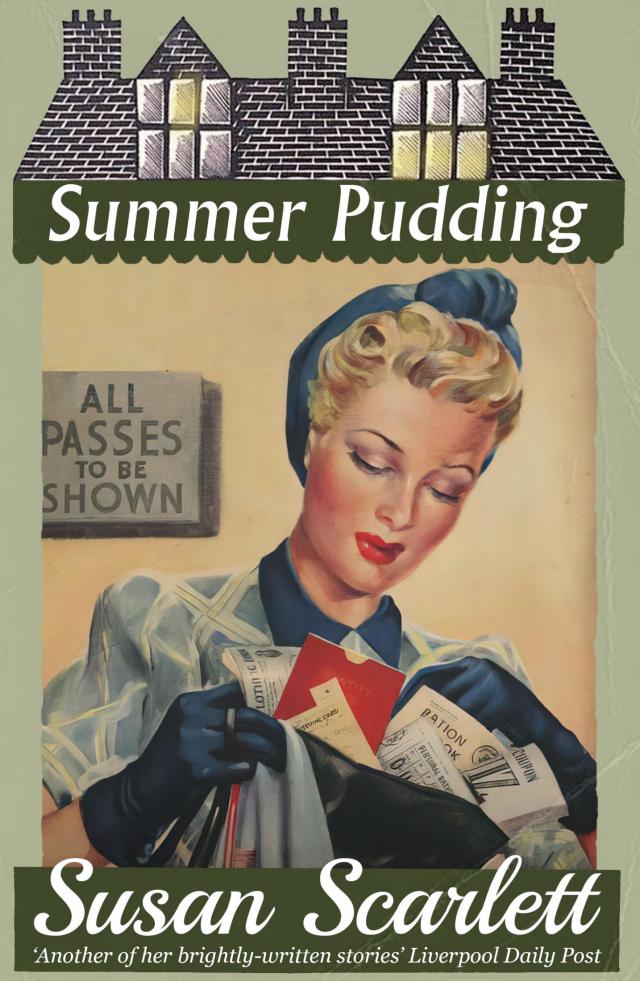
Susan Scarlett
Summer Pudding
There was silence. In it Janet heard the twittering of innumerable birds chatting as they settled down for the night. Some rooks cawed overhead. The baa of a sheep came from a distant field. London had been so noisy, with its crashes at night, and blastings and hammerings at smashed buildings by day, that the quiet and peace fell on her spirit like a cold hand on a sprained ankle.
Janet Brain has been bombed out of her job in a London office and comes to the village of Worsingford (surely a case of going from bad to Worsingford), where her self-absorbed sister Sheila and their mother Maggie are weathering the war. Maggie has a bad heart and should be resting, but Sheila’s too busy fancying herself a film star to help out. Close at hand are Donald, a handsome young widower, and his adorable daughter, as well as Barbara, a charming girl whose love is away on active service, and Barbara’s curmudgeonly but likeable old father, a retired colonel (not to mention the ghosts in his house). There should be happy endings for all, but Donald’s possessive young housekeeper and a series of misunderstandings precipitated by Sheila’s selfishness will have to be dealt with first.
Summer Pudding is the eighth of twelve charming, page-turning romances published under the pseudonym “Susan Scarlett” by none other than beloved children’s author and novelist Noel Streatfeild. Out of print for decades, they were rediscovered by Greyladies Books in the early 2010s, and Dean Street Press and Furrowed Middlebrow are delighted now to make all twelve available to a wider audience.
“A writer who shows a rich experience in her writing and a charm” Nottingham Journal
FM92
Contents
Cover
Title Page/About the Book
Contents
Introduction by Elizabeth Crawford
Section One
Section Two
Section Three
Section Four
Section Five
Section Six
Section Seven
Section Eight
Section Nine
Section Ten
Section Eleven
Section Twelve
Section Thirteen
Section Fourteen
Section Fifteen
Section Sixteen
Section Seventeen
Section Eighteen
Section Nineteen
Section Twenty
Section Twenty-One
About the Author
Adult Fiction by Noel Streatfeild
Furrowed Middlebrow
Copyright
INTRODUCTION
When reviewing Clothes-Pegs, Susan Scarlett’s first novel, the Nottingham Journal (4 April 1939) praised the ‘clean, clear atmosphere carefully produced by a writer who shows a rich experience in her writing and a charm which should make this first effort in the realm of the novel the forerunner of other attractive works’. Other reviewers, however, appeared alert to the fact that Clothes-Pegs was not the work of a tyro novelist but one whom The Hastings & St Leonards Observer (4 February 1939) described as ‘already well-known’, while explaining that this ‘bright, clear, generous work’, was ‘her first novel of this type’. It is possible that the reviewer for this paper had some knowledge of the true identity of the author for, under her real name, Noel Streatfeild had, as the daughter of the one-time vicar of St Peter’s Church in St Leonards, featured in its pages on a number of occasions.
By the time she was reincarnated as ‘Susan Scarlett’, Noel Streatfeild (1897-1986) had published six novels for adults and three for children, one of which had recently won the prestigious Carnegie Medal. Under her own name she continued publishing for another 40 years, while Susan Scarlett had a briefer existence, never acknowledged by her only begetter. Having found the story easy to write, Noel Streatfeild had thought little of Ballet Shoes, her acclaimed first novel for children, and, similarly, may have felt Susan Scarlett too facile a writer with whom to be identified. For Susan Scarlett’s stories were, as the Daily Telegraph (24 February 1939) wrote of Clothes-Pegs, ‘definitely unreal, delightfully impossible’. They were fairy tales, with realistic backgrounds, categorised as perfect ‘reading for Black-out nights’ for the ‘lady of the house’ (Aberdeen Press and Journal, 16 October 1939). As Susan Scarlett, Noel Streatfeild was able to offer daydreams to her readers, exploiting her varied experiences and interests to create, as her publisher advertised, ‘light, bright, brilliant present-day romances’.
Noel Streatfeild was the second of the four surviving children of parents who had inherited upper-middle class values and expectations without, on a clergy salary, the financial means of realising them. Rebellious and extrovert, in her childhood and youth she had found many aspects of vicarage life unappealing, resenting both the restrictions thought necessary to ensure that a vicar’s daughter behaved in a manner appropriate to the family’s status, and the genteel impecuniousness and unworldliness that deprived her of, in particular, the finer clothes she craved. Her lack of scholarly application had unfitted her for any suitable occupation, but, after the end of the First World War, during which she spent time as a volunteer nurse and as a munition worker, she did persuade her parents to let her realise her dream of becoming an actress. Her stage career, which lasted ten years, was not totally unsuccessful but, as she was to describe on Desert Island Discs, it was while passing the Great Barrier Reef on her return from an Australian theatrical tour that she decided she had little future as an actress and would, instead, become a writer. A necessary sense of discipline having been instilled in her by life both in the vicarage and on the stage, she set to work and in 1931 produced The Whicharts, a creditable first novel.
By 1937 Noel was turning her thoughts towards Hollywood, with the hope of gaining work as a scriptwriter, and sometime that year, before setting sail for what proved to be a short, unfruitful trip, she entered, as ‘Susan Scarlett’, into a contract with the publishing firm of Hodder and Stoughton. The advance of £50 she received, against a novel entitled Peter and Paul, may even have helped finance her visit. However, the Hodder costing ledger makes clear that this novel was not delivered when expected, so that in January 1939 it was with Clothes-Pegs that Susan Scarlett made her debut. For both this and Peter and Paul (January 1940) Noel drew on her experience of occasional employment as a model in a fashion house, work for which, as she later explained, tall, thin actresses were much in demand in the 1920s.
Both Clothes-Pegs and Peter and Paul have as their settings Mayfair modiste establishments (Hanover Square and Bruton Street respectively), while the second Susan Scarlett novel, Sally-Ann (October 1939) is set in a beauty salon in nearby Dover Street. Noel was clearly familiar with establishments such as this, having, under her stage name ‘Noelle Sonning’, been photographed to advertise in The Sphere (22 November 1924) the skills of M. Emile of Conduit Street who had ‘strongly waved and fluffed her hair to give a “bobbed” effect’. Sally-Ann and Clothes-Pegs both feature a lovely, young, lower-class ‘Cinderella’, who, despite living with her family in, respectively, Chelsea (the rougher part) and suburban ‘Coulsden’ (by which may, or may not, be meant Coulsdon in the Croydon area, south of London), meets, through her Mayfair employment, an upper-class ‘Prince Charming’. The theme is varied in Peter and Paul for, in this case, twins Pauline and Petronella are, in the words of the reviewer in the Birmingham Gazette (5 February 1940), ‘launched into the world with jobs in a London fashion shop after a childhood hedged, as it were, by the vicarage privet’. As we have seen, the trajectory from staid vicarage to glamorous Mayfair, with, for one twin, a further move onwards to Hollywood, was to have been the subject of Susan Scarlett’s debut, but perhaps it was felt that her initial readership might more readily identify with a heroine who began the journey to a fairy-tale destiny from an address such as ‘110 Mercia Lane, Coulsden’.
As the privations of war began to take effect, Susan Scarlett ensured that her readers were supplied with ample and loving descriptions of the worldly goods that were becoming all but unobtainable. The novels revel in all forms of dress, from underwear, ‘sheer triple ninon step-ins, cut on the cross, so that they fitted like a glove’ (Clothes-Pegs), through daywear, ‘The frock was blue. The colour of harebells. Made of some silk and wool material. It had perfect cut.’ (Peter and Paul), to costumes, such as ‘a brocaded evening coat; it was almost military in cut, with squared shoulders and a little tailored collar, very tailored at the waist, where it went in to flare out to the floor’ (Sally-Ann), suitable to wear while dining at the Berkeley or the Ivy, establishments to which her heroines – and her readers – were introduced. Such details and the satisfying plots, in which innocent loveliness triumphs against the machinations of Society beauties, did indeed prove popular. Initial print runs of 2000 or 2500 soon sold out and reprints and cheaper editions were ordered. For instance, by the time it went out of print at the end of 1943, Clothes-Pegs had sold a total of 13,500 copies, providing welcome royalties for Noel and a definite profit for Hodder.
Susan Scarlett novels appeared in quick succession, particularly in the early years of the war, promoted to readers as a brand; ‘You enjoyed Clothes-Pegs. You will love Susan Scarlett’s Sally-Ann’, ran an advertisement in the Observer (5 November 1939). Both Sally-Ann and a fourth novel, Ten Way Street (1940), published barely five months after Peter and Paul, reached a hitherto untapped audience, each being serialised daily in the Dundee Courier. It is thought that others of the twelve Susan Scarlett novels appeared as serials in women’s magazine
Between 1938 and 1951, while writing as Susan Scarlett, Noel Streatfeild also published a dozen or so novels under her own name, some for children, some for adults. This was despite having no permanent home after 1941 when her flat was bombed, and while undertaking arduous volunteer work, both as an air raid warden close to home in Mayfair, and as a provider of tea and sympathy in an impoverished area of south-east London. Susan Scarlett certainly helped with Noel’s expenses over this period, garnering, for instance, an advance of £300 for Love in a Mist. Although there were to be no new Susan Scarlett novels, in the 1950s Hodder reissued cheap editions of Babbacombe’s, Pirouette, and Under the Rainbow, the 60,000 copies of the latter only finally exhausted in 1959.
During the ‘Susan Scarlett’ years, some of the darkest of the 20th century, the adjectives applied most commonly to her novels were ‘light’ and ‘bright’. While immersed in a Susan Scarlett novel her readers, whether book buyers or library borrowers, were able momentarily to forget their everyday cares and suspend disbelief, for as the reviewer in the Daily Telegraph (8 February 1941) declared, ‘Miss Scarlett has a way with her; she makes us accept the most unlikely things’.
Elizabeth Crawford
The train ran out from London. Straggling narrow streets and cramped houses, little gardens flapping with washing and chickens and crowded with rabbit hutches and the family effort at digging for victory, dreary gaping bombed areas, all gave way to fields, hedges, and a blue distance.
Janet had managed to get not only a seat, but a corner seat. She sat relaxed, her grey eyes staring through the window. It was early summer, the fields were spangled with daisies and buttercups, the first dog roses were opening. She took a deep breath, and in doing so moved and her book slipped off her knee and in retrieving it her elbow dug into the person sitting next to her. “I’m so sorry,” she apologized.
Her neighbour was a girl, slim, with red hair and brown eyes. She was, Janet noticed, expensively dressed. The sort of clothes that look good always, no matter how long they have been owned. The sort of clothes, in fact, that she had always wanted herself, and was sure it was an economy to buy, only she never had the money to do it.
“It’s all right,” the girl laughed. “We can’t very well turn without knocking each other. Sort of ‘when father turns we all turn’. Awful travelling these days, isn’t it? Daddy told me to travel first, but I won’t in wartime, and anyway it wouldn’t be any better, everybody gets in everywhere, and it would just be a waste of money.”
“I suppose it would,” Janet agreed. “I never travel first so I didn’t know it was as bad.” She turned back to the window. “Isn’t the country looking lovely?”
“Yes. You haven’t been out of London much lately, have you?”
“No. How did you know? Only for one week since the war started, as a matter of fact.”
“You sat down with a sort of pleased ‘now we’re off’ look, and then as the last of the houses disappeared you were like a cat that’s going to purr.”
“It’s not only going to the country. I’ve had an awful time packing up, and settling things, and getting off.”
“You bombed out?”
“Not at home. The office where I worked was.”
“How miserable!”
“Yes. My old boss was killed, and his partner’s in the army and overseas, so I couldn’t get at him.”
“What are you going to do now?”
Janet did not find these questions impertinent, she liked her red-haired neighbour, and could feel every question came from friendliness.
“I’ve not quite made up my mind. I’m a secretary so I expect I’d better put in for the same sort of thing in one of the services; the W.R.N.S. is what I should like.”
“Wouldn’t you rather have a change?”
“I would, but I’ve been a secretary for years, so I’d be more use in that than anything.”
“You can’t have been very many years.”
“Why not? How old do you think I am?”
The girl studied Janet. The small, slim figure. The pale, square, not pretty, but alive face, made noticeable by wide-set, beautiful grey eyes. She watched Janet’s smile. It was a lovely thing. It not only lit her up as though a light were switched on inside her, but seemed to spread outwards to make other people smile too; she was smiling in answer herself.
“Twenty-two? Twenty-three?”
“Twenty-five!”
“Are you? I shouldn’t have thought you were that much older than me. I’m twenty-one. I’d like to do something. I want to join the W.R.N.S. too, but I can’t just yet because of Daddy.” She lowered her voice, not that the five soldiers, two sailors, and three elderly women who filled the rest of the carriage were listening, but her dropped voice suggested that she was confiding something personal. “He was terribly ill last winter. The doctor thought he was going to die; he says he’s much stronger now, but he mustn’t have any worries. You know, no upset in his life. So of course just now I can’t leave him to join the W.R.N.S. or . . .” she hesitated and finished lamely, “or anything.”
Janet’s sympathetic eyes caught a faint flush on the girl’s cheek. She felt a wave of pity. The ‘or anything’ sounded suspiciously like marriage. Of course she was very young, but in these uncertain times it would be hard to put off getting married even for a month or two.
“I hope your father’s soon better. I’m lucky I’m not tied. My mother’s not very strong, but I’ve a younger sister who lives with her. She’s rather delicate, not fit for war work, but she can manage the work of the cottage they’re living in, so I’m not needed at home, thank goodness. I’m simply longing to join up, would have done it ages ago only I couldn’t leave my boss.”
The ticket collector came in from the corridor. He could not reach the end of the carriage so Janet gave her ticket to be passed to him. The girl took it casually then turned an amazed face.
“You’re going to Worsingfold.”
“Yes.”
“But that’s where I live.”
“So do my mother and sister.”
The girl’s eyes widened, and Janet thought looked somehow not too pleased.
“You can’t be Sheila Brain’s sister.”
“Yes, I am. How did you guess? Do you know her?”
“Of course I know her, everybody knows everybody in Worsingfold. Anyway, she and your mother live in one of Donald Sheldon’s cottages, and he’s a tremendous friend of Daddy’s and mine. Your sister’s going to teach his little girl, Iris.”





