

Elizabeth and Elizabeth, page 1


Sue Williams is a bestselling author and award-winning journalist, working in newspapers, magazines and TV in Australia, the UK and New Zealand. Born in England, but settling in Australia in 1989, she’s also a travel writer and university lecturer. She lives in Sydney’s Kings Cross with her partner, writer Jimmy Thomson.
Her books include Getting There: Journeys of an accidental adventurer; the story of her travels around isolated Australia, Welcome to the Outback; and a series of other books about the outback, Women in the Outback, Outback Spirit and Outback Heroines. She’s also written biographies of Father Chris Riley, Mean Streets, Kind Hearts; Father Bob Maguire, Father Bob: The larrikin priest; navy diver Paul de Gelder, No Time For Fear; Fred Brophy, The Last Showman; and Australia’s youngest Everest climber Alyssa Azar, The Girl Who Climbed Everest.
Sue’s true-crime book And Then The Darkness: The disappearance of Peter Falconio and the trials of Joanne Lees was shortlisted for the international 2006 Gold Dagger Award for the world’s best crime non-fiction. Her first children’s book was Everest Dreaming.
Elizabeth & Elizabeth is her first novel, borne out of a love of early colonial Australian history—pivotal in the development of the country—and an overriding admiration for women of that era making their own way in life. With both Elizabeth Macquarie and Elizabeth Macarthur having a huge impact on the fledgling nation, despite all the odds, Elizabeth & Elizabeth is the result of an enduring fascination with what might have been.
This is a work of fiction. Names, characters, places and incidents are sometimes based on historical events, but are used fictitiously.
First published in 2021
Copyright © Sue Williams 2021
All rights reserved. No part of this book may be reproduced or transmitted in any form or by any means, electronic or mechanical, including photocopying, recording or by any information storage and retrieval system, without prior permission in writing from the publisher. The Australian Copyright Act 1968 (the Act) allows a maximum of one chapter or 10 per cent of this book, whichever is the greater, to be photocopied by any educational institution for its educational purposes provided that the educational institution (or body that administers it) has given a remuneration notice to the Copyright Agency (Australia) under the Act.
Allen & Unwin
83 Alexander Street
Crows Nest NSW 2065
Australia
Phone:(61 2) 8425 0100
Email:info@allenandunwin.com
Web:www.allenandunwin.com
ISBN 978 1 76063 134 5
eISBN 978 1 76087 015 7
Typeset by Bookhouse, Sydney
Cover design: Christabella Designs
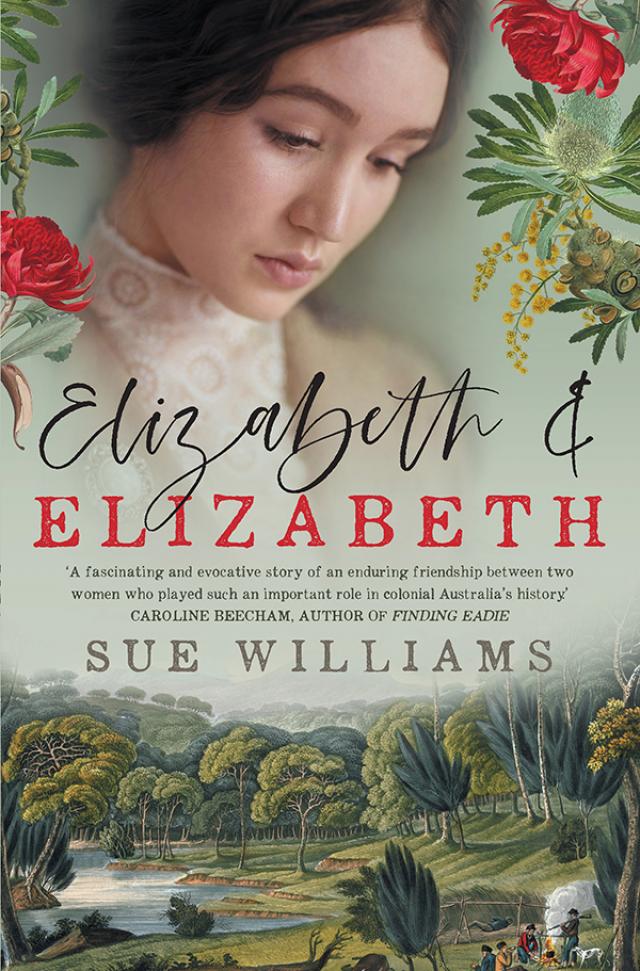
Cover images: © Lee Avison / Arcangel Images; ‘View upon the Nepean River at the Cow Pastures, New South Wales’ by Joseph Lycett (1825)
For Jimmy,
without whom none of this would be possible
Contents
Author's Note
Part One
Chapter 1 First Impressions
Chapter 2 A Reunion of Sorts
Chapter 3 Fine Palaces and Footmen
Chapter 4 A Hot-Head and Trouble-maker
Chapter 5 Back to Business
Chapter 6 Haunted by Past Love
Chapter 7 A Woman's Place
Chapter 8 Celebrations and Commiserations
Chapter 9 Cruel Punishment
Chapter 10 Mrs Macquarie’s Chair
Chapter 11 A Shared Horror
Chapter 12 Sticking Together
Chapter 13 A Terrible Secret
Part Two
Chapter 14 I Have Failed Him
Chapter 15 A Dangerous Game
Chapter 16 The Pain of A Mother
Chapter 17 A Stark Under-Estimation
Chapter 18 Blood on our Hands
Chapter 19 A Betrayal
Part Three
Chapter 20 The Arrival
Chapter 21 A Warning
Chapter 22 More Bad News
Chapter 23 Stirring the Pot
Chapter 24 Unleashing the Passion
Chapter 25 A Miraculous Escape
Part Four
Chapter 26 Betrayal Upon Betrayal
Chapter 27 Sharing Troubles
Chapter 28 A Kind of Desperation
Chapter 29 For Whom the Bells Toll
Chapter 30 Mrs Macquarie's Choice
Chapter 31 Ever Your Affectionate Wife
Chapter 32 The Last Paper Trail
Afterword
Further reading
Acknowledgements
AUTHOR’S NOTE
In 1809, Elizabeth ‘Betsey’ Macquarie, the wife of Major-General Lachlan Macquarie, accompanied him on the long voyage to Britain’s most far-flung penal settlement, where he was to become Governor of the country that ultimately became Australia. The couple arrived in the colony after the Rum Rebellion of 1808 overthrew the sitting Governor, William Bligh, following a series of disagreements between Bligh and one of the coup d’état’s ringleaders, powerful wool pioneer John Macarthur. Lachlan was appointed to bring stability back to New South Wales, and both he and Betsey were eager to leave their mark on the development of the nascent colony.
Elizabeth Macarthur arrived in Sydney in June 1790 with her husband John Macarthur. After a period in Sydney Town, they moved to Parramatta where they established Elizabeth Farm, which would become famous for its merino fleeces. When John journeyed back to London in 1809 with their two youngest sons to defend himself against possible charges of treason because of his role in the revolt, he left Elizabeth behind with their three daughters to look after the family’s growing wool empire.
The two Elizabeths were women from strikingly different backgrounds. And they both had to contend with their husbands’ sharply conflicting visions of the future of the new colony.
WARNING
This book is about colonial Australia and contains words and descriptions of Aboriginal people by non-Indigenous characters, as well as the recounting of events from a colonial standpoint, that today may be considered insulting or inappropriate.
PART
ONE
I’m feeling so many mixed emotions. I’m relieved that our long, long voyage is over, but fearful of what awaits us in this new land with, by all reports, its strange creatures and hostile environment. The smudge on the horizon marks the beginning of our great adventure and, while I will be happy to be on dry land once more, my heart is racing at the thought of the unknown challenges ahead.
Betsey Macquarie’s journal,
31ST DECEMBER 1809
Chapter 1
FIRST IMPRESSIONS
Betsey Macquarie
31ST DECEMBER 1809, SYDNEY
Oh my Lord, I’m going to be sick. That stink! It’s like a punch to the gut. My eyes are beginning to water and I feel the bile rise in my throat. I tighten my grip on my husband’s arm, lift my skirts and try to pin a smile on my face. First impressions are important. It would never do for the new First Lady of the colony of New South Wales to step ashore and immediately sink to the ground retching.
There are rows and rows of officials standing in the hot noon sun in Sydney Town waiting to greet us. Behind them, the crowd is ten deep either side, shouting greetings and waving and yelling. As we make our way slowly forward, shuffling through the stifling heat, I can see a slash of red uniforms and glitter of gold braid in amongst them. There are cries of ‘God save the King!’ and ‘Huzzah!’ I wasn’t sure what kind of reception we would meet, but they sound keen to see their new Governor and his wife.
I nod to them, smile sweetly and wave back. But it’s an effort. The light is so sharp and harsh, unlike anything I’ve ever experienced before, almost blinding. Already I have a pounding headache. I’ve waited for this moment so long, dreamed of it, prepared for it, I can barely believe it’s finally here. But it is. And it is nothing like I expected.
I can feel a gentle touch from Lachlan on my hand and I smile up at him, gratefully. He knows I am nervous and he’s trying to reassure me in his own quiet way. He probably thinks I’m anxious about the crowds and their scrutiny of us, particularly of him, an unknown quantity. In truth, I’m worried about a whole lot more, of which most he would have absolutely no clue.
But Lachlan is walking ram-rod straight, like the good soldier he’s always been. He’ll be smelling that same foul smell and feeling a little overwhelmed by the crowd, just like me, but he’s showing few signs of any of it. The only outward hint of discomfort I can see is sweat glistening on his forehead; he must be suffering from the heat inside that stiff new uniform. I only just resist the temptation to blot his brow with my handkerchief. He carries on regardless, shaking all the hands reaching out to him, and saluting the army officers, making it clear he’s in charge. I have to make a good impression, too. This feels like my first real test. I can’t afford to let him down.
I look around furtively. It’s wet and muddy underfoot and I can see a wash of fetid water a few feet away from where we’re receiving our first greeting party. I nod my head politely at the men clustering around Lachlan, but am distracted by the sight of what looks suspiciously like human waste floating by. Open sewers, of course. I see a large pig snuffling around a mound of decaying rubbish, and a couple of mangy, probably feral, dogs beyond. One limps up then defecates on the path before us. What a charming welcome, I think to myself. But let’s hope the people receive us with a little less disdain.
It’s all very, very different to what I’d so
Of course, my world has been small. At thirty-one, I know little beyond Scotland, England and the ports we stopped at on the way here. Lachlan, sixteen years my senior, is so much wiser, having served in the British Army around the world, often facing terrible danger and privation to keep himself and his men alive. And I can’t say he didn’t warn me.
‘Don’t forget, Betsey,’ he’d said at one point during the voyage, ‘New South Wales is a penal settlement, and a relatively new colony. I don’t believe it’s going to be as pretty as you think, and nothing like as easy.’
I’d smiled sweetly. ‘Yes, yes, I realise that,’ I’d replied. ‘But I’ve read many of the letters from the colony, so I think I have a fair idea of what to expect. Don’t worry about me. I’m made of far sterner stuff than I look!’
He’d laughed at that, taking my hand and kissing it. ‘I don’t doubt it, my darling,’ he’d said.
But now I am the one with the doubts. I realise that I really was not ready for what I’m now experiencing. The heat and the humidity are overpowering, and I can barely believe what I’m seeing … I quickly readjust my face again to make sure I’m smiling rather than showing any outward sign of my dismay.
This is worse, far worse, than even my darkest fears. Behind the ragged grey people and their own shabby infantry officers—now forming a line of honour from the wharf up to the grand building, which I assume must be Government House perched on the hillside looking down at us—the houses are little more than ramshackle huts hewn from mud and split wood. They’re all sitting higgledy-piggledy in a jumble of narrow tracks around the place, with no sign of any order or even of the most rudimentary pride. The streets, if you can call them that, are simply rutted mud paths strewn with rubbish. And that smell.
We’re guided to the front row of a set of seats positioned in front of a platform. Lachlan sits and I slump down beside him, just as my legs threaten to give way completely. Someone—I don’t know who—hands me a parasol. I feel almost faint with gratitude as it finally blocks out that fearsome sun. I know there are sweat patches under the arms of my dress, so I keep them close to my sides. I cross my ankles and catch sight of my good cream silk shoes now caked in something that I fear is far worse than mud. I look away quickly and out into the crowd that is steadily amassing around us, everyone staring as if we’re creatures from another planet. I imagine they’re anxious about what Lachlan plans for this place. After so much upheaval in the governorship in the past few years, they’ll be keen for a period of calm, order and, hopefully, prosperity.
One of our party from the ship, Mr Ellis Bent, takes to the platform, and unfurls his documents. As the man anointed to be our Judge Advocate, he’s our master of ceremonies, but I can see he also looks nervous. At only twenty-six years old, this must be as daunting for him as it is for me. But at least he’s had much longer to prepare for it. I’ve had time to get to know him on our long journey to this place, and found him hard-working, conscientious and very proper about what he sees will be his role in the upkeep of the rule of law in the colony. While he is always deferential to Lachlan, he’s also extremely considerate towards me. He was very solicitous during my long bouts of seasickness on the voyage, even though he often didn’t seem too well himself. I’ve decided I like him very much. I hope he’ll be a good friend to us in whatever lies ahead.
I smile towards Mr Bent encouragingly in case he can see me. He draws a breath, and the crowd grows silent. Then he gravely reads out the official proclamation of Lachlan’s commission as Governor. As the words tumble on, I steal a glance at Lachlan’s face. He looks serious, solemn, giving nothing away of what he must be feeling. But what is he feeling? I realise with a jolt that I don’t really have any idea. Sometimes I feel as if I don’t know my husband at all. He’s lived such a full life, travelled around the world, experienced things I could never dream about, and of which he’ll never speak. Occasionally, he withdraws completely and goes to a very dark place, and I’ve learned to just let him go and wait patiently for him to return. At those times, he’s almost a stranger to me.
Yet there have been moments when I’ve felt we’ve been as close as any two human beings could be. Our wedding day was one of the happiest of my life, and I believe of Lachlan’s too. While we spent so much of our engagement apart, in the two years of our marriage we’ve known both great joy—and terrible heartache. I will never forget the day our baby daughter Jane died at just two and a half months old, and I saw this great courageous soldier let down his guard and actually weep with misery and despair. The sight cut me to the quick. I tried to console him but he pushed me away, embarrassed at what he saw as a terrible weakness. It made me only care for him more, want to protect him more fiercely and, most important of all, make him happy. A new start in a new land will be good for us both.
I look back out into the crowd. I am hoping to see one particular face there, that of Mrs Elizabeth Macarthur. I quickly scan everyone but I can’t see her. Even though I last saw her twenty years ago, I feel sure I will recognise her. Elizabeth was always so beautiful and had a quiet elegance about her that would doubtless mark her out today in a crowd like this. She made such a strong impression on me as a young girl that I’ve been following her progress ever since. Indeed, I even have letters from home for her. I wonder why she isn’t here? She surely would have known that this was the day of our arrival? I hope she’s not sick or that she’s not left and gone back to London with her husband. As the only woman of similar stature in this country, I hope she’ll be a good and loyal friend. Otherwise this strange place is going to be extremely lonely.
It suddenly dawns on me that being the wife of the Governor of New South Wales is going to be nothing like I’d pictured, back home. Home. Today, Hogmanay back in Scotland, there’ll be a frost on the grass crunching underfoot and it’ll probably now be snowing. Our families and friends will be gathering, ready to see in another New Year with the kind of gusto only the Scots can summon. My family home, Airds House in Appin, in the West Highlands, will have a blazing fire in the hearth warming the house ready for all its visitors. I wonder if my brother John Campbell, the laird, will be missing me. I know my sister Jane, who lives close by on the Isle of Mull, certainly will be. I think, with a pang, of all my nieces and nephews growing up so far away. I wonder how long it will be before I see them again.
When we’d boarded our ship in Portsmouth, I hadn’t thought too much about what I was leaving behind, so dazzled had I been by this extraordinary honour afforded my husband. It was to be the final distinction of his brilliant career, and his legacy. For me, it was my chance to broaden my horizons in a way I’d never dreamed possible and to put all my reading and education into action, and, most importantly, to help him make a difference in the new world. I’d spent the seven months of our voyage listening to Lachlan outlining his plans and his hopes, and writing my own journals of things I’d like to do to support him, studying my architectural pattern book of building designs I’ve brought with me, as well as drawing my own sketches of buildings I’d like to see take shape. Lachlan appreciated my suggestions—he had known when he met me that I can be quite independent-minded—but at various times he seemed determined to try to temper my aspirations.
‘Hopefully we will be able to bring our ambitions to improve the colony to fruition,’ he said one day while we were sitting on either side of his desk. ‘However, I’m warning you that we’ll have to be patient. Life in Sydney is going to be far harder than you imagine.’


