

Holt 2, page 1


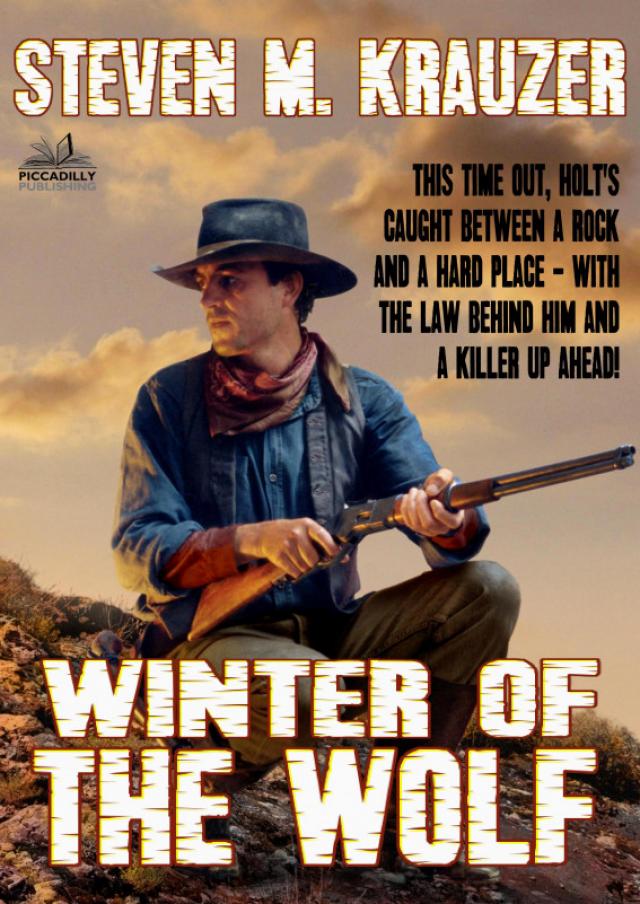
The Home of Great Western Fiction!
Times were tougher than leather for Holt. If the lawman-turned-outlaw didn’t prove his innocence in the murder of a mining camp madam, he was a dead man. Holt had to find the real killer, a brutal giant of a man named Gutt, before the bounty hunters found him.
But in the deadly, snowbound mountains where Gutt was trapping wolves, the odds start to stack up against Holt and beautiful Samantha Lowell, the gutsy reporter who helped him escape from Yuma jail. With Gutt sworn to kill him and U.S. Marshal Pert sworn to catch him, Holt was going to have a rough time staying alive—if the blizzards didn’t kill him first …
HOLT 2: WINTER OF THE WOLF
By Steven M. Krauzer
First Published by Fawcett Gold Medal in 1994
First Digital Edition: January 2019
Copyright © 1994, 2019 by Steven M. Krauzer
Names, characters and incidents in this book are fictional, and any resemblance to actual events, locales, organizations, or persons living or dead is purely coincidental.
All rights reserved. No part of this book may be reproduced or transmitted in any form or by any means, electronic or mechanical, including photocopying, recording or by any information or storage and retrieval system, without the written permission of the author, except where permitted by law.
This is a Piccadilly Publishing Book
Series Editor: Ben Bridges
Text © Piccadilly Publishing
Published by Arrangement with the author’s estate.
For Dorrit
Chapter One
It was fascinating, Holt thought, how many notions could pass through your mind in the span of eight seconds: the abstraction that you wished to be anywhere else at this moment; the observation that you could hold no solid image in your field of vision, only lantern-show-like snapshots of sky, hard-packed ground, faces of men who perched on a fence rail, your own hand cinch-wrapped at the base of a horse’s mane; the anticipation of at any moment getting your neck broke.
While Holt’s brain was elsewhere, his legs were automatically pumping, his spur rowels raking and gouging at the animal’s withers. The horse’s reaction was reasonable enough: It was doing everything instinct could devise to throw Holt off its back.
The bronco sunfished, arching the half ton of its body into a bow. All four hooves left the ground for a moment, and then it came down hard on the front pair. Holt was thrown forward so violently he almost banged his nose on the horse’s hide. He jerked himself upright as the animal went into a twirl. It didn’t appear to be losing any of its energy; that made one of them, Holt reckoned.
The horse reared, landing with a jolt so profoundly spine-compressing that Holt expected when this was over, he’d be six inches shorter. But he went on raking as the horse feinted another buck and instead tried to toss him sidewise, as if it actually had any sense. Holt hung on, and a moment later blessedly heard the shrill whistle that meant his eight seconds had elapsed.
He heard the encouraging hoots and hollers of the cowboys on the fence; during the ride, his world seemed drained of sound, in the way a dream is sometimes absent of colors. But now that he’d managed to stay aboard for the time required to qualify his ride, he was faced with the issue of dismounting.
That Holt was no longer scraping with his spurs did little to mollify the bronco. It bucked on with undiminished vigor, as if this were now a personal conflict. Holt looked for a propitious moment to let go of the cinch with some chance of landing on a non-vital part of his anatomy.
The horse abruptly abandoned its antics and took off in a pure straight gallop at the nearest fence rail. Holt had grown up with horses, and knew this one would stop—probably. In a similar circumstance, he’d once seen a horse die of a massive heart attack but continue running on pure nervous-system mechanics, crashing right through a corral’s plank wall.
But this one stopped after all, swinging sideways at the last moment and slamming its rump against the rails. Holt heard one break as he was thrown ass-over-teakettle above the fence top. He did a complete flip and landed flat on his butt.
The horse snorted and sprayed him with flecks of spittle, then trotted away docilely. Holt thought he might just sit there for long enough to inventory his skeletal parts, but by and by Teddy Brantville was standing over him extending his hand, so to save face Holt had to take hold and let Brantville pull him to his feet. He was relieved to find he was able.
“A fine ride, Mr. Johnson,” Brantville intoned. The cowboys were gathered around, and one slapped Holt on the shoulder. It was meant in bonhomie, but it made his spine jerk with a spasm of pain.
Brantville ticked off a mark in his notebook. “I score it at eighty-three. You have won second place.”
“What do you have to do to win first?” Holt inquired. “Pick up the horse and toss him over the barn?” But the mark was fair; earlier Holt watched while a rider named Mars endured an equally aggressive animal, and with somewhat more grace.
Brantville laughed pleasantly. On the edge of the ring of cowhands, Holt saw Samantha Lowell. The boys weren’t sure what their relationship was, but they were polite enough not to ask questions, and treated her with courtesy. Now they parted to admit her.
Sam looked him over, nodding as if satisfied that he was still alive. She gestured with her chin toward the rails over which Holt had been tossed.
“Don’t ever take up boxing,” she advised. “You just got thrown out of the ring.”
The rodeo was partly sport and partly the breaking of horses, and the centerpiece of the activities marking the end of the fall roundup on Teddy Brantville’s spread, thirty miles south of the Missouri River Breaks. The first day of November had dawned that morning on the rolling plains of central Montana, and the next day the cowhands who’d served Brantville through the summer of stock growing would be riding out for who knew where. Most would return the next season; those who found better wages or new professions or, once in a while, violent death, would never be heard from again.
“Which way are we heading?” Sam said at Holt’s side.
Now and again she demonstrated a disconcerting facility for reading Holt’s thoughts, but he’d learned to live with it. She was good company, a steadfast partner in all ways, and a handsome companion to boot. Somewhere in her late twenties, perhaps ten years Holt’s junior, she had a trim, compact figure, full lips, and high, slightly freckled cheekbones. She was dressed at the moment like most of the men, in flannel shirt, leather jacket, and denim jeans with the cuffs rolled above riding boots.
“You decide,” he said. “We been here the better part of two months, so we’re following a cold trail.”
“No trail at all,” she amended.
It was evening, and the end-of-season festivities continued with Brantville hosting an outdoor banquet. He’d ordered one of his fat beeves butchered, and a hindquarter was roasting on a spit over a big pit fire dug in upwind from the corrals and barn near the ranch’s main house, a two-story frame structure that looked like it got a fresh coat of whitewash every spring. Brantville was a widower of middle years who lived with his cows, horses, and housekeeper, a hawk-nosed, spare, wire-haired biddy named Eliza Maplethorn.
Mrs. Maplethorn brooked no nonsense from these boys, not that nonsense was frequently offered. Brantville’s hands might be semi-drifters, but like Holt, they came from what passed for middle-class backgrounds, had some schooling, and adhered to a code that was basically grounded on courtesy and getting along. None was armed; their handguns were tools worn only on the job, for dispatching the occasional injured horse or cow, or a predatory wolf. The Brantville ranch was a place of serene industry, and in many ways, even as Holt was itching to get moving again, he appreciated the time he and Sam had been afforded here.
The oldest of the hands rotated the spit of beef and poked at it with a long steel fork. “Just about ready, Eliza,” he hollered. “Better see to the potatoes.”
On the front porch of the big house, Mrs. Maplethorn placed her hands on her hips and thrust out her bony chin. “That’s Miz Eliza,” she declared.
“I’m near as old as you.” That brought some chuckles from the crowd. “I guess I can dispense with the ‘Miz.’” Aside from some desultory herding, this man’s main job was helping to feed the crew. He liked to talk in his off hours, and Holt didn’t mind listening, so he knew the old-timer had worked as provisioner on innumerable wagon trains in his early days. Inevitably, that meant he was known to one and all as “Cookie.”
Mrs. Maplethorn put aside her mostly feigned pique and went inside for the spuds, while Cookie basted the meat with red sauce. Though the days were growing shorter, this one had been bright and clear, and the sun was still an hour above the peaks of the Rocky Mountain Front, sixty miles off to the west. “In a way I’m sorry to leave, too,” Sam said to Holt. Her arm brushed his.
“We got ourselves a little grubstake,” Holt said. “Near a hundred between us, plus the twenty-five I won this afternoon.” His back spasmed a bit. “Damn that bronco. I think he had some personal grudge.”
“You’re feeling abashed.” Now she touched at his arm. “Would it help if I said I was concerned for you?”
Holt looked at her. “Were you?”
Sam gave him a roguish smile. “Why, I don’t know,” she said. “I hadn’t considered until this moment.”
Nearby a cow lowed. Mrs. Maplethorn came out of the house with a cauldron of boiled potatoes, and went back for stewed carrots and fried tomatoes. The dozen or so men lined up for their plates. Coo
Cookie had some culinary talent, and Mrs. Maplethorn was no mean hand herself. The beefsteaks were tender, well-sauced, and, most important to Holt, generously cut; nearly getting one’s back broken did wonders for the appetite. Mrs. Maplethorn insisted that Brantville keep a few milk cows, so the potatoes were flavored with butter, and although Holt didn’t have much truck with vegetables, he was hungry enough to down a portion of carrots and tomatoes as well. He forked up the last square of his second slice of beef and enjoyed a satisfying belch, which earned him a look from Sam.
“You got that right,” he said languidly. “I could enjoy this.” He was even entertaining the notion of lolling back for a postprandial nap, when Brantville appeared before the bench on which he and Sam were sitting.
“Are you finished, Mr. Johnson?”
Over the weeks here, Holt had always been disconcerted with the formality, probably a result of giving the kindly rancher a false name. “That was a real fine feed, Mr. Brantville,” he said.
“It is time to settle accounts,” Brantville said. The previous day, he and Holt had ridden down to a middling-sized village called Lewistown, where they’d passed the better part of the day while Brantville withdrew two thousand dollars in cash from the First Territorial Bank. Brantville said he wished some company for the twenty-mile round trip, but Holt suspected there was more to it than that. Brantville struck him as an astute judge of character, and Holt figured the rancher had recognized that in case of predation, Holt knew which end of a revolver was which. But they went unmolested as they transported the sack of cash, discussing the weather and the fine country and the market for beef and similar matters of little consequence.
“My custom is to have a private word with each of my people when I pay the wages.” Brantville looked around and lowered his voice, in a way that increased Holt’s disconcertment. “Our talk might take a bit longer, so you two will visit with me last.”
“Yes sir,” Holt said. He watched Brantville approach the hand named Mars, who’d won the rodeo prize, and the two of them went inside the big house.
Holt sat back down, got out his makings and began work on a cigarette. “You think he suspects?” Holt licked at the paper.
Sam accepted the cigarette. “I think he’s known from the start.”
Holt turned ideas over while he built a second smoke. “But he didn’t make an issue of the matter. That means we’re not in trouble.”
Sam exhaled smoke. “Not from him, I’d warrant,” she said, “but generally speaking, we’ve been in trouble since the day we met.”
Chapter Two
Teddy Brantville’s office was the first chamber to the left of the entry way hall, a spacious room furnished with a sideboard and two armchairs facing a broad flat-topped desk. On it was a leather-edged blotter, a pen and inkwell, goose-necked lamp, and in one corner, a three-inch-high stack of foolscap paper with writing on the top sheet that Holt recognized as Sam’s hand. Large mullioned windows looking south and west provided a panoramic view of the rancher’s domain, and around the sashes the walls were covered with red-and-white flocked paper. Sam gazed out, watched the men passing the three bottles of whiskey that Brantville had provided, enough to make them mellow without causing liquor-driven hi-jinks. Cigarette tips winked in the gathering twilight.
Behind Holt Brantville said, “Did you have a drink?”
Holt turned. One of the interior walls framed a stone fireplace where cottonwood chunks blazed against the chill of the autumn night. Around it, towering above the desk and framing the door of the adjacent wall, were shelves running floor to ceiling, filled with what had to be thousands of books. Outside of a Carnegie library, Holt had never seen so many volumes in one place. “I took a taste,” Holt answered.
Brantville gestured them into the chairs and went to the sideboard, where amber whiskey in a crystal decanter sat amidst matching glasses. He smiled, not unkindly. “Another, perhaps? To settle the nerves, as they say.”
Holt shook his head politely and watched Brantville pour. The stockman was tall and lean, and looked to be maybe in his mid-fifties. His full head of mostly dark hair was cropped short and, like his handlebar mustache, flecked with streaks of white. He wore gabardine trousers over pointy-toed, high-heeled riding boots that had been recently polished, a white linen shirt, and a suede vest.
Sam accepted a glass from Brantville and thanked him. Brantville took his own drink to the desk and perched himself beside the pile of paper, tapped absently at it. “I want no doubts to linger once you have left,” Brantville said.
Given the crack about nerves, Holt assumed Brantville was talking about their secrets, his and Sam’s. But the rancher’s demeanor was jovial rather than threatening, and to Holt’s relief, he continued, “Surely you wondered what your partner and I were doing all that time you were seeing to my livestock.”
“I mind my business,” Holt said neutrally, “and Sam didn’t volunteer to me any of yours.”
Brantville nodded, as if that was a good answer. “When I came into this territory in 1854, there were perhaps five dozen Europeans in all of Montana, mostly clustered southwest, in the Bitterroot Valley. There I settled, first to trade with the Flathead Indians and later to begin my initial herd.”
“If you were still there five years later, we were almost neighbors,” Holt said. “My people ranched in the Beaverhead.”
Brantville was surprised. “Are they still there?”
“My father was killed in a riding accident while I was in the war.” To Brantville’s inquisitive reaction, Holt replied, “On the Union side. Anyway, we sold out and my mother went back East.”
Sam shook her head slightly, as if giving him permission to omit the details of the minié ball he’d taken a fraction of an inch from his spine, the bullet that had nearly crippled him and left him shy of getting shot ever since. To switch the conversation from himself back to Brantville, Holt said, “You hired Sam to do your accounts, is all I know. I reckon she was good at it.”
Brantville bowed slightly at Sam. “Indeed, but my accounts hardly take more than a few days each month.” Brantville tasted his drink. “I have seen and done some things,” he said formally.
“In the early sixties, I drove my dozen head of cows to Virginia City soon after gold was struck,” Brantville went on. “I provided beef for the miners, ran a mercantile, prospected a bit myself, with no particular success. When Henry Plummer visited his depredations on the camp, I helped—” Brantville searched for the right words “—put an end to his shenanigans.”
Holt knew of the notorious Plummer. At the same time he served as sheriff, he was also running a band of road agents that committed the most outrageous robberies and murders. The citizens of the mining district finally reached the end of their rope, and so did Plummer. Along with dozens of his men, he was hanged in the early days of 1864 by vigilantes. Apparently Brantville was among them.
“During the seventies,” Brantville said, “I was elected to three terms in the Territorial Legislature, while building up what you see here. Adventures ensued—conflict with rustlers, peace with the Indians, political intrigues, and the like.”
Brantville waved a hand to take in the shelves that surrounded them. “And I built my collection. Once, in the early times, I heard that a band of emigrants had gone bust near Deer Lodge, and possessed books now for sale. I rode two hundred miles round trip to purchase five tomes.” Brantville picked up the stack of paper. “I determined to write one of my own, an autobiography,” he said to Holt, “and in your partner I saw an amanuensis and editor of wit and craft.” He gestured with what Holt now realized was a manuscript. “Here is the product of our labors, holed up here while you tended the animals.” Brantville turned to Sam. “You have talent—the talent of a professional.”
He put down the manuscript and went to the shelves, prised out a copy of Harper’s Illustrated Weekly magazine. A slip marked the page he sought, which he displayed so both of them could see it. An article about the timber industry in northern Idaho was bylined “Samantha Lowell,” and beside it was a line drawing of the author.


