The Takeover (1995), page 1
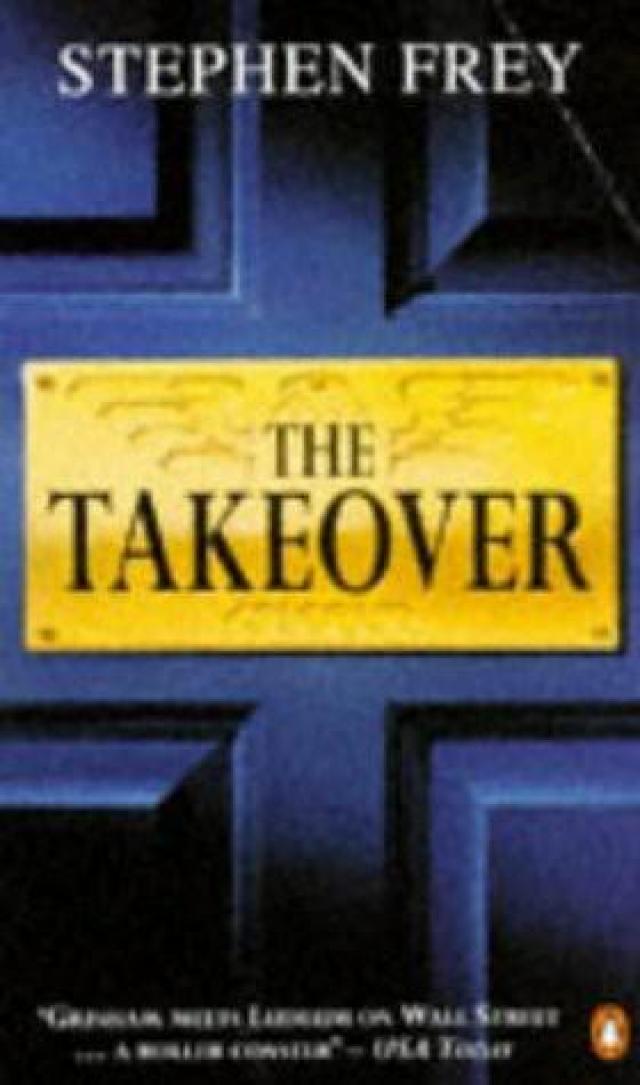


The Takeover [036-4.8]
By: Stephen W. Frey
Synopsis:
A hotshot investment banker is about to organize the largest corporate takeover the world has ever seen in this New York Times bestseller.
But there's more than meets the eye to this megadeal, and he soon finds himself caught in a web of political intrigue and murder--a web spun by a powerful secret society who will stop at nothing to change the course of history.
DUTTON Published by the Penguin Group Penguin Books USA Inc 375
Hudson Street, New York, New York 10014, U.S.A. Penguin Books Ltd, 27
Wrights Lane, London W8 5TZ, England Penguin Books Australia Ltd, Ringwood, Victoria, Australia Penguin Books Canada Ltd, 10 Alcorn Avenue, Toronto, Ontario, Canada M4V 3132 Penguin Books (N.Z.) Ltd, 182-190 Wairau Road, Auckland 10, New Zealand Penguin Books Ltd, Registered Offices: Harmondsworth, Middlesex, England First published by Dutton, an imprint of Dutton Signet, a division of Penguin Books USA Inc. Distributed in Canada by McClelland & Stewart Inc. First Printing, August, 1995
Copyright, 1995 All rights reserved
Printed in the United States of America Set in Janson Designed by Julian Hamer PUBLISHER'S NOTE This is a work of fiction. Names, characters, places, and incidents either are the products of the author's imagination or are used fictitiously, and any resemblance to actual persons, living or dead, events, or locales is entirely coincidental.
Without limiting the rights under copyright reserved above, no part of this publication may be reproduced, stored in or introduced into a retrieval system, or transmitted, in any form, or by any means (electronic, mechanical, photocopying, recording, or otherwise), without the prior written permission of both the copyright owner and the above publisher of this book.
This book is printed on acid-free paper.
For my wife, Lil, and our daughters, Christina and Ashley.
You mean so much to me.
PROLOGUE February 1992
Life was good. Andrew Falcon was about to come into a tremendous amount of money - he hoped. Only fifteen months before, he had become the youngest partner in the 142-year history of Winthrop, Hawkins & Company, Wall Street's oldest and most prestigious investment-banking firm. He inhaled deeply from the Macanudo cigar, leaned back in his wing chair, and blew thick smoke gently toward the high ceiling of the Racquet Club, the staid New York City gentlemen's establishment.
Typically, he didn't smoke a cigar, but tonight it tasted good.
Falcon's head was spinning. The annual partners' dinner-his first, since last year had been his first as a partner-was four hours old. He had enjoyed several Glenlivet cocktails prior to the meal and a bottle of cabernet with his filet mignon. Now he noticed the white-gloved waiters beginning to uncork magnum bottles of Dom Perignon.
It would take several minutes for the waiters to serve all seventy-six partners, and Andrew needed to maintain his stonecalm composure. In a very short time the annual bonuses would be distributed, and the anticipation was gut-wrenching. This wasn't the corporate "ten thousand dollars and a pat on the back" bonus. This was real money, investment-banking money. Falcon reached for the snifter of cognac standing before him on the linen tablecloth.
The tables were arranged so that they formed a large U shape in the dimly lit, mahogany-panelled room. The chairman and most senior partner, E. Granville Winthrop IV, great-greatgrandson of the firm's founder-and a direct descendant of the Massachusetts Bay Colony's first governor-sat at the head of the arrangement. The other partners were seated on either side of Winthrop according to their tenure with the firm. The most tenured of the partners sat immediately to Granville's left and right and so on away from him as the individual's length of service to the firm decreased.
Falcon sat at one end of the U, directly across the room from Roland Thompson. Thompson was a thin, Waspish-looking man of thirty-eight who, even though his eyesight was 20120, wore tortoiseshell glasses.
Thompson had made partner two years ago. Almost overnight he had guided Winthrop, Hawkins to the top of the convertible-debt league tables. This year, however, it was rumored among the partners that Thompson had made some very bad trades and lost the firm a great deal of money. But only Granville, the four other members of the Management Committee, and Thompson knew for certain. Losses in specific groups of Winthrop, Hawkins were not disclosed to the partners. Of course, that did not stop them from speculating among one another. Andrew noted that Thompson had become drunk early in the evening. He also noted that no one seemed eager to speak with Thompson during cocktails. Now the man was so intoxicated his head was almost resting on the table.
Thompson's group was not the only area of the firm rumored to be bleeding. Revenues for the Fixed Income and Equity Underwriting divisions, two of the firm's flagship units, were supposed to be below the healthy numbers of previous years. Origination, underwriting, and trading figures in those groups were all off. Off as a result of what the President of the United States termed economic stability-slow but steady growth. And what the investment bankers called anemia. They didn't like slow and steady. They needed volatility to generate their huge profits. And there hadn't been much of that lately. Andrew puffed on the cigar. Perhaps he should not expect so much from this dinner.
Falcon glanced toward the head of the table. Granville was smiling in his restrained, guarded way at something one of the other senior partners was saying. It was the same way Granville smiled at any piece of information, be it good, bad, or indifferent. Andrew scrutinized Winthrop's face, but there was no way to determine anything about the bonuses from that visage. Granville was the consummate "I" banker, as investment bankers were called in Street parlance. His face never revealed his feelings. Because you could lose a deal that way.
Andrew relaxed into the comfortable chair, grinning. Granville acted differently away from Wall Street. As a rule, he didn't become overly friendly with others at the firm, but he had made an exception in Falcon's case. In the past four years, Andrew had become an increasingly frequent weekend guest at Winthrop's sprawling, oceanfront East Hampton estate-weekends Falcon wasn't putting together another multimillion-dollar deal. There Andrew had learned of Granville's personal side. He had learned of Granville's love of Thoroughbred racehorses-of which he kept four at the grounds' stables; of his prized antique gun collection; and of his huge yacht. They would sail all day with a crew of ten, then return at sunset to a delicious dinner prepared and served by the estate's staff. After dinner Andrew and Granville would retire to the mansion's venerable study to break open a bottle of hundred-year-old Scotch and discuss business and politics.
They would talk for hours, and Falcon would commit to memory any shred of advice Granville imparted. "What's so goddamn funny?"
Falcon turned. The speaker was Jim Kunkowski, the partner who headed Winthrop, Hawkins' interest-rate swaps desk. The s1nile faded from Falcon's face. "Nothing." It was the first word Falcon had said to Kunkowski despite sitting next to him for the past two hours. But that was investment banking. There were stories of men sharing offices for years and saying nothing to each other. They were there to make money.
That was all.
Kunkowski was not a pleasant man. His temper was legendary, and it was no secret that people in his group despised him. But until this past year he had earned a great deal of money for the firm, so no one could complain about him openly. Making money was the bottom line at Winthrop, Hawkins, and he had been producing. But this year Kunkowski had lost a great deal of money, and the sharks were circling.
"Nothing." Andrew said the word again quietly and turned away.
Falcon relaxed into the chair and closed his eyes. The Mergers & Acquisitions Group, the most profitable area of Winthrop, Hawkins, and the one in which he labored fourteen hours a day, was also seeing a decline in income. But Falcon was not worried about his position, even though other investment-banking firms were laying off M&A specialists in droves. The senior people at Winthrop, Hawkins loved him.
Granville Winthrop had made that clear just yesterday when they met in the senior partner's ornate office on the tenth floor of the firm's headquarters at 72 Wall Street. The two had laughed about the fact that Granville's office was on the tenth floor and not higher in the skyscraper, because the tenth floor was as high as New York City's fire-engine ladders could reach. And in the next breath Granville had showered Falcon with compliments. "Despite the difficult times," Granville had said, "you doubled your fee generation this year. You originated several important and visible transactions and brought a number of new, highprofile clients into the firm. We are all proud of you. Keep up the good work." Andrew could still hear the words.
There should be no need for Falcon to worry about his bonus. It ought to be at least fifty thousand dollars more than the two-hundred-and-fifty-thousand-dollar bonus he had earned last year as a vice president. But with the firm potentially performing poorly, Falcon realized that the compliments in Granville's office might have been intended to take the place of a good deal of this year's bonus.
And he needed the money terribly. Somehow last year's two hundred and fifty thousand dollars was gone, despite being supplemented by his hundred-thousand-dollar annual salary.
Falcon opened his eyes and took another sip of the cognac. Did he have the fortitude to pull off what he was planning? Would he follow through on his convictions? Perhaps, even if the bonus was not what he hoped, he should remain conservative.
As the last glass of champagne was poured, Granville Wi
He moved stiffly toward a slightly raised podium in one corner of the room, pausing several times to bend down and whisper to some of the older partners seated near him. They treated him like royalty, several of them standing as he approached, nodding nervously at everything he said.
Falcon glanced about the room. The all-male partnershipthere had never been a female partner at Winthrop, Hawkinscontinued to speak to one another, but the noise level of the room subsided significantly as the men pretended not to notice Granville approach the podium.
The partnership was about to learn just how poorly the firm had performed this year, and they were nervous. A tremendous tension pervaded the large room, a tension Falcon could not sense, this being his first partners' dinner. Normally the men would be in a raucous mood by now, intoxicated not only by the liquor but also by the prospect of the money they knew they were about to receive. But this was the first time in many years that profits were rumored to be down.
And though the majority of the partnership was unaware of the extent to which earnings had declined, they were certain, as a result of hushed, private conversations in the firm's rest rooms, in lonely conference rooms, and at secluded lunches away from Wall Street, that profits were definitely down.
Now each man was to find out how the Management Committee-the ruling body of the world's premier investment banktruly perceived him as an individual. Those who were in favor would probably still receive strong bonuses even if they or their areas had not performed well, because for whatever reason they were liked. Because they had the correct last name, or the right country club membership, or a trophy wife who had been subtly made available to one of the Management Committee this past year.
Those who weren't in favor would likely receive nothing. It was called the "Sanction" at Winthrop, Hawkins. No bonus whatsoever. It meant that the Management Committee had determined you to be undesirable and wanted you gone. They waited until the economy was down to clean house. That way they could blame the denial of bonus on difficult times. But in reality, they did it because they didn't like you. They did it to send a message. And the message was: Get out.
There was always enough money to go around at Winthrop, Hawkins.
The Sanction had last been delivered in 1981, over a decade ago. And while it was true that no bonus would be distributed to a man receiving the Sanction, the firm would buy back his partnership interest immediately, at full value-which meant millions, even on an after-tax basis. The pain of the Sanction was not so much financial as psychological. It meant the world's elite no longer wanted to associate with you; that for whatever reason, you did not measure up.
And everyone in Wall Street's exclusive club would know.
Granville reached the podium. Andrew leaned forward and watched as the silver-haired senior partner painfully lifted himself to the lectern.
Granville always struggled when he walked. His right leg had been torn apart by a sniper's bullet in Korea and had never healed properly, or so the story went.
He adjusted the small, gold-plated spotlight on the podium, then extracted a pair of half-lens reading glasses from his tuxedo jacket pocket and balanced them on his thin, patrician nose. As if on cue, the room fell silent. Conversations were abandoned in mid-sentence.
Suddenly, Granville thrust his champagne glass into the air.
"Gentlemen, I bid you a prosperous new year!" As one, the men slammed their shoes on the floor and champagne glasses in hand, rose from their seats. "Here, here!" The voices rose in unison, filling the great room.
Several of the partners glanced at Falcon to see if he had been caught unaware of the tradition. But he had risen exactly at the proper moment. The tradition was not to be revealed outside the room, but Andrew hadn't missed a beat. It was a good sign. It meant that their newest partner was adept at obtaining inside information, which in the long run could only mean greater profits for the partnership.
To these men, inside information was only illegal at the SEC. It was an essential part of the business. A risk you ran. Andrew would never tell anyone that Granville Winthrop himself had disclosed the protocol yesterday in his office, because one never disclosed his source of inside information. That was the law. "Mr. President, would you please give the partnership a synopsis of the financial results of Winthrop, Hawkins & Company for the fiscal year ended December thirty-first?" "Yes, Mr. Chairman," Ben Weingarten answered from his positiOn to the right of the chair Granville had vacated.
The partnership, resplendent in identical black tuxedos and studded white dress shirts, still thrusting champagne glasses aloft, held its collective breath. Falcon could almost hear the men's hearts pounding.
Weingarten read from an ancient leather-bound notebook. His voice was full and clear. "Mr. Chairman, for the year ended December thirty-first the partnership earned, before any employee incentive distributions, five hundred seventy-four million dollars, a six-percent decrease from last year."
Five hundred seventy-four million dollars! Falcon could not believe it. He performed several quick calculations. The figure worked out to well over seven million dollars per partner. And this was a down year.
Even if the five members of the Management Committee appropriated twenty percent of the profits for themselves and set aside another fifteen percent for all of the other nonpartner employee bonuses, almost three hundred and seventy-five million remained. That was still close to five million dollars for each of the non-Management Committee partners.
Income figures were never released to anyone but the men in this room, Winthrop, Hawkins's accountants, and the Internal Revenue Service. It was one of Wall Street's last great secrets. Despite all his efforts, Falcon had been unable to access this information in his years as a nonpartner. Now that he knew, he was astounded. Perhaps he needed to rethink his decision.
The partnership seemed to exhale a collective sigh of relief.
Profits were down but not as significantly as they had anticipated.
Perhaps there would be no bloodshed after all. "Thank you, Mr. President." Winthrop paused as he surveyed the men before him. "To your good health, gentlemen." The senior partner brought the glass to his lips and continued to drink until the pale golden liquid was completely consumed.
The rest of the partnership followed suit, every man standing until the last glass was empty. Then the men sat and waited as the white-gloved attendants refilled the glasses. "Fellow partners, I will not take a great deal of your time tonight. I know that you are much more interested in the contents of what lies beside me than in what I have to say"-Winthrop gestured toward the seventy-six sealed envelopes stacked neatly on a sterling silver tray atop a stand next to the podium-"but I feel compelled to say a few words before I distribute the envelopes."
The partnership shifted uncomfortably in its seats. There was an ominous tone to Granville's voice. "As you all have just heard, profits were down this year. And remember"-Winthrop paused for effect-"your personal cash flow will be cut significantly because of the high tax rates on the so-called wealthy the new administration has been able to ramrod through Congress."
The appropriate grumble rippled through the room at the mention of high taxes.
Winthrop continued. "Still, the profit decrease is an unacceptable development, even in the face of a difficult economy. A completely unacceptable development."
Here it came. The partners were suddenly on the edge of their seats again, particularly the middle-aged men who had experienced the last cleansing in 1981. Six men had received the Sanction that year. "In addition to the decline in profits, we had other extraordinary cash needs. We completed the renovation of our offices. We installed several state-of-the-art computer systems. And we purchased the money-management firm of Bates, Hilger in July. And since we decided, as a firm, not to allow any of Bates, Hilger's senior managers to become partners here at Winthrop, Hawkins, we were forced to pay the purchase price completely in cash. In the long run that acquisition will pay off handsomely for us. We should thank our newest partner, Mr. Falcon, for initiating and negotiating the purchase on our behalf." Granville nodded in Andrew's direction.