

Her Lost Words, page 1


Praise for
Her Lost Words
“A stunning homage to two legendary women writers. . . . Stephanie Marie Thornton’s ability to bring historical women to life for the reader is unparalleled as she chronicles their passions, struggles, and legacy with impeccable research and emotional resonance. An extraordinary read!”
—Chanel Cleeton, New York Times bestselling author of Our Last Days in Barcelona
“Beautifully crafted, spellbinding, heartbreaking. . . . This novel is a masterpiece I won’t forget, an ode to motherhood, to love, and to two brilliant women who changed the world with their words. One of the best historical fiction books of the year, and one that I’ll be thinking about for a long time to come.”
—Kristin Harmel, New York Times bestselling author of The Forest of Vanishing Stars
“Stephanie Thornton delivers a stunning historical fiction with lyrical prose and vivid description. . . . Set amid a cast of literary names we all recognize and love, Her Lost Words is sure to be a reader favorite.”
—Madeline Martin, New York Times bestselling author of The Librarian Spy
“Thornton’s prose sparkles with wit and wisdom about literature, romance, and family. The Marys are heroines for their time and ours, remarkable women with independent hearts and minds, true inspirations to anyone who dreams of making the world a better place.”
—Kerri Maher, national bestselling author of The Paris Bookseller
“One would be hard-pressed to find two stronger or more significant female writers, and both are brought to life with elegant prose and wisdom.”
—Renée Rosen, USA Today bestselling author of The Social Graces
“Immersive, elegant, engaging. . . . Readers will savor the details of this fascinating account of the making of two brave, brilliant women—mother and daughter—who defy the odds as authors and early feminists.”
—Heather Webb, USA Today bestselling author of Strangers in the Night
“A vibrant, immersive portrait of two brilliant women! Both highlights as well as humanizes the Marys’ extraordinary achievements. A timely inspiration.”
—Evie Dunmore, USA Today bestselling author of Portrait of a Scotsman
“Thornton grips our hearts with prose on love and loss, grief and survival, and the power of art and expression to heal our very souls. An extremely moving and enlightening novel that is an absolute must-read!”
—Eliza Knight, USA Today bestselling author of The Mayfair Bookshop
“An extraordinary work of historical fiction, weaving together the journeys of two brilliant thinkers and writers who lived and wrote with a daring that was centuries ahead of their time.”
—Christine Wells, author of Sisters of the Resistance
“Stephanie Marie Thornton doesn’t merely breathe life into Mary Wollstonecraft and her daughter Mary Shelley, she brings them blazing onto the page. . . . This masterful narrative is hard to put down.”
—Janie Chang, bestselling author of Dragon Springs Road and The Library of Legends
Praise for the novels of Stephanie Marie Thornton
“Thornton is a rare talent who always pairs fast-paced writing with excellent research.”
—Stephanie Dray, New York Times bestselling author of The Women of Chateau Lafayette
“Take a firecracker of a plot and add to it the true story of a female double agent and the result is one explosive and unforgettable story.”
—Natasha Lester, New York Times bestselling author of The Paris Seamstress
“And They Called It Camelot is the book club pick of the year. Stephanie Marie Thornton brings an American icon to life: Jackie the debutante, the First Lady, the survivor who at last becomes the heroine of her own story.”
—Kate Quinn, New York Times bestselling author of The Diamond Eye
“Thornton harnesses her immense talent for historical fiction and combines it with a biographer’s immersive research to create a rich portrait that is both intimate and thoughtful while also wildly addictive.”
—Steven Rowley, author of The Guncle
“Stephanie Marie Thornton has compellingly and sympathetically humanized an American icon. Well researched and beautifully written, And They Called It Camelot is compulsively readable historical fiction!”
—Laura Kamoie, New York Times bestselling coauthor of My Dear Hamilton
“Students of history will appreciate Thornton’s exacting research and convincing portrayal of the First Lady and style icon, and Kennedy aficionados will feel as if they have an unparalleled access to Camelot. Thornton’s magnificent portrayal of Onassis will delight fans of Kennedy-related fiction.”
—Publishers Weekly (starred review)
“A sumptuous, propulsive, scandal-filled peek behind the curtain of American royalty. Thornton gives the reader a fascinating look at the masks worn by those who live in the public life.”
—Erika Robuck, national bestselling author of The Invisible Woman
“As juicy and enlightening as a page in Meghan Markle’s diary.”
—InStyle
WRITING AS STEPHANIE MARIE THORNTON
American Princess
And They Called It Camelot
A Most Clever Girl
Her Lost Words
WRITING AS STEPHANIE THORNTON
The Secret History
Daughter of the Gods
The Tiger Queens
The Conqueror’s Wife
COLLABORATIONS
A Song of War
BERKLEY
An imprint of Penguin Random House LLC
penguinrandomhouse.com
Copyright © 2023 by Stephanie Thornton
Readers Guide copyright © 2023 by Stephanie Thornton
Penguin Random House supports copyright. Copyright fuels creativity, encourages diverse voices, promotes free speech, and creates a vibrant culture. Thank you for buying an authorized edition of this book and for complying with copyright laws by not reproducing, scanning, or distributing any part of it in any form without permission. You are supporting writers and allowing Penguin Random House to continue to publish books for every reader.
BERKLEY and the BERKLEY & B colophon are registered trademarks of Penguin Random House LLC.
Library of Congress Cataloging-in-Publication Data
Names: Thornton, Stephanie, 1980– author.
Title: Her lost words: a novel of Mary Wollstonecraft and Mary Shelley /
Stephanie Marie Thornton.
Description: First edition. | New York: Berkley, 2023.
Identifiers: LCCN 2022034436 (print) | LCCN 2022034437 (ebook) |
ISBN 9780593198421 (trade paperback) | ISBN 9780593198438 (ebook)
Subjects: LCSH: Wollstonecraft, Mary, 1759-1797—Fiction. | Shelley, Mary
Wollstonecraft, 1797-1851—Fiction. | LCGFT: Biographical fiction. | Novels.
Classification: LCC PS3620.H7847 H47 2023 (print) | LCC PS3620.H7847 (ebook) |
DDC 813/.6—dc23/eng/20220725
LC record available at https://lccn.loc.gov/2022034436
LC ebook record available at https://lccn.loc.gov/2022034437
First Edition: March 2023
Cover design by Lisa Amoroso
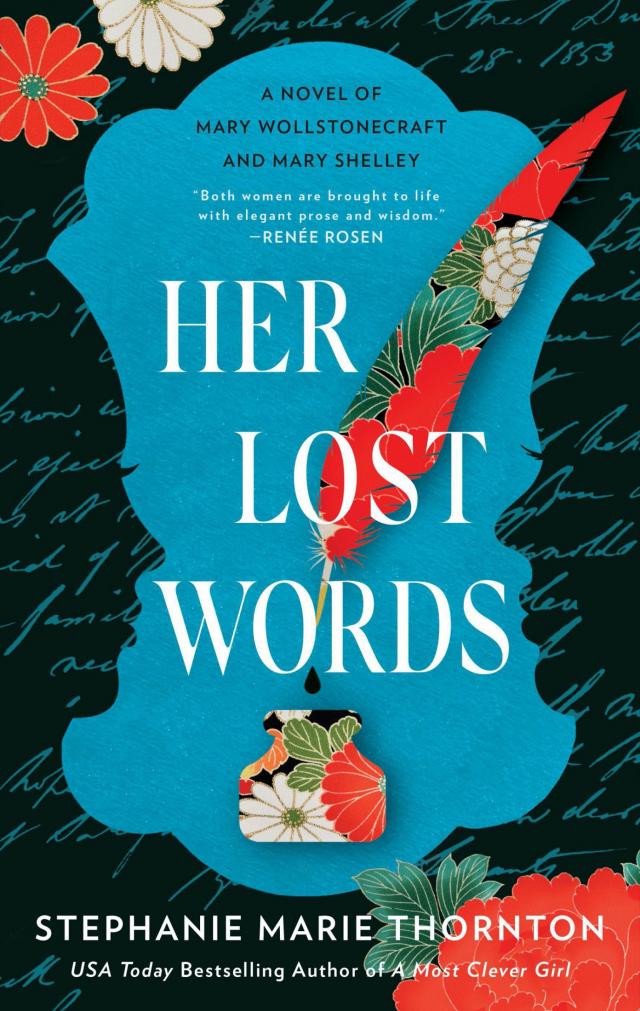
Cover images: (flowers) Yagi Studio / Getty Images; (quill and inkwell) Big Ryan / Getty Images; (letter) Roy Wylam / Alamy Stock Photo
Book design by Nancy Resnick, adapted for ebook by Kelly Brennan
This is a work of fiction. Apart from the well-known historical figures and actual people, events, and locales that figure in the narrative, all other characters are products of the author’s imagination and are not to be construed as real. Any resemblance to persons, living or dead, is entirely coincidental. Where real-life historical persons appear, the situations, incidents, and dialogues concerning those persons are not intended to change the entirely fictional nature of the work.
pid_prh_6.0_142922427_c0_r0
Contents
Cover
Praise for Stephanie Marie Thornton
Books by Stephanie Marie Thornton
Title Page
Copyright
Dedication
Epigraph
Dear Reader Letter
Prologue
Chapter 1
Chapter 2
Chapter 3
Chapter 4
Chapter 5
Chapter 6
Chapter 7
Chapter 8
Chapter 9
Chapter 10
Chapter 11
Chapter 12
Chapter 13
Chapter 14
Chapter 15
Chapter 16
Chapter 17
Chapter 18
Chapter 19
Epilogue
Closing Quote
Author’s Note
Recommended Reading
Readers Guide
Questions for Discussion
About the Author
To my fearsome kraken of an agent,
Kevan Lyon
For her passionate and unwavering support of women writers
I do not wish [women] to have power over men, but over themselves.
Mary Wollstonecraft, A Vindicati
The memory of my mother has always been the pride and delight of my life.
Mary Shelley
London, December 11, 1800
My Dear Reader,
The past has not been kind to women. Those who strayed from the prescribed path and dared make a name for themselves were branded as witches or traitors, harlots or madwomen. And yet, despite all this, some women still dared. They dared to dream and hope and imagine and create.
We owe them a magnificent debt. Instead, we have been content to let these inconvenient women disappear.
History is shadowy even at recording broad strokes of important women’s lives—the dates of their births, their schooling or lack thereof, the titles of their written works, their first loves, and the names of all their progeny. We know that Cleopatra fled at Actium and we can still read Queen Elizabeth’s speech from Tilbury, but we may only guess at these women’s deepest anxieties and wonder what monsters kept them awake at night. We possess the frailest skeleton of history but have lost the person.
Be warned that the pages herein lay bare woman’s loathsome fears and scandalous dreams, searing romances and heartbreaking tragedies. At the time they occurred, these scandals threatened to drown those involved. Times will not have changed so much as to render these affairs mundane, but remember that some bold woman was the first to imagine that a girl might be educated in the same manner as her brother, that a wife and husband might be equals in their own home and before the law, or that the ideas conceived in the mind of a woman were as worthy as those dreamed by a man.
The pages that follow are filled with the hopes of a better world. To the benefit of all women.
With affection,
M. G.
PROLOGUE
February 1775
MARY WOLLSTONECRAFT
I yearned to disappear.
It had been two days since I’d last eaten and still longer since I’d bathed, but those were inconsequential trifles at this moment. Huddled in the corner of Hoxton’s cold stone church, I grimaced at the poppy-blossom spatters of blood that now speckled the muddy hem of my threadbare muslin dress. I thought about my mother cowering on the scuffed wooden floorboards of our drafty front hall, her front tooth chipped and lower lip leaking blood. The weak winter sunlight had illuminated her like a fallen angel when she had turned toward me, her eyes pleading with me to run. Then my father had clutched her auburn hair with one fist, the other poised to land yet another blow.
“Stop!” I had yelled in a rush of breath. “Stop!”
“Shut your mouth,” my father had growled, his breath reeking of gin as it had since he’d squandered the last shilling of his ten-thousand-pound inheritance. “Shut your mouth or I’ll shut it for you.”
But then I was on him, biting and hissing and clawing, anything to have dragged him away from my mother.
The mess of her blood and broken teeth had been the last thing I saw before he raised his fist again. Then my world exploded.
When I’d come to, everything had changed. With one eye swollen shut and my ears still ringing with my mother’s urging to go, I’d run out of the house as fast as my feet would carry me, as if ravens had nipped at my heels and torn at the very threads of my soul. I ran as if I could escape this hell.
I told myself I was running toward a better life.
The howling winds brought me back to the present. The mild winter temperatures had plummeted and my fingers cracked and bled, the victims of my incessant picking at them as I worried over what to do next. It was a rare stroke of luck that Reverend Clare made a habit of leaving the Hoxton church door unlocked; otherwise I’d already be frozen stiff.
The recent horrors I’d experienced were still circling my ravaged mind when the reverend’s wife found me curled in one of the front pews on that second morning.
“Jesus, Mary, and Joseph!” She clutched one hand over her heart as she peered down at me. The candle in her hand lit her up like a kindly seraphim, one with dimples and graying hair at her temples. “Who have we here?”
“No one so exalted, I’m afraid. Just plain Mary Wollstonecraft.” My mouth felt as if it had been packed with wool as I rubbed my eyes, then winced at the throbbing pain rooted somewhere deep within my left eye socket.
“It is you, Mary.” Mrs. Clare frowned as she touched her candle to those on the simple wooden altar. “What in heaven’s name are you doing here at this hour?”
“Praying.”
It wasn’t truly a lie. Over the past two days I’d prayed for many things—a cure for my father, a new life for my mother, and a way to make everything better. Essentially, I’d prayed to rewrite the entire history of my fifteen-year-old life. Or to find a new one.
“Well, we could all use a little more prayer in our lives.” Mrs. Clare held up the altar candelabra and offered her customary warm smile. Then she gasped.
It took a moment to remember that I must look an absolute fright. “I tripped,” I mumbled, feeling my body cave in on itself: chin down, shoulders forward, arms clasped around my middle.
As if I might truly disappear.
Mrs. Clare hesitated, but I could tell her mind was churning from how her gleaming eyes darted to and from my face, like curious little minnows. We’d lived in Hoxton only a few months—this decaying village north of London claimed three crumbling insane asylums that rang at all hours with the screams of the unfortunate inmates locked within—but kindly Mrs. Clare slipped me a new book to read every Sunday: Voltaire, Diderot, Rousseau. I wanted her to like me, but today I desperately needed her not to send me back to my father’s house. “A nasty fall, to be sure,” she said, as if mulling over each word. “Does your mother know you’re here?”
I shook my head, ever so slowly.
“Well, you’ll catch your death of a cold,” she announced. “Follow me.”
I merely stared until she turned at the entrance, arms akimbo as she cleared her throat. “Do you usually dawdle?”
With downcast eyes, I hustled after Mrs. Clare, and breathed a sigh of relief when she opened the door to the rectory instead of leading me down the weed-choked lane to my father’s house. “Miss Wollstonecraft is joining us for luncheon today,” she announced matter-of-factly to Reverend Clare through the open door of his first-floor study. The reverend merely gave a distracted wave. He was a tougher needle to thread than his good-natured wife, given that I’d only ever heard him speak during his long-winded Sunday sermons. In fact, he so rarely left the rectory that I’d once heard him boast that he’d owned the one same pair of shoes for fourteen years. That might have been the case, but as I followed Mrs. Clare into a room down the hall, I discovered the one thing that the Clares did not scrimp on.
Books.
Beautiful, wonderful books.
The Clare library was merely a back room on the bottom floor, but it was crammed from floor to ceiling with all manner of volumes. Fat books, thin books, some freshly leather bound, and others so aged they looked ready to crumble at the slightest touch. I could feel a difference even in the air of that room, as if it were somehow heavier, weighed down by all that knowledge.
I thought of how glorious it would be to curl up here in the sunshine and spend an entire afternoon immersed in reading. Except this wasn’t my house, and that sort of honeysuckle fantasy would never come true, certainly not for a girl like me, whose earliest memory was of my father hanging our family dog during a drunken rage. Not even my fist pressed against my lips could stifle the tears that stung my eyes then.
Mrs. Clare glanced my way, hesitating before thumbing through a shelf. “Sometimes, the Lord sends us challenges, to test our mettle and forge iron into our bones.” Her delicate fingers flitted over several titles before finally pulling one from its shelf. “Reverend Clare and I hoped to be blessed by a passel of children, but our Heavenly Father had other plans for us. Thus, we transformed this room into a library.” She handed the volume to me and closed my fingers over the embossed letters on the front. I expected the Bible, but it was Locke’s An Essay Concerning Human Understanding. “Words have the power to transform us, Mary. They can lift us from our grief. The ideas they form can even offer humanity the hope for a better future.”


