Night of Power, page 1
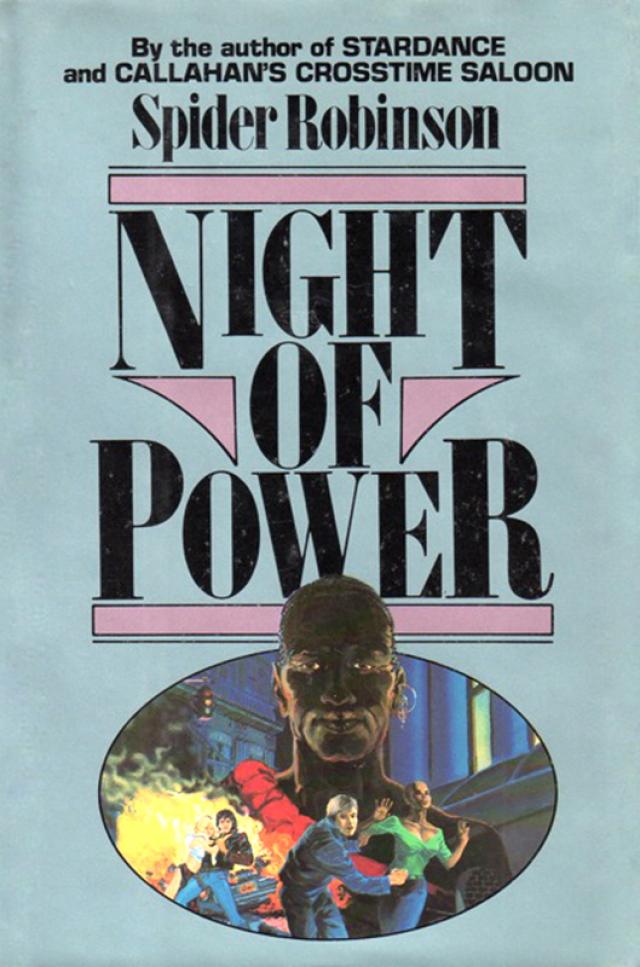


The year: 1996. The place: a New York City torn by racial tension and ripe for rebellion. In this frighteningly prophetic novel Spider Robinson—a multiple Hugo and Nebula Award winner—postulates a near future in which black Americans at long last demand what is theirs…and have the power to take it. Their weapons are high technology and careful planning; their soldiers well trained and sworn to secrecy. And their plans are unsuspected…until the Night of Power.
Caught in the middle of the insurrection are Russell and Dena Grant, and their daughter Jennifer, a 13-year-old whose genius-level I.Q. saves her life more than once after insurrection breaks out. As an interracial couple, the Grants are scorned by both blacks and whites. They face the problems every couple does—but the Night of Power becomes the ultimate test, of their loyalty to each other and to their separate races.
“Spider has written a very courageous novel in NIGHT OF POWER. He ‘tells it like it is’—or like it will be given a continuation of present circumstances—without pulling any punches against blacks or whites. Spider is going to raise a lot of hackles with this one…but perhaps if those hackles are raised now and dealt with now, we will be able to avoid the future he so grimly and graphically depicts.”
— Charles R. Saunders,
author of IMARO
OTHER BOOKS BY SPIDER ROBINSON:
Novels:
TELEMPATH (1976)
STARDANCE (1978) with Jeanne Robinson
MINDKILLER (1982)
Collections:
CALLAHAN’S CROSSTIME SALOON (1977)
ANTINOMY (1980)
TIME TRAVELERS STRICTLY CASH (1981)
MELANCHOLY ELEPHANTS (1984)
Anthologies:
THE BEST OF ALL POSSIBLE WORLDS (1980)
NIGHT OF POWER
This is a work of fiction. All the characters and events portrayed in this book are fictional, and any resemblance to real people or incidents is purely coincidental.
Copyright © 1985 by Spider Robinson
All rights reserved, including the right to reproduce this book or portions thereof in any form.
A Baen Book
Baen Enterprises
8-10 W. 36th Street
New York, N.Y. 10018
First Baen printing, May 1985
ISBN: 0-671-55944-3
Cover art by David Willson
Library of Congress catalog data
Robinson, Spider.
Night of power.
“A Baen book.”
I. Title.
PS3568.03156N5 1985 813'.54 84-24442
ISBN 0-671-55944-3 (Simon & Schuster)
Printed in the United States of America
Distributed by
SIMON AND SCHUSTER
1230 Avenue of the Americas
New York, N.Y. 10020
ACKNOWLEDGMENTS
Night of Power was written with the assistance of the Canada Council for the Arts, and the Nova Scotia Department of Culture, Recreation & Fitness. Additional invaluable assistance, in the form of time, expertise, research, advice, and/or general support, was given to me by (among others): George Allanson, Susan Allison, Isaac Asimov, Stanley Asimov, Bob Atkinson, Jim Baen, John Bell, Bill and Sue Bittner, Ben Bova, Kathy and Tom Cullem, Patrick Doherty, Robert A. Heinlein, Don Hutter, Bill Jones, Jack MacRae, Kirby McCauley, Betsy Mitchell, Major H.K. O’Donnell, USMC, Fred Pohl, James V. Robinson, Charles Saunders, Richard Seaver, Fred Ward, and Eleanor Wood. My thanks go to all these individuals and institutions, as well as any I may have omitted. And of course Night of Power, like all my books, could never have existed in anything like its present form without the ongoing love, encouragement and support of my wife Jeanne and my daughter Luanna.
CONTENTS
Chapter One
Chapter Two
Chapter Three
Chapter Four
Chapter Five
Chapter Six
Chapter Seven
Chapter Eight
Chapter Nine
Chapter Ten
CHAPTER ONE
“The infant mortality rate in Central Harlem and the Fort Greene section of Brooklyn is almost double the city rate, and twice as high as the national rate, according to a recent report.
“The report…showed that of every 1,000 babies born in 1980, 27.8 in Central Harlem died and 26.6 in Fort Greene died. The citywide infant mortality rate was 16.1 per 1,000 births compared with 12.5 per 1,000 births nationwide…
“The infant mortality rate for minorities here in 1979 was 68% greater than the rate among white New Yorkers, the report indicated.
“The infant mortality rate is an indicator used to measure the quality of life…”
— Esther Ross, New York Amsterdam News,
August 21, 1982
“In the first years after the [First World] War, 70 black Americans were lynched, many of them still in uniform. Fourteen were burned publicly by white citizens; 11 of them were burned alive. During the ‘Red Summer’ of 1919, there were no fewer than 25 race riots across the country. A riot in the nation’s capital lasted 3 days; in Chicago, 38 people were killed and 537 injured during 13 days of mob rule.”
— C. Eric Lincoln,
The Black Muslims in America
“The white man need expect no more Negro blood to be shed on his behalf…the dying to be done by the black man in the future will be done to make himself free.”
— Marcus Garvey, 1920
“There’s a shitstorm coming.”
— Norman Mailer, The White Negro
* * *
It was, of course, just after they had passed the last exit from the New England Thruway that the car cleared its throat apologetically.
“Ahem. Excuse me,” it said with its usual irritating diffidence. “I will be needing fuel within the next fifty klicks.”
Russell Grant groaned silently; had traffic permitted, he would have rolled his eyes skyward.
“Oh, good,” thirteen-year-old Jennifer said from her niche in the back seat, confirming his worst fear. “I’ve been needing a bathroom for simply klicks.”
“Me too,” Dena agreed before he could speak, and Russell’s dismay increased.
“Sorry, ladies,” he said to both of his passengers and the car. “We just left the land of rest-stops behind. The next toilet you see will be called New York.” And we’ll be lucky to find proper fuel there, he thought to himself; I’ll probably have to reset the carburetor set for gasoline.
“Dad-ee,” Jennifer cried in horror. “Why didn’t you tell me before we passed the exit?”
“For the same reason you didn’t ask me, princess,” he said as patiently as he could. Jennifer required him to explain the obvious considerably less often than might most thirteen-year-olds; consequently he tried to bear her occasional lapses. “Because I didn’t think of it. Sorry.”
“Can’t be helped,” his wife said at once. “We’ll survive, Jennifer. Hang on to it—it’s good exercise.”
Russell almost glanced at Dena, wondering if she meant what he thought she meant. But he preferred not to find out. Besides, the road demanded his full attention. “Get the map for me, would you, hon?”
Dena keyed it to display on her side of the windshield. “We want the Bruckner Expressway, I think. It’ll say either that or ‘Route 278.’”
“Got it.” He liked the way his wife gave directions. Short, clear, accurate. It was one of several thousand things about her that he liked.
“Ahem,” the car said again. “Excuse me. Toll station in one klick. Two dollars U.S.” Dena got out the coins, and he fed them to the toll booth when they reached it. “Welcome to the Empire State,” Jennifer read aloud.
It was as though the invisible border between Connecticut and the State of New York had real, tangible existence; things changed. It began subliminally. The traffic seemed no heavier or more aggressive than it had been since Boston—but the individual cars were older, shabbier, more battle-scarred. Potholes became worse, then more frequent. The sky itself seemed to darken just perceptibly.
But the first change that Russell Grant consciously noticed was the sound. It grew from a hum to a distant rumble, audible even over the sound of traffic and the rush of air through his open window.
The realization of what he was hearing struck him all at once. It was the approach of New York City. The three days’ drive from Halifax, Nova Scotia was nearly over.
Russell was more than ready for the trip to end: his whole body was one large cramp. Above and beyond the physical discomforts, he had for the last eight hundred klicks or so been an uneasy combination of bored silly and scared to death, with absolutely nothing to do except meditate, chat with his wife and daughter, listen to music, watch yellow and white lines whiz at him, and foil the occasional and unpredictable attempt of a homicidal psychopath to kill them all.
But as he realized now how eager he was for this journey to end, Russell realized simultaneously, and for the first time, how little prepared he was to reach his destination. A small voice in his head whispered, you have not thought this thing through. Somehow in the last umpty-hundred klicks of highway narcosis, of jumbled thoughts and boredom, he had neglected to get ready for New York.
It rumbled now on his horizon, approaching at over 100 kph, and heaven help him if he slowed down.
“Damn,” he said, trying to sound cheerful. “I can actually hear the city coming.”
“I can smell it,” Jennifer said grumpily. She was not ready for New York either.
Russell raised the car windows and put the air conditioning on low. “Nonsense. That’s the East River you’re smelling. The smell of the city itself could never penetrate that.”
But his attempt at light humour fell through, because by then they were barreling through the South Bronx, and what was visible to their right struck them all speechless.
“Re-pulse-o!” Jennifer was the first of the three to regain her powers of speech. She was a prodigiously bright and imaginative child; both her father and stepmother had laboured mightily—and successfully—to develop her faculty of empathy; nonetheless, she was thirteen years old. The horror of the South Bronx in the year of Our Lord 1996 was, to her, primarily an aesthetic offense.
“Fuck,” Russell breathed finally. He ordinarily made a point of cussing creatively, but on this occasion invention failed him. “It’s worse than I remember. It’s worse than I read. It’s worse than I imagined.” Russell was forty-eight years old; he had been born in New York, but had not lived there since early adolescence; he had been living in Canada, in the pleasant seaport city of Halifax, for the last twenty-odd years. Aesthetic dismay was a strong component of his own reaction. He was a designer; this was obscenity. But human empathy for the pain implicit in what he was seeing shocked him just as badly.
And there was a third component to his emotional turmoil, represented by the foreground past which he saw the South Bronx. In the background, the burned out cars were black; the burned out buildings were black; the glassless, curtainless windows opened onto a deeper black; the doomed faces seen in some of those windows were mostly black; the few doomed people visible on the streets were black. He saw all this past the hair, the nape and part of the left cheek of his wife, all of which were also black.
Dena’s curly hair was the kind of black that is sometimes called blue black. Her complexion was the deep, glowing black of lightly burnished obsidian, and as she turned her face forward Russell saw that it might as well have been carved out of that volcanic glass.
What must it be like for her? he wondered. His designer’s mind groped for an analogy. Perhaps an American Jew, driving past Dachau in a brand new Ford, while the ovens were still in operation? That made him the Nazi behind the wheel. Dena had been born and raised in Halifax—not in the North Preston ghetto outside Dartmouth, or in the tiny slum district around Gottingen Street, but in the South End of the city. Both of her parents full professors at Dalhousie University, she had been one of the comparative handful of Haligonian blacks who grew up in, and were fully accepted into, white society. Poor blacks were as despised and feared in Halifax as in any other city (although some met with great tolerance in rural Nova Scotia, where everyone was poor), but middle-class blacks fitted in well. Halifax was one of the few remaining cities in North America in which interracial couples—such as Russell and Dena—could walk together anywhere without the slightest paranoia. While no black grew up without an awareness of racism, Dena had throughout her life been subjected to about the absolute minimum of personal contact with it.
Now they were racing together toward the Big Apple.
Tell me again, he said to himself, why this is necessary. Remind me, please.
Okay. Dena is a dancer. Not, Dena dances sometimes, or Dena has done a lot of dancing, or even Dena dearly loves to dance. Dena is a dancer, a Modern dancer. Not a choreographer, a dance maker. Not a particularly good teacher. A dancer. Give her some choreography, put a dance on her, and she will go out there and dance it better than almost anyone on earth, make it live and sing. Dena is a gifted dancer, gifted by God. And God is an Indian giver.
Dena is a thirty-seven-year-old dancer.
The injuries have been coming more frequently, taking longer to heal, healing imperfectly. A normal human being would probably envy Dena her physical conditioning; nonetheless she has no more than one or two good years left. If that long: tomorrow an ankle or a knee could let go, just like that, or that fourth lumbar could decide to start chewing on her sciatic again—and not let up this time. And her old friend Lisa Dann has offered her a chance—one last chance—to dance in New York, and not just in New York but at the Joyce Theatre, the showcase, the worldwide Mecca of Modern dance. The opportunity cannot be passed up…and so the Grant family is entering the combat zone.
Only temporarily, Russell reminded himself. Only for three months. A quick smash-and-grab; hopefully we’ll be in and out before the city notices we’re there.
As if on cue, the skyline of Manhattan appeared on the port bow, shimmering in the heat.
“There it is,” Russell said a little too jovially, glad to end the uneasy silence in the car. “La Grande Pomme.”
“Froky.” Jennifer was impressed. Child-geniuses were even harder to impress than normal thirteen-year-olds—but this was New York.
“Sure looks pretty,” Dena said quietly. (Was there the slightest hint of emphasis on the second word?)
“Just look at the energy being thrown away,” Russell said. “One day they’re going to have to put a Fuller Dome over that town.”
“Yuck,” Dena said as politely as that syllable can be said. “New York is dark enough already.”
“Transparent dome.”
“And how long would it stay transparent over that smog?”
“Hmmm. Touché. But dammit, look at that thing. You couldn’t design a more efficient energy waster—all those hot spires sticking out into ocean breeze, like the biggest radiator in the world. The only thing I can think of that has that much built-in waste is…” His voice trailed off.
Dena waited, then said softly, “Something?”
“Huh. It just came to me. The two most energy-wasteful appliances in the world. Just as stupid, in their own way, as that skyline. Two of the most common appliances in the world—naturally.”
“The stereo and the TV,” Jennifer said at once.
Russell chuckled. “No, princess. The refrigerator and the stove. A fridge spills money on the floor every time you open it. And an oven spills money on the ceiling the same way. Now, if you designed a fridge to lay on its back, like a freezer, and moved the heat-sucker so it wouldn’t be underneath…or if you designed an oven door to roll up like a garage door…”
“The fridge would take up too much room,” Dena said argumentatively. “And it’d be too hard to get at stuff in it.”
“Well, maybe, but suppose you combined the two, the fridge and the stove? Silly to have a heat-maker and a heat-loser side by side, unconnected.”
“I don’t see it. Connect them how?”
He did not answer. He went instead into something as near to a warm creative fog as is possible for a man driving on a New York highway. His women left him alone in it; he did not see the glance they exchanged. The fog lasted through several successive toll booths, all the way through the Bronx and across the Triboro Bridge.
And then he heard Dena’s cry, and looked to his left. “Creeping Jesus!”
The overpass that led to the FDR Drive was down. Russell knew just enough about municipal construction to be certain that it had been dynamited, by a freelancer. That shocked him, but not as badly as the secondary realization that he was now committed to driving his family through Harlem, with a near-empty fuel tank.
Dena was already reading the map display. “Left on Second Avenue.” Traffic was slowing drastically.
“No good. Look.” Second Avenue was sealed off by police barricades. “I’ll try Third.”
“That’s no good either—it’s one-way uptown.”
“Slithering mother of shitcakes and syrup.” Traffic came to a halt, then began a spasmodic crawl.
Jennifer picked up on the sudden increase of tension. “What is it? What’s wrong, Daddy?”
“Nothing, honey,” Dena said. “Just a detour.”
Russell glanced around: no other white motorists were visible anywhere. Belatedly he remembered that the prudent New York driver monitors the radio traffic bulletins. “What’s the next entrance to the FDR south of here?” he asked.
“This map doesn’t say.”
“Great.”
At the beginning of their trip, Russell had physically disabled the car phone, rather than simply switching it off. The symbolic gesture now seemed excessive—to reconnect the phone he would now have to park and open the hood…