

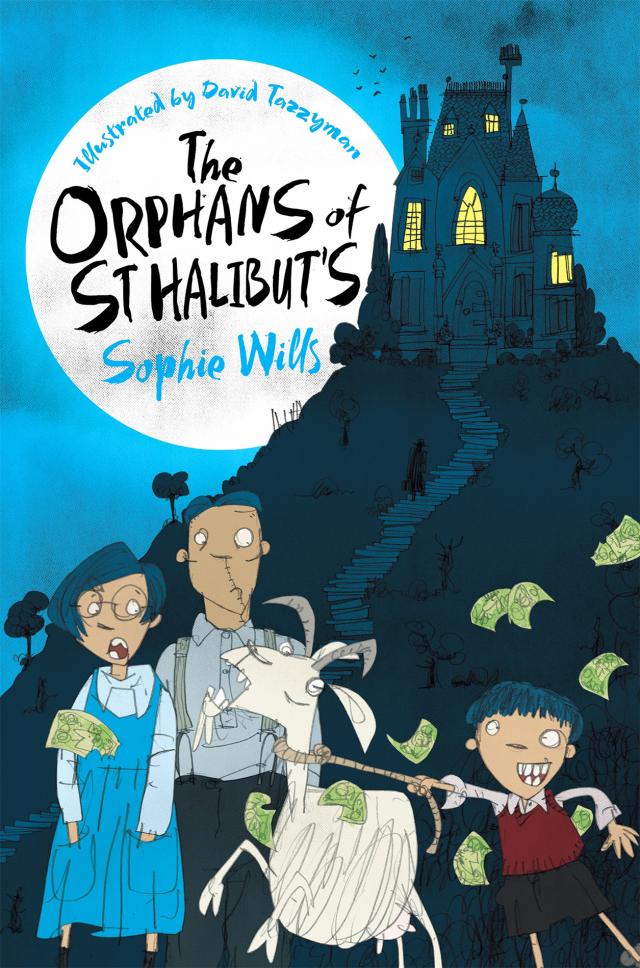
The Orphans of St Halibut's, page 1


For Fraser and Cameron
And in memory of Ken and Jenny Wills
CONTENTS
Prologue
Chapter One
Chapter Two
Chapter Three
Chapter Four
Chapter Five
Chapter Six
Chapter Seven
Chapter Eight
Chapter Nine
Chapter Ten
Chapter Eleven
Chapter Twelve
Chapter Thirteen
Chapter Fourteen
Chapter Fifteen
Chapter Sixteen
Chapter Seventeen
Chapter Eighteen
Chapter Nineteen
Chapter Twenty
Chapter Twenty-One
Chapter Twenty-Two
Chapter Twenty-Three
Chapter Twenty-Four
Chapter Twenty-Five
Chapter Twenty-Six
Chapter Twenty-Seven
Chapter Twenty-Eight
Chapter Twenty-Nine
Chapter Thirty
Chapter Thirty-One
Chapter Thirty-Two
Chapter Thirty-Three
Chapter Thirty-Four
Epilogue
Acknowledgements
When Herc woke up in the middle of the night, his first thought was of the cake, which had already been stolen twice. His second thought – that he had most definitely heard a noise downstairs – should probably have come first, but his brain had firm ideas about what sorts of things were important and there was no point in fighting it.
Something had smashed, and for once it definitely wasn’t his fault.
Herc sat up and looked across the empty rows to the only other occupied bed in the dormitory, where Stef lay snoring, his finger rammed up one nostril as though plugging a leak in his head. Stef had asked Herc several times not to keep waking him in the night unless there was a real emergency. Apparently that didn’t include wondering what the time was, needing a wee, having an itch, not even a nightmare. Herc always felt uneasy in the darkness, seeing those other beds, because they had once contained his friends. It was like sleeping in a room full of ghosts.
He thought about getting Tig, who at twelve was a whole four years older and who would tell him not to be daft in the reassuringly cross way that only a big sister could. But she was all the way down the landing in the other dormitory – the only girl left in a room of what had once been twenty – and the floorboards between them squeaked, so he was afraid to tread on them. He was pretty sure the squeaks had been put there for exactly this reason.
The only other person left in the mansion that he might wake was the matron, Miss Happyday herself, and he didn’t fancy being dangled out of the window by his hair again. Besides, it was she who had stolen the cake for the second time. Although she called it ‘confiscating’ and told him it was going in the bin. What was the point of stealing something if you were just going to throw it away?
The huge cake had been given to him by Ma Yeasty in the bakery, a free treat for her favourite orphans, but he had been robbed as he cradled it carefully home. The thief had been aiming for the whole cake and it was only due to Herc’s whip-like reaction that her grasping hand had plunged through the middle of it instead. The girl had run off with her half-prize while Herc shouted after her, using words that weren’t in any of Miss Happyday’s dictionaries. He didn’t need to follow the trail of crumbs to know where the crook in the yellow uniform lived: St Cod’s. He hoped they’d all choke.
Herc hadn’t even got past the front door of St Halibut’s with the remaining half of the cake. Miss Happyday had spotted it behind his back the moment he’d returned home.
If anyone was going to steal it for a third time it was jolly well going to be him.
His bare feet made no sound on the stairs, and he could very clearly hear more noises below – heavy thuds, as though someone was throwing things around. A burglary? There was a lot of it about down in the town, that was for sure.
Off the back corridor downstairs, the kitchen door stood wide open. The sight that greeted him was devastating. He took in the plate, the two tiny crumbs, the shape of a finger having been swirled in the smear of chocolate icing and, no doubt, licked.
The empty plate confirmed it: now he was even more certain that there must be an intruder. Miss Happyday might have taken the half-cake from him, but she herself would never have eaten it. She was always telling them how unhealthy such things were. Whenever she found the children’s hidden sweets, her eyes would widen in horror. The offending items would disappear into her pockets; he supposed she was too busy to throw them away immediately.
Another noise, a sort of scrabbling; it was coming from the library.
Now that the cake was gone, there was no real reason to hang about downstairs. But Herc had little use for reasons. If it turned out you needed any, you could always make them up afterwards.
He padded past the sour gazes of the wigged portraits in the hallway, and hesitated outside the library door. There was definitely a person in there. Someone was cackling and hiccupping at the same time. The oddest thing was, he recognized the voice, though he’d never heard her laugh before. It couldn’t be . . .
‘Miss Happyday?’
There was no answer. Only more thuds, another hideous cackle, and . . .
‘Oooh ooh ah AHH!’
He frowned. Either the library had a monkey in it, or the matron doing an impression of one.
It struck him that Miss Happyday might not be quite well.
He turned the handle as gently as he could, opened the door a tiny crack, and put his eye to it.
The rows of shelves stretching all the way to the ceiling stood in front of him like giant dominoes. Herc realized he had been quite wrong about Miss Happyday – she was plainly in excellent health. So excellent, in fact, that she was giggling, clinging to an upper shelf a dizzying distance from the ground, her stockinged legs bicycling in mid-air for something to rest on. He could see the path she had used to clamber to her current position, by the empty places where her sensible black boots had kicked books down to the floor.
Drawing in a sharp breath, Herc snapped the door closed again.
If Miss Happyday had taken up gymnastics, anything could happen.
He was just considering what to do about this when a shushing began from beyond the door, very much like the shushing the matron did when the children were breathing too loudly, but the sound grew in volume, as though the tide was coming in. The thuds became more frequent, a hailstorm drumming louder and louder, gathering strength.
Instinctively, Herc took a step back, as the floor under his feet began to shake and windows rattled in their frames. The crystal drops of the chandelier high above him tinkled, and then jangled and clashed. Several paintings fell to the ground behind him. The noise from inside the library was deafening, a thunder roll that echoed through his head and made Herc clap his hands to his ears. An earthquake? Was the whole house about to collapse? Just as suddenly as it had started, the noise began to die down, and then finally all was quiet.
Whatever had happened, it was over.
When he gathered the courage to open the door, it took him a moment to understand what he was seeing. Books. Which was not unusual in itself – this was the library, after all. But they were no longer on their shelves. They filled the room nearly to the top, a few slithering over his feet as the door swung open. Not a single one of the enormous shelves remained standing.
‘Miss Happyday?’ he called. ‘Someone ate the cake you constipated. And, er, some books fell on the floor.’ Silence. ‘It wasn’t me,’ he added automatically.
He peered down at the textbooks covering his feet. There were several volumes of Very Important Words to Learn, a large hardback copy of The Deadly Consequences of Poor Spelling – the matron’s favourite subject – and peeking out from underneath that was The Joy of Fronted Adverbials, its spine crushed and half hanging off, a muddy heel mark on the cover.
Tentatively he reached out and plucked one from the pile. It was another of Miss Happyday’s favourites: Fifty Thousand Little-Known Rules of Grammar (subtitle: You’re Getting It All Wrong). When Herc saw a familiar tightly laced boot revealed underneath it, he felt sure Stef and Tig wouldn’t mind being woken up.
This was no nightmare.
Far from it.
Two months later
Tig stood on the driveway of St Halibut’s Home for Waifs and Strays, watching the dot that was Maisie the postmistress increase in size as it lumbered towards her up the steep, winding path with their mail. As ever, she marvelled at the dedication of the woman who risked a heart attack by climbing all the way up here every time the orphanage had a single item of post, even if it was just a flyer for one of Ma Yeasty’s regular bakery sales (ten per cent off any muffins more than six months old). If it were Tig’s job, she’d let the letters build up for a couple of weeks and then send one of the town kids to deliver them for her, with the promise of a shiny halfpenny. She allowed herself a small smile. It wasn’t as if she was short of halfpennies anymore. And Maisie could keep her job – she, Herc and Stef weren’t ever going to need one. Just as long as they kept their mouths shut.
A chilly breath of wind lifted her hair and cut a shiver down her back. She wrapped her arms closer about her and eyed the fog that had gathered over the woods below. It crouched over the uppermost branches of the trees, its misty fingers stretching out greedily
The town of Sad Sack resembled nothing so much as a splodge of something unpleasant that should have been mopped up but, left to moulder, had eventually evolved its own life forms. The other local orphanage, St Cod’s Home for Ingrates and Wastrels, festered near its centre, its residents feeding off the unguarded pockets of townsfolk like leeches. The bakery, the library, the butcher’s, the pharmacy that sold incense and strange herbal medicines and smelt so thickly perfumed that the air inside the shop was almost solid in your throat – all were crammed into the winding cobbled streets in haphazard rows that looked like they might fall down if you laid a finger on one of them. But it was the huge Mending House next to St Cod’s that dominated everything. Its stone walls formed a square with one missing side; tall iron railings and gates joined the open section, making a courtyard at the front. It squatted fat and menacing, its bleak chimneys casting murky shadows over all who lived there, the darkness seeming to spread from within its very walls. Tig did not like to look at it.
From the town, the grey stone mansion of St Halibut’s looked the same as it always had – she’d made sure of that. It was beautiful in an unwelcoming sort of way. The same theme continued inside – high ceilings and great big sash windows and old paintings of gammon-faced jowly geezers, all designed to suggest that you weren’t really posh enough to gaze upon it, let alone live there. Miss Happyday had floated about inside, the lady of the manor, as though she and the house were both in denial about the fact that it was also home to scruffy orphans. No one ever ascended the rickety stone steps that led up the steep hillside, apart from Maisie, and occasionally Arfur, who described himself as a travelling curiosity salesman, though he neither travelled much, nor sold anything worth being curious about. Tig knew what he really was, of course: a total slimeball.
Both visitors always came on foot, since the route up had not been fit for horse nor carriage for hundreds of years. It took a good twenty minutes to make the climb, even if you were fit and didn’t stop to catch your breath, and the entire path was in full view of the sweeping drive, so the children were always forewarned of any approach. It was much faster on the way down, as Arfur had once demonstrated when he was drop-kicked off the driveway by Miss Happyday.
Today, Maisie’s good-natured face was as rosy as ever from her exertions. She frequently insisted that each delivery might be her last – not, as Tig suspected, because the hill was going to kill her, but because she had big plans to set up her own knitting business. She’d been delivering the mail for more than twenty years, and had been threatening to stop for nineteen of them. She often brought up her spectacularly garish handmade scarves, socks and hats for the orphans, worrying that they were constantly in danger of hypothermia and needed to be wrapped in as many layers as possible.
‘Love letter for your Miss Happyday, no doubt,’ she told Tig with a wink as she handed over a buff envelope.
The ridiculousness of this idea always raised a smile, no matter that it was an old joke now. If ever the matron of St Halibut’s had attracted feelings of love, they’d been vaporized on contact.
‘Haven’t seen her for an age, and it’s just as well, far as I’m concerned, love. Hope she’s not getting you and the other little ones down?’
‘Not at all.’
‘Ghastly, obnoxious woman. Don’t give her my regards, will you?’
‘I won’t,’ Tig promised as usual.
It was true that the matron was both ghastly and obnoxious, but she could be given no regards even if Maisie had wished it. The last thing she’d been given was two months ago, and that was a good, deep burial under the vegetable garden. The children had even chosen a suitable funeral hymn for the graveside, though it had probably never been intended to be sung quite so cheerfully as it was that day.
‘You keep nice and warm now, in this weather. And make sure that little brother of yours wears his socks. That fog is bitter cold,’ Maisie instructed.
Tig shrugged. ‘It won’t bother us up here.’ Very little did, anymore.
The matron’s death in the freak library collapse had been a shock at first, naturally. Herc claimed that the reason all the shelves had fallen on top of her was that she had been climbing them, but he’d clearly made that up. The only other theory was an earthquake, but that seemed just as unlikely. Why she’d even been there in the middle of the night was also a mystery. But before long the orphans had started calling it the Happy Accident, and after the unfortunate woman’s secret funeral, a shadow lifted from St Halibut’s. It was as though for the first time in the children’s lives, the sun had come out, and they had not until that moment realized they had existed in darkness. A week later, they buried all the hated textbooks too, in a grave even deeper than that of Miss Happyday.
Though Tig wasn’t quite the oldest – that was Stef – it was she who, in the first days of chaos after the death of the matron, had pointed out that their survival depended on bringing some tasks back into their lives, and suggested what might need doing. But it would never be like the matron’s old Schedule; on that they were all agreed. No more spelling tests at 5 a.m., no more ‘playtimes’ spent ironing the matron’s knickers and folding them with the help of a ruler and a ten-step diagram.
After some discussion they had decided it would be best not to rely entirely on trips down to Sad Sack for food, and so the vegetable garden was cared for as it had been before, but anything the children now found to be non-essential was ditched. As time went on, that included the reciting of times tables, the study of grammar, the washing of clothes, the using of cutlery, the making of beds, the brushing of hair and the tidying or cleaning of almost anything. Where once there had been a girls’ dormitory and a boys’ dormitory, they now fell asleep wherever took their fancy. After a wild few weeks of dragging their blankets on to window sills, into the porch and under the kitchen table, they had mostly decided beds were more comfortable, though they arranged them at awkward angles just because Miss Happyday would have been enraged to see them that way.
There was one exception to the general lack of rules, and that was that anyone going down to Sad Sack for supplies must look vaguely presentable to avoid arousing suspicion. On no account could any adult have the slightest inkling that all was not as it should be up on the hill. Even those few who seemed friendly, like Maisie, must be kept strictly in the dark. And so a bath would be filled, a comb found, and a grey St Halibut’s uniform scrubbed and pressed for the occasion, holes darned. The school hat – there was only one tattered example remaining, the others having been used variously for catching cricket balls, nesting birds, and in one case, eaten – was donned before finally each mission to Sad Sack could be undertaken. Usually this job fell to Stef.
Stef, at twelve, was large for his age – thickset and taller than some adults – with hair that looked blue-black indoors but turned chestnut in sunlight. A vivid scar ran from just under his nose, across his mouth, down his chin and all the way to his neck. He had arrived as a two-year-old with this injury, after a tragic horse-and-carriage accident in which he was the only survivor. It had been Miss Happyday who had taken out a needle and thread and sewn Stef ’s face back together, resentment seeping from her every pore. ‘Typical of them to give me the blemished ones,’ she had said as she pressed her lips into a thin line, her needle going in and out in a fury, all her frustration sewed into his hot, red, bawling face. ‘At least you’ll never have cause to be vain.’ Like the others, Stef knew nothing of his parents, although he had gathered that neither was from Sad Sack. Complete strangers seemed to have opinions on the matter – he was frequently asked where he was from and what sort of a name Stef was supposed to be, even once when he was standing in the bakery right next to Ma Yeasty, a woman named after a fungus.
Since Miss Happyday’s untimely demise, Stef had been the only one to occasionally take a bath, filling the tub in the matron’s en-suite bathroom with cold water and heating it with a stove of coals that she had fitted at vast expense for her own personal use. Therefore it was usually he who traipsed down to the town and bought meat from the butcher, tins of beans from the grocer, and more importantly the illegal – and expensive – sweets and biscuits that a few shopkeepers kept secretly under the counter, their sugar content being above the government-approved level.





