Chase, page 4
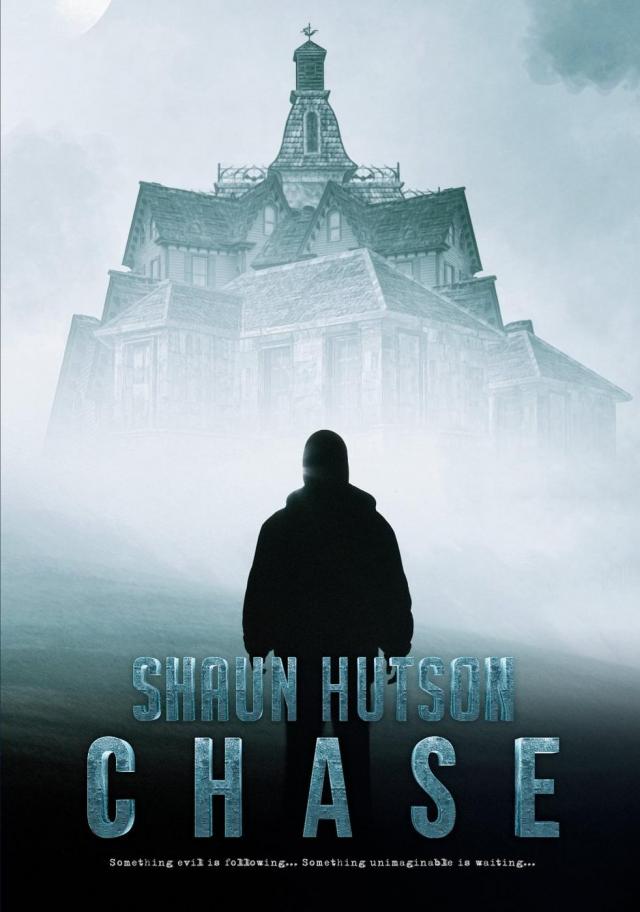


Exactly whose land it stood on no one seemed to know. If the barren patch of earth upon which it stood was the property of anyone then they obviously didn’t care too much about it. Even if anyone had wanted to enter the church, the large wooden planks that had been hammered across its main doors would have prevented that simple act. It remained neglected and forgotten, in time to crumble and rot away just as anything else that had been discarded.
On the other side of the river a large crow sat in the branches of a tree gazing out across the gently flowing water. Finally, it left the branch, rising high into the clear blue sky on its black wings, soaring out over the river and then towards the church on the other side.
It flew high over the church as if some kind of primal instinct were driving it as far from the edifice as possible. Why it flew so high it didn’t know. Why it wanted to avoid the building it had no idea. Some primordial instinct forced it away from any close proximity to the battered building.
Had it swooped lower and closer, it may well have heard the faint sounds coming from the forgotten and dilapidated structure.
EIGHT
Amy Carson sat back from her Mac screen, massaged the bridge of her nose between her thumb and forefinger and blinked myopically. When she looked at the screen again, the image that stared back at her looked no better than it had when she first looked.
It was a mermaid. A generic, cliché of a mermaid. And after the mermaid it would be a rabbit, or a fairy or a puppy or something else excruciatingly cute, probably decorated with sparkles. Amy smiled to herself. That was the way here, everything was pink, sparkly, cute and cuddly. That was the Eskimo way.
Unlike most publishing houses, Eskimo Publishing was situated not within the grimy and noisy confines of a big city like London but in expansive and beautiful countryside. Housed in a converted farm building, it had been in existence for more than fifteen years and had been growing rapidly since it’s foundation. One of the main reasons for its growth was not the quality of the product it delivered but the company’s ability to deliver illustrated books and toys so cheaply. The printing was done in Taiwan or China. The books themselves were usually eight or ten page ‘board books’ aimed at very young children who were going to do little more than chew them when presented with them. A team of editors and designers (of which Amy was one) were from a diverse range of backgrounds, very few of them having previously been in publishing, gathered together every day to hasten through more of the cut-price product that had made Eskimo such a force in children’s publishing.
Amy had been in her current position for the last two years and, despite the fact that the money was poor, it was the relaxed atmosphere and working hours that had appealed to her. The novelty, however, had worn off fairly rapidly. Amy had always wondered how a company, so resolutely determined to crush all creativity within its employees, had managed to flourish but that vexing question was one that she considered less and less these days.
There were strict guidelines that had to be adhered to in order for each book or activity pack to maintain the Eskimo style. Certain colours were anathema (on the orders of the publishing director). Even some words were taboo (on the orders of the publishing director). Words like ‘mischievous’ or ‘naughty’. Words that (on the orders of the publishing director) didn’t sound right. Words that someone, somewhere, might be offended by. Everything had to be safe and predictable. Everything had to be right. Nothing new or original could be attempted for fear that it failed. Cliché was the order of the day. So, work was done within these strictures and restraints and it was all done on budgets and schedules that prevented even the smallest amount of employee input. That was why their turnover of staff was so high.
‘Amy.’
Hearing her name made her jump and she looked up to see who was standing so close to her.
It was Alan Knox, the editorial director. He was wearing his usual practised smile and looking down at her with the kind of expression a lion might wear if it had stumbled on a crippled zebra.
‘Yes, Alan?’ Amy said, trying to inject a little enthusiasm into her voice. Alan liked enthusiasm and positivity. He liked team work. He liked anything that had just come out of the latest management manual.
‘How’s Magical Mermaid coming along?’ Alan asked, moving from one foot to the other as if he was about to spring forward and run a sprint.
‘It’s coming,’ Amy said. ‘It’s not particularly magical at the moment but I’m getting there.’ She pointed at the screen which showed a mermaid (the Magical Mermaid of the title) sitting on a rock beside the sea, gazing wistfully out at the ocean and the gently breaking waves.
‘Not sure about the colour of that seaweed,’ Alan said, pointing at the clump of withered plant that was pictured along the bottom of the illustration. ‘It’s a bit dull. A bit murky.’
‘Shall I try green instead of brown?’ Amy suggested.
Alan sucked air through his teeth and his face showed the kind of expression he might have worn if Amy had suggested inserting a red hot poker into his anus.
‘Not green,’ he winced. ‘Try teal.’
‘Teal? It’s seaweed.’
‘Yes, but Frank doesn’t like green. Teal is more of an upbeat colour.’
Amy raised her eyebrows.
‘Let me know when you’ve done it,’ Alan smiled and walked away towards the nearest desk to Amy’s. ‘Oh, and by the way,’ he added, spinning around and pointing one index finger at her. ‘Don’t forget we’ve got our meeting later.’
Amy nodded sagely and carried on with her work.
There were four pods set up in the large room, each of them peopled by two editors and two designers. It was the duty of these two ‘publishing pairs’ to check the art work and text that was sent into Eskimo by the large numbers of freelancers who actually completed their projects. These freelancers weren’t referred to within the company as writers or artists but as ‘packagers’, something which, Amy thought, spoke volumes about their abilities. Present on Amy’s pod was Carl, who was about thirty but acted as if he was twice that age, and Stephanie who was in her mid-twenties and as irritating as anyone Amy had ever had the misfortune of meeting. Enthusiasm was fine but she ran around the office as if she’d just snorted a kilo of cocaine, washed down with pure caffeine. However, she did suffer from migraines which, Amy thought, was a blessing in disguise because when one struck her it at least shut her up for a couple of hours.
Both she and Carl were editors, or passed for them. They were basically project managers who thought they were creative and defined that creativity by the number of books they worked on and how much they’d contributed to them, although correcting spelling mistakes in an eight page version of HICKORY DICKORY DOCK hardly seemed to qualify as great creativity as far as Amy was concerned.
She glanced at her watch and noticed that it was approaching one p.m. Lunch time. She blinked myopically and yawned.
‘Are we going for a walk?’
The question came from Nicola Gray, the other designer on her pod, who was sitting opposite her.
Amy nodded.
‘I need to clear my head,’ she told Nikki, who was four or five years younger than her. ‘And it looks as if it’s finally stopped raining.’
She glanced towards the large picture windows that afforded views of the countryside and saw that the rain had indeed stopped falling. There were several deep puddles on the ground but there was a long winding driveway that cut across the land surrounding the buildings making up Eskimo publishing, so there would be enough firm ground for them to walk on, Amy thought. She would be glad to get out of the office for an hour.
She always was.
THE INFECTION
COLORADO, USA
The term hypodermic comes from two Greek words meaning beneath the skin.
The man holding the needle in front of him had no idea why this should enter his mind, now of all times.
But it did. He merely sat gazing at the syringe he held as if it were about to impart all the secrets of time and the universe to him. The untold secrets of humanity, creation and evolution all contained within a small plastic syringe, its long hollow needle and the almost clear 50ml of fluid it contained. He smiled to himself.
Fifty millilitres. The measurement might not be correct but the only way he could discover that was by trial and error. How many attempts he would have to make before he finally got the correct measurement was unknown. He hoped that this latest attempt would be more successful.
One hundred millilitres had been too much. Twenty had been too little. Or, had it been the composition of the fluid itself, not the actual amounts that had caused the previous failures? He couldn’t be sure. He knew he had to continue with his work in an attempt to isolate both the correct measurements, and also the correct composition. There were other imponderables too. Even if the amount was right, if the composition was correct and everything else was favourable then perhaps it was the location of the injection that was wrong.
He sucked in a deep breath and gazed more intently at the syringe.
Into a vein or into a muscle?
He shook his head. Did it really make a difference? He had made the last two injections directly into the base of the skull.
On both occasions, the recipient had been dead within an hour.
There had to be a better place to put the needle. Somewhere on the body that would allow swift absorption of the injected liquid but also somewhere that would allow time for the newly introduced substance to adequately reach those parts of the anatomy it needed to reach.
He continued to gaze at the needle, watching as the light glinted on the elegant steel tip. It was a shorter needle than usual and thinner. This would allow easier insertion into the part of the body that he chose.
The man got to his feet and turned towards the other side of the basement.
That was where the child was secured.
Held to a wooden table by a combination of rope and straps, it had not moved much in the last ten minutes. Its struggles had gradually receded since he first brought it down here, as if it realized that fighting against the restraints was pointless. Occasionally it would strain against the straps but, apart from that, the only sound it emitted was a low sob every now and then.
As the man walked across the basement the child began to struggle again, jerking against the straps and ropes for a moment or two as it heard the footsteps approaching. The man slowed his pace, his hand shaking slightly as he lowered the syringe. He knew that the child would scream or shake or try to escape again when it saw the needle.
They always did.
But then, he reasoned, no matter what he did there would be screams and crying and suffering.
That was the way it had to be.
He stood over the child, running appraising eyes over it.
A girl of ten or eleven. She was a pretty little thing. Or she had been at one time. The cuts and sores on her face had negated the dainty beauty he had noticed when he’d first taken her. Her lips were swollen and bloody, cut in several places where she’d chewed through them. The flesh there wasn’t very strong and her teeth had cut easily through the tissue. Her fingernails too were bloodied and broken, from where she had scratched at her own body but also from where she had attempted to escape by clawing at the walls of the small room he’d imprisoned her in shortly after snatching her.
He looked down at the child, regarding her evenly.
She lay still, unaware as yet that he held the syringe. When he raised it into view she began to struggle again, her eyes bulging wide with terror.
And then he realized where the needle must go.
He wondered why he hadn’t thought of it before. The solution seemed so obvious. He leaned over the child using one hand to hold her head steady, then, he brought his other hand up, his thumb already poised over the plunger of the syringe.
The girl tried to scream but the rag that had been secured in her mouth by a length of rope prevented that exhortation.
It was probably just as well.
The man leaned closer and brought the syringe close to her face.
He steadied it and aimed the needle at her eye.
NINE
Amy knocked lightly on the door, waited a second then walked in.
Trying to control the quite irrational nervousness she was feeling, she smiled efficiently and slipped into the room, noticing immediately that there was another figure present too. One she hadn’t been expecting.
Seated behind the desk, Alan Knox waved her in, pointing to the small wooden chair that had been placed opposite him.
To Knox’s right sat the individual Amy hadn’t expected to see.
Carla Sheringham was in her early thirties and head of Eskimo’s HR department. She was an attractive woman who towered above most of the other staff in the organisation, her three-inch heels boosting her already considerable height to close to six feet. Fortunately, she was sitting down now and Amy also sat, exchanging brief pleasantries with Carla who had her iPad before her and occasionally tapped at the screen for reasons best known to herself.
‘Carla’s going to sit in on our little chat,’ Knox said.
‘Am I getting the sack?’ Amy asked, trying to smile. ‘Usually HR only turn up when someone’s getting the sack.’
‘We don’t use that word, Amy,’ Carla interjected, smiling and raising her hand to her mouth.
‘Well, whichever word you use,’ Amy went on. ‘Am I getting it?’
‘As you know,’ Knox continued. ‘Eskimo has recently been purchased by a major American company and, inevitably, there may be some staffing issues. Stream-lining that’s been requested by the new owners.’
‘Cuts in staff,’ Amy offered.
‘Possibly,’ Knox conceded. ‘We don’t know yet but we just wanted to make people aware.’
‘There could be changes here and they might affect the levels of staff required,’ Carla added.
‘And I could be one of the ones losing their jobs?’ Amy asked.
‘No, no, no,’ Knox said, waving a hand before him as if he was trying to clear the air of a bad smell. ‘No decisions have been made. We’re just allowing people to prepare for the possibility. Just giving them the heads-up.’ He smiled.
Amy nodded.
‘These new owners are looking for a specific kind of employee,’ Carla added. ‘They’re very community minded.’
‘Meaning?’ Amy asked.
‘We see ourselves as a big family here at Eskimo,’ Carla went on.
Amy sighed, wearily.
‘We work hard together and we play hard together,’ Carla went on.
‘The social side of the company is nearly as important as the business side,’ Knox added. ‘That’s why so many social events are organised by Carla and her department.’
‘But you don’t come to many of the staff social events do you, Amy?’ Carla said looking devastated. ‘You didn’t come to the Christmas Party or the barbecue, did you?’
‘And you don’t come to the end of month pub lunches,’ Knox intoned.
‘And you didn’t come ice skating last month either, did you?’ Carla added, sadly.
‘I have things to do outside work you know,’ Amy said. ‘Most of the staff in there are younger, they don’t seem to have any interests outside work and the people they work with. I have a husband and a child.’
‘I’ve got a family too, Amy,’ Knox chimed in. ‘But I find time to join in. I have a son called Corrado, you know.’
Amy ignored the temptation to tell Knox that was his problem. Anyone who named a child Corrado needed a slap as far as Amy was concerned.
‘I’ve heard you mention him,’ she said. ‘Once or twice.’
If he caught the sarcasm in her voice, Knox didn’t comment on it.
‘So, you can understand the concerns we have,’ Knox went on. ‘It’s important to interact with your colleagues out of work as well as in it.’
‘Why?’ Amy said, flatly.
‘To foster the feeling of one-ness,’ Knox told her, a smug grin on his face.
‘I come to work to earn money, not to make friends,’ Amy announced. ‘I have friends outside work. Friends I’ve chosen, not ones that the company thinks I should have.’
Carla and Knox both looked suitably distraught. They glanced at each other then at Amy almost apologetically.
‘Well,’ Knox said. ‘We’ve told you the situation.’
‘So you’re threatening me with the sack if I don’t socialise more?’ Amy told him. ‘That’s about the size of it isn’t it?’
‘No, no, no, not at all,’ Knox went on. ‘I like you Amy, I want to help you. I’m just telling you the way it is. The company that purchased Eskimo is very keen on a community spirit.’
‘And any staff who don’t toe the line are out, is that it?’ Amy said.
‘It isn’t like that,’ Knox told her, a self-satisfied smile on his face. ‘They’re already planning a summer party at the home of the new Managing Director. There’ll be a special marquee erected in his garden and it’ll give employees from here and from the parent company the chance to mingle. We’re all expected to attend.’
‘Why?’ Amy wanted to know. ‘So he can show off his big house and remind us all we’ll never earn that much money?’
‘That’s a very negative attitude, Amy,’ Carla murmured, a look of displeasure on her face.
‘I’ll go and sit on the naughty step shall I?’ Amy retorted, shaking her head.
‘It’s important to have a good work stroke leisure balance,’ Knox told her.
‘I agree,’ Amy offered. ‘But I prefer my leisure time away from the people I work with.’
‘All the staff here can bring a guest to the summer party,’ Carla added. ‘The new company will pay for accommodation over that weekend.’
‘My husband hates socialising even more than I do,’ Amy chuckled.