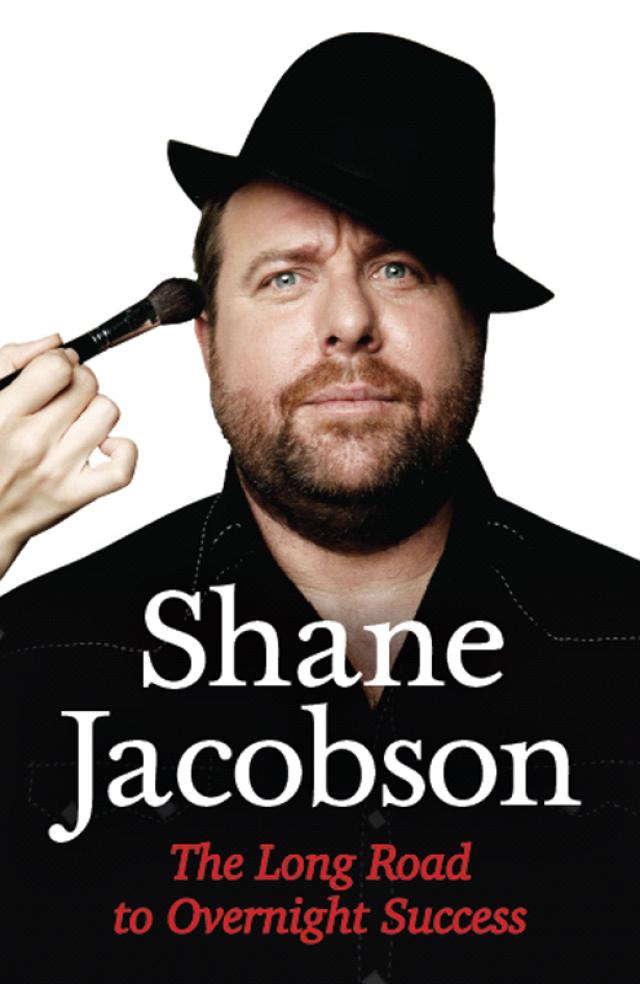
The Long Road to Overnight Success, page 20


If I’m presenting at an awards night or I’m MC at an event, I ad-lib a lot and I am very much in the moment. When I go up to the lectern they have a thing called autocue with the words I’m meant to say showing on a screen. But I’m not necessarily going to stick to those words because I have no idea where my brain is going to take me. Once I get to a mic I never really know what’s about to fall out of my mouth. That frees me up, and I think that’s the secret. My brain very rarely lets me down; we have a lot of fun together. I could probably sit on my own in a room and burst into laughter every now and then at a thought I’ve had. I’m not sure everyone else can do that.
Theatre and filming are different, of course, but being in the moment comes in with both of them too. If you’re doing a scene with another actor and you’re supposed to be arguing with them, say, you have words that are delivered to you in the form of a script. Once you’ve learned those words you have to repeat them in front of a room full of other people, but more than that, you’ve got to live them in the moment. You have to tell yourself, ‘Now I’m having an argument with this person,’ or ‘I’m telling this person that I love them and they mean the world to me.’ You’ve got to imagine yourself in that space. When I’m doing a scene I tend to do what I would do in real life in that moment — no filters, whatever feels right at the time. I’m an animated person, so I use my hands and move around a lot, and that’s just me, the way I am.
That capacity to be in the moment was tested to the limits when I was filming the Beaconsfield telemovie.
Clay had long wanted to do a movie about the Beaconsfield mine disaster: he was intrigued by the story of the world converging on a quiet little town like Beaconsfield. In a town like that, if a tourist walks down the main street everyone around them knows they are a tourist because everyone else in town knows each other and they all know that person is the only new thing in town that day. Then in 2006, a small earthquake triggered a rock fall at the Beaconsfield gold mine, and suddenly the entire world was looking at Beaconsfield through a magnifying glass. Not only were the people of Beaconsfield going through something completely outside their experience, they all knew the men who were caught in that mine, as well as the people who were risking their lives to save them. Three men were trapped down there: Larry Knight, Brant Webb and Todd Russell. Brant and Todd were trapped for just over two weeks before they were rescued. Larry Knight didn’t come out of that mine alive, so now a woman is without a husband, their children are without a father, a family is without a son, miners are without a mate. As in all deaths, the ripples go wider and farther than the immediate waters.
When the Beaconsfield tragedy happened, people said they could see a resemblance between me and Todd Russell. I was often told, ‘Whenever they get around to making a movie about this, with your goatee you’re a lay-down misère to play Todd Russell.’
As it turned out, Southern Star and Channel 9 asked me to audition for a telemovie about Beaconsfield. I met Glendyn Ivin, the director, and found out he wanted me to audition for the part of Brant Webb. After talking with my agent I said to Glendyn, ‘Look, if the part you want me to play is Brant Webb, I’m going to turn it down. I’ve only ever imagined myself playing Todd Russell, so I don’t think I can get my head around the idea of playing Brant Webb.’
It took a while, but Natasha Harrison, an agent who was working with my agency at the time, talked me into it. I had to re-read the entire script and imagine myself as Brant Webb. In the end I said yes. To this very day I’m so glad I got a chance to do it because it was one of the most challenging roles I’ve ever had to play, and certainly the most moving. It was the first time I had been asked to play a real person, someone I had actually met, a man who had endured an inconceivable fourteen days of hell.
As I worked through the script I was able to ring Brant and talk to him about each and every moment and how he felt. One day I asked him, ‘If I was only allowed to ask you one question about being trapped in that mine and you were only allowed to give me one answer, what would be the one thing you would want to tell me?’
‘That I thought I was going to die every single second I was in that mine,’ he replied.
Hearing him describe the pain, the fear and the horror of every moment he was down there, the responsibility to tell this story well started to weigh on me. It had become more than acting. It was as if I was being handed a piece of Australian history and being asked to do more than look after it; I was being asked to recreate it. If someone said to me, ‘Here are Tutankhamun’s jewels, lock them away safely,’ I could do that. But we were being asked to rebuild them perfectly. And this wasn’t some artefact, these were human lives.
Being in the moment and imagining each one of those occurrences was the most emotionally draining thing I’ve ever had to do in my time in entertainment. In my mind, Lachy Hulme (as Todd) and I were showing what it was like to be trapped a kilometre underground with razor-sharp rocks hanging over us. People think that Brant and Todd were in a cage with a roof over it, but in fact they were on an open metal pallet with some side walls, and the rocks over their heads were just wedged together like a bundle of knives waiting to fall.
It was an incredible situation for Brant and Todd. In one scene we were talking about missing our children and saying goodbye to our families and I threw myself into it and dug deep into my emotions. When we finished filming, the director came over and said, ‘That was wonderful, but you were crying so much it was hard to understand the dialogue.’
People often say about an extreme experience, ‘I can only imagine what it would be like.’ Now I had imagined what Brant and Todd had been through and as difficult and heart-wrenching as that was, I knew that imagining it didn’t come anywhere near the reality.
When filming was complete we had a special screening at a cinema in Melbourne for the cast, the director and the production team. I sat beside Brant Webb and his wife, Rachel, and Todd and Caroline Russell. For the first time in my life I watched an entire movie next to the very person that I was playing. When it was over I saw Brant’s hand start to move towards me and I honestly thought, ‘I can’t believe it — he’s going to slap me, he thinks it’s that bad.’ In fact he was reaching across to shake my hand. ‘Well done, mate, well done. It’s great,’ he said.
I doubt that any other critique of my work will mean more to me than having the man whom I’d just played in a project like Beaconsfield shake my hand and say, ‘Well done.’
The one question I always get asked about Top Gear is whether it’s the dream job. It is. It’s someone else’s cars and someone else’s insurance, but it’s my hands and my feet and my fun and my time, and I get paid for it, so it really is the dream job.
The opportunity to be part of Top Gear came when I was invited to have lunch with some Channel 9 executives to celebrate completion of filming on a show that, as it so happens, never went to air. One of the station executives was saying she had just come back from England after doing a deal with Top Gear to produce the Australian version of the show.
There’s a segment on the English show called A Star in a Reasonably Priced Car. A celebrity comes on as a guest, the host Jeremy Clarkson interviews them, then they show footage of a lap the guest has done around a racetrack in a fairly standard car. I assumed Channel 9 had already cast their presenters for the Australian show, but I offered to be one of those guests when the show came to Australia. ‘Oh, do you like cars?’ the executive asked me.
‘Yeah, I own a few cars’ — at the latest count I owned seven of them — ‘and I raced at the Grand Prix Celebrity Challenge a couple of years back.’
‘Great! So you must have your CAMS licence as well as a normal road licence?’ she asked.
‘Well, yes, and I’ve got my motorbike licence — I used to race my motorbike on amateur days at Phillip Island racetrack, as well as racing amateur rally when I was younger. Then I’ve got licences for car, bus, heavy rigid and articulated semitrailer, scissor lift, boom lift, fork lift, jet ski, boat — pretty much anything that goes, I’ve got a licence to drive it.’
‘Well, we should have a chat with the executive producer of Top Gear and arrange a meeting,’ they said. I thought they were being very thorough, going to this kind of effort for the Star in a Reasonably Priced Car segment. But when I went to have breakfast with the executive producer it turned out that they actually wanted to chat to me about being the host. Before you knew it the job was offered to me and I was hosting Top Gear Australia alongside Steve Pizzati and Ewen Page, two terrific blokes who are now friends for life.
Apart from asking me whether it is the dream job, the other question people ask is, is it dangerous? Well, yes, and sometimes the dangers come from unexpected quarters. To kick off the series we went to England and filmed a special. We met with Jeremy Clarkson, James May and Richard Hammond, the three hosts of Top Gear UK, and they set us a series of challenges. One of them involved driving through the Knowsley Safari Park near Liverpool, where they have all sorts of animals: lions, rhinos, baboons. All of the visitors go through in their cars, but the difference for us was that we had to make sure the animals showed some interest in us, so the producers hung pieces of raw meat off the edge of my car, just out of sight of the cameras. That drew the attention of the lions. Then the producers scattered cashews around our cars in the baboon area and that got them interested. The baboons took a particularly strong interest in Steve, who was driving a Triumph TR-7 with a soft roof. Before we went through we had to screw chicken wire into the roof of his car to strengthen it, but the baboons pulled the chicken wire off and tried to get in. Steve made a very wise decision to drive out of the baboon area before one of them became the world’s most unwanted passenger. Then we went through the rhino and water buffalo area, where they were as interested in us as Keith Richards is in politics.
We were then presented with three identical cars called Peel P50s, the smallest cars in the world. They are literally one-seat cars with Perspex windows and a small electric motor that achieves a speed slightly faster than the walking pace of an elderly person the week before their hip operation. In these toy-like cars we had to go back through the same enclosures: the lions, the baboons, the rhinos, past some buffalos and a herd of bongos — a type of deer with massive horns that don’t make them look so dear at all.
The lions were used to hearing engines run and scenting an automobile’s petrol smell, but these little cars were electric so they were quiet, and they didn’t have that fuel smell. And they were tiny: I literally had to squat down to get in mine and I had a great deal of trouble getting out of it. When I’d driven through in a normal car with raw meat hanging off it, the lions had shown a bit of interest but they were very calm. When we went in driving the Peels, the lions clearly thought we were three predators trying to sneak up on them. At that point they became very, very interested in us indeed. The cars were red, so with me jammed inside the tiny vehicle, it looked like a meat-filled jaffa. They started surrounding us. I couldn’t see behind me, but a lion had got between me and Steve and Ewen. I kept going forward, but on my two-way radio I could hear one of the park officials saying in his bright and proper English accent, ‘For goodness’ sake, do not separate from each other.’ When he started to swear into the speaker, I figured this really wasn’t going to plan.
The park managers brought some four-wheel-drives in to drive alongside us and move us through. Once we were out of the enclosure and they commented that things had got a bit tricky, I thought, ‘Okay, I’m glad I survived that.’
That was as bad as it was going to get, I figured. Now we’ve just got to go in with the baboons. We drove in and immediately it was clear the baboons thought we were fascinating little targets. They jumped on the cars and started tearing bits off them. One leapt up on the front of my car and pressed his backside against the window. At the best of times a baboon’s backside looks like a handful of mince in a Glad bag, so that was pretty much unmissable. Clearly this baboon had seen some of my earlier work and decided to give me his critique.
On my left-hand side there was a very angry baboon exposing its teeth and growling at me. It grabbed the handle of the door but couldn’t immediately figure out which direction to turn it. Peel P50s don’t have locks on the doors, so I had to grab the handle and hold it shut — but not look down at the handle because baboons are smart animals and this one would realise it was on to something. So I grabbed the handle and looked the other way. As I looked out the right window I could see a baboon that clearly had no problem with my earlier work. He liked me far more than the guy with his backside on the front window and wasn’t as angry as the baboon working on the handle over on the left-hand side. In fact, the baboon on the right side of the car liked me a lot and was extremely busy showing me just how much.
This was getting a bit out of control, so we moved on from there. The next enclosure we had to go into was the rhino enclosure. When we made Kenny’s World we filmed a segment about the rhinos at the Werribee Open Range Zoo in Victoria. The segment didn’t make it into the final series but in the process of filming we learned a lot about rhinos, including the fact that they have incredibly bad eyesight but amazing hearing, and their sense of smell is something like 600 times keener than that of a dog (if that figure is wrong, then just trust me — it’s very, very good). They can smell even a small quantity of testosterone from a very long distance. At the zoo they keep the male rhinos entertained by putting female rhino poo in a bowling ball drilled with holes. The male rhino smells it, gets excited and comes over and plays with that bowling ball, which is the only thing that is strong enough to survive the weight of a rhino playing with it.
Knowing all these things didn’t help to steady my nerves as we drove our Peels into the rhino enclosure. There was a mother rhino in there with her young, and just like the lions, she thought we looked like predators sneaking up on her, with the added complication that she couldn’t really see what we were. We startled her so she swung around to assess us with her bad eyesight. Things went wrong very quickly then and on the radio we heard our English mate saying, ‘Do not move, do not move.’ We had to sit motionless in our cars for two or three minutes while the rhino rocked back and forth right in front of Steve Pizzati’s car, figuring out whether she was going to kill us or not. When the park officials felt she had stayed steady for long enough, they told us to drive off and go around her. It was without a doubt the most terrifying experience I’ve ever had in my life. I’ve bungee jumped from sixteen storeys off a tower in Las Vegas; I’ve ridden motorbikes at over 260 kilometres an hour; I’ve skidded sideways through forests in rally cars; I’ve spun a race car backwards off a track at well over 200 kilometres an hour; I’ve even said no to my dad once. None of those was even close to the fear that I felt looking into this rhino’s eyes and wondering whether she was going to kill us or let us go.
After facing death by rhino filming that first episode of Top Gear Australia in England, we came back to Australia and for two years on and off I worked on Top Gear. It was another moment when my dreams, my hobbies, my profession and my career all came together.
One of the problems with working on the show, though, was that orphans in the shape of automobiles kept following me home. It’s a habit I have. After I finished work on Charlie & Boots, I purchased one of the HJ Kingswoods we used in the film and an HQ Holden ute. On Top Gear Australia, we featured a Celica rally car that I purchased, then for another story there was a 1976 Kombi Campervan that we didn’t end up using, but I bought that. I built up quite a collection of automobile orphans.
For a couple of years I had a ball travelling all over Australia as well as New Zealand and England, driving all sorts of cars. I got behind the wheel of a Ginnetta F400, an E-type Jag, a seven-litre supercharged Blue Meanie Commodore, an Audi R8 Spyder, an FPV Falcon, a Supercar called a Redback Spyder, and a Lamborghini Gallardo that the owner let me thrash around a racetrack because he wanted me to have a go at his car — to name a few. Then an opportunity came to host Top Gear Live, the arena show, in Australia, with Jeremy Clarkson and James May. Channel 9 flew me to Ireland to do a story about it, which would also give me a chance to see the show. But because I was reporting, filming behind the scenes and doing interviews backstage, I didn’t get to sit down and watch the show from start to finish, or to take notes and really absorb it.
Top Gear Live came to Australia a few months later, starting off in Brisbane. I met up with Jeremy and James on the Gold Coast and we stayed at Palazzo Versace. We needed to work up some additional script to modify the show for Australia and to write some script for me. Apparently the Versace wasn’t quite conducive to script meetings, so one morning we went down to the wharf and got on an enormous multi-million-dollar super yacht. ‘We’re going to have a bite to eat, run through your lines and have a chat about the show,’ the assistant told me. The yacht set sail and we spent a few hours going through some lines and ideas. ‘Are you guys ready to go and see the venue and do a mic check?’ the assistant asked us after a couple of hours. We all agreed that was a good idea, so one of the crew spoke into a radio; minutes later a helicopter landed on the top deck. Jeremy, James and I hopped in and flew to the venue, where a golf cart picked us up to take us the last 150 metres to the stage door. Inside the venue, all the stunt drivers and lighting guys and producers and the sound team were working hard on getting everything set up for the show. Jeremy, James and I spent a few minutes doing a sound check, then when everyone was happy with that Jeremy said, ‘Great, we’ve got the rest of the day off — let’s go back to the boat, go for a swim, take a rest, and have a few drinks.’