

Weird World War: China, page 1


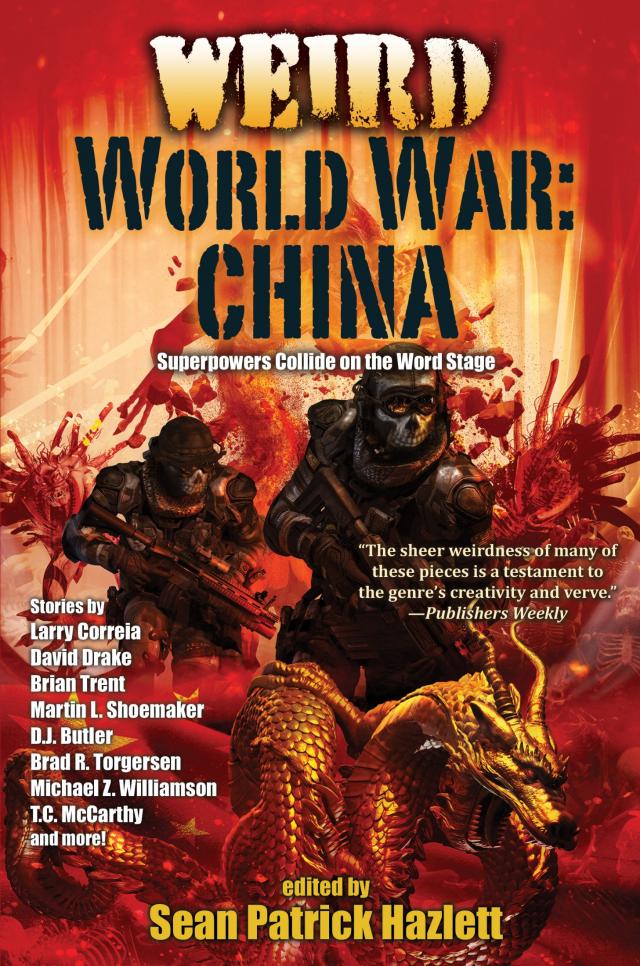
Table of Contents
Dedication
PREFACE
ELDRITCH OPS
LURKING DEATH
EMPTY YOUR CUP, OR DRY IT?
FLAWED EVOLUTION
LUNAR ASYLUM
RICOCHET
THE GREYHOUND’S GAMBIT
PROJECT BLACKWORM
THE VIRUS DUET
THE MIDNIGHT HORDE
RADIOAKTIVITÄT
SP1K3
THE KEEPER
TUNNEL VISION
DO DRAGONS TEXT?
SCION OF THE SOUTHERN CROSS
THE LAST OHIO
IT TAKES TIME TO GROW
DISPATCHES FROM KREDO
DUPLICATE
ABOUT THE AUTHORS
ABOUT THE EDITOR
Baen
Weird World War: China
Edited by Sean Patrick Hazlett
When the United States and China clash, the world will never be the same, especially when forces beyond reality threaten to intervene.
What if the United States went to war with the People’s Republic of China? How would these rivals fight for supremacy on land, sea, air, and across the stochastic streams of time? What wonder weapons would be unleashed? What horrors would emerge from the eradiated sludge of the South China Sea? What heroes would rise and forever change the course of history? Tread into the deepest and darkest dimensions of the multiverse, gaze through a kaleidoscope of fractured realities, and bear witness to the disturbing visions of World War III from today’s greatest minds in science fiction, fantasy, and horror.
Stories by: Larry Correia, Steve Diamond, David Drake, Nick Mamatas, Brian Trent, Martin L. Shoemaker, Blaine L. Pardoe, Kevin Andrew Murphy, Julian Michael Carver, D.J. Butler, David J. West, Sean Patrick Hazlett, Deborah A. Wolf, Stephen Lawson, Erica L. Satifka, Rob McMonigal, Brenda Clough, Kevin Ikenberry, Brad R. Torgersen, T.C. McCarthy, Nadia Bulkin, Freddy Costello & Michael Z. Williamson.
BAEN BOOKS
edited by
SEAN PATRICK HAZLETT
Weird World War III
Weird World War IV
Weird World War: China
WEIRD WORLD WAR: CHINA
This is a work of fiction. All the characters and events portrayed in this book are fictional, and any resemblance to real people or incidents is purely coincidental.
Copyright © 2024 Sean Patrick Hazlett
“Preface” © 2024 by Sean Patrick Hazlett; “Eldritch Ops” © 2024 by Larry Correia and Steve Diamond; “Lurking Death” © 2024 by David Drake; “Empty Your Cup, Or Dry It? ” © 2024 by Nick Mamatas; “Flawed Evolution” © 2024 by Brian Trent; “Lunar Asylum” © 2024 by Martin L. Shoemaker; “Richochet” © 2024 by Blaine L. Pardoe; “They Greyhound’s Gambit” © 2024 by Kevin Andrew Murphy; “Project Blackworm” © 2024 by Julian Michael Carver; “The Virus Duet” © 2024 by D.J. Butler; “The Midnight Horde” © 2024 by David J. West; “Radioaktivität” © 2024 by Sean Patrick Hazlett; “SP1K3” © 2024 by Deborah A. Wolf; “The Keeper” © 2024 by Stephen Lawson; “Tunnel Vision” © 2024 by Erica L. Satifka and Rob McMonigal; “Do Dragons Text?” © 2024 by Brenda Clough; “Scion of the Southern Cross” © 2024 by Kevin Ikenberry; “The Last Ohio” © 2024 by Brad R. Torgersen; “It Takes Time to Grow” © 2024 by T.C. McCarthy; “Dispatches from Kredo” © 2024 by Nadia Bulkin; “Duplicate” © 2024 by Freddy Costello and Michael Z. Williamson.
All rights reserved, including the right to reproduce this book or portions thereof in any form.
A Baen Books Original
Baen Publishing Enterprises
P.O. Box 1403
Riverdale, NY 10471
www.baen.com
ISBN: 978-1-9821-9314-0
EISBN: 978-1-62579-946-3
Cover art by Kurt Miller
First printing, January 2024
Distributed by Simon & Schuster
1230 Avenue of the Americas
New York, NY 10020
Library of Congress Cataloging-in-Publication Data: TK
Printed in the United States of America
Electronic version by Baen Books
www.baen.com
10 9 8 7 6 5 4 3 2 1
Dedication
This volume is dedicated to three people who’ve made a difference in my life. They aren’t the only ones who’ve made an impact—there are far too many to list here—but they have all passed on and deserve to be remembered for their many contributions to humanity.
The first person is my brother-in-arms, Captain Ralph J. Harting III (1976–2005), who rode honorably with the Blackhorse in the sands of Mesopotamia. You sacrificed your life so others could live. One day, I will share a pint with you at Fiddler’s Green where cavalrymen rest forever. Allons!
The second is Mike Resnick, who passed in early 2020. A legend in the genre, Mike always made a point of giving back to the science fiction and fantasy community by taking new writers and editors under his wing. I consider myself one of his “writer children” as do several of the authors in this anthology. I owe a great deal of my publishing success to his mentorship and support. Mike’s advice and encouragement were instrumental in bringing this project to life. Without his guidance, this anthology and the two that preceded it would not have been possible. Fare thee well, old friend.
The third is former Secretary of Defense Ashton B. Carter (1954–2022), whom I consider to be a mentor and the smartest person I’ve ever met. As my thesis advisor and boss at the Stanford-Harvard Preventive Defense Project, he taught me everything I know about international security strategy. Without his keen stewardship of the Nunn-Lugar Program to denuclearize Belarus, Kazakhstan, and Ukraine, as well as to stabilize the remaining Soviet nuclear arsenal in the wake of that empire’s collapse, the world would’ve been a far more dangerous place. He also designed and executed the DOD’s strategic pivot to the Asia-Pacific region, a topic that is highly relevant to the subject matter of this volume. Farewell, my friend. The world will be a less secure place without you.
PREFACE
Sean Patrick Hazlett
The term “Thucydides’ Trap” has often been used to characterize the evolving relationship between the United States and China. The phrase describes a situation where an emerging power threatens to displace a dominant one. It harkens back to a time when the rise of Athens and the Spartan fear of that rise made the Peloponnesian War inevitable. Whether China’s ascent truly represents a Thucydides’ Trap, it is fairly obvious that the United States and China are currently on a collision course.
In late October 2022, China’s ruling Communist Party awarded President Xi Jinping an unprecedented third five-year term as general secretary, eschewing a tradition of a two-term limit established since the death of Mao Zedong, the last leader to rule China for more than a decade.
Xi’s break with custom is an ominous sign of things to come for China. The elevation of Xi and the increased concentration of power in his hands have almost certainly increased the likelihood of future conflict. His calls for faster military development and defense of China’s interests abroad, as well as retrograde notions of a return to the past “glories” of Mao’s China are concerning. As I write this, the people of China are bravely resisting an oppressive lockdown in major cities like Beijing, Shanghai, Wuhan, and Chengdu, among others, to protest the country’s zero COVID policy at a time when the rest of the world has long since returned to some semblance of normality.
His crackdown on Chinese entrepreneurs and shift backward toward a state-controlled economy could be especially damaging, particularly for a country that has one of the fastest-growing ageing populations in the world. According to the World Health Organization, 28 percent of China’s population—an estimated 402 million people—will be over age sixty by 2040. With a proportionally declining labor force, that rapid growth will require an adaptable approach to support this demographic shift; an approach that will challenge a China hamstrung by an inflexible and corrupt economy composed of state-controlled enterprises.
At the same time China’s domestic concerns are growing increasingly unstable, the country has become progressively bellicose abroad. Chinese adventurism in the South China Sea’s Spratly and Paracel Islands has involved a patient but inexorable march to steadily establish footholds on uninhabited islands claimed by multiple nations in the resource rich expanse using a strategy akin to slowly peeling away multiple layers of skin from an onion.
Not only do the Chinese employ this strategy at sea, but also on land. Since 1962, the Chinese military has been carefully creeping forward along its Indian border to seize contested land from its neighbor in the Himalayan foothills around the Line of Actual Control.
The Chinese have also ramped up military shows of force near the disputed Senkaku Islands in the East China Sea, which Japan also claims. The threat there is dire enough that Japan’s ruling party has proposed doubling its defense budget as a share of GDP from one percent to two percent over the next several years.
China’s military sorties into Taiwan’s air defense identification zone to wear out Taiwan’s air defense forces have not only been provocative, but also have dramatically increased the likelihood of a war over the island. Chinese jingoistic rhetoric prior to US Speaker Pelosi’s 2022 trip to the island nation, and its simulated blockade and live-fire exercises afterward, represent yet another instance of concerning adolescent behavior by a rising power. And with more than 90 percent of the world’s most advanced semiconductor manufacturing c
Most recently, in February 2023, the Chinese government went as far as sending a surveillance balloon over the continental United States, violating US sovereignty. The situation ended with US aircraft shooting down the object over the Atlantic Ocean and the US Air Force conducting an ICBM test in the Pacific Ocean as a show of force.
The infiltration of American society by Chinese interests is also a major cause for concern. As of July 2020, the FBI was opening one new China-related counterintelligence case every ten hours, and half of the FBI’s five thousand active counterintelligence cases involved China. Chinese intelligence ran an extensive operation between 2011 to 2015 to influence and compromise local, state, and national politicians, including several members of Congress. One suspected intelligence operative, Chinese national, Fang Fang or Christine Fang, targeted rising politicians in the Bay Area and nationally, like Representatives Eric Swalwell, Ro Khanna, Judy Chu, Tulsi Gabbard, and Mike Honda.
The Chinese have also established unauthorized “police stations” in numerous countries around the world to include the US and Canada, possibly to pursue influence operations, spread propaganda, and harass Chinese nationals living in these countries.
Through talent recruitment programs like the Thousand Talent Programs, the Chinese government paid scientists at American universities to secretly establish parallel research programs in China, sometimes involving US federally funded research. In fact, one estimate suggests that over the past decade, the Chinese government spent two trillion dollars on such efforts—a sum larger than its military budget over the same period.
China has also been active in the cyber realm. Beginning in 2009, Chinese hackers infiltrated US corporate networks and stole trade secrets from dozens of US companies ranging from Morgan Stanley to Google. In 2014, Chinese intelligence hacked into the Pentagon’s Office of Personnel Management, stealing the personnel files of all current and former federal employees as well as all security clearance applications, affecting more than 22 million people, including the editor of this very anthology. In 2017, the Chinese military hacked Equifax and stole the sensitive personal information of 150 million Americans—nearly half the US population.
Chinese intelligence has also attempted to use its commercial technology as a Trojan horse to penetrate the telecommunications infrastructure of the United States and its allies. In 2012, Australian intelligence officials discovered malicious code in a Huawei software update that had infected that country’s telecommunications systems.
Even today, the FBI warns that video-sharing app, TikTok, owned by the Beijing-headquartered ByteDance, could be used by the Chinese Communist Party to influence users, control their devices, and even spy on US federal employees by hoovering up data about their location, preferences, and salacious details about their private lives that might make them vulnerable to compromise. In November 2022 and prior to the US midterm elections, Twitter uncovered three covert Chinese operations spanning nearly two thousand user accounts to stoke partisan discord.
While the looming great power competition between the United States and China is only starting to heat up, the myriad histories of the next world war are now in your hands. What strange circumstances precipitated the Great Sino-American Conflict? Was it triggered by an ultrasecret US occult computer that hurled American soldiers backward in spacetime to thwart a Chinese-summoned eldritch horror or does an extraterrestrial intelligence spur an arms race that leads the two countries to war? Did a US military campaign in mainland China awaken a supernatural force that could move mountains and rend continents or did World War III begin with a bomb sent from the future to erase the past? To find out, gaze through the kaleidoscope of multiple realities and bear witness to the disturbing visions of World War III from today’s greatest minds in science fiction, fantasy, and horror.
ELDRITCH OPS
Larry Correia and Steve Diamond
Three pairs of children’s shoes rested on top of a small, folded pile of clothes.
Considering the things I’d seen in various timelines, across several centuries, on more eldritch hunts than I could count, I don’t know why that sight bothered me so much.
Two members of my squad stood silently beside me, each staring down at the threadbare rags on the edge of a road outside a small town in the middle of podunk China. I could tell it bothered them too. I took a deep breath and knelt down, poking the clothing with my M5’s suppressor. We’d learned the hard way not to touch suspicious stuff with our hands.
“Careful there, Sarge,” Lieutenant Cicero warned. He nodded his head at a barely visible swirl of black dust. “That looks like the same residue that got on—”
“Private White and melted his face in Vietnam. Yeah, I know.” I heard one of the boys make a noise. “You all right, Mok?”
Specialist Mok had his eyes closed and pinched the bridge of his nose. Getting launched through time and space could be both mentally and physically degrading. “Yeah, Sergeant Cainho. Massive migraine. I feel hungover.” He wiped his nose and showed me his bloodied hand. “I don’t know how you down timers do this.”
“Lots of practice, kid.” I’d done this more times than I could remember. Mok was the new guy, on his first jump, attached to this mission as our linguist because none of my boys knew Bai, the primary Chinese dialect spoken in these parts. “You good for now?”
“Sure. I just traveled back to 2028 because the Pentagon’s top-secret occult computer warned us the PRC government in this timeline was about to summon some ancient elder god whose name no one knows how to pronounce to start World War III so they can conquer the world . . . before I was born. Yep. Totally good. Anyone got a Snickers?”
I remembered when Snickers had been invented—1930. “They still have those?”
Cicero pulled out a small piece of glass and scrolled through strings of data. We’d been born in the same era, but unlike me, the LT had adapted to all the crazy technology people took for granted now. “Looks like Snickers bars stopped being sold in 1987 in this deviant timeline.”
Mok sniffed at the light nosebleed. “This is why we can’t have nice things.”
I flipped over some of the clothing, revealing more shiny black dust. A lot more. There was a certain feel to the stuff. It made the hair on your arms stand up. My team knew it well.
“Elder residue.” Cicero made the sign of the cross.
“All right.” I checked the countdown on my watch. “We’ve got two hours to stop these godless heathen communists from accidentally destroying the universe. This is where the wormhole dropped us. Where the hell are we?”
Cicero tapped on his datapad. “Shengcun.” Leave it to the miracles of future technology to make it so a West Point grad could actually do land nav. “It’s in . . . Yunnan Province. That mean anything to you, Specialist?”
“Yes, sir,” Mok answered. “It’s where they speak Bai.”
“No shit. Any notes on that toy of yours?” I asked Cicero.
“This area used to be known for rice terraces and markets. Some of these pictures make it look quite beautiful.”
I glanced around at the abandoned houses and empty, trash-strewn streets. The place stank like oil smoke and decay. “Yeah. Real tourist trap, LT.”


