Winter Territory (Jack Widow Book 2), page 1


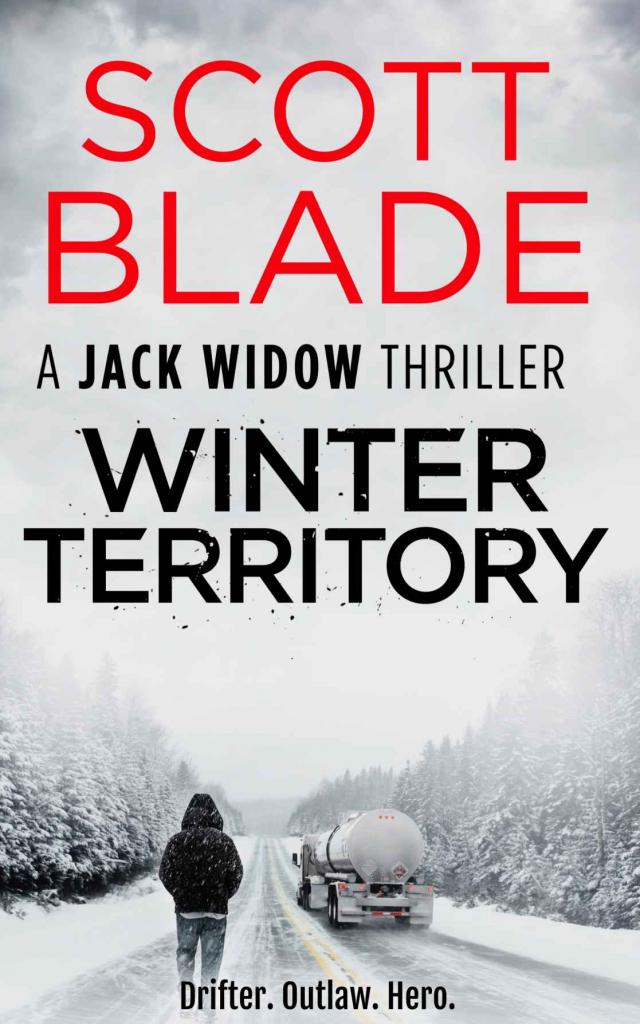
WINTER TERRITORY
A JACK WIDOW THRILLER
SCOTT BLADE
Copyright © 2016.
Scott Blade.
A Black Lion Media Publication.
All Rights Reserved.
Available in eBook, paperback, and hardback.
Kindle ASIN: B01MFGPKLB
Paperback ISBN-13: 978-1-955924-03-0
Hardback ISBN-13: 978-1-955924-02-3
(Original KDP ISBN-13: 978-1539926351)
Visit the author's website: ScottBlade.com.
This book is copyrighted and registered with the US Copyright Office under the original ISBN. All new and alternate editions are protected under this copyright.
The Jack Widow book series and Winter Territory are works of fiction produced from the author’s imagination. Names, characters, places, and incidents either are the product of the author’s imagination and/or are taken with permission from the source and/or are used fictitiously, and any resemblance to actual persons, living or dead, or fictitious characters, business establishments, events, or locales is entirely coincidental.
This series is not associated with/or represents any part of any other book or series.
For more information on copyright and permissions, visit ScottBlade.com.
This book is licensed for your personal enjoyment only. This book may not be resold or given away to other people. If you would like to share this book with another person, please purchase an additional copy for each person you share it with. If you’re reading this book and did not purchase it, or it was not purchased for your use only, then please return it and purchase your own copy. Thank you for respecting the hard work of this author.
The publisher and/or author do not control and do not assume any responsibility for author or third-party websites or their content.
No part of this book may be reproduced, scanned, or distributed in any printed or electronic form without express written permission from the publisher. The scanning, uploading, and distribution of this book via the internet or any other means without the permission of the publisher is illegal and punishable by law. Please do not take part in or encourage piracy of copyrighted materials in violation of the author’s rights. Purchase only authorized editions.
Published by Black Lion Media.
CONTENTS
Also by Scott Blade
Chapter 1
Chapter 2
Chapter 3
Chapter 4
Chapter 5
Chapter 6
Chapter 7
Chapter 8
Chapter 9
Chapter 10
Chapter 11
Chapter 12
Chapter 13
Chapter 14
Chapter 15
Chapter 16
Chapter 17
Chapter 18
Chapter 19
Chapter 20
Chapter 21
Chapter 22
Chapter 23
Chapter 24
Chapter 25
Chapter 26
Chapter 27
Chapter 28
Chapter 29
Chapter 30
Chapter 31
Chapter 32
Chapter 33
Chapter 34
Chapter 35
Chapter 36
Chapter 37
Chapter 38
Chapter 39
Chapter 40
Chapter 41
Chapter 42
Chapter 43
Chapter 44
Chapter 45
Chapter 46
Chapter 47
Chapter 48
Chapter 49
Chapter 50
Chapter 51
Chapter 52
Chapter 53
A Reason to Kill: A Preview
A Reason to Kill: A Blurb
Chapter 1
Chapter 2
Chapter 3
Without Measure: A Preview
Without Measure: A Blurb
Chapter 1
A Word from Scott
The Scott Blade Book Club
The Nomadvelist
ALSO BY SCOTT BLADE
The Jack Widow Series
Gone Forever
Winter Territory
A Reason to Kill
Without Measure
Once Quiet
Name Not Given
The Midnight Caller
Fire Watch
The Last Rainmaker
The Devil’s Stop
Black Daylight
The Standoff
Foreign and Domestic
Patriot Lies
The Double Man
Nothing Left
The Protector
Kill Promise
1
The man was about twenty-five years old and freezing.
The cold pierced through his skin and shot straight to his bones. The temperatures outside dipped into the low twenties, and the winter hadn’t even come on yet. Not fully. It was still the middle of November, but the mountaintops were snowcapped, and the sky was wet with the cold, dewy feeling that came with high altitudes and frigid skies. Which exactly described his location—high up in a stark, cold winter. He was in the Absaroka Mountain Range, a part of the Rockies. The elevation was somewhere around thirteen thousand feet, but he wasn’t sure of the exact number.
The man was hiding out in a familiar place—a place he used to hide when he was young. He felt safe there.
Outside, the night wind blew and battered the ruggedly built wooden structure. It was primitive, but had endured the cold winters for many, many years. For the moment, nothing and no one would find him. The man was safe, but it wouldn’t be for long. He had nowhere else to go. He had run out of options and time.
They were coming for him, and they would come in hot with guns blazing. They would kill him for sure—no doubt about it. He had been running for days, and he knew he would come face-to-face with them soon enough. His cover had been blown all to hell and back.
No changing that now. No changing the past.
But that wasn’t the thing that worried him at the moment. The thing that was the immediate danger wasn’t the guys coming to kill him for betraying them. It wasn’t the fact that they had trusted him, and he had turned on them. It wasn’t the dangerous enemies who had once terrified him. The immediate danger wasn’t the contents of the stolen bulletproof briefcase that was covered in dirt and grime and still damp from being dragged through the snowy terrain.
The immediate danger that ate away at him was that he was starving. He hadn’t eaten in days, so many days that he had no idea when the last time was.
Two weeks ago, he had been on a military stealth helicopter on his way into Mexico, or maybe back from Mexico, across the Mexican–United States border. He couldn’t remember for sure. The details were fuzzy because his thinking was muddled. Five or six or seven days without food will do that to a man. He tried to remember his training, his tradecraft, but all he could focus on was the stealth helicopter.
He had thought it was such a cool thing. It was a Comanche RAH-70, the most terrifying machine he had ever seen. Reports from around the world had claimed that highly modified Black Hawk UH-60s were the stealth helicopters used in the raid on Osama bin Laden’s compound in 2011. He hadn’t been there in 2011—he had been far too young at the time to have been involved in that operation—but he had top secret clearance and was privy to knowledge that the helicopters used were, in fact, Comanche’s RAH-70s, cousins of the RAH-66.
Public knowledge said that the Comanche helicopters had been canceled way back in 2004. The programs were too expensive for the US military, but not for his employer. His employer had found a use for them and had financed dozens of them to be created for stealth missions. They were housed in strategic military installations all around the world. Military service personnel were restricted from accessing them. Authorized persons had been told never to reveal any details about them to anyone.
The helicopter was a remarkable machine with deadly and accurate machine guns attached. It was equipped with special side turret-style machine guns based on the Vulcan-style gun and could fire M50 ammunition at fifteen hundred rounds per minute. The ammunition housed five hundred rounds and could be reloaded in fifteen minutes.
The man knew this information not because of his military training, but because of his tradecraft. Although now he questioned the statistics and details in his mind because he knew one thing for certain—he was starving, and the lack of sustenance in his body was causing him to lose focus and reasoning. He tried desperately to concentrate on the details of the stealth helicopter. And it helped. But he was still starving.
He was in one of the richest states in the country, and at that moment, he was a rich man. He was richer than he had been five or six or seven days ago because of the value of the contents of the security briefcase in his possession.
Next to the man was a Beretta nine millimeter, a service weapon given to him just before his secret mission. It rested on top of a closed shoebox next to him in close grabbing distance. The safety was on, but that could change quickly. The shoebox was stacked on top of a large appliance box that held old items from a childhood long past.
The room the man was in was dark and dank and not well insulated. Spiders indigenous to the region crawled in the far corner of the ceiling. They crawled in the shadows of a swinging bulb that hung down on a long cord and swayed back and forth in a curved arc from west to north. A wind that chilled the room blew the bulb from side to side. The man could hear a faint whistle that sounded with the gusts of wind from the outside terrain.
The man was sitting on the floor with his back to the wall. He craned his neck to look out of a snow-covered, shuttered window above his head. He had to press his body up against the wall and use his arms to hoist himself up just to see. Billions of stars shimmered across the stretch of sky. The ground was covered in snow, but the night sky was clear and dark blue and picturesque, like the wallpaper on a desktop computer. Perhaps on a computer back in Langley, Virginia, which was where he had lived for the last year of his life.
The man leaned forward some more and looked straight down at the front of the house. He couldn’t see the front door from his position, but he was over two stories up, and he could see more than a hundred yards down the steep land in front of him. Behind him were dense trees and then the edge of a rugged mountain. He wasn’t much worried about men coming for him from that direction. He figured these guys would just come straight up the long, wide driveway if they could find it. The snow had covered it over, leaving no signs of where it used to be. More than likely, his enemies would come in by snowmobile, and he would hear their engines in the dead silence around him. The noise would echo and bounce off the far-off trees or the sides of the mountains. No way could anyone surprise him on a snowmobile. The only alternative means of transportation would’ve been horses. The snow on the ground wasn’t deep enough to prevent them from riding on horseback up the track.
Either way, it wouldn’t matter. He was ready. His main problem wasn’t how they would come for him, but when.
The owner of the house didn’t know he was there. He was hiding out. He prayed he wouldn’t be discovered. The last thing he wanted to do was involve innocent people.
Just then, he heard a noise, a creaking on the staircase below him. He stretched back up and craned his head to look out the window. He couldn’t see the front door because of the huge porch, a fact he had forgotten. Then he remembered he had just looked down only moments ago.
The man heard more noises from below him. He heard footsteps growing louder and louder. A moment later, someone was on the floor beneath him, and then he heard a chair moving across the floor and light footsteps as if someone had climbed the chair and reached up for the rope to the attic door. He heard the creaks of his frozen bones as he twisted to look at the trapdoor and then the squeaking of springs from the door itself as someone pulled it down. The sound was deafening in the house's silence.
He grabbed his Beretta and quickly pointed it in the direction of the attic door as it was pulled downward. Light flashed in through the crack and up onto the ceiling above him. Soon it filled half of the attic. He wanted to slide over to hide behind some of the larger boxes, but he couldn’t really move his legs. He had lost feeling in them some time ago but couldn’t remember when. He had forgotten they were paralyzed, but not permanently. It was from exhaustion.
The trapdoor went down all the way, and the folding staircase attached plopped down below. The man heard the creak of the wooden ladder as someone climbed it. A head stuck up into the attic, and a body followed. The tiny figure in front of him scanned across the attic and the boxes until their eyes connected.
The man lowered his Beretta when he saw a small boy, approximately six years of age. The boy glowered at him peculiarly. Most likely a combination of fright because of the gun and then recognition.
The man had been in and out of sleep for days and had spent so much energy in guarding himself, holding the Beretta up, that before he knew it, his eyes closed under the heavy weight of his eyelids.
2
Jack Widow was doing what he loved best—wandering without a care in the world. This was what he thought was true freedom. A lifetime of doing as he was told had turned him into a man who no longer listened to anyone. He did as he wanted and went where he pleased.
Widow had spent the last several months doing more and seeing more of his home country than he had ever done or seen in his entire life. He had traveled from Mississippi, a place that seemed so far away and long ago in his memory, through seven states, across hundreds of highways, around thousands of cloverleaves, and over the southern part of the Rocky Mountains. He’d traveled all the way west until he couldn’t go any farther unless he started swimming or chartered a boat or stole a submarine or bought a plane ticket. And even then, he was out of states except for Hawaii and Alaska, depending on whether you considered them to be west.
Over the last year, he had discovered three addictions. The first was the open road. There was nothing like the freedom of the American frontier. The second was coffee. Coffee was a drug he couldn’t explain. Perhaps it was from being a Navy cop. Perhaps not. Or maybe it was just a drug that did what drugs do and did it well—it created an addiction. Whatever the case was, he didn’t care. And the third was that he was constantly picking up old paperback books and reading them along his travels.
He had slept only about five hours the night before because he had met a girl named Farrah in Salt Lake City. The only person he had known with that name was the actress Farrah Fawcett, but when he’d asked the girl about it, she had denied being named after her. She told him she had been asked that question for her entire life but claimed never to have even seen a Farrah Fawcett film. As the girl was only nineteen years old, that was probably true. Farrah had been dead for years and hadn’t really done any acting in decades. The only thing Widow knew her from was Charlie’s Angels, a horrible show in his opinion, from before he was born.
Farrah—the nineteen-year-old and not the actress—had been a lot of fun for Widow. She was a part-time waitress and student, not at the University of Utah but at a community college. She was taking night classes to be a nurse, a trade that Widow admired. He admired anyone who was in the profession of helping others. The military, criminal justice, firefighting, the medical field, and even the clergy were all trades he respected.
Farrah was the complete opposite of Farrah Fawcett, but that didn’t mean she wasn’t gorgeous. She was absolutely gorgeous, far more so than the 1970s actress. At least that was Widow’s conclusion. Farrah was six feet tall. She was dark-skinned with long, straight black hair and even longer legs. She was toned, but not in the way of someone who was into fitness. It was more of a youthful way, the way you are when you have good genes.
Widow had met Farrah while she was working at a local bar. She had thought it was odd that he was reading a book in a bar, and they struck up a conversation. He had asked her to have a drink after her shift ended, which they did. His time on the road had been lonely. Not that the isolation didn’t appeal to him as well. He liked to be alone. And there was something romantic and resolute about wandering. He found peace. Widow accepted the aloneness, but finding the occasional friend was something he looked forward to.
After they had a beer together—some local craft brew—Farrah had invited Widow back to her place for another beer, which turned the one beer into an all-night thing, which was okay by him.
In the morning, Widow put his clothes on and said goodbye to Farrah as she slept. He wasn’t sure if she had heard him or not, and it hadn’t mattered. He was ready to be on his way.