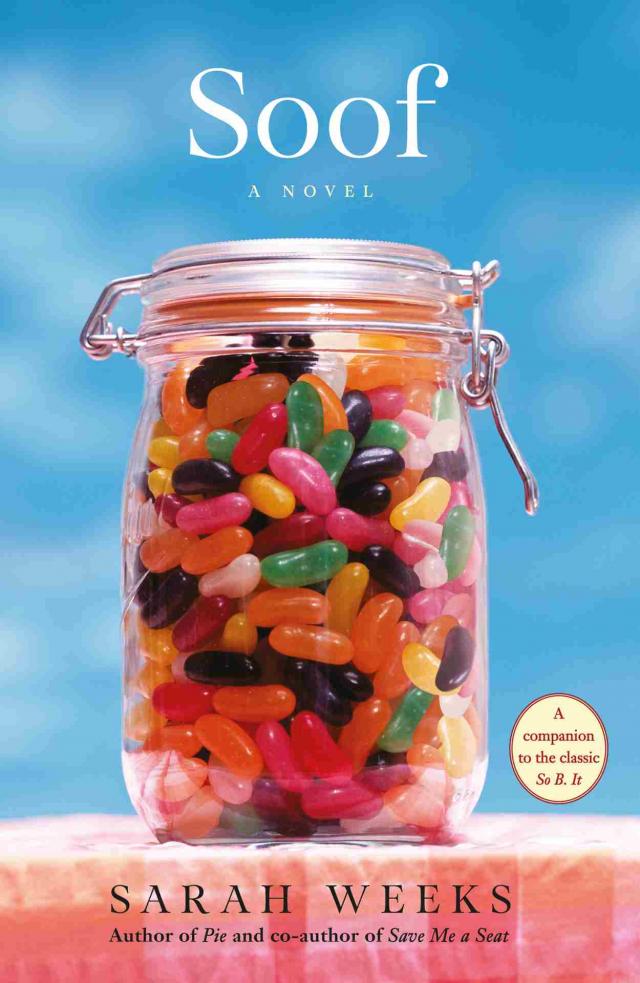
Soof (Scholastic Gold), page 1


For the midwestern boy who gave me the idea for this book. This one’s for you.
SW
Title Page
Dedication
Chapter One: More than a bird loves to sing
Chapter Two: More than a fish loves to swim
Chapter Three: More than a bell loves to ring
Chapter Four: More than a wheel loves to spin
Chapter Five: More than a spark loves to fly
Chapter Six: More than a mouse loves to nibble
Chapter Seven: More than a breeze loves to blow
Chapter Eight: More than a finger loves to point
Chapter Nine: More than a key loves to turn
Chapter Ten: More than a clock loves to tick
Chapter Eleven: More than an ear loves to listen
Chapter Twelve: More than a tail loves to wag
Chapter Thirteen: More than a broom loves to sweep
Chapter Fourteen: More than a cat loves to scratch
Chapter Fifteen: More than a willow loves to weep
Chapter Sixteen: More than a heart loves to beat
Chapter Seventeen: More than a cradle loves to rock
Chapter Eighteen: More than a moon loves to rise
Chapter Nineteen: More than a dog loves to dig
Chapter Twenty: More than a page loves to turn
Save Me a Seat Sneak Peek
Acknowledgments
About the Author
Copyright
I saw a white rabbit with one bent ear hopping over a giant spoon filled with whipped cream. That’s what it looked like to me anyway. I’d been lying on my back in the bed of my father’s rusty old pickup truck all morning, watching clouds. I tapped the end of my nose once, twice, three times with my finger and wished I’d remembered to put on sunscreen.
“Aurora!” my mother called from the house. “Lunch!”
“Coming!” I called back, but I didn’t move. I was busy watching the rabbit turn into a girl with a puffy white bow in her hair. Lindsey Toffle, a girl who sat in front of me at school, wore a bow like that sometimes. It was so big I had to lean over to one side in order to see the blackboard.
The cloud broke apart and drifted away, but I was still lying there thinking about Lindsey Toffle. She was the most popular girl in my class, and she didn’t like me at all. It might have had something to do with the fact that I bit her once when we were in kindergarten, but (A) that was a long time ago, and (B) it hardly even left a mark. The main reason Lindsey Toffle didn’t like me was because I was weird.
Sometimes, just for fun, when I walked down the hall I would hop on one foot or flap my arms and pretend to be a bird. Other times, also for fun, I would speak in a British accent or a language I’d made up called Beepish. I wore my T-shirts inside out because the tags bothered me even after my mother cut them out. I liked counting stuff, I was obsessed with coloring in the middle of o’s, and I had an annoying habit of dividing my sentences into two parts, with an (A) and a (B).
“Aurora!” my mother called again.
“Coming!”
I climbed out of the back of the truck and dusted myself off. Duck was busy digging a hole in the corner of the yard, shooting dirt out from between his hind legs like a maniac. When I whistled through my teeth, he stopped digging and came running. Duck was the sweetest, smartest, most loyal dog in the world, and as if that wasn’t reason enough to love him, the inside of his ears smelled like popcorn.
I pulled open the screen door. “After you, guv’nor,” I said in my best Cockney accent. Duck followed me into the kitchen and flopped down expectantly on the floor beside my chair.
“Don’t think I haven’t noticed you two are in cahoots,” my mother said, setting a bowl of tomato soup and half a grilled cheese sandwich in front of me. “If I had a nickel for every scrap of food you’ve ‘accidentally’ dropped on the floor for that dog, I’d be a wealthy woman.”
My father says the reason my mother’s name is Ruby is because her parents took one look at her and knew she was a gem. She likes it when he says that. I can tell because her eyes sparkle.
“How’s the quilt coming along?” I asked, biting off a corner of my sandwich. I had a system—corners first, then a row of tiny, evenly spaced bites across the top edge to make it look like waves. I counted sixteen bites in all, including the corners.
The quilt was for Heidi, a girl who had stayed with my parents for a little while before I was born. She wasn’t a girl anymore; she was all grown up now and married to a very tall man named Paul. The quilt was for the baby Heidi was expecting, a little girl due in July.
“I’m almost finished with the border,” my mother told me. “I don’t know if Heidi will recognize the fabric, but it’s from the curtains that used to hang in that back bedroom before it was yours. That’s where Heidi slept when she was here.”
“I know,” I said, tapping the edge of the table once, twice, three times. Tapping was another weird thing I liked to do—always in threes, because three was my favorite number.
I’d never met Heidi, but I’d heard a lot of stories about her. There was the one about the jar of jelly beans and the one about the penny getting stuck in the vacuum cleaner. There was the one about Heidi’s mama learning how to use the electric can opener and the one about Bernadette, Heidi’s neighbor, making a bet with my father that Heidi could guess ten coin flips in a row without missing. I’d heard the Heidi stories so many times I knew them all by heart, but my favorite by far was the one about me. My mother always told it the same way:
“We’d been waiting for a baby of our own for a very long time. We’d all but given up hope. Then one day, out of the blue, a stranger arrived in Liberty. Her name was Heidi It. From the outside she looked like an ordinary girl, but inside she had a powerful streak of luck running through her like a river. Heidi didn’t stay for very long, but her visit changed our lives forever. Before she left she passed her good luck along to your father and me, and the following winter, on a snowy Monday morning, you were born.”
That was it. The whole story. But the message came through loud and clear: My parents had been given a whole lot of luck, and they’d used it all up wishing for me.
Duck whined to let me know he was tired of waiting.
“Beep-boop-beep-boop-bing-bing,” I said.
“Translation, please,” my mother replied. She was used to me speaking to her in Beepish.
“May I have some milk, please?” I asked.
My mother opened the fridge and grabbed the carton of milk. While her back was turned, I took the opportunity to drop a ribbon of crust on the floor for Duck, who quickly gobbled it down.
“It’s hard to believe that Heidi’s old enough to be having a baby,” my mother said wistfully as she opened the cupboard and took out a tall glass with a cheerful ring of daisies painted around it. “It seems like only yesterday she was sitting at this very table eating blueberry pancakes.”
“They weren’t blueberry pancakes,” I corrected. “They were regular pancakes with blueberry syrup.”
“That’s right,” she said. “They were.”
“That was the day Heidi was mad at Dad for going up to Hilltop Home without her. Later he came back and got her, and that’s when she met her grandfather for the first time.”
My mother nodded and set the glass down in front of me, along with a multivitamin. She was wearing the yellow apron I’d given her for Mother’s Day the year before.
“I worry you’re not getting enough vitamin D,” she told me. “It’s important for your bones.”
“Don’t worry, Mom,” I said, tapping the shiny orange tablet three times with my finger. “My bones are fine.”
“Mothers are supposed to worry,” she explained as she poured another inch of milk into my glass.
“That’s not what Dad says. He says worrying is like a rocking chair. It’s something to do to pass the time, but it doesn’t get you anywhere.”
My mother sighed. She was tired of people telling her not to worry, especially my father.
“Do me a favor and take your vitamin, will you, please?” she said.
As she took off her apron and hung it on a hook in the broom closet, I popped the vitamin in my mouth and took three quick sips of milk to wash it down. Thinking about Heidi eating those pancakes had gotten me thinking about Heidi’s grandfather, who used to run the place where my mother worked before I was born.
“Thurman Hill’s eyes were the same shade of blue as the chunk of sea glass Bernadette kept in her jewelry box,” I recited matter-of-factly.
My mother turned and stared at me.
“What?” I said. “That’s what Heidi said the first time she saw him, isn’t it?”
“Word for word. But how is it that you can remember an obscure little detail like that, yet forget to put on sunscreen before you go outside?”
“Sorry, Mom,” I said and began to nibble a new set of waves along the edge of my sandwich.
“I’ll pick up some aloe lotion this afternoon at the drugstore,” my mother told me.
“Could you tell by looking at Heidi that she had a lucky streak?” I asked when I’d reached the end of the row. Fourteen bites this time, because the corners were already gone.
“No,” my mother answered. “But it’s a good thing she did, because otherwise we wouldn’t have you.”
My mother always did that—connected Heidi’s story with mine. Most of the time I didn’t mind. But sometimes I wondered what it would feel like to have a sto
I was swallowing the last spoonful of soup when my father strolled into the kitchen carrying a plastic bag full of frozen minnows. He was still wearing his uniform, but he’d left his hat in the car.
“You’d better not be planning to put those fish in my freezer, Roy Franklin,” my mother warned.
“They’re double bagged, Rube,” he said, kissing her on the cheek. “Trust me, they hardly stink at all. Besides, it’s just ’til tomorrow morning. Rory and I are going out on the lake first thing—right, baby girl?”
My father was the sheriff of Liberty. He was tall and handsome, with a thick brown mustache that sometimes made it hard to tell if he was being serious or pulling your leg. While he was on duty he carried a gun in a holster and a pair of handcuffs clipped to his belt. He wore a big gray hat and a gold badge, and when he walked into a room or drove down the street in his black-and-white cruiser, you could tell strangers were a little afraid of him. Anybody who really knew him, though, understood that hidden underneath that shiny gold star lay a heart as soft and warm as the dinner rolls at the Liberty Diner.
“Can Duck come too?” I asked.
At the mention of his name, Duck’s tail thumped against the leg of my chair a couple of times.
“No way. He’ll scare the fish away,” my father complained as he opened the freezer door and tossed the bag of minnows in.
“Roy!” my mother scolded, playfully snapping the dish towel at him. “What did I tell you about those fish?”
He grinned and dodged the snapping towel.
“Trust me, Rube, it’s the lesser of two evils,” he said as he danced away from her. “The only thing more smelly than a frozen minnow is a thawed one.”
She laughed and snapped the towel at him again.
“Save me, Rory!” my father cried, jumping behind my chair in mock terror.
“Only if Duck can come fishing with us tomorrow,” I said. “Right, boy?”
Duck threw back his head and howled in agreement.
My mother flicked the towel once more. This time, instead of dodging it, my father reached out, caught hold of the end, and pulled her toward him.
“Family hug!” he shouted, and I jumped out of my chair to join them. We wrapped our arms around each other, and Duck howled again, which made everyone laugh.
When I think back on that moment now, all of us together in the kitchen, there’s a golden glow around the memory, like a frame around a picture. It was nothing out of the ordinary. We were a close-knit family, but something was about to happen that would unravel my world, and it all started with Lindsey Toffle’s silver charm bracelet.
“Did you see this, Rube?” my father asked the next morning, pointing to an article on the front page of the Sunday paper. “They’re tearing down Hilltop Home.”
“What a shame,” my mother said, looking over his shoulder at the picture. “It was such a beautiful place back in the day.”
My father groaned.
“It says here they’re putting in another Dollar General Store. Just what we need, huh?”
“More coffee, Roy?” my mother asked. “I can brew another pot.”
I’d been up and dressed for hours.
“I thought you said we were going fishing first thing, Dad,” I grumbled. “It’s almost eight o’clock already!”
My father folded the newspaper and pushed back his chair.
“You grab the minnows, baby girl, and I’ll get the poles,” he said.
I helped him load the tackle box, net, and other gear into the back of the truck, and in record time we were rolling down the driveway, my mother calling after us, “Have fun, you two!”
“You mean us three!” I called back, pointing to Duck as I waved to her out the open window.
Twenty minutes later we were sitting in a rowboat, watching our red-and-white bobbers drift on the sparkling green surface of Bartlett Lake. Duck kept a lookout from the bow, snapping at passing horseflies.
“Your mother mentioned that she drove by the Toffles’ house last night,” my father said as he clicked open the lock on his reel and let out a little more line. “She said it looked like they were having some kind of a party.”
“Yesterday was Lindsey’s birthday,” I explained.
“I kind of figured as much. How come you weren’t invited?”
“I was,” I told him. “I didn’t feel like going.”
I’d been excited at first when I’d found the pink envelope lying on my desk. I’d never been invited to one of Lindsey’s parties before. This time the whole class was coming, even the boys. I’d heard there was going to be a DJ and a chocolate fountain for dipping strawberries—I’d seen one advertised on TV and was really looking forward to trying it out. Then during PE I overheard Lindsey telling one of her friends that the only reason she’d invited me was because her mother had told her she had to. When we got back to our classroom, I tore the invitation in half and threw it away. Even the promise of chocolate-covered strawberries wasn’t enough to make me go someplace I knew I wasn’t wanted.
My father got a nibble, but when he reeled in the line there was nothing but a tangle of slimy green weeds on the hook.
“Looks like we’ll be having salad for dinner tonight,” he said.
I laughed.
“Even if we catch a fish we’re not going to bring it home,” I said. “Mom would have a fit. I think she’s making meat loaf and mashed potatoes tonight.”
“I know,” said my father. “I was making a joke.”
We were both quiet for a while, the water slapping softly against the sides of the boat. Then Dad cleared his throat, and I knew something was coming.
“How’s school going?” he asked.
“Regular,” I answered cautiously.
“Nothing new?”
“Danny Lebson was out sick this week, so now I’m the only one in class who has a perfect attendance record. Mr. Taylor says if I keep it up he’ll bake me a cherry pie on the last day of school.”
“That’s nice,” said my father, but it was clear there was still something on his mind. “Did I ever tell you that when I was your age, I used to get teased about my teeth?”
“They look okay to me,” I told him.
“Sure, they are now, but before I got braces there was a boy in my neighborhood named Stevie Pritchett who used to call me Graveyard Franklin.”
“How come?”
“He said my teeth were so crooked, my mouth looked like a cemetery full of old tombstones, all leaning in different directions.”
“That was mean,” I said.
He nodded and looked over at me. “Kids can be pretty mean sometimes.”
I sighed. Here it was. The something I’d felt coming.
“Are we about to have a Mom talk?” I asked.
“What’s a Mom talk?”
“You know. The ones where she asks me if kids are picking on me at school because I’m weird, and I tell her no, they just ignore me, and she says, doesn’t that hurt your feelings, and I say not really, but she doesn’t believe me so she asks me again and I tell her that I’m used to it and then she looks really sad.”
I could tell by the look on my father’s face that he knew what I was talking about.
“Your mother and I are both concerned for your happiness,” he said.
Oh, brother. I was used to my mother fussing over me, but now my father was getting in on the action too?
“Here’s the deal, Dad,” I told him. “You can’t both be concerned because that’s too much. Like when the snow piles up on the roof and you have to go up there and shovel it off. Mom gets to be the worrier because she can’t help it. You have to be the normal one who doesn’t freak out about everything.”
“I’ll try,” he said. “Can I finish my story now?”
I shrugged and he went on.
“One day on my way home from school I saw Stevie Pritchett coming up the street in my direction. I could tell by the look on his face that he was gearing up to say something mean, but instead of turning around or crossing over to the other side of the street the way I usually did, I reached into my pocket and pulled out a package of Wrigley’s.”
“What’s Wrigley’s?” I asked.
“It’s a kind of gum.”
“Why’s it called Wrigley’s?”