

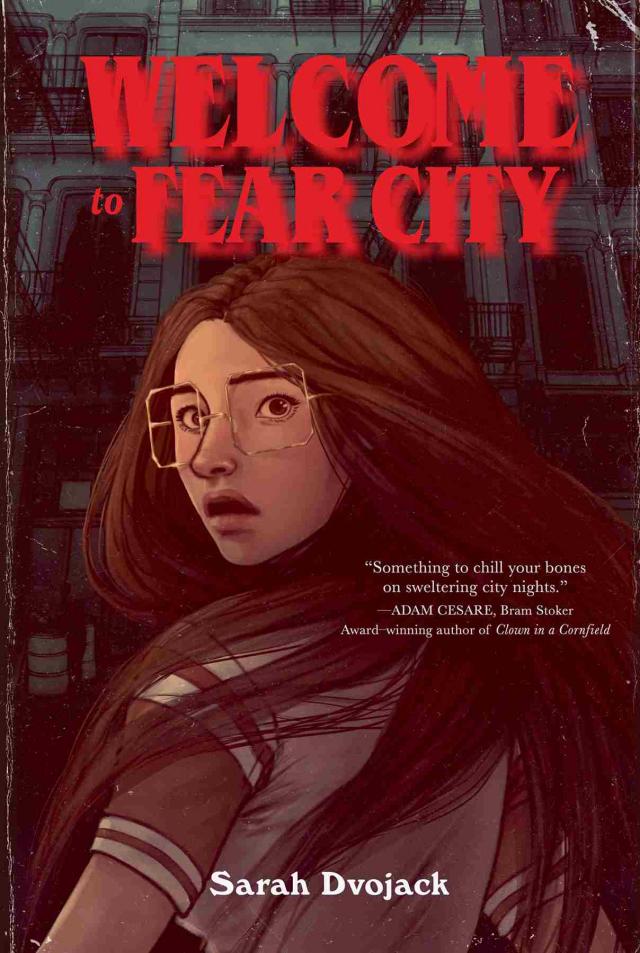
Welcome to Fear City, page 1


For the Haran Irish Dancers and for the City of New York.
Past, present, and future.
UNION SQUARE & CO. and the distinctive Union Square & Co. logo are trademarks of Sterling Publishing Co., Inc.
Union Square & Co., LLC, is a subsidiary of Sterling Publishing Co., Inc.
© 2024 Sarah Dvojack
All rights reserved. No part of this publication may be reproduced, stored in a retrieval system, or transmitted in any form or by any means (including electronic, mechanical, photocopying, recording, or otherwise) without prior written permission from the publisher.
ISBN 978-1-4549-5390-6 (hardcover)
ISBN 978-1-4549-5392-0 (paperback)
ISBN 978-1-4549-5391-3 (e-book)
Library of Congress Control Number: 2023052239
For information about custom editions, special sales, and premium purchases, please contact specialsales@unionsquareandco.com.
unionsquareandco.com
Cover and interior design by Marcie Lawrence
CONTENTS
Cover
Title Page
Copyright
Dedication
Bushwick 1667
Bushwick 1965
Prologue
Chapter One
Chapter Two
Chapter Three
Chapter Four
Chapter Five
Chapter Six
Chapter Seven
Chapter Eight
Chapter Nine
Chapter Ten
Chapter Eleven
Chapter Twelve
Chapter Thirteen
Chapter Fourteen
Chapter Fifteen
Chapter Sixteen
Chapter Seventeen
Chapter Eighteen
Chapter Nineteen
Chapter Twenty
Chapter Twenty-One
Chapter Twenty-Two
Chapter Twenty-Three
Chapter Twenty-Four
Chapter Twenty-Five
Chapter Twenty-Six
Chapter Twenty-Seven
Chapter Twenty-Eight
Chapter Twenty-Nine
Chapter Thirty
Chapter Thirty-One
Chapter Thirty-Two
Chapter Thirty-Three
Epilogue
Acknowledgments
About the Author
What’s past is prologue.
The Tempest, Act 2, Scene I
Or
Hello from the cracks in the sidewalks of N.Y.C. and from the ants that dwell in these cracks and feed in the dried blood of the dead that has settled into the cracks.
Son of Sam, May 30, 1977
PROLOGUE
THE VALLEY
THE CAST-IRON DISTRICT
HELL’S HUNDRED ACRES
SOUTH HOUSTON INDUSTRIAL AREA
“SOHO”
November 9th, 1965
Sylvie Stroud was watching an episode of Where the Action Is. At five years old, she was hopped up on the day’s top hits as they piped through the old black-and-white set, dancing wildly within the confines of the woven rug beneath her bare feet. (Stray one toe outside of it, and you were sure to get a splinter from the old floor.)
As Little Richard ended his performance and the jerking teenagers on the screen stopped to clap and screech, the screen began to flicker. Sylvie didn’t notice it, but even if she had, it wouldn’t have bothered her. The TV was forever doing funny things like that, both because it was ten years old, and because the loft didn’t have reliable electricity.
She was home alone—in a way. Her dad and brother were out, but her mom was downstairs in the other studio reupholstering a chair they’d fished from an industrial dumpster. Sylvie could hear her radio through the thin floorboards, so she started dancing to that instead. Hey, you, get off of my cloud!
But then the TV started spitting out incomprehensible garbage, and Sylvie turned to see the image whirring whirring whirring at a frenetic pace until, with a soft pop, the screen went black. And with it went all the lights, and the sound of her mom’s radio. Sylvie could see her surprised face in the smudged glass of the TV set, lit up now only by the moonlight coming through the tall windows.
Sometimes that happened, too, when the old fuses couldn’t take the pressure. But there was something different about it this time because Sylvie quickly realized that moonlight was all there was. The buildings across narrow Greene Street were as dark as her own, including the factory that made cheap plastic dolls and women’s underwear.
Outside, an empty truck rattled by and people on the sidewalks called to each other. You seein’ this? What in the hell!
All the warmth from her dancing left her very quickly. Her skin felt like it was buzzing, all the hairs on her arms shivering. The silence was so thick that it was loud inside her head. And the rest of the unfinished loft was dark and deep as a cave—Sylvie had never noticed that before. It had always seemed bright and open.
A tickling sensation on her foot made her jump, and she looked down to see a couple of ants crawling over her toes. Like everything else, that didn’t surprise her, either—the building had holes and cracks at every seam, and rats still kept a functioning highway between the floors.
It had been at least two minutes and her mom hadn’t come upstairs and Sylvie didn’t want to be sort-of-home-alone anymore.
She sat down to brush off the ants and pull on her socks, and when she got back up again, she put her bare hand down on the floorboards for leverage.
All at once, she wasn’t alone anymore. A whole entire world burst into her own. Instead of furniture and art and stacks of sheetrock, there were machines and noises and the foulest smells. Old oil and dirty fabric and rancid smoke and things she had absolutely no names for because she was only five years old.
People wearing old, unfamiliar clothes marched into and over each other, talking and laughing and yelling in equal measure as they moved through and around piles of acrid furs or thundering machines. The floor was covered in discarded waste all knotted together. Were those boxes of buttons? No. Piles of fabric? Mounds of wool? Her street was still covered in bales of fabric and clippings, but not in here! Like staring at ten slides all stacked up and held to the light, the images didn’t make sense. She was frozen in the middle of it, unable to move for shock. The moon glowed through the people, turning them to ghosts. They had to be ghosts. Her house was haunted.
She shut her eyes.
The people disappeared when she ran, screaming, for her mother, her sock-covered feet beating a path to the door—a path that these strange people had already taken. Were probably the reason the floor was so worn out in the first place.
She couldn’t explain what had happened, so she pretended she had been afraid of the dark, and her mom believed her.
But then she made the mistake of touching the windows to see down into the dark street, and all the ghosts erupted from the walls again. This was how Sylvie learned that they only showed up if she touched the old parts of her building. The windows, the floor, the exposed brick walls. Then she learned that objects held ghosts, too, even the old typewriter her dad found sitting on a curb (there had been a note taped to it—NOT BROKEN). Several ladies in shirtwaists typed when Sylvie typed, so Sylvie never used it again.
She wore mittens indoors and her parents laughed it off because it was nearly winter, and the loft was cold. But she wouldn’t take off the mittens at school, and she wouldn’t take them off in bed, and when her parents fixed the boiler, she wouldn’t take them off then, either. Every surface was a perpetual game of hot lava, but she appeared to really believe it would burn her.
By spring, she was in front of an NYU psychoanalyst, her now six-year-old mind trying to come up with a lie because she didn’t understand the truth but knew it was too unbelievable to convey. He said she would probably grow out of this behavior, that kids sometimes developed anxiety around starting school, but he still looked at her funny and she still had to see him every other Wednesday.
Forced to think about it, she began to wonder—if these were ghosts, shouldn’t others see them when she did? Why weren’t they lurking under her bed or shouting “BOO!” from dark corners? They never even looked at her.
In the fall, she went on a field trip to the Metropolitan Museum of Art with her first-grade class and leaned against a pillar in the patio from the Castillo de Vélez-Blanco. A mere sliver of her wrist brushed the marble—and as both a Spanish castle and a Park Avenue mansion suddenly overlaid the staid museum, Sylvie realized that she wasn’t seeing ghosts at all.
She was seeing the past.
Almost immediately filled with relief, she wanted to tell everyone she knew, but her teacher simply praised her vivid imagination and joked with the chaperones about some ladies who time-traveled at Versailles.
Not being afraid didn’t make it any easier to endure the chaotic mess that is the passage of time. She was sick of wearing mittens and sick of going to the analyst. When she read X-Men comics with her older brother, she thought of the young mutants who could control the uncontrollable and decided to figure out how to sort the pile of slides into an orderly projection that could be switched on and off when she wanted.
It took years, but it worked, and she learned a lot about her powers as she spent all her time with them. When she began to need glasses, she called the power her 20/20—because her hindsight was particularly good.
She learned that she couldn’t use it on living things, like people. She learned tha
Because once obliterated, some memories were lost for good. She couldn’t find Collect Pond or even an inch of pre-European Manhattan underneath all the concrete and steel. When she watched West Side Story, her parents told her the neighborhood was beneath Lincoln Center. When she learned that Penn Station was finally getting demolished, she made her parents take her there nearly every weekend, and she would prowl the exterior, trying to collect stories that were about to be thrown away, writing things down in notebooks she refused to let anyone read, though her brother often tried.
Her own neighborhood was as vulnerable as Penn Station and San Juan Hill. While the adults organized, she wrote furious letters to Robert Moses like it was a hobby. Her dad found one and hung it at a gallery opening. An art dealer bought it for $50 and turned it into a mimeo that was spread around the neighborhood, then into the Village and beyond: ROBERT MOSES STOP PUTTING ROADS THROUGH OUR HOMES!!!
After four years, she stopped wearing mittens (even in winter) because she could finally move through the world like other kids again, putting her bare hands and bare feet wherever she pleased and only seeing things when she felt like it.
By the time she was ten, she had been kicked out of every museum in the city because she couldn’t (wouldn’t) stop touching everything. She was banned from school trips until her parents explained that the oils from her skin could damage old things. (They wondered if touching too much was compensating for all those years in the mittens, but they stopped taking her to the shrink.)
Of course, she didn’t keep it to herself, but still no one believed her. She pretended to be a reverse psychic, able to tell anyone anything about their school building as long as it happened years ago. She made two dollars doing it, but a teacher stopped her, asked her how Encyclopedia Stroud knew all that.
Oh, I just touch the building and it shows me.
It gave her a sense of ownership of her city that no one else could have. She made a game of looking through old photographs at the public library her mom worked at. She would find a famous face, a famous event, and scour the past to find them. She learned how much of New York was reused, some buildings on their fifth or fiftieth iteration. Square pegs in round holes, either chopping off their corners or crudely busting out more space (like her neighborhood). Some buildings wore their history proudly. Others covered it up.
For years she would peek at every building she passed, creating parades of moments around her like episodes of TV, seeing everything without fully comprehending how real it all had been, despite the smells, despite the sounds. Too young to grapple with the ugly parts, until she wasn’t anymore.
The history in and around her neighborhood had its own particularly bitter flavor, full of dregs. Rat pits and frozen bodies. A man sleeping on the steaming corpse of a horse and children keeping warm on a grate. A family thrown from their apartment, their possessions already on the sidewalk, the children thin with bellies distended. Gangs of men shooting and slashing at each other—several with their innards spilling out or blood gushing from their necks and gasping mouths. Police raiding brothels and dragging women down the steps. Black men beaten by raging white men. The kidnapping of a scarlet-haired dancer from the ghost of a Bowery theatre, her head—identifiable only by that scarlet hair—dumped where an old wood-frame house used to be. An unconscious girl Sylvie’s age hauled onto a cart and carried away. A woman with sharpened teeth picking flesh from long, brass nails on the tips of her fingers. Fires. So many fires. Young women falling from the sky to escape a raging inferno that burned Sylvie’s skin and hair and filled her nostrils as though it were still happening.
In the sixth grade, Sylvie kept her hands to herself for almost an entire year. For months, she had night terrors. It was back to the analyst, where she decided she couldn’t be so adventurous or so callous. Her focus shifted to the present, to dance class and crushes, to the only friends who actually believed her. She visited the same places and always vetted new ones, letting go of the idea that she could learn everything buried in the surfaces around her, realizing that no one could.
The country thought her city was dying, but Sylvie knew it couldn’t. She could see through Manhattan, right to its beating heart.
At least, she thought there was a heart there.
CHAPTER ONE
HELL’S KITCHEN
May 30th, 1977
The gunshot severed the scream.
A teenage girl hit the sidewalk and collapsed over the curb, into the street. Her splayed arms nearly flung beneath the wheels of a Ford Pinto.
The Pinto didn’t sound its horn. A nearby dog-walker didn’t flinch, nor did her little Pomeranian.
Sure, this was Hell’s Kitchen, but unless the Westies and Gambinos had changed their targets, there was no reason for a teenage girl to be shot during the dinner rush on a Monday evening. There was less of a reason for no one to care about it.
The Post would probably say this was the moment the City of New York finally lost the battle for its soul. Earth to city: GIRL DROPS DEAD.
If, in fact, a teenage girl had been shot at all.
Her body was already gone.
Sylvie’s heart thudded in her ears, pumping her head so full of blood that it felt like her brain was being smothered. She gripped her dance duffel and tripped down the last two steps of the row house stoop. Her knee hit the iron gate, chipping off bits of black paint and knocking the small, wooden sign affixed to the rungs: BYRNE SCHOOL OF IRISH DANCE.
“Wow, Sylvie,” said one of the girls coming up behind her. Nessa Murray, of strawberry hair and a pale face full of freckles and erythema. “You gotta open it first.”
Sylvie couldn’t think of a reply.
The accordion music began again, two floors up, proudly striding out an open window, while the rest of her dance class dispersed over the sidewalk. A few of them waved to a pair of girls smoking by a scraggly but determined tree.
Sylvie didn’t even feel the impact of the gate on her knee. She had to keep moving, had to spread the block between herself and whatever that was. Whatever that was, wasn’t supposed to happen. Sylvie thought she knew how it worked, the palimpsest that only she could read.
After all these years, she didn’t want to be wrong.
The two girls by the tree flicked their cigarettes away and dropped beside her. Marzelline Hallan, a Black girl with her hair in braids she’d done during homeroom, moved her eyebrows in different directions and folded her arms. Her leather jacket squeaked at the elbows. In that moment, she was the epitome of skepticism and looked exactly like her contralto mother, rather than the soprano who fronted a punk band. (It was the formation of that punk band that had Marzelline switching out her nickname from Lina to Marz. Marz and the Martians. Her opera diva mom hated it.)
“Hello to you, too,” said Marz. “Where’s the fire?”
“I thought I forgot my hardshoes for a sec,” Sylvie said, rescuing her voice from her bone-dry throat. “So, did you find a new drummer?”
On Sylvie’s other side, Marybeth Huang laughed, though it came out as a snort that seemed rather undignified coming from someone in a gleaming ballet bun and pink tights.
“Smooth,” said Marz. “Subject expertly changed.”
Talk through it, Sylvie. “I’m not changing the subject; I’m making conversation.”
Marz looked at Sylvie in astonishment. “Okay, babe. Sure. No, I didn’t find a new drummer in the last two hours.”
Sylvie hugged the strap of her duffel harder. “Sorry for asking! Damn.”
“Now why are you getting all shitty?”
Marybeth looked down at Sylvie’s leg. “You just fell down the stairs. Did you notice?”
When Sylvie didn’t answer, Marz took hold of her ponytail and tugged it once.
“Space.”
Twice.
“Ca-”
Three times.
“-det.”





