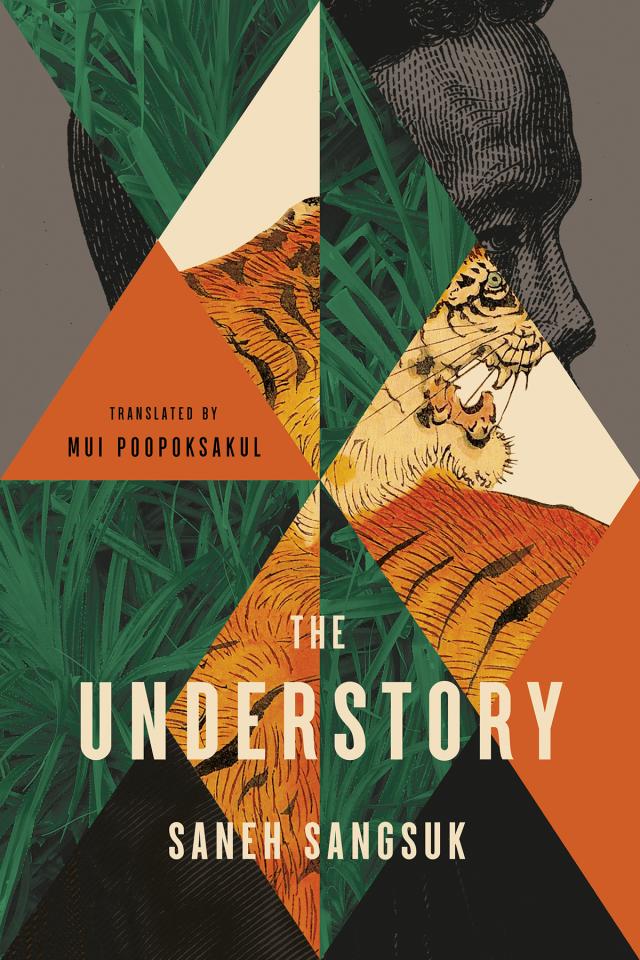
THE
UNDERSTORY
___________
Saneh Sangsuk
Translated from the Thai
by Mui Poopoksakul
Deep Vellum Publishing
3000 Commerce Street, Dallas,Texas 75226
deepvellum.org · @deepvellum
Deep Vellum is a 501c3 nonprofit literary arts organization founded in 2013 with the mission to bring the world into conversation through literature.
Copyright © 2003 by Saneh Sangsuk
Translation copyright ©2024 by Mui Poopoksakul
Originally published as Jao Garagade by Samanchon Books (Bangkok, Thailand, 2003)
Published in the United Kingdom as The Understory by Peirene Press (Bath, UK, 2023)
FIRST US EDITION, 2024
All rights reserved.
Support for this publication has been provided in part by the National Endowment for the Arts, the Texas Commission on the Arts, the City of Dallas Office of Arts and Culture, the PEN/Heim Translation Fund, and the George and Fay Young Foundation.
ISBNs: 978-1-64605-275-2 (paperback) | 978-1-64605-296-7 (ebook)
LIBRARY OF CONGRESS CATALOGING-IN-PUBLICATION DATA
Names: Saneh Sangsuk, author. | Poopoksakul, Mui, translator.
Title: The understory / Saneh Sangsuk ; translated from the Thai by Mui Poopoksakul.
Other titles: Čhao kārakēt. English
Description: Dallas, Texas : Deep Vellum Publishing, 2024.
Identifiers: LCCN 2023039964 (print) | LCCN 2023039965 (ebook) | ISBN 9781646052752 (trade paperback) | ISBN 9781646052967 (ebook)
Subjects: LCGFT: Novels.
Classification: LCC PL4209.D28 C4713 2024 (print) | LCC PL4209.D28 (ebook) | DDC 895.9/134--dc23/eng/20231122
LC record available at https://lccn.loc.gov/2023039964
LC ebook record available at https://lccn.loc.gov/2023039965
Front Cover Design by Emily Mahon
Interior Layout and Typesetting by KGT
PRINTED IN THE UNITED STATES OF AMERICA
To the valiant souls of my maternal great-grandparents and my father’s mother:
the source of many wondrous tales.
Literature has nine flavors:
Sringara
the taste of which is love
Raudra
the taste of which is anger
Veera
the taste of which is courage
Bibhatsa
the taste of which is disgust
Hasya
the taste of which is laughter
Karuṇa
the taste of which is pity and compassion
Adbhuta
the taste of which is amazement
Bhayanaka
the taste of which is fear
Shanta
the taste of which is peace
—The Rasavahini
from the Thai edition translated by Saeng Monvitoon
THE NIGHT WAS COLD AND QUIET AND DRAB, like every night that early winter in Praeknamdang. The season’s chilly winds had arrived, but were yet to launch a full assault; for now, they were only a persistent trickle, a constant waft, chapping-dry and soundless, an insinuation of the coming brutality, a nascent harshness lurking in the cool air that slithered through the trees. The later the hour, the more sluggish the breeze grew, but somehow the bitter and dry quality about the air only magnified, and it seeped into every particle that made up the land and the sky, the streams and the swamps, and made up those sweeping, forlorn paddy fields, green brushed with yellow, which seemed to glow all on their own under the light from the stars and moon, and it seeped into everything there was, from shrubbery and the chains of toddy palms forming an undulating line on the horizon, to houses and huts, to the breaths drawn by all the domesticated animals and their human masters. It was a year the floods rose high enough to sweep into the yard of every home in Praeknamdang—no matter that the village was located on a tract of upland—and the turbid, white water took a long time subsiding. People herded their cattle and pigs to places of even higher elevation; they moored their boats right at their front steps and seized the chance to fish right in their own yards, and everybody caught copious amounts of different kinds of fish, which they smoked or cured with salt or fermented and kept in jars large and small. But the paddy crops had suffered no small degree of damage. The surviving rice plants came up tall and stringy like climbers, and when they sprouted ears, they were populated by small, deflated grains rather than the usual, plump ones, and all that season, there wasn’t a child in Praeknamdang who got to eat any pandan rice pudding at all, however much they begged their mothers or grandmothers to make them some. It was the animals who first sensed the deluge and the calamity it would bring. Bees built their hives only on high-up branches; baya weavers too built their nests on high-up branches; serpents and other such creatures, both poisonous and not, flocked to hillocks or rises or tall trees; and green tree ants grew wings and began to fly about, relocating their nests to areas they thought beyond the flood’s reach. The people of Praeknamdang paid heed to the animals and relayed what they were seeing to one another, to their children and grandchildren, and could foresee the situation they were about to face, the hardships they would have to bear and the struggles that were in store for them. It was a night near the end of December in 2510 BE, or 1967 CE, and the tam kwan khao ceremonies for the Goddess of Rice had come and gone, this time mirthless occasions without the usual fanfare, even subdued like a funeral, but the harvest season hadn’t yet arrived. For the people of Praeknamdang, it was a period of rest. Everyone among them was somber, in despair and miserable, weighed down by all the problems such as there were. All the physical and mental effort that they had dedicated to their land during the planting season would, it was now clear, prove practically pointless. Even the children were somber, in despair and miserable as they observed their parents sighing and venting to one another in hushed tones. It was a year when Chartchai Chionoi was still the world flyweight champion, a year when Suraphol Sombatcharoen was still alive and still crooning and writing songs, putting out hit after smash hit, a year when Mitr Chaibancha was still alive and still playing the leading man in seemingly hundreds of motion pictures. It was the year the people of Praeknamdang were abuzz about Shah Pahlavi of Iran’s upcoming visit to Thailand and the preparations for Emperor Haile Selassie of Ethiopia’s visit to Thailand and the earlier official visit to Thailand of Lyndon B. Johnson, President of the United States of America (all news learned from the radio). It was a year when the young ladies emulated Petchara Chaowarat’s fashion, dressing themselves in blouses and pants, and emulated her hairstyle as well, and a year young men across Thailand went wild for the Twist and the Watusi; the young men in Praeknamdang, too, knew their way around these dances, because a traveling ram wong troupe had introduced them to the people there. It was the year the radio theater group Kaew Fah was at the height of its fame and its Blessing of Brahma and Farmhouse Angel and Gem in the Slums were on-air, to all of which the people of Praeknamdang were incorrigibly addicted. It was a year when the novel House of Golden Sand was still a bestseller, and its sequel Pojaman Sawangwong was still a bestseller, and Lonely Road was still a bestseller, which catapulted K. Surangkanang to the position of Thailand’s number one smith of words, and she would remain popular for a long time to come, even though the writer-critic self-styled as “The Grouch” had already issued the following sarcastic advice to the author: “If I were K. Surangkanang, I would have combined these three novels into one and renamed the whole tome Pojaman Sawangwong on a Lonely Road Behind the House of Golden Sand.” It was the year the only son of Kraam Kichagood, the latter the owner of a large herd of cattle and Praeknamdang’s village chief, was preparing to go and continue his education in town, which meant he had better opportunities in life than the other children in Praeknamdang of his age group, nearly all of whom received only a third-grade education. It was a year when the great lady Ms. Prayong Sisan-ampai still taught at the local Praeknamdang Temple School, still harbored big hopes and big dreams for the children of Praeknamdang, her pupils, when she imagined their futures: that when they grew up, they would possess fulgent and beautiful spirits, like the one Ms. Prayong herself had, and entertain big hopes and big dreams, like she herself did, and never in their lives allow themselves to become creatures of despair, no matter how much and how often misery would be theirs to endure. It was the year the Venerable Father Tien Thammapanyo, or Luang Paw Tien, the abbot of Praeknamdang Temple, turned ninety-three years old, and was seventy-three years into his monkhood, and though his body was ancient and he suffered because of his asthma and arthritis, he remained vital enough to walk his alms route into the village nearly every day, the round-trip distance just shy of seven kilometers, and Kamin, his big ox who was tame as a dog, still tagged along right behind him and ate for his meals whatever food Luang Paw Tien received as alms, ate not only bananas, sugarcane, watermelon, and oranges and such, but everything, indiscriminately, be it curry over rice or rice with salt-cured fish or sweets, as long as it was Luang Paw Tien who hand-fed the food to him, the ox being unwilling to accept food from anyone else’s hand, being that he had once been severely injured when he had stumbled in a wua lan race, and for that he had been slated for slaughter, but Luang Paw Tien had, on an alms round, asked for the ox’s life to be spared and had nursed and cared for him until he had gradually regained his strength; therefore Luang Paw Tien was the only person Kamin loved and trusted, and he accompanied the abbot pract
ically everywhere, as far as possible. It was three years before Chomnad Boonleu, Kraam Kichagood’s wife, in fact if not in law, would hang herself, her death causing Kraam Kichagood, her de facto husband, to lose his mind and drift away from the village, unheard from for a whole twelve years. It was five years before Prae Anchan, whose father was Put Anchan, would pack up and run off with an itinerant country singer, to be swept up by the cavalier winds of destiny and eventually, like a few naïve country girls before her who had chosen to take on life in the city, to fall into prostitution. It was six years before Pun Naerapusee, the son of Pae and Samrieng Naerapusee, would be ordained as a novice at his paternal grandmother’s (Mrs. Pin Naerapusee’s) funeral, then to discover his path and choose not to give up the robe, later to become a full bhikkhu, and eventually to be named Abbot of Praeknamdang Temple, succeeding Luang Paw Tien. It was eight years before Prai Padchanai would set out from Praeknamdang and become a laborer, and then a farmhand at a sugarcane farm in Kui Buri District, Prachuap Khiri Khan Province, and then a rebel, and be shot dead one summer night in a village right there in Kui Buri while he was in the middle of rallying a crowd amid light from storm lanterns and torches, in stifling heat and the leaden stillness of the air, and there he lay dying, both hands digging and scratching into the earth, face and body drenched in blood and sweat, mouth foaming with saliva, breath reeking of cheap tobacco and nipa palm fronds, his faded black clothes worn threadbare and pungent with stale sweat, sandals made from car tires on his feet; he was a communist with hardly any education who, until the moment he was gasping for his final breath, remained faithful to communist ideology in its pure form as evidenced by the fact that after being gunned down, he still strained to gather the last bits of his remaining strength to shout out “Long live the Communist Party of Thailand!”; he died without having the faintest idea that the bullet that punctured his abdomen and blew through his vertebrae was an M16 bullet fired by the hands of Wonrung Teptaro, his own dear friend—the two of them had been born in the same year, and growing up, they used to strip naked and cannonball themselves into the water together, and spin tops together, and used to wrestle and fistfight each other, and used to fall out only to reconcile and deepen their friendship, and used to walk together from the village to their school, the Praeknamdang Temple School, in the morning and walk back together in the afternoon, and during one lunch break had snuck into the taithun beneath the temple’s living quarters and stolen bantam chicken eggs and had been caught red-handed by Luang Paw Tien and been flogged for it, and in the third grade had had their palms slapped three times each by Ms. Prayong because neither of them could read the word “atmosphere”; he was shot and killed without having the faintest idea that his death was at the hands of Wonrung Teptaro, who had dropped out of school after the fourth grade and worked the rice fields and had taken up boxing as a side gig, using Wonrung S. Damnerngasem as his ring name, and had even fought in big-time, professional rings like Lumpini and Rajadamnern, but ultimately hadn’t been able to make much of himself in boxing and had drifted or been dragged along by others until he joined the Volunteer Defense Corps and was sent to be stationed in a “reddish” zone in Kui Buri District, where he ultimately chanced upon the opportunity to kill his own dear friend like something out of a dime novel, and who bawled like a child upon realizing the identity of his bullet’s victim but was later able to collect himself and justify to himself and his fellow volunteers that he, too, was following his duty and acting in accordance with his own pure set of principles, namely the protection of Nation, Religion, and Monarchy, and he still insisted the same, even to Luang Paw Tien, when he returned to Praeknamdang to visit the abbot, declaring: “I had no choice but to kill Prai because our Nation, Religion, and Monarchy must be defended. I did my duty, and I shouldn’t have to feel sorry for it,” which resulted in Luang Paw Tien, who at that point was one hundred and one years old and in the eighty-first year of his monkhood, and was infirm and ailing on and off, bolting upright into a sitting position as if a fire were under his back, grabbing his famous cane and whacking Wonrung full force in the mouth, which resulted in Wonrung’s mouth filling with blood and his two front teeth being broken, and this vehement display of wrath resulted in Luang Paw Tien falling gravely ill, never to rise from his bed again, and he passed away five years later, on February 28, 2523 BE, and his death profoundly affected Kamin, his ox, who in disregard of all rules of propriety climbed up the stairs of his residence and lay in front of his chamber, refusing to move an inch from the spot after the first signs of his master becoming bedridden, failing to understand why Luang Paw Tien didn’t go out for alms like he used to and didn’t hand-feed him food like he used to or tease him like he used to, talk to him like he used to, failing to understand why Luang Paw Tien seemed to only want to lie still nearly all day and all night; and all Kamin knew to do was to lie there and watch Luang Paw Tien with his big, round, doleful eyes and rasp out sounds that came directly from his heavy heart. He was unable to accept that one day he would not see Luang Paw Tien anymore, and when Luang Paw Tien’s body was laid inside a coffin and brought to the funeral pavilion for merit rites, Kamin followed him there and lay guarding his casket, urinating there and defecating there, refusing to leave his side no matter how the monks and novices tried to chase him away, and Kamin himself turned into an aged bull, skinny to the point that the entire rack of his ribs was visible, weeping to the point that tears came out not in drops but in streams, his long, crescent horns fell off one after the other, while his hide was dry and matted and unkempt, and fifteen days after Luang Paw Tien’s passing, Kamin followed him in death. It was fifteen years before Kraam Kichagood would reappear in Praeknamdang, now as a bhikkhu, centered and serene, a monk seasoned in leading the vagabond life of tudong and an expert in the practice of Vipassana Kammatthana, and would try to found a Vipassana meditation center at Praeknamdang Temple, to teach what he claimed was Luang Pu Man Puritatto’s method of Vipassana Kammatthana, even as he declined to attend to the villagers’ suffering, which was caused by their destitution, refusing to give the villagers advice on how to better go about making their living, even though back when he was a layman, he had kept fish ponds and had raised pigs and ducks and chickens and had farmed rice and grown different crops and had been the owner of a large herd of a local breed of cattle, the successes of which had made him into a man of wealth, into a quintessential country gentleman; refusing to discuss anything having to do with earthly pursuits indeed, his excuse being that those weren’t pursuits that would extinguish misery, and all he would do was coax, and sometimes outright push, people into taking up the practice of dharma, even though in his heart he must have realized full well that the inhabitants of Praeknamdang were bankrupt croppers facing death by starvation—that son of a bitch, people said. It was eighteen years before Kraam Kichagood’s only son would return to Praeknamdang as a young man down on his luck and penniless, his hair and beard unkempt and his eyes bloodshot and vacant, to find that Praeknamdang was in the midst of becoming an abandoned village, and Praeknamdang Temple an abandoned temple, and the sea, which used to be a long way to the east, was encroaching ever closer, and the ground in Praeknamdang was lined with deep cracks and had sunk and was covered in salt stains that stung the eye when they dazzled in the sun, and the paddy swamps had become shallow and been left deserted, and brushes of seepweeds, which were a seaside plant, were spreading in and taking over the land, and the people of Praeknamdang who still remained had sold off so much of their land to investors from the local city or from another province or even from Bangkok that practically nothing was left, and those investors all had plans to convert Praeknamdang’s fields into fancy resorts on the edge of mangrove swamps, or to build what they were calling in English “fishing parks,” complete with neat little “huts” in bright colors like houses out of a storybook, or to start black tiger shrimp farms, or build golf courses, or even construct condominium towers, which would irrevocably transform Praeknamdang’s skyline, which had been from time immemorial formed by toddy palms, and the herds of local cattle, which used to number in the tens or hundreds of thousands, had nearly all disappeared, and the masses and multitudes of toddy palms that used to grow dense in the area had seen their number dwindle to a sorry handful, and the handful that did remain were only stumps with amputated crowns, standing like black pillars of shame, and the young man who had become a stranger on the soil of his birth averted his face from the laments of the people of Praeknamdang, refusing to set down roots there, saying he was going to return to Bangkok, saying he was by nature a chaser of dreams and pursuer of imagination, that he had “literary duties,” that he would never return to Praeknamdang ever again, and though he was sorry he could not stay with the people of Praeknamdang while they faced the final act of their tragedy, the role of the hero who would save Praeknamdang was not a role that should be given to him but should be played by somebody else, and after floating through the village and fields of his birth and boyhood for three days and three nights like a ghost that had died of unnatural causes, he left Praeknamdang without a trace, just as he had shown up—that son of a bitch, people said. But on that cold winter night, in 2510 BE, the children of Praeknamdang were still all present: Choob, Chid, Prai, Pun, Peug, Gloy, Wonrung, Wonram and Ruang and Prae and Kraam Kichagood’s only son. Some of them were sitting, some lying down on cowhide rugs with a layer of hay spread on top for extra cushioning. Each wore many layers of shabby clothes to shield them from the cold; some of these garments were comically short on them, having already seen them through two or three winters—children grow so fast—while some of the clothes the children were swimming in, because they were hand-me-downs from their parents or older siblings. The skin on the children’s arms and legs felt tight and chapped from the cold, and was starting to flake, and their lips were starting to feel tight and to become chapped as well, and all of the children developed a shared problem, which was that the cold constantly made them feel like they had to pee, and the girls, who had to lift up their sarongs or peel down their pants in the process of squatting down to relieve themselves, would whisper to one another afterward how every time they went to pee, their butts froze and their coochies froze. As for the boys, they could pee standing and only needed to unzip their pants, but they tended to rush zipping back up and in their hurry would wind up catching themselves with the zipper, and it would sting terribly and their eyes would tear up, and they would detail the experience to one another of getting their weenies pinched by a zipper, their tone of voice and facial expressions attesting to the horror, and they would solemnly swear to their friends that from now on, they would always take their time zipping up. Some of the children had on fabric boonie hats, some had khao mah cloths pulled over their heads, or cotton throws, or hoods if their tops came with one, but under those hats or hoods or whatever fabric was draped over their heads, the children’s eyes were visible, and they shone and were full of life. The children sat by the fireside like this every night, liking to tag along with their fathers or uncles or older brothers; the grown-ups came and congregated like this every night after they were finished with their work out in the fields. Their meeting spot was a dirt patch under a large tamarind tree that stood in front of the hut enclosed within Kraam Kichagood’s pen for his large herd of cattle. The adult contingent was exclusively made up of men—the women of the village never joined them—and, with a couple of exceptions, they were all getting along in years. Every night, they made a large fire and chatted about all manner of things. It might seem as though they stole their stories from theater plays, but no, it was the plays that stole from them. They were all country men: simple, easygoing, straightforward. With Praeknamdang being a rural village far away from the bright lights and the brash sounds, their pursuit of entertainment could only take limited forms. Touring shows like likay operas, lakorn chatree, open-air films and shadow-puppet performances only came through once in a blue moon. So, they gathered here seeking the simple joy of chatting quietly with one another and listening quietly to one another. They rarely drank anything intoxicating, and never on nights when Luang Paw Tien was part of the group; they mostly drank bael juice or medlar tea or jasmine tea. These nightly gatherings would commence after the last downpours of the monsoon season and would cease when the rice plants in the paddy fields showed ears golden enough to harvest. Time and time again, they sat there like that until dawn, and Luang Paw Tien would stay there all night, too, and then take his breakfast there. The adults, sitting placidly by the fire, seemed lifeless compared to the children, who on these nights would make full use of the blaze by grilling chicken eggs or straw mushrooms or roasting taro or sweet potatoes or corn. The children never failed to find something to grill or roast. Even on meager nights, they still managed to come up with Silver Bluggoe bananas or overripe Namwah bananas to cook in the fire and share among themselves. They could always find something: even sugarcane or young coconuts or bamboo shoots weren’t to be overlooked. On nights when the pickings were slim, the children persevered and went about collecting tamarind seeds so they would have something to toast and crunch in their mouths for the fun of it, and after they were finished with their snacks, they would pile themselves together like a bunch of puppies, and after horsing around, after some taunting and teasing and some fighting, lots of the children would doze off, and lie quiet and still. But there were always some that stayed awake and sat quietly or lay quietly listening to the adults’ conversation, and the winter breeze would carry on sweeping through the fields. There was a melancholy to the stillness of their surroundings, and the village looked fragile against that vast, lonely landscape. It looked like something meaningless, senseless, ephemeral. The existence of the people and the things they had created appeared utterly inconsequential to the land and the sky.