

The Therapy Room : A totally unputdownable crime thriller, page 1


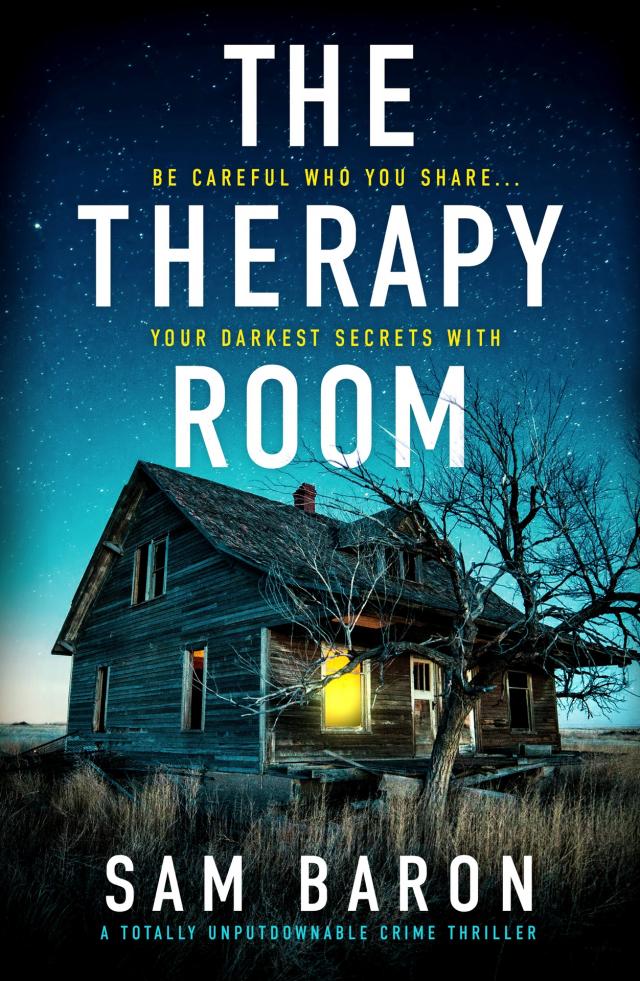
THE THERAPY ROOM
SAM BARON
CONTENTS
Chapter 1
Chapter 2
Chapter 3
Chapter 4
Chapter 5
Chapter 6
Chapter 7
Chapter 8
Chapter 9
Chapter 10
Chapter 11
Chapter 12
Chapter 13
Chapter 14
Chapter 15
Chapter 16
Chapter 17
Chapter 18
Chapter 19
Chapter 20
Chapter 21
Chapter 22
Chapter 23
Chapter 24
Chapter 25
Chapter 26
Chapter 27
Chapter 28
Chapter 29
Chapter 30
Chapter 31
Chapter 32
Chapter 33
Chapter 34
Chapter 35
Chapter 36
Chapter 37
Email Signup
A Letter from the Author
for
May
&
Sheila,
my
alpha
&
my
omega
and
for
Leia
my
tau
“The very emphasis of the commandment: ‘Thou shalt not kill’, makes it certain that we are descended from an endlessly long chain of generations of murderers, whose love of murder was in their blood as it is perhaps also in ours.”
—Sigmund Freud
ONE
There is a knife on his threshold and the door is ajar.
The knife is a wicked-looking thing, curved and serrated with razor-sharp teeth that form a jaguar smile.
A sliver of light slips in through the door, making the blade gleam in the darkness of his room.
Why is it here?
He pushes tentatively at the door, not actually expecting it to yield. When it swings wide open, he is astonished.
This has never happened before.
He looks around, trying to make sense of it.
All the other doors are still locked.
Why has only he been let out?
He moves through the basement. After weeks—or is it months?—down here, he has never seen any other part of the house.
Another surprise: the door at the top of the basement steps is ajar!
He climbs with a rising sense of dread, expecting at any minute to be challenged, forced back to his room, made to undergo more therapy.
He cringes at the thought.
When he reaches the top of the stairs unchallenged, his confidence grows.
He can hardly believe his luck.
Stepping onto the first floor, he is startled by a familiar sound. Music! The sweet strains of a classic oldie and the savory aroma of food evoke memories. Saliva floods his parched mouth.
Moments flash across his mind’s eye. Dancing. Singing. A pretty young woman. Days spent working in an office. Nights at a karaoke bar with friends. The taste of spicy wings and cold beer.
All that was taken from him!
Anger flares white hot, setting his brain ablaze.
He grips the knife tightly and pads through the house on bare, filthy feet, seeking out the source of the melody and the aroma.
He finds it in the kitchen, where a man sits at a table, digging into what looks and smells like a sumptuous feast.
He feels an overwhelming rage at the sight of this tableau.
This monster, who has held them all captive for so long, subjecting them to unspeakable suffering, depriving them of even the most basic human necessities, stripping them of all dignity, reducing them to a state of near-animalistic existence. This bastard is feasting!
He approaches from behind, the ugly weapon raised high to strike.
The eating man pauses, mid-mastication. Perhaps he has caught the scent of the other’s unwashed stink.
He starts to turn—too late.
The wicked blade rises and falls, rises and falls, until it is little more than a red blur.
TWO
I could kill her now. Before her husband brings their four-year-old home from swimming lessons. She always leaves the back door open. It would be easy to slip in, come up behind her, and slide a knife in without her ever seeing me. All this pain and rage I carry bottled up inside me will finally have a place to go.
My name is Susan Parker. I’m an FBI agent. It is late November, the night before Thanksgiving. I should be home with my family.
Instead, here I sit in my Prius in the leafy shadow cast by a large elm, between streetlamps on a deserted suburban back lane. Watching a house. The brightly lit living room has a picture window. Inside, a woman around the same age as me is setting a table for dinner.
I don’t know this woman. I’ve never met her, and as far as I can tell, we have no friends or social acquaintances in common, even though I live only a few miles from here.
But she is the last person to have seen my husband Amit alive.
The dump from his phone’s GPS shows this address as his last stop that night. Camera footage from a neighbor’s surveillance camera shows Amit’s pickup truck stopping in her driveway, him getting out, walking to the porch, then going in. He comes out again around half an hour later and drives off.
Not long after that, an anonymous call reported gunshots from a house only a couple of miles from here, and when first responders arrived on the scene there, they found Amit lying dead in a pool of blood, a gun in his hand. No suicide note was found.
His phone had no contact matching this woman’s name, address, or phone number. I had never heard him mention her. In her statement to the police, the woman claimed she had never seen him before in her life. She couldn’t explain Amit’s visit to her house that afternoon and denied meeting him. She claimed she was out at the time, running errands, but there’s no way to prove or disprove her alibi, except for the fact that her car wasn’t visible in the driveway in the neighbor’s surveillance footage.
Who is she?
I don’t mean that literally. I know she’s a preschool teacher at a local daycare center, happily married by all appearances, with a four-year-old son, a husband, and a mortgage. Said husband is a lawyer with a big firm who works in the city and commutes. But that’s it. There’s no connection to my husband, none that I could find, nor the Santa Carina Valley Police Department and FBI.
But really, who is she?
What was she to my husband?
Were they having an affair?
The question prods my already aching heart. I feel like I’m disrespecting Amit’s memory simply by thinking it. While we weren’t a perfect couple—who is?—we were certainly close enough for complete, undoubting trust. Guilt pricks at my conscience for questioning his fidelity.
But given his actions on that last day, and as a law enforcement officer myself, it’s a question I can’t avoid.
Was guilt over his infidelity one of the factors, or maybe even the factor, in his subsequent suicide? It would explain some of the things that are driving me crazy.
Amit was a straight-arrow guy with a clear moral compass. If he did stray, which I can’t imagine him ever doing, it would have eaten away at his insides, hammered at his conscience, tearing him down. I still can’t see him taking the extreme step of shooting himself over it, but maybe that’s what infidelity did to him: drove him temporarily, emotionally insane.
And if not infidelity, then why was he here at this strange woman’s house on that particular Wednesday afternoon? Twenty-eight minutes is a helluva long time. Why did Amit choose to spend those last precious minutes with this woman? Did she in some way influence him to take his own life? Why? These questions buzz like a swarm of hornets trapped inside my skull. But the lawyers and my own superiors were very clear about the fact that if I am ever caught harassing her, there will be serious consequences.
Just to be clear: I’m not a bad person and thoughts of murdering random women in home invasions are not my usual daydream fare. But I have seen some very bad things in my career as an FBI agent, and experienced trauma in my personal life. Those experiences change you. If I have moments of frustration when I feel tempted to use deadly force to compel this woman to talk, it’s only because that’s how my obsessive-compulsive mind works: I must have answers, one way or another.
In the brightly lit diorama of the picture window, happily unaware of my dark thoughts, the woman finishes setting the table just as my phone buzzes.
I look at the message:
Home for dinner? N’s asking.
Damn. I lost track of the time. Have I really been out here that long?
On my way. Home in 5.
I start the Prius and bring it around, remembering to switch on the lights. The beams flash across the picture window of the house across the street. The woman pauses in the act of setting down a bowl of mashed potatoes. Our eyes meet.
With the headlights in her face, she can’t actually see me, but I still feel a pang of guilt. What was I thinking, sitting out here? Parked out on this quiet, leafy, suburban street, watching this strange woman and her family? I should be home with Natalie and Lata.
As I drive away, I console myself that my stalking her isn’t an obsession. I don’t know this woman or what her relationship might have been to my dead husband, but I do know that she’s the last person to have seen Amit alive. She must know something.
Less than four minutes later, I turn into my lane.
That’s one advantage of surveilling someone who lives in Santa Carina Valley. The entire township is spread out over a few dozen miles. You can drive from one part of it to the other in under twelve minutes, even at rush hour. It’s also a disadvantage because there’s a better than average chance your subject might recognize you from somewhere.
I feel a rush of pleasure as the Prius slows to a halt.
That Schwin bike with the purple handlebar tassels leaning against the garage door—instead of the side wall where it ought to be parked—is my daughter, Natalie. The dust-spattered Jeep Explorer with the four-wheel drive, offroad tires, and the bumper sticker with the USMC logo and the words “The Few, The Proud” is my sister-in-law, Lata. This dusty, overworked Prius in desperate need of a tune-up and some TLC is me.
And this charming little cottage on its tiny lot, the one with the red roof, the bright blue door, and the avocado tree in the front yard, this is us.
Welcome to the Parkers.
Caution: we are not all we seem.
THREE
Natalie is on the couch, bent over her iPad as she usually is at this hour. She doesn’t hear me come in, of course, but Lata pops out of the kitchen, an unlikely figure in an apron. The short-cropped hair with red and blue streaks, kohl eyes, nose stud, toned arms and ridiculously fit physique go surprisingly well with her spatula-wielding sponge Bakers Gotta Bake apron.
“Hey, SpongeBob Martha Stewart,” I say as I hang up my jacket.
She ignores my quip and asks, “All good?”
I make a circle with my thumb and forefinger. “Copacetic.”
She looks skeptical.
I change the topic by gesturing at Natalie’s back. “How’s munchkin?”
Lata gives me a double thumbs up.
I come up behind the sofa, leaning over and suddenly dropping my upside-down face in front of Natalie’s. “Boo!”
Natalie stares at me then signs with mock attitude, “Halloween’s over, Mom!”
I indicate the ghoul-infested game on her screen and sign, “Yet here you are, playing that game again.”
Her little face breaks into a pretty smile as she gives up the pretense of being upset with me for not being here when she came home from art camp.
“I was just kidding,” she signs. “You know I love Halloween!”
I laugh, signing, “And yet you get freaked out every year when we dress up and go trick-or-treating!”
She pouts. “I can’t help if some of the costumes are too scary!”
I laugh and hug her. “It’s fine, sweetheart. To be honest, I get a little freaked out, too.”
She looks at me to gauge whether I’m joking.
“Honest,” I sign.
She laughs and points at me. “You? Get scared? That’s crazy!” she signs vigorously, the deaf equivalent of yelling.
“Ya got me!” I sign back just as vigorously.
We laugh together.
Then she hugs me unexpectedly. I savor the hug, knowing that these precious years will pass, like all good things in this world.
“I love you, Mom,” she signs.
“Love you, too, sweetie,” I sign back, feeling a lump in my throat.
Holding her little seven-year-old body to mine, feeling our hearts beatmatching, I feel a great rush of love and joy. These are the moments when the darkness that has taken up residence inside me retreats, kept at bay by the bright light of living, at least for a while.
Over dinner, Natalie pours out all the things she usually shares with me at the end of each day, telling me everything she saw, felt, did, learned, and said today. Her observations about the world, her friends, teachers, anything and everything under the sky.
I ask a few questions, comment a couple of times, but mostly just sit watching her and take it all in. Basking in her energy. It’s an incredible feeling knowing that you sent this new life out into the world who is very much her own person, navigating her own path through the vast wilderness. I live for these moments, content simply to be her parent and a part of her wondrous life.
Lata watches us, her soldier’s face a calm mask, only her eyes betraying the pleasure she feels in observing us. I smile at her with my eyes; she smiles back.
We are a family now. I can’t say we were the best of friends before Amit’s death; in fact, I barely even knew Lata because of her military tours and postings, but less than a year after his passing, we’re as close as can be. The truth is, I could never have survived this past year without Lata, and I can’t imagine how things would have been for Natalie, who was six when it happened, and has only just turned seven this month, without Lata to take up my slack. Especially during my darker days.
We’re halfway through dinner when my phone vibrates in my jacket pocket.
“You going to answer that?” Lata asks after it continues for several seconds.
“It can go to voicemail,” I say. Though I can’t help wondering.
“It’s okay, Mom,” Natalie signs. “It might be important.”
She says it so sincerely, I give in. For the past several months, I’ve been focusing on family time, on simply “being present in the moment” as my therapist calls it, and one consequence of not being on active duty is that I can ignore my phone at such times. It’s also important because we’re trying to set a good example by showing that we can do without our devices.
But something compels me to reach for my phone.
“Susan Parker,” I say as I take the call. I dropped the “FBI” part a while back, again, on my therapist’s advice. I am suspended, after all.
There’s a brief pause, then, “Special Agent Susan Parker?” a man’s voice says.
“Speaking,” I say.
“This is Detective Naved Seth, Santa Carina Valley Sheriff’s Department.”
I frown, aware that Lata is watching me without seeming to watch me, while passing Natalie the mashed potatoes.
“How can I help you, detective?” I ask.
“This will sound a little strange,” he says.
“Try me.”
“I need you to come down to view a crime scene.”
“Where?”
“A farm on the north end of the Santa Carina valley. Keep heading north after LARC Ranch. You’ll see an old dirt road that winds left up to a ridge and then down again after about a mile, until you see an old, abandoned ranch house—”
“The old Dirty Tricks Ranch?” I ask.
He sounds surprised. “You know it?”
“What is this about, detective?”
I hear a low keening sound in the background, similar to a dog howling but at a different pitch.
“I think I’ve found Splinter,” he says.
My heart thumps like a trap drum in my chest.
“Agent Parker?” he asks as the seconds tick by.
I make eye contact with Lata. She knows that something’s up. It’s probably written all over my face.
“Be there in ten minutes,” I say, and hang up.
Lata raises her eyebrows.
“I have to go,” I say to her.
Then to Natalie: “Sweetie, something came up. I might be back really late, okay? Aunty Lata will put you to bed.”
I glance at Lata who nods.
“Sure, Mom,” Natalie signs.
I give her a hug and kiss her on her forehead. “Bye, sweetie.”
“Bye, Mom,” she signs as I sling my jacket over my shoulder and start for the door. “Stay safe!”
Her words echo in my mind as I leave the house.
Stay safe.
She says it out of habit, I know, because she’s aware, in her own fuzzy, seven-year-old way, that my job involves hunting down dangerous people.
But it has special resonance tonight.
Because tonight, I have a date with a serial killer.
FOUR
A pair of red eyes floats in the darkness.
My foot eases off the gas and taps the brake.
I come to a halt less than ten meters from the coyote.
She stands in the middle of the road, head low, shoulders hunched, staring directly at me. With the headlights in her face, she shouldn’t be able to see me through the windshield, but I think she does, somehow. She holds my gaze for a moment, and I feel the same prickle of unnamable emotion I experience every time I encounter a creature in the wild.


