George VI and Elizabeth, page 1


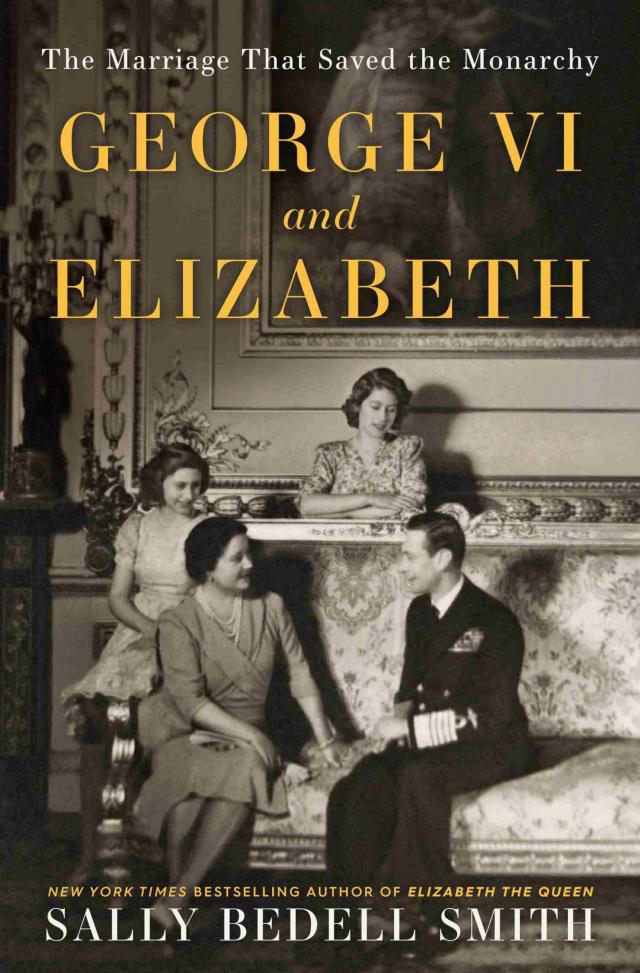
King George VI and Queen Elizabeth with Princesses Elizabeth and Margaret in coronation robes and crowns.
Copyright © 2023 by Sally Bedell Smith
All rights reserved.
Published in the United States by Random House, an imprint and division of Penguin Random House LLC, New York.
Random House and the House colophon are registered trademarks of Penguin Random House LLC.
Grateful acknowledgment is made to Curtis Brown, London, for permission to reprint excerpts from both the published and unpublished diaries of Harold Nicolson, © The Estate of Harold Nicolson. Published diary quotes are taken from Diaries and Letters 1930–1939 by Harold Nicolson, edited by Nigel Nicolson (New York: Atheneum Books, 1966), The War Years 1939–1945, Volume II of the Diaries and Letters by Harold Nicolson, edited by Nigel Nicolson (New York: Atheneum Books, 1967), and The Later Years 1945–1962 by Harold Nicolson, edited by Nigel Nicolson (New York: Atheneum Books, 1968). Used by permission of Curtis Brown, London.
Library of Congress Cataloging-in-Publication Data
Names: Smith, Sally Bedell, author.
Title: George VI and Elizabeth : the marriage that saved the monarchy / Sally Bedell Smith.
Description: New York : Random House, 2023. | Includes bibliographical references and index.
Identifiers: LCCN 2022017389 (print) | LCCN 2022017390 (ebook) | ISBN 9780525511632 (hardcover) | ISBN 9780525511656 (ebook)
Subjects: LCSH: George VI, King of Great Britain, 1895–1952. | Elizabeth, Queen, consort of George VI, King of Great Britain, 1900–2002. | George VI, King of Great Britain, 1895–1952—Marriage. | Elizabeth, Queen, consort of George VI, King of Great Britain, 1900–2002—Marriage. | Marriages of royalty and nobility—Great Britain—History—20th century. | Great Britain—Kings and rulers—Biography. | Queens—Great Britain—Biography. | Royal couples—Great Britain—Biography. | Monarchy—Great Britain—History—20th century. | Great Britain—History—George VI, 1936–1952.
Classification: LCC DA584 .S65 2023 (print) | LCC DA584 (ebook) | DDC 941.0840922—dc23/eng/20220426
LC record available at https://lccn.loc.gov/2022017389
LC ebook record available at https://lccn.loc.gov/2022017390
Ebook ISBN 9780525511656
randomhousebooks.com
Book design by Susan Turner, adapted for ebook
Cover design: Belina Huey
Cover photograph: Cecil Beaton/Victoria and Albert Museum
ep_prh_6.0_143000293_c0_r0
Contents
Cover
Title Page
Copyright
A Note on Royal Names
Prologue
Part One: Loss and Love
Chapter One: Twelve Days
Chapter Two: An Honorable Boy
Chapter Three: Stuck in Sick Bay
Chapter Four: The Rent You Pay for Life
Chapter Five: Coolness and Courage
Chapter Six: Do’s and Don’ts
Chapter Seven: Radiant Vitality
Chapter Eight: Improved in Every Way
Chapter Nine: More Than an Ordinary Friend
Part Two: Halcyon Days
Chapter Ten: Don’t Forget Your Honey Lamb
Chapter Eleven: A Gilded Carriage
Chapter Twelve: A Splendid Partner
Chapter Thirteen: Family Affairs
Chapter Fourteen: Out of the Welter
Chapter Fifteen: My Heart Goes Pit-a-pat
Part Three: The Road to the Crown
Chapter Sixteen: Tremendous Joy
Chapter Seventeen: Eager to Do Well
Chapter Eighteen: Family Crises
Chapter Nineteen: Interlude
Chapter Twenty: A Certain Person
Chapter Twenty-one: The Sunset of Death
Chapter Twenty-two: Tears of Destiny
Part Four: A Royal Beginning
Chapter Twenty-three: Upright Bearing and Grave Dignity
Chapter Twenty-four: His Brother’s Shadow
Chapter Twenty-five: Simplicity and Dignity
Chapter Twenty-six: Transatlantic Triumph
Chapter Twenty-seven: We Shall Prevail
Part Five: The War Years
Chapter Twenty-eight: Sharing the Suffering
Chapter Twenty-nine: American Friends
Chapter Thirty: The Tide Turns
Chapter Thirty-one: Overlord
Part Six: An Indelible Legacy
Chapter Thirty-two: Changing of the Guard
Chapter Thirty-three: Romance in the Air
Chapter Thirty-four: Sunlight and Clouds
Chapter Thirty-five: Farewell, with Love
Photo Insert
Dedication
Acknowledgments
Sources
Illustration Credits
Index
By Sally Bedell Smith
About the Author
_143000293_
A NOTE ON ROYAL NAMES
Names in the royal family are inconsistent and often puzzling, partly due to habitual nicknaming, but more because of the inevitable changes that come with the progression of titles, especially among those first in line to the throne.
For the purposes of this book, King George VI will be variously known as Prince Albert (his given name); Albert; Bertie, his nickname in the family throughout his life; the Duke of York—the title his father gave him in 1920; George VI, the name he chose from among his four Christian names when he ascended the throne in 1936; and the King.
Queen Elizabeth will be referred to as Lady Elizabeth Bowes Lyon; Elizabeth; the Duchess of York—her title on marrying Albert, the Duke of York, in 1923; Queen Elizabeth, the title she took on her husband’s accession in 1936; the Queen; and the Queen Mother after the death of her husband in 1952.
Princess Elizabeth, the future Queen Elizabeth II, will be referred to as Princess Elizabeth, her name from birth; Lilibet, the nickname from childhood she gave herself; Queen Elizabeth II on taking the throne in February 1952; and the Queen.
Princess Margaret, the younger daughter of George VI and Queen Elizabeth, will be called Princess Margaret, her birth name, and Margaret.
King George V will be called first Prince George, then George V.
Queen Mary will be referred to initially as Princess May, as she was known from the time of her birth, and Queen Mary after her husband, George V, took the throne in 1910.
King Edward VIII, the older brother of King George VI, will be called Prince Edward or Edward, as well as David, his name within the family; the Prince of Wales—his title from 1910 until he became king in January 1936 on the death of George V; and the Duke of Windsor—the title his brother gave him after the abdication in December 1936.
Wallis Warfield Simpson, the Duke of Windsor’s wife, will be called Mrs. Simpson, Wallis, and the Duchess of Windsor following her marriage to the duke in 1937.
Prince Henry, a younger brother of George VI, will be called Henry rather than Harry, his family nickname (to avoid confusion with his sister Mary’s husband, also nicknamed Harry), and the Duke of Gloucester, the title given him in 1928 by his father, George V.
Princess Alice, Duchess of Gloucester, will be called the Duchess of Gloucester and Alice. (It was not until the death of her husband in 1974 that Queen Elizabeth II designated her aunt as a princess.)
Prince George, another younger brother of George VI, will be called Prince George, but also Georgie, his family nickname; he will also be referred to as the Duke of Kent, the title given him by King George V in 1934.
Princess Marina, the wife of Prince George, will be called Princess Marina, the Duchess of Kent, and Marina.
Princess Mary, the younger sister of George VI, will be called Princess Mary.
Henry Lascelles, the sixth Earl of Harewood (pronounced “Hahrwood”), Princess Mary’s husband, will be called Harry Lascelles and later Harry Harewood, when he inherited the earldom in 1929 on his father’s death.
Prince John, the youngest brother of George VI, will be called Prince John and Johnnie, as he was known in the family until his death at age thirteen in 1919 from a major epileptic seizure.
Other historical and collateral members of the royal family will be known by their given titles: for example, King Edward VII or Edward VII and Queen Alexandra or Alexandra, the grandparents of King George VI.
In the interests of simplicity, the terms His or Her Royal Highness and His or Her Majesty will be avoided except in specific circumstances or when mentioned in a direct quotation.
“They were more resilient and strong-minded than they appeared to be.”
King George VI and Queen Elizabeth on their twenty-fifth wedding anniversary, April 26, 1948.
PROLOGUE
It is a big claim to say that a single royal couple saved the centuries-old British monarchy. But King George VI and Queen Elizabeth, later known as the Queen Mother (or “Queen Mum”
The accident of history was the constitutional crisis provoked by George VI’s older brother, King Edward VIII, who abdicated in 1936 because of religious, official, and popular opposition to his intended marriage to the American socialite Wallis Simpson. She had already divorced one husband and was divorcing her second. Because the monarch is the nominal head of the Church of England, which forbade divorced people to remarry in the church, she was considered an untenable choice to be queen. When Edward defied the advice of Prime Minister Stanley Baldwin and insisted on Queen Wallis, Baldwin and his cabinet threatened to resign en masse. In the end, Edward VIII chose Mrs. Simpson over the Crown.
Shocked by his older brother’s decision, George VI nevertheless embraced his destiny. He transformed himself into an exceptional leader, through grit and determination. During his fifteen-year reign, his wife, Queen Elizabeth, was at his side every step of the way, providing support, encouragement, and wise counsel.
Their remarkable partnership lasted until George VI’s death at age fifty-six. Elizabeth was just fifty-one and would live to be nearly 102. Her fifty years as a widow—the merry Queen Mum beloved by the British people and throughout the world—have overshadowed the nearly three decades of a successful and happy marriage that is the scope of this book. The British actor Colin Firth said he had no idea that the Queen Mother had been George VI’s wife until he made the Oscar-winning film The King’s Speech, about the monarch’s struggle to overcome a crippling stammer.
Crucial to the marriage of King George VI and Queen Elizabeth were the qualities of duty and service they exemplified, especially during Britain’s ordeal in World War II. From the earliest days of the war, Adolf Hitler targeted the King and Queen. His bombers hit Buckingham Palace nine times. On one occasion they nearly succeeded in killing the monarch and his queen consort.
As I began my research into the lives of George and Elizabeth, I soon realized that her life was more deeply entwined with that of the King than is generally known. Not only is theirs a touching love story—with surprising dramatic twists—it is a story of inspiration in the most challenging circumstances: repeated personal tragedies and ailments, the ravages of two world wars, and a terminal illness. It’s equally a story of resilience and shared joy.
With the centenary of the marriage of King George VI and Queen Elizabeth being celebrated in 2023, it seems a good time to reflect on who they were, what accounted for their strong marriage, and how they made a difference in the world. How did he grow into his job? How did this inherently withdrawn man gain confidence in his judgments and his interactions with others? How did she mature from a fundamentally unserious aristocrat into a public-spirited source of strength for her husband, her family, and her nation? How did she balance her work as consort with her role as a mother?
Their indelible legacy was their daughter Queen Elizabeth II, who would be widely admired not only for her unflagging service but also for her wisdom and her modesty. Their second daughter, Margaret, caused heartache for both her mother and her sister, starting in the years after her father’s death. Insecure and spoiled, she never found an appropriate role despite her many advantages.
With the permission of Her Majesty Queen Elizabeth II, I was able to spend three months in the Royal Archives at Windsor Castle and several days at Glamis Castle, the ancestral home of her mother’s Bowes Lyon family—the earldom of Strathmore. The extent of this access was noteworthy for someone who was not designated an official biographer.
Reaching the archives at Windsor posed a challenge each day. It required climbing with a backpack up a staircase of more than one hundred medieval stone steps—the equivalent of ten stories—with my lunch in tow so I wouldn’t have to climb them again. The reward was a research room atop the Round Tower that is cozy, hushed, and efficient. Getting to Glamis (pronounced Glahms) involved a flight from London to Edinburgh, a ninety-minute drive, and a comparable climb to the top of a tower. This aerie was cluttered and minimally heated, but it offered an illuminating trove of letters and other documents, mostly handwritten.
My research also included reminiscences from elderly friends and family who shared helpful insights. But King George VI and Queen Elizabeth revealed themselves most fully in their diaries and letters. Elizabeth’s correspondence was vivid and often entertaining, but thoughtful—and even poignant—when the moment demanded. Her adult diaries, kept intermittently during her twenties, were less mature than her husband’s detailed chronicle from 1939 to 1947, but similarly telling.
The story that unfolded in leather-bound books and on monogram-engraved writing paper showed their strengths as well as their frailties, their complicated family dynamics, and the crosscurrents of intrigue and secrets within the royal court. Amid the wartime terrors of air raids and invasion threats came unexpected pleasures: shooting weekends, movies, plays, golf, bicycle and horse riding, and dances. These papers also revealed the perspective of the King and Queen on their relationship with Winston Churchill, who became prime minister in May 1940. Their dealings encompassed lunches, dinners, and other occasions that went far beyond the typical weekly formal audiences of a monarch and the first minister.
Supplementing these documents, additional previously unexplored archives shed light on the royal couple’s relationships with an array of political and military leaders, and show how others saw them working as a mutually supportive duo. George VI’s and Elizabeth’s “special relationship” with key Americans, from President Franklin D. Roosevelt on down, emerges from these documents in surprising ways, revealing both admiration and annoyance.
The British royal family is by definition insular and wrapped in mythology, much of it self-created. It wasn’t until the late twentieth century that the press dropped its deference, and the tabloids filled their pages with a mixture of fact and speculation. In the twenty-first century, the Netflix series The Crown upped the ante by presenting a beautifully produced but largely fictitious account of the monarchy that most viewers believed to be factual. It was a long leap from the time of George VI and Queen Elizabeth, when Buckingham Palace tightly managed all information about the royal family.
The men in control were the top-echelon advisers to the King and Queen, the “courtiers.” Aristocratic and well-educated, they held military rank, and many fought heroically in the First World War. They had impressive connections throughout British society and in Parliament and at Whitehall. They had the inside track, and through their letters and diaries, combined with those of royal family members, a modern biographer can better understand the story of George VI and Elizabeth and their family.
First among these courtiers was Sir Alan Lascelles, an erudite and commanding figure who worked for the royal family for twenty-seven years. During eighteen of those years, he served as private secretary to King George V, King Edward VIII, King George VI, and Queen Elizabeth II. He was the most influential of royal insiders—and the most problematic.
When he was a boy, his father likened his large head and skinny body to “Tommy Tadpole.” Everyone thereafter called him “Tommy” except Winston Churchill, who always referred to him as Alan. Over the decades, Tommy Lascelles melded into the blur of the “grey men” (as Diana, Princess of Wales, derisively called them) in the royal court. But his razor-sharp depiction by the actor Pip Torrens in The Crown made him an unforgettable figure—something of a twenty-first-century star with his intense dark eyes, basso profundo voice, bristling mustache, punctilious manner, and severe opinions. His words may have been invented for the television show, but his personality was true to life.