

Charles Carr, page 1


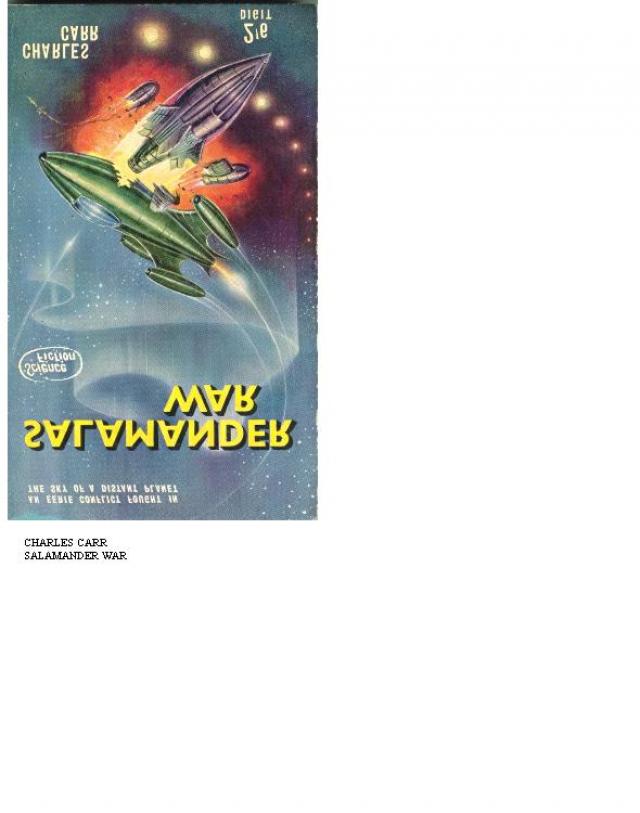
CHARLES CARR
SALAMANDER WAR
DIGIT BOOKS R616
BROWN, WATSON LIMITED, LONDON
First published by Ward Lock & Co. Ltd.
Digit Books are published by
Brown, Watson Ltd., Digit House, Harlesden Road,
London, N.W.10.
Printed in Great Britain by
The Redditch Indicator Co. Ltd., Easemore Road,
Redditch, Worcs.
1
“More!” he had cried eagerly. “More!”
Back there, on one of the hills of Earth, he had held his mother’s hand tightly, watching one bright spark after another climb the sky and burst into the coloured stars that enchanted him as they floated lazily down. There were other fireworks, but it was the rockets that he loved and for which he cried, “More! More!” till the show was ended and he was coaxed protesting, away. Next day he had come back to search the ground and find the fallen cases, sad, empty cylinders of cardboard, soaked by the dew, blackened and sour-smelling.
For him the attraction of such displays did not pall as he grew. When he was a college student he had still watched them. Even after he had graduated and secured his first spaceship appointment, he had gone to watch. There had been a girl with him. What was her name?
Molly - that was it. They had stood arm in arm, looking at the show organised as a celebration for victory in World War III. It was not so long ago, though very far away.
Remembering this, Taylor, the assistant engineer, had for a while almost forgotten the threatening present. He lay on his couch, a dark, slim, virile young man; in the dimness he could just see the ceiling of his hut. Through one wide window stars showed in thick clusters above the dark side of the planet; through another window he could just see the spaceship Colonist, whose long voyage had ended here. It stood like a slim monument out there beyond the village of huts that had been built by the hundred-odd members of its crew in the reservation that had been allotted to them by those whom they had found in possession.
He lay quite still, summoning up that vision, seeing rockets that were not the power units of spaceships with which his training had made him familiar, but things of fleeting beauty.
He was relaxed in body, but his mind was unquiet. On this planet, Bel, sleep was unknown.
But rest was still necessary, especially for the latest arrivals, and periods of repose had been arranged by their Captain, Lyon. Taylor had found that during these periods he could induce a dreamlike state that was sometimes comforting. This time, however, it seemed to have been a mistake. He was moving among disturbing memories. It would have been better to have forgotten.
But how could he forget that time with Molly? It had a special poignancy, because for him it had been the last time. Before the next anniversary he had himself climbed the sky in a rocket on the first stage of the journey that had ended here. And for Molly, as for all those on Earth, all victory days were ended. There had been the final day of defeat, when the whole globe had become a firework, a burnt-offering to the genius of destructive Man. Now it was a dead cinder that circled the Sun, with sterile winds that blew aimlessly across its surface, driving the mingled, uneasy dust.
He sighed and then filled his lungs with the unsatisfying air. Why must he think of these things? To escape he tried to retrace the steps that his mind had taken. Was it the analogy between rockets of different kinds, or that between the burnt scraps of cardboard and…?
But that was not how he came to pursue the train of thought. No, it was the light - the half-light. Of course, that was it.
Back there on Earth there had always been a pause, a thrilling period of suspense when the sky had dimmed, and yet it was still a little too light for fireworks. In that time of impatient waiting, until the darkness deepened a further shade, one could still see faces clearly enough. In a moment the fireworks would show to advantage.
That was it. The light here on Bel had just that same grey quality, but the balance was held; it was perpetual. Here in the temperate belt of the planet it was always twilight. One could see quite well out of doors; inside a building one needed artificial light to work by.
Bel was his home now, a planet chosen for colonisation because on a small part of of its surface conditions approximated to those on dead Earth. Here Man, his animals and plants could live. Elements existed in roughly the same proportions as on Earth. Gravity was so little less that hardly any adaptation was needed.
But there were differences, of which the impossibility of sleeping was only one. Children grew to be adults in the equivalent of three years of obsolete Earth time. In the narrow belt occupied by the human race there was neither night nor day. On one side of them lay a hemisphere of everlasting night, and the other a hemisphere of everlasting day - the cold side and the hot.
No sleep, thought Taylor, and little joy in living. Laughter had died out already among the grave Swiss pioneers whom the crew of Colonist had found on Bel. Their unresting minds had extended and developed in mental power. The kindly contempt of the Swiss towards the newcomers was imperfectly concealed and hard to bear. Taylor writhed at the thought that he was treated almost as one of a band of savages, confined to a reservation far from Una, the capital city.
To him it was a humiliation to be dependent for the air he breathed upon those brilliant and unsmiling scientists and technicians. Their great system of oxygen plants had enriched the atmosphere and made it breathable without distress, until recently.
Worst of all to him was the impotence of knowing so little of what happened beyond the confines of the reservation. For the last two hundred hours it had been difficult to breathe.
That would not have been so bad if only he knew the reason.
He fought his fears, taking deep, regular breaths. It would be ridiculous to panic, for the discomfort was not really bad except when physical exertion was necessary. The oxygen content of the air was declining gradually; it could not fall suddenly. And there were masks and cylinders that could be used if necessary.
And there was the personality of Lyon, the Captain. Surely he would not tamely allow disaster to overtake his people.
Taylor’s hopes and fears seesawed. Yes, he thought, but what could even Lyon do, if he did not know the reason for the impoverished air? Lyon’s powers, too, might have deteriorated.
For too long the man had been harnessed to an insufficient load.
But surely this emergency must have roused the Captain. Else why had he sent Kraft, the Chief Scientist, to Una by the periodical liaison ‘plane? Surely it was to find out what was the cause of failure in the oxygen plants, and whether it was only a temporary breakdown or not.
Taylor heard an approaching scream in the sky. Looking up, he saw the trails of jets and a flash of silver. The rays of the sun, which never touched the reservation, caught the wings of the
‘plane at it’s high altitude. So Kraft was coming back. He must be aboard the ‘plane. Now they would soon know their fate.
2
As soon as he left the hut he saw the ‘plane. It was circling, coming down to land. Staring up at it, he collided with a huge animal mass which yielded slightly from the impact.
This was a shug, a creeping thing, one of the larger ones, three metres long and nearly a metre high. The foolish creatures usually kept away from the huts, browsing among the tall ferns. It was lost here - the one that Taylor had encountered, its greedy snout snuffling in its instinctive search for food.
There was no vice in these shugs, but they had been known to damage buildings in their heavy, stupid blunderings. Taylor held his hand over one side of the shug’s single, many-faceted eyes.
That was the quickest way to steer a shug out of trouble. This one now turned docily towards the uninterrupted light.
Taylor left the shug to crawl back to its pasture. The incident had take a little time, however.
He began to hurry towards the landing-ground, and quickly became aware again of the shortage of oxygen in the air. He stopped, sucked in more air, and then went on more slowly.
The plane was down by the time he arrived. Pratt, the mechanic on duty, helped to open the door.
“Can’t ‘ardly breave,” he announced. “What a bloomin’ climate!”
But no shortage of oxygen could tame Pratt.
“Welcome ‘ome, cock!” Taylor heard him say. And then, “No, mate, ‘tain’t you I mean.”
For it was the pilot who first appeared in the doorway. He was a young man, fit, hard and of good physique. Probably his age was not more than fifty thousand hours, but maturity came quick on Bel. This man had the usual appearance of one of the Swiss born on the planet - very intelligent but glum. He wore a light woollen robe belted at the waist.
The pilot disregarded Taylor and Pratt as he spoke over his shoulder to someone behind him.
“I can no acteefity see.” He came evidently from a German-speaking family.
Kraft appeared beside the young man. Kraft was stout, rather bald, and middle-aged. Unlike the pilot he wore overalls; these were the uniform of the Colonist men. “It’s the time for repose,” he pointed out.
“Repose!” the pilot said contemptously. His contempt, however, was not directed at his passenger. Kraft, as Chief Scientist of the reservation, was respected even by the intelligentsia of Una.
Kraft resented the implication that his people were lazy. Taylor saw him prepare to make an angry retort to the pilot. But the scientist though better of it, and spoke instead to Taylor.
“I must see Lyon at once,
He thanked the pilot. Pratt, puffing stertorously, was heaving into the ‘plane a number of heavy sacks which clanked metailically.
“‘Ere’s the bagwash comin’ aboard,” Pratt panted. “Light as a fevver, I don’t think.”
“What is it you say?” The pilot stooped and felt the contents of a sack. “But these are not vashing, but oxygen cylinders.”
“My mistake, mate.” Pratt kept a straight face, then winked at Taylor as he turned away.
Already, before Kraft and Taylor reached Lyon’s office, the ‘plane had taken off and was climbing to gain elevation for the return flight to Una.
Kraft opened the office door, and Taylor saw that the interior was brightly lit. Lyon, the Captain, was there with Harper, his deputy, and Loddon, the engineer. Lyon, white-haired, vigorous, but with his face now set in lines of bitterness, caught sight of Taylor and called out to him.
“Taylor!”
“Sir.”
“Find Hyde, and ask him to come back here with you.”
“Yes, sir.”
Taylor found Hyde, the doctor, in the hut that he occupied with his wife, Eleanor, and their three-thousand-hour-old baby boy.
“What does Lyon want me for?” Hyde asked. He was Taylor’s age and markedly cheerful.
The responsibilities of marriage and paternity in the novel conditions of this Planet seemed not to weigh upon him.
“Kraft’s back from Una.”
Hyde whistled. “Now we may hear what’s happening to the oxygen. You know that’s what Lyon sent him about?”
“I guessed it.”
“So Lyon’s holding a conference? Are you sitting on it, young Taylor?”
“I don’t know. He told me to come back with you.”
Lyon did, in fact, invite Taylor to stay. There were now six of them at the table. Harper’s face was expressionless. Loddon was grinning youthfully, showing his excellent third set of teeth. The engineer was much older than he looked; acceleration on the voyage to Bel had strangely rejuvenated him.
Lyon was giving some instructions to Harper.
“There’s to be no panic an any account. Understand? And you can help there, Hyde. We’re all a bit short of breath, but that won’t kill us. If you get complaints you can tell ‘em it’s only like being up a mountain on Earth.”
“A pretty high mountain,” Hyde said. “About five thousand metres.”
“Even so, it’s bearable.”
“Unless it gets worse.”
“Kraft can tell us all about that,” said Lyon. “Well, Kraft, what did you find out? You’ve been a long time away.”
“That’s true,” Kraft admitted. “But it was unavoidable, sir. ‘Planes, cars - everything goes slower because of the oxygen shortage. We go slower too. Besides, I wasn’t in Una all the time. They took me out to one of the oxygen plants -“
“Yes?” said Lyon. “And what did you find? What’s behind the oxygen decrease? Is it going to last, or will things improve?”
“So far as I can foretell, sir, it may be checked for a short while. Then the oxygen will decrease slowly again. But later there’s reason to hope that the supply will go back to normal.”
“Can I tell our people that?” Lyon asked. “I don’t want them to live in apprehension, but if I give them hopeful news I must be sure it’s true.”
“I understand, sir,” the, scientist said. “I think you should be very cautious in any announcement you make. Let me explain. There were several oxygen plants out of action.
Now, for a time, they will be working again.”
“Why only for a time?”
“Because the reason for failure was not mechanical. Those plants ran out of material -
fissionable material. They have overcome the difficulty temporarily by borrowing from the stocks of other plants.”
Kraft paused. It was Lyon who, at once grasped the significance of what the Chief Scientist had said.
“And there’s no central stock?” asked Lyon.
Kraft nodded. “They used to mine the stuff from the edge of the hot side. That source of supply has petered out. Let me say at once that they plan to push deeper into the hot side.
There should be plenty of the stuff there, and it should be in a more easily workable state if it comes from where the temperature is very high. But it won’t be easy to reach it.”
“And meanwhile -?”
“At the worst, sir, we could live in big air-conditioned chambers.”
“We could exist like that,” said Lyon wryly. “It wouldn’t be living. And what of the vegetation and animals from Earth that the Swiss have farmed and bred? All that part of their work would be destroyed.”
“Yes, that’s why they’re prepared to risk a lot to keep up the supply of oxygen in the temperate belt.”
“Is it such a risk, Kraft? If they know where to get this fissionable material -“
“It’s partly the question of the temperature on the hot side. It would be unbearable for human beings without protection.”
“Then they’d better arrange protection.”
“They’ve done that sir. They’ve proofed vehicles and ‘planes. They’re preparing quite a big expedition. Oh yes, they’re going; and I’m to go too.”
“With my permission,” Lyon snapped.
“With your permission, of course, sir. I meant that I’ve been invited.”
“Then it looks as though the difficulty is well on the way to being overcome?”
Kraft hesitated.
‘There’s one other thing,” he said. “I don’t take it seriously myself. But I’ve spoken to the men who are organising the expedition, and they fear - they’re worried about - the salamanders.”
“The things that inhabit the hot side,” Lyon. He sniffed sceptically.
‘The Swiss swear that they exist, sir.”
“I suppose they breathe volcanic gases and live on lava. I’ll believe in salamanders when I see them, Kraft.”
3
“I’m thinking,” said Lyon, “of sending you to Una with Kraft.”
Taylor asked eagerly, “To go with the expedition, sir?”
“Perhaps, if there’s room for you. The numbers are likely to be limited. But that’s not why I want to send you to Una. Kraf;t will have plenty to think about without worrying over details.
Your job would be to make things easier for him - act as his assistant and secretary. Do you think you can do that?”
“Yes, sir. Does Loddon know?”
“No, but you needn’t worry about that. He can spare you easily enough.” Lyon was becoming irritable, as he often did new. With his white hair and a frown of discontent, he looked old. “You engineers haven’t enough to do. Though that’s true of all of us, I suppose.”
“Since you’ve mentioned it, sir, may I say that we’re busier than usual? We have all the oxygen masks and cylinders to -“
“True, but you worked longer shifts on the voyage, didn’t you? Never mind about that, Taylor. If there’s a crisis while you’re away, young Pitt can do your job. The point is: do you want to go? If you don’t, I can easily find someone else.”
“Of course I do, sir. I’d like to help Kraft, and the change’ll be welcome.”
“You’re right there.” A smile flickered over Lyon’s firm lips. “I’ll get Kraft over.”
There was silence then till the Chief Scientist came to the office.
“Taylor is going to Una with you,” Lyon said. “You told me you needed an assistant.”
“Thank you, sir,” Kraft said. “That’ll be splendid.”
“Splendid for you,” Lyon grumbled. “Not so much fun for the rest of us. I wish,” he added restlessly, “that I could have gone myself. But Leblanc hasn’t invited me. And he’s right, of course. You’ll profit - you’ll learn more than I should. You’re a scientist, and this is a scientific job, or so it seems. When’s the next ‘plane due?”
“In about thirty hours,” Taylor said.
“Well, you’ll both get ready. Don’t talk about what’s going on, except to Harper or Loddon.
That’s all.”
Taylor made ready for the journey to Una. When his preparations were complete he returned to his engineering duties under Loddon. Work went on in the settlement; the necessary mechanical maintenance and the supply of power for light and heating had to continued. Crops and vegetables were still cultivated.


