

Alchemy, page 1
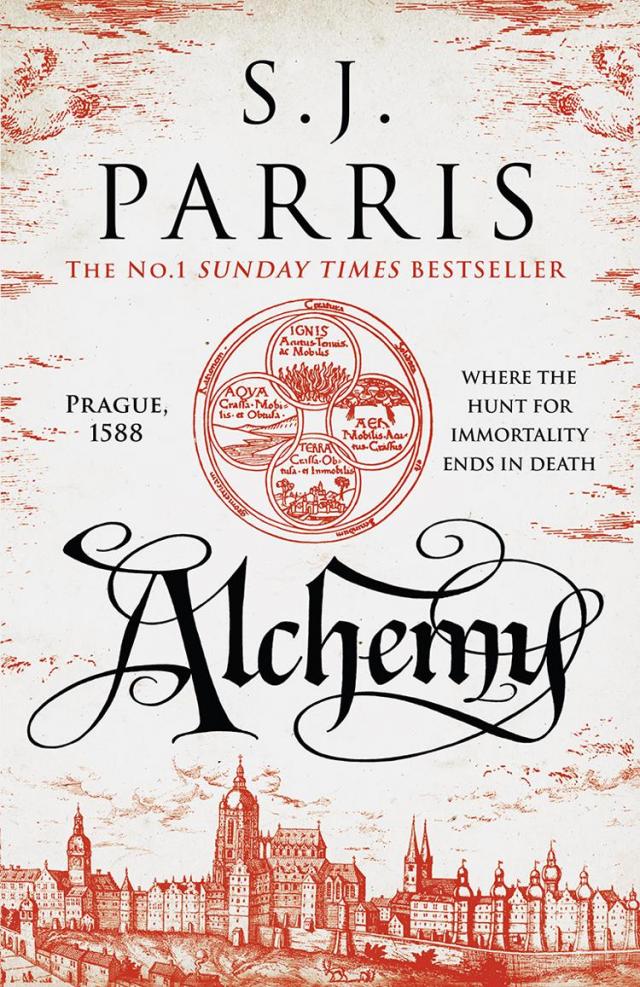


ALCHEMY
S. J. Parris
Copyright
HarperCollinsPublishers Ltd
1 London Bridge Street,
London SE1 9GF
www.harpercollins.co.uk
First published by HarperCollinsPublishers Ltd 2023
Copyright © Stephanie Merritt 2023
Jacket design by Holly Macdonald © HarperCollinsPublishers Ltd 2023
Title lettering: Stephen Raw
Jacket images: Sueddeutsche Zeitung Photo / Alamy Stock Photo (city), Science History Images / Alamy Stock Photo (alchemical symbol) and Shutterstock.com (wax seal and torn paper)
Prague Castle map © Nicolette Caven 2023
Stephanie Merritt asserts the moral right to be identified as the author of this work.
A catalogue copy of this book is available from the British Library.
This novel is entirely a work of fiction. The names, characters and incidents portrayed in it are the work of the author’s imagination. Any resemblance to actual persons, living or dead, events or localities is entirely coincidental.
All rights reserved under International and Pan-American Copyright Conventions. By payment of the required fees, you have been granted the non-exclusive, non-transferable right to access and read the text of this e-book on screen. No part of this text may be reproduced, transmitted, down-loaded, decompiled, reverse engineered, or stored in or introduced into any information storage and retrieval system, in any form or by any means, whether electronic or mechanical, now known or hereinafter invented, without the express written permission of HarperCollins.
Source ISBN: 9780008208547
Ebook Edition © July 2023 ISBN: 9780008208561
Version: 2023-06-14
Epigraph
His Majesty is interested only in wizards, alchemists, Cabalists and the like, sparing no expense to find all kinds of treasures, learn secrets and use scandalous ways of harming his enemies … He also has a whole library of magic books. He strives all the time to eliminate God completely so that he may in future serve a different master …
Proposition to the Archdukes in Vienna, on Rudolf II, 1606
I am forced to be brief. That which we suspected in England is also here.
Letter from John Dee to Sir Francis Walsingham, Prague 1588
Contents
Cover
Title Page
Copyright
Epigraph
Map
Prologue
Chapter One
Chapter Two
Chapter Three
Chapter Four
Chapter Five
Chapter Six
Chapter Seven
Chapter Eight
Chapter Nine
Chapter Ten
Chapter Eleven
Chapter Twelve
Chapter Thirteen
Chapter Fourteen
Chapter Fifteen
Chapter Sixteen
Chapter Seventeen
Chapter Eighteen
Chapter Nineteen
Chapter Twenty
Chapter Twenty-One
Chapter Twenty-Two
Chapter Twenty-Three
Chapter Twenty-Four
Chapter Twenty-Five
Chapter Twenty-Six
Chapter Twenty-Seven
Chapter Twenty-Eight
Chapter Twenty-Nine
Chapter Thirty
Chapter Thirty-One
Chapter Thirty-Two
Chapter Thirty-Three
Chapter Thirty-Four
Chapter Thirty-Five
Chapter Thirty-Six
Keep Reading …
About the Author
Also by S. J. Parris
About the Publisher
Map
PROLOGUE
Seething Lane, City of London
15th day of February 1588
My dear Bruno
I hope Wittenberg is treating you well, and that you have thus far managed to avoid falling foul of the university authorities with your bolder ideas. I know few men who can boast the distinction of being thrown in prison for heresy by both the Catholics and the Calvinists.
I will be brief. I must beg a favour of you, in the hope that your past service to England will incline you once more to our cause. You know that our friend Dr Dee has been at the court of Prague this past while. I have this day received a communication from him, sent a fortnight since, touching some great matter of secrecy that he dared not openly express; yet from his hints, I deduce it concerns the discovery of malign practices against the Emperor Rudolf. If the Emperor’s enemies should succeed in his destruction, the tremors will be felt throughout Christendom. I hardly need tell you how vital it is to England, with the balance of power in Europe on a razor’s edge, to have a friend in the Holy Roman Emperor, at a time when Her Majesty Queen Elizabeth has few enough of those abroad.
I therefore entreat you: hasten to Prague, and there use all your endeavour and industry to give Dee good assistance and learn more of this affair. There is no man I would trust so greatly in this business, and I have every faith that your reputation as a philosopher will ensure your warm reception in the city, which you might use as cover. Convey to Dee the enclosed cipher; I fear the one he has at present is no longer safe. If that is so, then nor is he. I will send further instructions to you in Prague. But I pray you: as you love Her Majesty, John Dee and the truth, do not delay.
God go with you, along with Her Majesty’s good wishes and my gratitude.
Your loving friend
Francis Walsingham
ONE
The alchemist was found hanging from the Stone Bridge at first light with his eyes and tongue cut out. Two sturdy ropes had been slung under his armpits and secured around the plinth of a carved saint who gazed serenely the other way as the corpse swung under the balustrade, dripping its lifeblood into the misty waters of the Vltava. Hebrew letters had been cut into his forehead. This much I had learned even before we reached the gates of Prague, from travellers on their way out of the city, and excitable taverners along the road who delighted in recounting every new detail they gleaned from those passing through. His name was Zikmund Bartos and he had been the Emperor Rudolf’s current favourite among the legions of scryers, distillers, prophets, conjurors, star-gazers, physicians and mountebanks who toiled inside and outside the walls of the great castle on the hill, all vying to be the first to succeed in presenting the Emperor with his heart’s desire, the Philosopher’s Stone. Naturally, there was a surfeit of theories surrounding the gruesome end of Bartos, who had been found on the morning of that chill March day I was due to arrive in Prague. The Ides of March, as it happened, the old Roman deadline for the settling of debts; I wondered if that was significant. By noon, the road was buzzing with definitive versions: he had been attacked by a jealous rival who wished to steal his magical secrets; he had killed himself in despair because he knew his mission was doomed (this one did not find many supporters, on account of the obvious practicalities); he had sold his soul to the Devil in return for forbidden knowledge, and the Devil had exacted his price. This last was seized upon with relish, thanks to the legend of Doctor Faustus, which had been published in the German language the previous year and proved popular with readers. But one word recurred more than any other as we rode those last ten miles towards the city walls in the fading light of the afternoon: Golem.
‘Maestro? What exactly is this Golem?’
I turned to my travelling companion with my best expression of forbearance. ‘Besler. For the thousandth time – don’t call me Maestro.’
He blinked his pale eyelashes at me, as if we had not already had this conversation repeatedly along the road from Wittenberg. ‘But you are my master, and I wish to acknowledge this by giving you a title of respect and honour, in your own language.’
‘I know, but it makes me feel old. And I am not, strictly speaking, your master.’
He leaned back in the saddle to give me an appraising look. ‘Well, you are quite advanced in years now, Doctor Bruno. When you do not shave for two days, there are flecks of silver in your beard. More than a few.’ He sounded apologetic, as if it were an unwelcome but necessary duty to inform me. ‘In any case, I have chosen you to be my master, and therefore you are so.’
‘I’m thirty-nine, Besler.’ I ran my hand across my chin, piqued. ‘And that is a quirk, shall we say, of Italian colouring. It’s nothing to do with age. At least I can grow a beard.’
His eyes widened as if I had struck him, and his head dropped; he fell silent and I smiled to myself. Besler was twenty-two, with those fair, Germanic looks that meant he appeared barely sixteen and needed to shave once a month at most, a shortcoming which made him acutely sensitive; I should not have mocked him. At his age, I recalled, I too had regarded anyone over thirty as half in their grave.
‘You have really never heard of the Golem?’ I asked, to change the subject.
He perked up. ‘I know only that it is some kind of Jewish monster.’
‘Not a monster. A creature. Like a man, but fashioned from clay, as God made Adam. Only a great rabbi steeped in the secrets of the Cabala can breathe life into it by performing certain rituals and incantations. Then he must carve the word EMET – Truth – on the Golem’s forehead and it will obey its master in everything. But on the Sabbath, he must erase the word from the creature’s head so that it can rest, according to the law.’ I shifted position in the saddle and lowered my voice for effect. ‘The story goes that once, on Sabbath eve, a rabbi had begun
‘Goodness. And the word is that this creature is now loose in Prague, killing people?’
I laughed at his earnest expression. ‘It’s just a legend, Besler. It’s said that the Chief Rabbi of Prague is the only living scholar with the mystical knowledge to create a Golem, but you must know it is all invention. Though it certainly sounds as if this murder is intended to make people afraid of a violent monster.’ And point the finger at the Jews of Prague, I realised, with dismay. Even in a city famed for its tolerance, there are those who would try to fuel religious tensions. ‘Still – that is not our problem,’ I added more cheerfully, nudging my horse to pick up his pace. ‘My task is to find my friend John Dee and secure an audience with the Emperor Rudolf. That is all. I have no intention of involving myself in speculation about a killing.’
But the news had made me uneasy. I had seen enough of murder in the past few years to satisfy any curiosity on that score; now I was content to pursue my studies, write my books and teach a select handful of private students, and I had nursed hopes that Prague – that bubbling cauldron of artistic and scientific daring – might prove the home in which my own contentious ideas could flourish. At the university in Wittenberg I met a man who boasted that the Emperor had paid him a salary of three hundred silver thalers for a wholly unoriginal treatise on the music of the spheres; what might this singular prince offer if I could present to him my theory of an infinite universe, free of the confinement of the Fixed Stars, filled with other suns and other worlds? At the very least, I hoped my publications on this subject might not land me in as much trouble here as they had elsewhere in Europe. But there was still the matter of the letter I carried inside my doublet; it pricked me with unease each time I felt it crackle against my side as I moved. I had not told Besler about the letter, and had done my best to hide my apprehension; it seemed wiser to keep him in ignorance.
Towards four o’clock we crested a ridge above the city and the sight caused my breath to catch in my throat, so that I drew my horse to a halt to take in the vista ahead. After so many days’ hard riding, I could scarcely believe we had reached our destination: Golden Prague spread out before us, more striking even than the engravings I had seen in Germany. A forest of spires and pinnacles filling the valley, from the ramparts of the great castle on its outcrop of rock, dominated by the tower of St Vitus Cathedral, down through the grand timber houses of the Lesser Town on the slope facing the plain, all the way to the narrow, crowded streets and bell towers of the Old and New Towns across the river. A sharp east wind herded drifts of cloud across a pale sky; the city glimmered in the low sun of late winter, that threshold season that only exists in these northern countries, when spring is not yet on the horizon but offers small intimations of her coming. Through the centre of the city, the wide, gleaming Vltava curved its path, the arches of its ancient Stone Bridge clearly visible from our vantage point. They would have removed the body by now, I guessed, though we were too distant to make out such detail.
‘I prophesy,’ Besler announced grandly, sweeping his hand from west to east to take in the wide reach of the city below, ‘that within a week all of Prague will know the name of Giordano Bruno.’
I gave him a brief smile. ‘Careful what you wish for, Besler.’
‘Nonsense,’ he said with the blithe confidence of youth. ‘This city is the very place for your ideas to blossom. It’s your destiny. And the Emperor Rudolf was born to be your patron. Your reputation will be made here, you’ll see.’
This was more or less what my English friend John Dee had insisted in his letters over the past year as he urged me to join him here, and yet, as his assurances grew ever more confident, so my unnamed doubt deepened. Until Dee’s last, enigmatic message a month ago, talking of a fear he dared not commit to ink and paper, urging me to come and find him with all haste. I had havered for a fortnight, knowing Dee’s tendency to see conspiracies and persecution where none existed. It was then that I had received the other letter, from England, and made up my mind to depart the next day.
‘Of course, they do say the Emperor is as mad as a basket of snakes,’ Besler added, sounding more circumspect.
‘My ideal patron, as you say. Listen, if I want cheap fortune-telling I can go to one of the booths in the Old Town Square. I hear the place is heaving with soothsayers and card readers ready to promise me long life and riches for a few pennies. Make yourself useful – explain our business to those men.’
‘Yes, Maestro.’
I watched him as he rode on ahead to the imposing gatehouse in the city wall, where two sentries regarded our approach with a mixture of boredom and suspicion. Besler’s mother was Czech and he spoke the language fluently; it was one of the reasons I had agreed to take him along with me on this journey. The others were equally practical: the boy had money, he was diligent and uncomplaining and had offered his services as my assistant with no expectation of being paid in coin, knowing that any such demand was beyond my means. Altogether the perfect clerk for an itinerant philosopher with a secret purpose. Set against this, he asked incessant questions the way a child would, had little sense of when to preserve a diplomatic silence, and the lack of remuneration left the exact status of our relationship blurry at best; I did not feel at liberty to command him.
For all that, I thought, more generously, I had grown unexpectedly fond of Besler in the past two years since he had presented himself at my door in Wittenberg and announced his intention of becoming my student. ‘Disciple’ was how he had put it, but I had firmly discouraged any suggestion that I was attempting to convert the undergraduates to my ideas; the authorities were watching me closely enough as it was. He wanted me to teach him my memory system; I feared it was a trap. But in time I discovered that young Besler – whose parents had christened him Hieronymus; the Lutherans have a cruel sense of humour – possessed a sharp intellect and a sincere hunger to understand the mysteries of the cosmos and our place in it. He was also one of those rare people born with unflagging good humour and optimism, which worked as an antidote to my more melancholic tendencies and was welcome in a travelling companion; no amount of bad roads, tired horses, surly innkeepers or obstructive guards could dampen Besler’s enthusiasm not merely for our destination, but for every mile of the journey. Officially he was at Wittenberg to study medicine, and had taken to heart the dictum of the great alchemist-physician Paracelsus that a doctor must also be a traveller. This was the first time he had set foot outside the German lands; consequently everything was relentlessly exciting and worthy of remark. It was often a relief when he fell asleep at night.
I watched him now as he engaged in animated debate with the sentries, turning and pointing in my direction. I did not like the sceptical expressions on their faces; I reached into my saddlebag for my letters of recommendation from the university. Besler had begged to accompany me to Prague; he was desperate to see the city and I had agreed because two men are less vulnerable on the road than one alone. Now I hoped I was not leading him into danger. The reports of this murder had done nothing to ease my fears on that score. Zikmund Bartos had been a sometime associate and rival of my friend John Dee. His brutal death cast a worrying light on Dee’s recent silence.
One of the guards beckoned me over and addressed me in German with a thick Czech accent.
‘You. This one says you are from Italy?’
‘That’s right. Nola, near Naples. But these past ten years I have lived in England, France, Switzerland and Germany.’
He did not look impressed. Instead he took my letters and affected to examine them closely, though I doubted he could read. ‘You move around a lot, then. On the run from something?’
I smoothed my expression. He could not possibly know.
‘I am a scholar. I travel between the great courts and universities of Europe to broaden my work.’
‘Huh. One of these alchemists, are you?’
‘No,’ I said, affronted.


