

The Bloody Throne, page 1


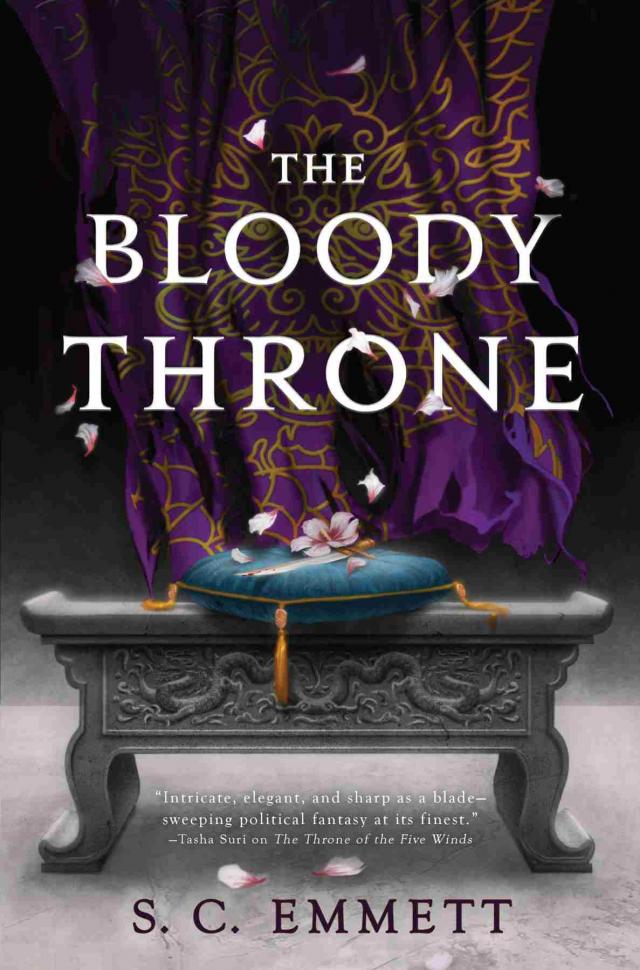
This book is a work of fiction. Names, characters, places, and incidents are the product of the author’s imagination or are used fictitiously. Any resemblance to actual events, locales, or persons, living or dead, is coincidental.
Copyright © 2022 by Lilith Saintcrow
Cover design by Lisa Marie Pompilio
Cover illustration by Miranda Meeks
Cover copyright © 2022 by Hachette Book Group, Inc.
Map by Charis Loke
Hachette Book Group supports the right to free expression and the value of copyright. The purpose of copyright is to encourage writers and artists to produce the creative works that enrich our culture.
The scanning, uploading, and distribution of this book without permission is a theft of the author’s intellectual property. If you would like permission to use material from the book (other than for review purposes), please contact permissions@hbgusa.com. Thank you for your support of the author’s rights.
Orbit
Hachette Book Group
1290 Avenue of the Americas
New York, NY 10104
orbitbooks.net
First Edition: March 2022
Orbit is an imprint of Hachette Book Group.
The Orbit name and logo are trademarks of Little, Brown Book Group Limited.
The publisher is not responsible for websites (or their content) that are not owned by the publisher.
The Hachette Speakers Bureau provides a wide range of authors for speaking events. To find out more, go to www.hachettespeakersbureau.com or call (866) 376-6591.
Library of Congress Cataloging-in-Publication Data
Names: Emmett, S. C., author.
Title: The bloody throne / S.C. Emmett.
Description: First Edition. | New York, NY : Orbit, 2022. | Series: Hostage of empire ; book 3
Identifiers: LCCN 2021033958 | ISBN 9780316453431 (trade paperback) | ISBN 9780316453448 (ebook) | ISBN 9780316453455
Subjects: GSAFD: Fantasy fiction.
Classification: LCC PS3619.A3984 B583 2022 | DDC 813/.6—dc23
LC record available at https://lccn.loc.gov/2021033958
ISBNs: 9780316453431 (trade paperback), 9780316453448 (ebook)
E3-20220210-JV-NF-ORI
Contents
Cover
Title Page
Copyright
Dedication
Map
Author’s Note
Epigraph
Accede with Grace
Filial, Severe
More Curse Than Blessing
Wise and Humble
A Sight One Should See
Ill News
Wisdom and Ambition
A Delicate Time
Survive This
A First Strike
Price of Rule
Quite Serviceable
Seeking Evidence
A Strange Effect
Silly Girl
Hand Wielding Her
According to Plan
Newcomers and Old Friends
Unbecoming in a Noblewoman
Whichever Will Suit
Certain Changes
Wolf’s Paw
A Pair of Reasons
Forms Observed
Usual Formality
Felicitous
Scarlet and Gold
Soup and War
Complete, Unexpected, Sweet
What You Wished For
Ladies’ Court
A Faithful Servant
Names and Schemes
Midmorning Meal
Burdens of Rule
Well Pleased
Sisters
Hammer and Anvil
Medicine
A Useful Crime
Venomous Tail
How to Rule
A Good Wife
Comforting Lies
Hands Aplenty
Held the Horn Spoon
No Doubt Ending
Bleeding the Horde
Hear Me
A Rider
A Length of Silk
A Loose Windowsill
Only a Skirmish
Propitiating Enough
A Pard of Folded Paper
Heaven Displeased
Sacrifice
Blood Boils Within Me
Child’s Play
Neatly Outmaneuvered
No Good Either
Battle of Five
A Turned Dish
First Harvest
Hold, Mother
A Star Displeased
Happy Chance Indeed
Rule Itself
A Bloodstained Throne
Grandfather and Little Two
Translator I May Trust
Women Always Do
Beloved Son
Quite the Challenge
Brother Mine
Messengers
Storm, Passed
Cannon or Thunder
Ants or Maggots
Traitor and Wisdom
Too Busy to Think
False Hope
Clay Soldiers
Last Fastness
Battle-Brothers
Extraordinary Shot
The Great Bell
Time to Kill
Bar the Door
Cry of an Ashani
Continue the Work
The Moon Wishes It
Watch for the Blade
Freedom
Motherless Child
Honorless
Until I Cannot
Ironically, Safer Here
A Strange Pair
Acknowledgments
Discover More
Meet the Author
Also by S. C. Emmett
Praise for Hostage of Empire
For Sarah Guan and Nivia Evans, with deepest gratitude
Explore book giveaways, sneak peeks, deals, and more.
Tap here to learn more.
AUTHOR’S NOTE
The reader is presumed to have read Books One and Two of these adventures; certain matters will otherwise be somewhat opaque. Many terms, most notably in Khir, are difficult to translate, and much effort has been made to find the correct, if not the prettiest or simplest, overtones; footnotes have been discontinued due to great uncertainty over their utility. Any translation errors are of course the author’s, and said author hopes for the reader’s kind patience.
Now, let us return to the center of the world, great Zhaon-An…
Honor speaks loudly
But who listens?
Only fools, madmen, the truly great.
And all three suffer for it.
—Zhe Har, The Book of Journeys
ACCEDE WITH GRACE
The dry time of summer was upon Zhaon. Dust lingered in every corner, curtained the roads, hung in the air as a golden haze. The fields stretched and shimmered under the sun’s unforgiving stare like restive children under a maiden aunt’s strictness, not yet willing to settle into sedate adulthood but too tired to protest.
North of Zhaon-An’s smoky, bustling hive, the bright white stone of new imperial tombs glittered. The most recently filled shrines saw a steady stream of visitors from peasant to noble. Or at least, one of them did, for Garan Tamuron had held the blessing of Heaven and unified Zhaon.
His eldest son and heir’s urn was also interred during the same ceremony three tendays ago, but few found it advisable to halt before Garan Takyeo’s deep-carved name and the dates of his brief reign—less than a moon-cycle, hardly worth celebrating. After all, there was a new Emperor; the warlord of Garan had left his land well provided for in that respect.
It was considered unwise, as well as impolitic, to linger before the new Emperor’s brotherly predecessor. After all, even the strictest filial mourning was done.
Still fewer visitors paused before Garan Takyeo’s wife, the Khir princess resting so far from her ancestors. Yet her shade had the most faithful caller, for every day a slight noblewoman, at first in deep pale mourning but afterward with a single unbleached armband denoting an unwillingness to turn her grief loose, paused before Garan Tamuron’s tomb to offer respects, paused for a longer while before Garan Takyeo’s, and lingered long before the stone wall holding the urn of Ashan Mahara.
It was there, bareheaded under the glare, that Komor Yala bowed thrice with her hands together and settled to pray.
The man accompanying her, broad-shouldered in the black tunic Shan noblemen preferred, gave only the token offerings at the old Emperor’s tomb, spent twice the time before the eldest son’s, and bowed thrice with impeccable politeness before the grave-shrine of the Khir princess before retreating to the shade of a fringeleaf tree near the wall. His gaze, dark and hungry, rested upon Komor Yala, and after a short while he spoke a curt word to send the kaburei to hold a cup-shaped shelter of taut-stretched, oiled cloth over her lady. The sunbell was crimson, that shade of luck and wealth, a bright blood-clot against white stone.
Such an infringement upon her prayers did not discommode the noblewoman. In fact, she hardly seemed to notice it, and endured the sunbell’s tiny, wobbling shade.
The nobleman—for such the quality of his cloth proclaimed him to be—waited with no sign of impatience, leaning against the fringeleaf’s bole with his arms crossed. A glint of greenstone upon his left first finger denoted not just nobility but princely status, and only one son of Garan Tamuron would wear a Shan lord’s somber costume with a hurai. Another glitter was a gold hoop in his left ear, a barbaric accoutrement most required to address him knew better than to mention. A
Finally, Komor Yala bowed thrice, her lips moving slightly, and retreated the prescribed number of steps from the august presence of her princess’s shade without turning. The small broom she used to sweep the dimensions of a Khir pailai clean before lighting the incense to feed a shade’s slight hunger was set neatly aside, and she turned to find Garan Takshin, Third Prince of Zhaon—for even if his now-eldest brother formally reordered the succession, Takshin was absent from its list and his title therefore static—regarding her as he often did, a line between his eyebrows and his mouth set as if puzzled by her mere existence.
Yala accepted the sunbell’s stem from Anh. The heat was massive, a living thing; the wet oven of spring was bad enough, but this dust and the dry air threatening to steal the breath and turn the skin to a crack-glaze upon pottery were different only in kind, not degree. The afternoon storms of the summer rain-season had receded, occasional dry lightning crackling over distant mountains providing no relief.
The kaburei hurried ahead to the horses, visibly longing for relative coolness inside the thick walls and high ceilings of the palace compound. Yala, hobbled by decorum, laid the fingers of her free hand in the crook of Takshin’s proffered elbow, and included him in the sunbell’s shade as well as she could.
Such graciousness did not last, for he made a short, irritated sound and glanced sideways. “I will not wilt, little lure. Keep it for yourself.” His scarred lip did not twist, though, and the words were sharp but not unkind.
“The sun hammers everything in Zhaon flat,” she murmured.
A shadow approached from the opposite direction, drifting along the wide paved avenue with a deceptively lazy stride. His dun merchant’s robe was of very fine quality and his boots even finer, though his topknot was caged merely in leather with a highly carved pin of fragrant ceduan. A flash of his glance showed pale grey like Yala’s own, marking him as a Khir of a certain status.
The Zhaon held that a dark eye was a trustworthy one. In the North, the proverb was somewhat different.
Takshin slowed, which meant Yala must. Her gaze met the merchant’s; she tilted her sunbell slightly. Do not, please.
Would he recognize the message? He either did not, or chose not to, for he swept them a deep, very formal bow. “My lord Third Prince, my lady Komor.” His Zhaon was spiked with Khir’s harsh consonants, but handled adroitly enough.
It would have been entirely Takshin’s right to refuse notice, but he halted instead, and for once his tone was not overly cold. “Honorable Narikhi, is it? You are most unexpected.”
“Hopefully not unwelcome, my lord prince.” The Khir straightened, and he did not try to catch Yala’s gaze. In any case, she did her best to appear utterly absorbed in the constitution of the paving-stones. Her cheeks were pale under their copper, but that could have been the heat.
“Not at all. I had little chance to thank you for your service to my Eldest Brother.” A stray breath—far too languorous to be called a breeze—ruffled Takshin’s topknot, caged in carved bone with an antique, dull silver pin. “I would have thought you eager to leave Zhaon-An.” Many traders were milling about in frightened fashion, since northern Khir had closed their borders and word of a certain disaster befalling Zhaon’s southron neighbor had begun to spread despite the Palace’s best attempts to keep a lid upon the rai-pot.
“Ah, a man must stay where he is needed, or where he may make a living.” The merchant’s smile widened a trifle. A much brighter sheen of sweat clung to his brow; he was, after all, a northern creature. The summers of dagger-shaped Khir were torrid enough, but not to compare to Zhaon’s. And their winters gave rise to the proverb cold as a northerner. “I have come today to make a few poor offerings.”
“Half of the city has, of late. The other half are probably not far behind.” Takshin regarded him levelly; many had quailed under the Third Prince’s gaze. “You saved his life; do you come to propitiate his shade? Or to pray for the Crown Princess?”
If it was an insult to use Mahara’s Zhaon title, it was a polite one, for naming the dead was unlucky and ill-mannered at once. The merchant Narikhi acknowledged as much with a gesture, spreading his hands, but his weight did not shift. He stood, indeed, in the manner of one who had more than a little martial training of the sort a mere merchant could not afford.
He was an enigma, then—but minor Khir lordlings were sometimes evicted from a family if there was not patrimony enough to feed them, and some few took to other occupations. This fellow could even be a byblow gotten upon a peasant girl in a moment of drunkenness or concupiscence, though his eyes spoke against such an estimation.
Yala’s throat was dry, and not just from Zhaon’s endless dust. It was a wonder the peasants had any soil to till, with so much of it hanging in the stale air. Her underlinen was uncomfortably damp; even sweating brought no relief.
“Both,” the merchant replied. “Unless it is unwelcome. It seems to me Lady Komor is the only mourner for the Crown Princess.”
Yala quelled another restless movement. Why was he doing this? She racked her brain and liver both for some polite way to send the Third Prince ahead, leaving her free to hiss a warning or, even better, utter a phrase of such manifest logic and soft power it would carry this man back to Khir.
It was far too dangerous for him here. She would never have thought Ashani Daoyan capable of this recklessness. If anyone discovered his true identity, he might well be closed in fetters and held in the Palace dungeons.
Having visited that place once, however briefly, she had no desire to return or to see her brother’s childhood friend sent there.
Garan Takshin simply nodded, with the mannerly brusqueness of a nobleman speaking to another who had fallen upon hard times. “It speaks well of you, honorable sir. Please do not let us keep you, and should you need future aid, remember my name.”
“How could I ever forget it?” The merchant bowed again, including Yala in the motion with easy grace. “I remain your humble servant, my lord prince, and the lady’s as well.” Mischief glittered in his pale gaze.
At least he was not wearing a pale mourning armband; that would have been entirely too much. Yala, numbly expecting disaster at any moment, suppressed the urge to bow in return. Takshin set off again, which meant she must glide at his side, her grey gaze properly lowered. There was no chance to address a mere merchant even if etiquette would have permitted, and in any case she was not entirely certain her voice would remain steady.
Did Daoyan watch her walk away under a sunbell’s trembling shade? Takshin evidently thought her almost prostrate with the heat, for he moved at a much slower stride than usual, and when he glanced at her bowed head she was occupied in watching the paving again, thinking furiously.
“An interesting fellow,” Takshin said, softly, and Yala made a soft, noncommittal noise.
There was no way he could guess. At least, she hoped not. Why had Dao not left as she begged him to? And coming to the tombs—was he mad, or simply stubborn?
By the time they reached the horses, her sorely tested equilibrium had returned. At least riding would create a breeze, even if they had to stay at a sedate pace for Anh to lead her mistress’s palfrey. Takshin said nothing else beyond mere commonplaces, but she could not be certain.
The Third Prince, like Yala herself, did not speak of all he knew.
Still, who would credit the heir to the Great Rider of Khir masquerading as a merchant in the chief city of his land’s greatest traditional enemy? Perhaps Ashani Daoyan only wished to visit his half-sister’s tomb before he left.
Yet Yala did not believe it. It wasn’t like Dao to admit defeat in anything, even when it would be better to retreat in order to strike twice as hard later, like the yue slicing clean air to gather strength.
The Third Prince swung into his saddle, and Yala let him lead the way. It was a relief to be out of his gaze save for the danger of an inadvisable word or gesture if relaxation made her unwary. The worries crowding her did not wait patiently while she visited the dead. No, they whispered in her ears, filled her head-meat, pressed behind her heart, and all but turned her liver pale.
She was to be married soon, for the filial mourning due Garan Tamuron was done. And her future husband, the Third Prince of Zhaon, was altogether too intelligent—not to mention watchful—to evade if he decided to seriously question her upon the matter of a Khir merchant who was not acting at all as if he knew his station.


