

Continuum 3, page 1
part #3 of Continuum Series


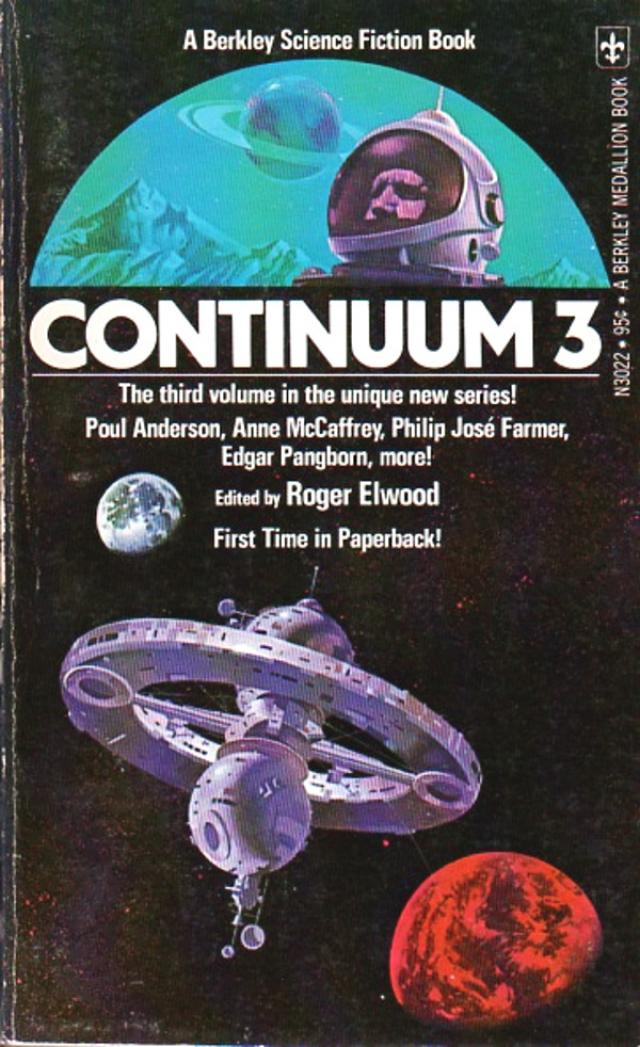
Continuum 3
* * *
Edited by
Roger Elwood
Copyright © 1974 By Roger Elwood
All rights reserved. This book or parts thereof may not be reproduced in any form without permissions in writing from the publisher. Published simultaneously in Canada by Longman Canada Limited, Toronto.
SBN: 399-1293-6
Library of Congress Catalog Card Number: 73-87174
Printed in the United States of America
Continuum 3
Introduction
Roger Elwood
Stations of the Nightmare — Part 3: The Evolution of Paul Eyre
Philip José Farmer
A Fair Exchange
Poul Anderson
The Middle Man
Chad Oliver
The Armageddon Tapes — Tape III
Thomas N. Scortia
Milekey Mountain
Anne McCaffrey
From the Notebook of Doctor Stein
Gene Wolfe
The Witches of Nupal
Edgar Pangborn
Darkness of Day
Pamela Sargent and George Zebrowski
Introduction
* * *
CONTINUUM is now three books old. Thus far, the critical response has been gratifying — the concept and its execution praised by most reviewers.
How was Continuum created? Well, it seemed important to have anthologies that were connected by other than the quality of the stories represented therein. Every other series done over the years has had that quality orientation. The feat was to add a greater strength to them individually as well as collectively. And the only way this could have been accomplished is the format presently utilized.
When the idea was presented to the authors, they greeted it with marked enthusiasm, which is apparent in the vibrancy of the material they have contributed. Edgar Pangborn has rarely done better than his stories centered in the general period of Davy; Poul Anderson’s Orbit Unlimited world is the stuff of adventure and solid characterization; Philip José Farmer’s Stations of the Nightmare shows this author at his best, with a strong plot and social significance; Anne McCaffrey’s Crystal Singer stories may be among the most unusual herein, and very possibly among the best this author has done to date. And, finally, the revolving authorship series created by Dean Koontz and continued by Barry Malzberg, Gail Kimberly, and George Zebrowski and Pamela Sargent… sensitive material, each author carrying the theme of a world of robots in a way true to the Koontz concept but also fresh and inventive.
Solid science fiction… top authors… an unusual format — this is the tapestry from which Continuum was created. After the initial four books, there may be others. You, the reader, are the key. We hope you enjoy the adventures upon which you are about to embark.
Roger Elwood
Linwood, N.J.
Philip José Farmer
Stations of the Nightmare
Part 3: The Evolution of Paul Eyre
1.
AWARE that he was being watched, Paul Eyre rolled under the bed. Here, the TV camera could not see him. The watchers would be frantic, but they would not dare to enter his cell. They did not want to drop dead.
Nude, he lay flat on his back, staring at the bedsprings and the mattress. Above the mattress were the sheets and the blankets, then the roof, then the clouds. And above the clouds was the night sky. And in the sky was a star that held a planet which was his home. No, not really his home. It was the birthplace of the thing hiding in his brain, the thing causing him to change.
That thought was not quite correct. The thing was becoming him and he was becoming the thing. The tiny yellow-brick thing in him had grown and was taking over. And he was taking it over. He and it were melding.
He was scared but not as scared as he thought he should be. Anticipation was mixed with the fright. Besides, the change was inevitable. He had seen it in dreams twelve nights in a row. The thing was communicating with him in dreams, in images and in feelings. They had no common language, but they did not need it.
His body was contracting, rounding, flattening. The flesh and the bones were softening, just as his daughter’s bones had softened when he had seen her in the car in the high-school parking lot while fleeing from the police. But her skeleton had become semi-jelly so that she could assume, or be shaped into, human form. Not a human form, he thought, since she had been all-too-human. An acceptable human form with a straight spine and full breasts and full legs. But he was going to have a nonhuman form. One, in fact, which no human had ever had before.
Where would his bones and organs go?
He held up one hand under the springs. The fingernails were shimmering; the flesh was glowing. Would the watchers see the darkness under the sheets hanging over the sides dissolve before a bright light? Would they think that he had set himself on fire? And then, knowing that he had no matches or flammable fluid, would they know that he could not be on fire? They would want to send someone into his room, but they would not dare. They could only watch and wonder.
He had enough wonder for all of them. How could his one hundred and fifty pounds be altered and squeezed so without killing him? How could his brain be flattened and condensed without killing him?
His body sagged and spread out. He tried to lift his head but could not. His eyes were separating, one drifting to the left, one to the right. At the same time, his vision was becoming weaker. Only the bright light enabled him to see at all. They felt smaller, and they were starting to sink within his skull. But they could not go far because his skull was spread out and at the same time shrinking.
For a while, his eyes were at the bottoms of wells or seemed to be. He remembered reading that a man could stand at the bottom of a deep well in the daytime and see, faintly, the stars. And here came the stars. And comets. And novas. But they were within him; the nerves were flashing signals. And soon, the nerves would be gone. Or changed into a structure which the neurologists of Earth could not understand. And changed in function, too, a function beyond their understanding.
His body moved across the floor as if it were an amoeba. Though he could not see himself, he knew that he must look as if he were becoming an amoeba. His trunk was flattening and becoming circular. His legs, his arms, his head were changing into flat, circular forms and also shrinking. He was an amoeba withdrawing its pseudopods.
Where would his brain go? What would happen to his eyes? What about his veins and arteries and capillaries? What would his bones become? His fingers? His toes? His ears? His nose? His teeth? What would become of him, Paul Eyre?
He had always believed that he had a soul. When his body died, he would ascend to heaven. Unchangeable, incorruptible, eternal Paul Eyre.
But his soul would be squeezed and flattened along with his body. Souls follow the map of the body. What the body writes, the soul reads.
And he did not know the language in which the writing was set.
He could not scream when the terror of full realization struck. He had no throat, and his lips were melted into each other.
Something within did scream then. Its voice echoed back and forth as if it were a man lost and screaming in a labyrinth deep underground. Somewhere in the dimness a form rose up and moved toward him. It was blacker than the blackness and only half-human in shape. It was menacing, yet when it spoke its voice was soft and reassuring. Paul Eyre did not want to be reassured and he wanted to run.
He felt his body swelling. A feeling of triumph and of disappointment filled him, and suddenly, he had a throat and a mouth. Instead of screaming, he whimpered.
2.
At ten in the morning he awoke. He was in his pajamas and lying flat on his back on the bed. He felt tired and hungry and also ashamed. Why should he be ashamed? Was it because he was a coward?
He got out of bed and wobbled to the only door to his room. A third of the way down on this door was a smaller door. He swung this open, and a shelf holding a tray of food and milk swiveled inward. He took the tray off and shut the little door. He carried the tray to a small folding table, set it on the table and sat down in the chair before the table. While he ate ham and eggs, toast and butter, and a grapefruit, he wondered what he would have eaten if he had allowed his new form to take over. What could a being with no mouth and no digestive organs, as far as he knew, use for food? Or fuel?
There was only one way to find out, a way he did not want to take. Or did he?
What he should be wondering about, he reminded himself, was why he accepted the change as reality. Once, he would have said that it was impossible. Anyone who actually thought he could change shape had to be crazy. Now, the universe seemed as flexible to him as his body.
He put the tray back on the swinging door and went into the bathroom. When he left it, he went to the doorless closet and changed from his pajamas into his clothes. At one time, he had gone into the bathroom to dress because there he would not be watched. At least, he had hoped he wasn’t. Now he did not care, even if women were watching him. And that meant that he was changing not only in body but in his attitudes. Before he had been brought here, he would not have undressed before any female. Even when going to bed with his wife, he had shed his clothes in the dark so she could not see him naked.
That reminded him of some of his dreams. Though fifty-four years old, no, fifty-five now, he had a strong sex drive. He had insisted that Mavice relieve him at least three times a week. It had not mattered to him whether or not she were sick or just disinclined. It was her duty to take care of him. Mavice had usually submitted but she had complained or else been silent and had let him know through her sullenness that she was angry.
If he were to be released, he would not go back to Mavice. She hated him, though he had to admit that she had cause. But he hated her, too. Perhaps part of his hate for her was hate reflected, hate for himself. Or contempt. But there was no use thinking about that. That was in a past that seemed even more bizarre than the present.
What a pair of wretches they had been!
“Falcons in a net,” Tincrowder had once said of them. The writer was probably quoting some poem or book; his talk was half-quotation, as if he had no power to make up his own phrases. But that wasn’t true. Tincrowder had then said, “No, not falcons. You and Mavice are more like vultures in a net. Or hyenas. Or rats in a hole plugged up with cyanide.”
He had hated Tincrowder, too. No wonder that the man was afraid to meet him face to face now. Not that he blamed him. Why should Tincrowder take a chance on dropping dead?
The sex drive had not been shut off when the door of his cell closed on him. He would have gone insane with desire if it had not been for those dreams. He would sleep, and he would see that glittering green city at the far end of many fields covered with red flowers. He would be walking across it on four feet, paws, rather. He was a creature half-human and half-feline. A leocentaur. And he was female. He had a beautiful human face, white shoulders and arms, and magnificent breasts. From the human torso down, his body was that of a lioness. A strange and powerful odor emanated from him, or, rather, her. His sexual organ twitched and stank with desire. He — she — was mad with desire, but, being sentient, could control somewhat his — her — lust.
And then a great male leocentaur would come leaping and bounding across the red fields, and he — she — and the male would couple.
What a difference eight hundred pounds of feline muscle, sweating, fur, a tail, and four paws with two hands and no inhibitions made!
Eyre quivered with memory of the ecstasy, far beyond anything he had experienced as a human. He also felt shame, but, as the day passed, the shame dwindled.
He could not understand why, if he was the female, he woke up with his pajamas sticky. But the orgasms of himself, the female, in the dream were paralleled by himself, the male, in his human body. Or form.
There were other dreams, dreams in which he was a small body with a hard shell, flying through the air, flying also through emptiness where stars were the only light. He saw the stars, or, rather, felt them in a way that he could not comprehend. This “seeing” was better than “seeing” with eyes.
Did the little yellow brick in his brain carry inside it ancestral memories? Memories that it could transmit to him via dreams?
He did not know. There were many things he could not explain. For instance, the thing in him could kill or cure human beings. If it saw a diseased or crippled human being, it cured that being. If it thought it was threatened, it killed. Paul Eyre was the agent through which the thing worked, but he had no control over it.
Yet, when he had been out hunting and had fired his shotgun at the saucerthing, why hadn’t it killed him? When he had searched for it afterward in those woods, why hadn’t it killed him then? It could not have been in doubt about his intentions.
He thought he had wounded it. How else explain the yellow haze that issued from some opening in its side? An opening his shotgun pellets must have made.
Or had it? Tincrowder had said that perhaps it was spawning or sporing. The cloud had been composed of microscopic quicksilver-like objects, and these were the saucerthing’s young. Some had undoubtedly gone into Paul Eyre, through his nose and perhaps through his skin. They had become millions of yellow-brick-shaped things in his blood cells and in his skin tissues. He had excreted all but one, which had lodged in his brain. The others, sneezed out, digested out, sweated out, had not affected any other living being. They seemed to have died.
While in the woods, he had seen the saucer, and he had also seen the female leocentaur, a creature of unsurpassed beauty. Only now did he understand that she was the saucerthing in another shape.
He could accept that because he had to. But why hadn’t the thing killed him with its thoughts or whatever power it used to kill?
If he allowed himself to become a saucerthing, then he might understand.
Tincrowder might have a theory. Tincrowder was a writer whose field was mainly science fiction. When Eyre had related his experiences in the woods, Tincrowder had given some fairly plausible theories to explain what had happened. Eyre felt that Tincrowder had, somehow, hit close to the truth.
He would ask Tincrowder.
Two days later, the closed-circuit TV screen lit up, and a broad red face appeared. For a minute, Eyre did not recognize him. Tincrowder had a shaggy red and white beard, and his eyes were sunken in black. He looked as if he had grown a beard to disguise himself from Death.
“Hello, Paul,” he said. “They flew me in, but the cheapos made me go second-class. I had to buy my own champagne.”
“Listen,” Eyre said. “The others might think I’m crazy, but that doesn’t matter. My situation won’t be changed by their opinions.”
He paused and then said, “Last night I almost turned into a flying saucer.”
3.
Tincrowder listened without interrupting. He said, “Some years ago, I would have thought you crazy, too. Now, I’m not so sure. What the hell, I know you’re not crazy! I’ll tell you why I believe what very few can believe. A few years ago an anthropological student named Carlos Castaneda wrote three books about his experiences with Yaqui Indian magic. Put quotes around the word magic, because that’s a word loaded with superstition and prejudice among Westerners. To the Yaqui brujos, sorcerers we’d call them, there are many worlds coexistent with ours. Parallel worlds, if you will, which intersect ours. By use of their quote magic unquote, the brujos can use entities, or forces, in these other worlds. Castaneda called these worlds nonordinary reality. That is, they are realities which we don’t usually encounter.
“I won’t go into how these brujos can perform their so-called magic. It’s not magic, but a rigid and always dangerous science. Or a discipline. Never mind the terms. The thing is that the brujos Castaneda knew, Don Juan and Don Genaro and some others, could perform incredible feats. They had powers we Westerners have always thought were mumbo-jumbo, fantasies, superstitions. Castaneda was convinced that the powers existed, have existed since the Old Stone Age. For instance, and I cite only one because it is relevant to your case, the brujos can change themselves into birds and fly. I became convinced after reading his books that they can do this. Castaneda is a level-headed scientist and no hoaxer.”
“You mean that I met a creature from this, this nonordinary reality, and that it has made these changes in me?” Eyre said.
Tincrowder shook his head. “Not entirely. You have met a nonordinary creature and are undergoing some nonordinary changes. But these are not of the nature which Castaneda described. Your saucerthing and your sphinx come from this world, this hard universe. They are nonordinary only because they have just arrived. Probably, many things here are nonordinary to them, or it, I should say, since the forms seem to be metamorphous, not discrete.
“Apparently, the yellow-thing in you is capable of causing these changes in shape. It many not derive its power solely from itself. We human beings may have this power but have never realized it. Rather, only a few have ever realized it. The devices exist in our bodies, and the yellow-thing knows how to use them.
“Here’s what I think the situation could be. Postulate a species of sentient, or maybe nonsentient, beings which can live in space. They can also travel through space, perhaps using gravitons as a means of propulsion. Gravitons are wavicles. Wavicles are phenomena which act as if they’re both frequency waves and particles. Gravitons are wavicles responsible for gravity, just as photons are wavicles responsible for light. Well, that doesn’t matter. It’s not how they can propel themselves through space and atmosphere but their biological setup that is important.


