

Too Clever By Half, page 1


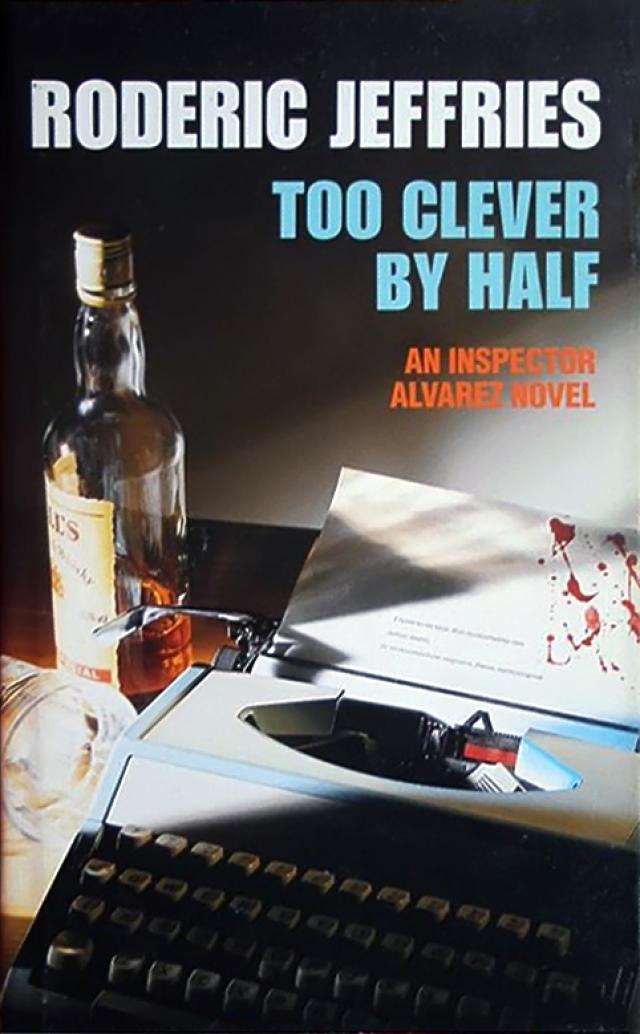
A blood-spattered floor. . . a generations-old revolver. . . an almost empty bottle of whiskey. . . and a strangely cryptic suicide note written in English and Latin. The easygoing Inspector Alvarez of Mallorca is perfectly willing to file a report of death by suicide, but the victim’s sister insists that it is all something much more sinister. Her brother would never commit suicide, she says. Nor would he write such a pretentious suicide note. And furthermore, he didn’t even drink whiskey. . . .
So if one mysterious death on the tiny Spanish island could be attributed to murder, what about a second, just days later? And what about the mysterious connection both victims have to an ancient Trojan treasure, long considered lost? It’s all enough to make Alvarez want to retreat to a double dose of his beloved brandy and a nice, long siesta for good measure, but he knows he must act quickly to prevent a ruthless killer from striking yet again.
But where does he start? To begin with, everyone seems to have an alibi, and although many people claim to have heard the voice of a visitor to the scene just hours before the death, no one can identify it. And then there is the lovely artist’s model who insists on having been in two places at once—and whose allure is clouding Alvarez’ investigation more than he would like to admit.
It will take all of the affable inspector’s wits to outsmart a murderer who is Too Clever by Half.
Too Clever by Half
Also by Roderic Jeffries:
Dead Clever
Death Trick
Relatively Dangerous
Almost Murder
Layers of Deceit
Three and One Make Five
Deadly Petard
Unseemly End
Just Deserts
Murder Begets Murder
Troubled Deaths
RODERIC JEFFRIES
Too Clever
By Half
An Inspector Alvarez novel
St. Martin’s Press
New York
TOO CLEVER BY HALF. Copyright © 1990 by Roderic Jeffries. All rights reserved.
Printed in the United States of America. No part of this book may be used or
reproduced in any manner whatsoever without written permission except in
the case of brief quotations embodied in critical articles or reviews. For infor-
mation, address St. Martin’s Press, 175 Fifth Avenue, New York, N.Y. 10010.
Library of Congress Cataloging-in-Publication Data
Jeffries, Roderic.
Too clever by half / by Roderic Jeffries.
p. cm.
ISBN 0-312-04987-0
I. Title.
PR6060.E43T6 1990
823’.914—dc20 90-37317
CIP
First published in Great Britain by William Collins Sons & Co. Ltd.
First U.S. Edition: October 1990
10 9 8 7 6 5 4 3 2 1
CHAPTER 1
The sharp sunlight was reflected off the surface of the swimming pool to dance in waves across the ceiling; the sitting-room was oppressively hot and stuffy. Yeo-Eaton looked at the blank television screen and thought about the latest video he had been lent, in which, apparently, there were a couple of ripe scenes. He wondered if he’d be allowed to see them or whether Bronwen would fast forward.
‘I think not the Varleys,’ she said.
He turned and briefly looked at her as she sat at the small, beautifully proportioned roll-top desk. Bronwen meant white-breasted, so it was ironic that she should have been christened thus since she regarded such specific anatomical references as disgusting.
‘Well?’ she said impatiently. ‘Don’t you agree?’
He jerked his thoughts back to immediate matters. ‘Agree, dear?’
‘It would help if you’d pay some attention when I speak to you.’
‘Of course, dear. Sorry.’ He needed a drink, but she believed very firmly that a gentleman did not drink before six-thirty in the evening. Alcohol and sex, she was fond of saying, were the Devil’s advocates. He wondered why it was that the Devil enjoyed all the good things in life.
‘You agree that we do not invite the Varleys?’
‘But I thought you got on with them quite well?’
She had thin lips and when she pursed them, they tended to disappear; her refined voice sharpened from exasperation. ‘You know as well as I do that there are people to whom one is pleasant yet whom one doesn’t wish to entertain in one’s home.’
‘He plays a good round of golf.’
‘That ceased to be the mark of a gentleman the day they allowed professionals into the club house.’
‘But the Varleys do a tremendous amount for the community. They even helped pay most of the fare back to the UK for that couple who hadn’t enough money.’
‘She sometimes drops her aitches.’
He visualized Hilda Varley. Generously built in all the right places, curly blonde hair topping a round face, and moist lips which promised what her brown eyes suggested. He doubted that she developed many headaches when it was time to go to bed . . .
From the hall came the sound of high-heeled shoes on the tiled floor and Victoria appeared in the doorway. ‘I finish,’ she said in her fractured English. ‘I go.’
Bronwen inclined her head. He said: ‘Goodbye, see you tomorrow.’
‘Adios, señor.’ Victoria flashed him a smile.
He watched her disappear out of sight. She was at the stage, reached early by most Mallorquin women, when beauty had matured to the point where it was teetering towards overripeness. When Bronwen was not present to censor his thoughts, he sometimes fantasized and endowed her with a sharp passion for a retired colonel who had been a dashing subaltern before he’d married his colonel’s daughter . . .
‘Not the Varleys.’ She crossed out the name on the list. She had inherited the desk from a great-aunt who had been Vicereine of India. He had once translated such rank as vice queen. She had expressed sharp displeasure at such stupidity. She used a lace-edged handkerchief to wipe the glow from her forehead (horses sweated, men perspired, ladies merely glowed). ‘When on earth is the engineer coming to mend the air-conditioning? Didn’t you tell him it was urgent?’
‘I said we were nearly expiring from the heat. He promised to come as soon as possible, but apparently he’s a tremendous amount of work in hand.’
‘A mere excuse. I should have spoken to him.’
He didn’t resent the inference, accepting that it was true. She spoke no Spanish, let alone Mallorquin, yet she possessed the ability to get things done even on the island. A natural sergeant-major of an officer.
She returned her attention to the guest list. ‘I suppose we do have to ask Phillipa, even though she never returns hospitality.’
‘That’s because she can’t afford to.’
‘Then she should not accept it.’
He knew that it was not Phillipa’s poverty to which Bronwen objected, but the fact that she was a woman of marked character, ever ready to speak her mind. She was one of the few people whom Bronwen did not treat with condescension.
‘So, with Gerald, that makes thirty-two people.’
He said, surprised: ‘D’you mean Gerald Heal?’
‘I wasn’t aware that we knew any other Geralds.’
‘No, we don’t. But I thought . . . I rather imagined . . .’
‘Do try not to bumble.’
‘Yes, dear.’
She closed up the desk and automatically looked around the large, oblong room to make certain that everything was exactly in its place. Clean and tidy in person, clean and tidy in mind. Satisfied, she walked across to the settee and sat. ‘Why are you surprised that I’m asking Gerald?’
‘Well, it’s not all that long ago that you called him distinctly NOCD.’
‘He is of the vulgus, obviously, but one can hardly blame him for his unfortunate background.’
‘But earlier you said that you wouldn’t ask the Varleys because—’
‘Godfrey, why do you always have to argue about everything?’
He knew that if he wished to avoid her sharp, bitchy displeasure for the rest of the evening, he should not pursue the matter, but a sudden sense of recklessness made him say: ‘You won’t ask the Varleys because they’re brash, never mind how much good they do among the community, so surely even less should you be ready to ask Gerald, who can be a lot brasher and almost certainly has never done any good to anyone but himself.’
‘You don’t see the difference?’
‘No, I’m afraid I don’t.’
‘Then it’s hopeless trying to explain. There are times when it’s quite impossible to talk sense with you.’
As he stared through a window at the pool, the lawn, the lantana hedge, and the mountains, he remembered a brief conversation he’d once heard between two of his subalterns. ‘Have you asked him?’— ‘Not yet.’— ‘Why the hell not?’— ‘Because every time I’ve seen him, Charlotte Corday’s been there.’ He savoured the memory, even though there’d been no certainty that he and Bronwen had been the two concerned.
‘By the way,’ she said, ‘Ruth rang while you were down in the village collecting the paper.’
‘How is she?’
‘All right,’ she answered.
Even after so many years, he could still be saddened by Bronwen’s lack of maternal affection. Just as he could still be amazed by their daughter: first since her presence on earth had called for certain acts of a physical nature; secondly because she had so warm and caring a nature. Ironically, she’d undoubtedly have led a far happier life if her character had been slightly less warm and loving and far more like her mother’s. She concerned herself too much with the inadequacies and misfortunes of others and as a result was usually suffering from badly bruised emotions. She had been married once and had later lived with a man—Bronwen had never learned about this—and both relationships had ended disastrously.
Bronwen said: ‘I’ve told her to come a week earlier than she was planning.’
‘Then that means she’ll be out in just under a fortnight’s time.’ His pleasure was immediate.
‘She wanted to bring some friend, but I said it would be much the best if she came on her own. One never knows how extraordinary her friends will turn out to be.’ She paused, then continued: ‘I’m quite breathless down here so I’m going up to our bedroom for a while. You did remember to switch on the air-conditioning earlier?’
‘Yes, dear.’
As she stood, so did he. His manners were as old-fashioned as his sense of duty. He believed that a man should honour his wife until death relieved him of that burden.
As soon as he heard her climbing the stairs, he crossed to the tall, heavily inlaid cocktail cabinet and poured himself out a very strong whisky, then went through to the kitchen and picked out three ice cubes from the dispenser in the refrigerator. Back in the sitting-room, he sprawled out in a chair and drank, his pleasure all the sweeter because it was not yet quite six o’clock.
He thought how odd it was that Bronwen should have suggested Ruth came out to the island a week earlier, since normally she liked arrangements to be strictly adhered to. Another odd suggestion of hers had been to invite Gerald Heal to their forthcoming cocktail party since it was only recently that she had referred to him as the complete cad. Was she beginning to learn a little flexibility? Not if the Varleys were anything to go by . . . Good God! Of course! Ruth had been ordered to arrive a week earlier in order to be at the cocktail party and Gerald was being invited because, so local rumour had it, he was divorcing his wife. What a ridiculously impossible idea! Gerald Heal wouldn’t look twice at a plain, often awkward woman; and in any case, Ruth would have no truck with him because wealth never blinded her to a man’s failings; only his inadequacies did that.
CHAPTER 2
‘Can’t I move?’ asked Alma.
‘No,’ Guy Selby replied.
‘But I’m getting pins and needles and I’m sweating like a pig and dying of thirst.’
‘Do pigs sweat?’
‘I don’t know, I don’t care, and I’m damned well going to move.’ She unfolded her right leg and rubbed the inside of her thigh. ‘God, you need a contortionist.’
‘Find one who’ll keep still for more than two seconds at a time and I’ll be happy. Provided she’s a body like yours.’
‘Your only interest is in my body?’
‘Of course.’
‘You’re a swine.’
‘Why not? You’re sweating like a pig.’
She stood and stretched. ‘I’m not only dying of thirst, I’m starving. Where shall we go for lunch?’
He pointed his brush at her. ‘Are you reckoning to eat like that?’ She was naked.
‘Why not?’
‘Mallorquins are conservative. They’ve only just got used to skinny sunbathing and skinny eating would really throw them.’
‘Check with the waiters; you’d find them willing enough to be thrown . . . How’s the painting coming along?’
‘Lousy.’
She threaded her way between the furniture and piles of books, magazines and general mess on the floor until she could study the canvas on the easel. After a while she said: ‘I can never make out whether you denigrate your own work because you’re over-modest or are fishing for compliments.’
‘Think the worse.’
‘You say you’re not very good at the human figure and need to practise and practise, yet this is really great.’
‘Before you let your enthusiasm overwhelm your critical faculties, you do realize that it’s not finished yet, don’t you?’
‘Of course I do, you idiot . . . You seem to have endowed me with some quality I can’t identify. What is it?’ She studied his face—rugged, expressing determination and some bloody-mindedness—and knew before he spoke that he was going to answer facetiously.
‘Heat, hunger, thirst, and cramp.’ He cleaned one brush in a pot, dried it on a square of linen. Six feet one tall and broad-shouldered, his chest bronzed by the sun, there was little of the stereotyped artist in his appearance.
‘Be serious,’ she begged.
‘You’re wondering if you remembered to take the Pill and are beginning to panic.’
‘You’re bloody impossible! Why can’t you sometimes admit to being sentimental and not always trying to hide your emotions behind cheap cynicism?’
He cleaned a second brush, then the palette—he was obsessively tidy in his painting, carelessly untidy in the rest of his life. ‘Haven’t you yet learned the most important fact in life? Whenever you get starry-eyed, you tread on a banana skin.’
‘Life can’t always have been that tough for you.’
‘The consumer society is only fun for people with plenty of money to spend.’
‘You can’t tell me you’d really like to be a yuppie, for God’s sake.’
‘Wouldn’t I? In my Porsche, driving back to my Docklands pad, my only worry which restaurant to take which girlfriend to? Wouldn’t I sell my artistic soul for material wealth after I’ve spent a humiliating hour trying to interest a gallery owner and he’s been yawning away because for him I’m just another slob who’s stupid enough to think his daubs are the new van Goghs?’
She said earnestly: ‘You must know that with your talent you have to be successful.’
‘Cue for the heavenly choir.’
‘Go to hell!’
‘My lovely dryad, do you really believe that ability always triumphs over indifference and ignorance?’
‘Yes.’
‘Then I salute you as the last remaining innocent on earth.’
‘Can’t you ever be optimistic about the future?’
‘Right now, I’m very optimistic about the immediate future.’
‘You’ve stopped thinking about painting. I’d better go and dress.’
‘Scared? Are you so nervous because you’re a virgin?’
‘Gallup poll your own sex life, not mine.’
‘But yours is so much more interesting.’
‘Not for me, I’m hungry. So let’s get ready and go out to eat.’
His tone changed. ‘I’d rather eat here.’ He began to pack tubes of paint into a metal box.
‘On what? The fridge is about as bare as Old Mother Hubbard’s cupboard.’
‘So I’ll nip out and buy a barra and some cheese.’
‘We are going to Ca’n Toni for lunch.’
‘I’d rather—’
‘With gentlemanly grace—and I’ll explain the term— you’re going to agree to do what I want to do, for once.’
The triangular-shaped area to the south of the island was known as La Curia and it was unusual in two respects— although its longest side was coastline, very few tourists visited it and there was not a single tourist hotel, bar, or restaurant. This absence of tourism was partially because the land was virtually featureless (being so poor it was covered in scrub), but far more importantly because there were no beaches, only cliffs, up to a hundred and fifty metres high, which plunged into the sea.
Of the two villages within La Cuna, Costanyi was the larger. Inevitably, there had been changes there within the past fifty years, since the ripples of prosperity reached everywhere, but compared to other parts of the island, here time had stood still. Ca’n Toni had no sign to mark it as a restaurant, the windows were small and allowed very little light inside, the wooden tables looked as if they must be almost as old as the building, even in summer much of the cooking was done on an open fire in one corner of the room, and the verbal menu offered few dishes.
The waiter—he had only one eye and two fingers on his left hand due to an accident in a quarry—told them the menu and then waited, his expression suggesting a total disinterest.
‘I’m going to have shoulder of lamb,’ Alma said. ‘The same for you?’


