

Love Odyssey, page 1


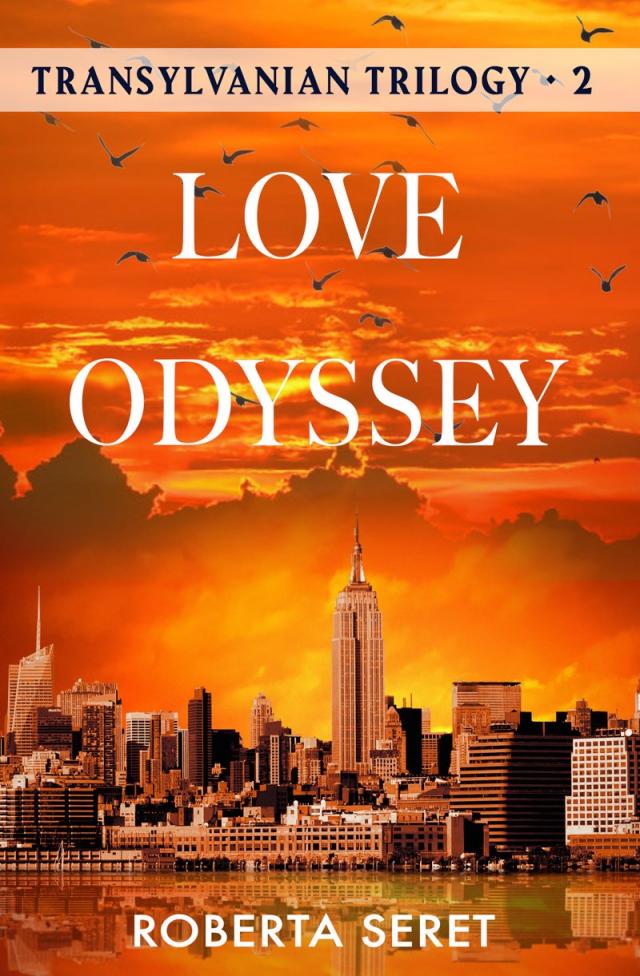
Love Odyssey
Roberta Seret
Copyright © 2021 by Wayzgoose Press
All rights reserved.
No part of this book may be reproduced in any form or by any electronic or mechanical means, including information storage and retrieval systems, without written permission from the publisher, except for the use of brief quotations in a book review.
This is a work of fiction.
There was no doctor who worked within Ceausescu’s government to begin the revolution or to overthrow the dictator.
The love story and characters do not resemble anyone in history or in the present.
Cover design by D.J. Rogers, Book Branders
* * *
31721
Contents
In Appreciation
Introduction
Prologue
I. Penelope and Odysseus
1. New York City
2. Bucharest, Romania
3. New York City
4. Bucharest, Romania
5. New York City
6. New Haven, Connecticut
7. New York City
8. New York City
9. Bucharest, Romania
10. New York City
II. A Plan
11. New York City
12. Timisoara, Romania
13. New Haven, Connecticut
14. New York City
15. New York City
III. Reign of Terror
16. Timisoara, Romania
17. Transylvania, Romania
18. Bucharest, Romania
19. New York City
20. Timisoara, Romania
21. New York City
IV. Return Home
22. Romania
23. Transylvania, Romania
24. Transylvania, Romania
V. Together
25. Hungary and Paris
Preview: Treasure Seekers
About the Publisher
About the Author
“Three thousand years have not changed the human condition in this respect: we are still lovers and victims of the will to violence, and so long as we are, Homer will be read as its truest interpretation.”
From the Introduction by Bernard Know to Homer’s The Iliad (Robert Fagles, Translator)
In Appreciation
No book is written alone.
Words and thoughts come alive on the page only after they are shared with those the author respects. I have been fortunate to have family and friends who have believed in me. For without them, my literary world could not have taken shape.
My deepest appreciation goes to each one of you:
Maggie Sokolik, Senior Fiction Editor of Wayzgoose Press; Dorothy Zemach, publisher of Wayzgoose Press; DJ Rogers, Book Branders, for her artistic book jacket, Linda Langton, my literary agent; Marcia Rockwood, my editor; Mridula Agarwal, my right hand and tech Guru; Natalia Donofrio, my web designer; Greenwich Pen Women: Anita Keire, Ginger Heller, Deb Weir, and Kyle Ridley.
My friends of many years: Judith Vogel, Leslie and Norman Leben, Lydia Eviatar, Judith Auslander, Raffaella Depero, Nancy Cushing-Jones, Will Nix, Elise Strauss, Nina Saglimbeni, Candida Iodice, Andreea Mihut, Ioana and Eugen Mihut, and Sandra Segal.
My sons: Greg and Cliff; my daughters-in-law: Hally and Arielle: my grandchildren: Annabel, Sam, Jack.
And my husband, Michel, who always at my side, has shared his story and our journey. Without his joie de vivre and optimism, these books would not have come to be.
* * *
Thank you all,
Roberta
To Greg, Cliff, Hally, Arielle, Annabel, Sam, Jack
* * *
My greatest wish has been to give you all I have learned.
* * *
My Odyssey–with Love–is for you.
Introduction
Dear Reader,
I invite you to go on a voyage with me to Transylvania where my imagination has borrowed political intrigues to create a different view of Literature. Facts fuse with fiction in Transylvanian Trilogy.
Gift of Diamonds, Love Odyssey, and Treasure Seekers—each book of the trilogy can be read independently or interchanged, depending on the reader’s choice. The main characters are Mica, Anca, Cristina, and Marina, four friends since their teenaged days in Transylvania, who appear and reappear in each book. They were known in their little town as best friends, the Four Musketeers, Poets of their Lives.
Gift of Diamonds is Mica’s story and her escape with rare colored diamonds as Communism in Romania explodes under dictator, Ceausescu.
Love Odyssey is Anca’s quest as she escapes alone while pregnant from those who have targeted her.
Marina and Cristina take center stage in Treasure Seekers when they are successful women living in New York City and Paris, and vacation together to exotic Turkey to fall, unexpectedly, into a web of terrorists.
The stories flow together amidst Romania’s politics. I have used the historical settings as a novelist would–to enhance the fictional storyline. Yet, I must confess, I have sometimes been tempted to make the history a little more exciting with touches of imagination. Accordingly, I’ve taken liberties under the guise of “poetic license” with time and place to recreate a literary fresco of Romania’s second half of the 20th century. The history is the “backdrop curtain” of the novels, not center stage.
I have used Romania’s dictatorial regimes to create an atmosphere of deceit that poisoned all Romanians during the Fascist and Communist years. One form of totalitarian government led to another. These were times of secret police, informers, fear, lies, double-crossing, dehumanization, shredding of documents, the destruction of the human soul. What we know today about these times is still masked with inconsistencies and ambiguities to cover up the Truth.
Yet the world I offer you is of Fiction, and I use four female characters as dramatic voices. Each woman of the trilogy takes center stage to create her own life as she journeys through political events to survive. Each one becomes involved with history and forges forward in an existentialist need to direct her own destiny. Sometimes, the four friends find challenges that are stronger than their willpower. Those are the times when the fictional protagonists merge and interact with factual events. It is then that their courage evokes exciting narratives. Fiction that could not exist without Truth.
I hope you enjoy this colorful kaleidoscope of Fact with Fiction, Truth with Crimes, History and Art, Strife with Love. For it is from my heart that I offer you these stories from Transylvania.
Roberta Seret, Ph.D.
Prologue
I have often tried to understand love.
Is there a logic, a pattern, a process? Does it begin as a chemical reaction? Does the heart tell reason that there is no place for logic? Or does the mind direct all feelings? How does it happen that love can transport us to a state of being that we have never known before? And why do we journey so far, so blindly, so willingly, for the person we love?
I have wondered if we love only once. Or can we love different people with different loves at different times? Is it possible that love can transform itself into something sinister and unrecognizable and still be love? And if we should choose to reject love completely, what is life without loving?
My story is one of love, colored with tender moments of pleasure and heights of ecstasy. But it is also shadowed gray when love was crushed by shame, when lies turned passion to pain.
On an autumn night in Transylvania, October 1970, the golden days of yellow leaves had turned into smoky evenings tinged with the smell of wood-burning fireplaces. Communism was at its peak under Nicolae Ceausescu. No one could do what they wanted unless the government approved. I was outspoken, independent, and uncooperative. I was being watched.
Alec, my best friend from childhood, had come to our two-room cottage late at night to give me and Petre, my husband of three years, some confidential information. I remember the storm that night, with its lightning and thunder, and even hail. But luck was in our favor; the police preferred to stay indoors, drinking with their buddies rather than patrolling the town or watching people like us.
Alec had been my father’s student at the Technical University of Civil Engineering and his helper on Sundays in our basement, where they both sent secret messages to people in other countries. He had graduated to become the chief engineer at the Ministry of Agriculture. Petre was a doctor, specializing in endocrinology. He was in charge of the clinic in our small town, Dova.
Alec came to tell us he had news: one of the Austrian tractors the government was using to work the farms was defective. The parts weren’t available in Romania and the tractor would have to be sent to Vienna for repairs. Alec knew that I was pregnant. He had been working on a plan to get me out of Romania, to hide me in the tractor as it traveled from Transylvania to Budapest and then by hydrofoil up the Danube to trustworthy contacts in Vienna.
“I won’t go,” I told Alec and Petre.
Petre insisted. “Anca, this is your only chance. You can’t have a baby in this country.”
“I will not leave without you.”
“I’ll follow,” he promised.
Alec persisted. “I can make another defective tractor for Petre in two months by detaching some wires needed to start the motor,” he told me. “Your husband can leave then. But you must take this one first.”
Petre paced our small living room. I had never seen him so agitated before. He was almost shouting at me. “The secret police have started an investigation on you. I know this from a patient. Someone I trust.”
“How will I be transported to Budapest?” I asked them. “The borders are locked as tight as an iron gate.”
“The tractor will be hauled in a truck from our town to Budapest,” Alec answered. “I’ll create space for you under the tractor’s seat where you’ll be hidden.”
“What about food and water?”
“It’ll be next to where you’ll lay comfortably on a mattress.”
“Comfortably?” I said, raising my voice. “Do you realize what will happen to me if the secret police come searching with their dogs?”
Alec shook his head. “As director of the agricultural project, I have the right to escort the tractor from here to Budapest and onto the hydrofoil, which I will do. Once on the hydrofoil, you’ll be on the Danube and safe.”
Petre took my hand. “Alec will protect you. He has the contacts from the Danube to the hotel in Vienna, and then…”
“No! It’s too risky.”
“You must take this opportunity,” Petre insisted. “The chief of the region is in charge of your case. He has proof you’ve given antibiotics to Gypsies1 and noncommunists. The police will very likely torture you. You could lose the baby.”
I was crying, pleading my case to both men, but as I felt the baby kick inside me, I knew they were right. “Petre, you promise to take the next available tractor?”
“Yes,” he assured me. “I’ll be at your side when you give birth. You have my word.”
Was I wrong to have agreed? I can’t help but wonder now: what was Petre’s true motive for getting me out of the country? Did he know then that his promise to follow me in just two months was simply a subterfuge? Over the years, I have tried to analyze the truth as well as the lies. I’ve wanted to forgive Petre, to feel less for him, to live my life guided by reason—and accept my fate. I have struggled with this. Then one morning, a newspaper and a telephone call tore my ordered world apart.
1 I use the term Gypsy with no intention of disrespect. The official term is Roma, but I use Gypsy as a colloquial word, spoken by Europeans in their daily conversations.
Part I
Penelope and Odysseus
Sunday, December 10, 1989
Penelope with Odysseus’s armor—Francis Legatt Chantrey (1781–1841)
1
New York City
So that I could meet the Odysseus I long for. Yet the evil is endurable, when one cries through the days, with heart constantly troubled.
Homer, The Odyssey, Book 20
Rubbing sleep from her eyes, Anca opened the front door of her Upper East Side apartment and picked up the Sunday New York Times. The kitchen was shadowed in morning darkness as she placed the newspaper on the marble counter and mechanically opened the refrigerator to take out a can of espresso beans.
She stared at her face reflected on the metal container as if she were a stranger, observing the straight black hair cropped short, hazel-green eyes so sleepy that the almond slits seemed buried within high cheekbones. The lips looked full above the pointed chin, and the oval face appeared younger than its forty-two years. She stretched her body in her blue bathrobe and tried to get her thin, five-foot-seven shape to fill the face of the silver container by tilting it this way and that.
While the coffee was brewing, she scanned the first page of the Times. She was stopped cold by one particular headline: Romania and Iran: Partners in Gold and Evil.
“Twenty years of friendship and billions of dollars in trade between Romania and Iran,” the article read. “First with Shah Reza Pahlavi, then with Ayatollah Khomeini, and now with Iran’s new president, Rafsanjani, with whom Ceausescu has a personal, financial relationship. The question is what are they planning together? Authorities talk about gold. An investigation has been traced to Transylvania in Romania.”
Anca took a deep breath. Transylvania. At this moment it was tied to a gold scandal. But, she also remembered her country as the place where her loving had its beginning and she could still feel his touch, his lips caressing her body. Such deep pleasure, wanting more and more.
“Would you like a glass of wine?”
It was during the harvest, a September evening when pine trees in Romania turned gold and the Gypsies gathered grapes.
Anca closed her eyes to keep the memory alive. She could feel Petre’s presence, strong and soft.
“The wine from the barrel is warm.”
The fiddler played a Gypsy song, “Te iubesc pe vesnicie”—I will love you forever.
Was she strong enough for feelings she had never experienced before?
She allowed the wine to cloud her mind and followed for the first time as he led her along a path, through the valley. He caressed her cheeks and she closed her eyes, the wine making her bold. He brought her closer, held her tighter, and laid her lovingly in a bed of golden leaves.
The next morning, with the memory of lovemaking inside her, she went to the Gypsy camp in their small town and overheard a Gypsy saying, “A woman loves only one man in her life.” Anca wondered, Was that a prophecy for me?
She recalled how each year the wine harvest varied by a few days depending on nature’s whims and summer rains. In Romania, there was no calendar to tell the farmers when to start picking the grapes. Instead, they knew because of the Gypsies who wandered in from Hungary and Serbia. They arrived saying that they had come to work; the grapes were ready. Then, on the last day of the harvest, they disappeared, late at night, not to be seen until the next year when the grapes had ripened again.
Anca wiped tears from her cheek remembering how three years later, Petre had sealed her fate with plans for her escape. To his mission he had remained true—working to free Romania from a dictator, while Anca had been sent to New York, alone.
2
Bucharest, Romania
Sing in me, muse, and through me tell the story of that man skilled in all ways of contending, the wanderer, harried for years on end.
Homer, The Odyssey, Book 1
“Atentie. Stop. Don’t move.”
“Oh, it’s you, Petre. Sorry,” a Romanian guard said as he put the pistol back inside his coat. “I didn’t recognize you in that long coat.” He bowed to the tall blond man who had barely flinched at the sight of the gun.
“I’m visiting the Leader,” Petre answered, pointing to his black doctor’s bag and taking off his wool hat and scarf. He walked through the concrete tunnel that led to Ceausescu’s underground bunker system. The hidden labyrinth, located beneath the presidential palace, was stocked with food, medicine and supplies for the Ceausescu family and their secret police force. In case of an uprising, the dictator could live here for several months. The complex also included offices, prison cells, a clinic, a cinema, and a dozen bedrooms. There was even an enclosed garage with a car from which Ceausescu and his family could flee, should they need to.
Petre passed through the archway that connected the medical dispensary to Ceausescu’s private quarters.


