

The Shadow of the Ship, page 5


A ferryboat drawn up and left on the far side of a river was a tolerable groundside analogy. It was moored to land, and you’re on land, so it is in the same spatial medium you are; but you can’t get at it. In contrast, even a sunken ferryboat, so long as it is in the shallows on your own side of the river, is attainable despite being in a different medium. It can be grappled, hauled out and repaired, and used to reach the far bank.
Only the fact that the Ship seemed to have been stranded or abandoned in subspace made it attainable at all to the Trails culture. If the dubious medium of the meadow had to be traversed beyond previous explorations, that was acceptable. To have a ship again, and slide it on home!
Shortly Rheinallt and Whitnadys were crouched behind a boulder, waiting impatiently for the squeaker which had followed them down into the gravity well. The darkness here among the larger rocks couldn’t approach that of the meadow as long as any of the overhead starfield was visible, but it did offer good concealment. Rheinallt wanted to be the one to decide if any encounter would take place.
“Interesting magnetostratification here,” he signed to Whitnadys, using for the technical term a rare word from intersign and a common one from trailsign. “I feel more pressures than there ought to be in such a castaway place.”
Whitnadys had propped her long-barreled haywire against a small stone to keep the mechanism a few inches off the grit and gravel. She rolled her eyes, signing briefly, “Someday tell me what lodestones have to do with landforms.”
With wide-lensed meadow binoculars she watched the point where the trail appeared on the surface, hoping to catch a glimpse in the few unguarded moments which necessarily followed breakout.
To anyone who didn’t know that the trail spent most of its length in subspace—and only deigned to touch a planetary surface when the quirks in the gravitational structure of the universe caught the trail like the bottommost droop of a loop of kite string—this groundside snippet of trail would have seemed strange enough.
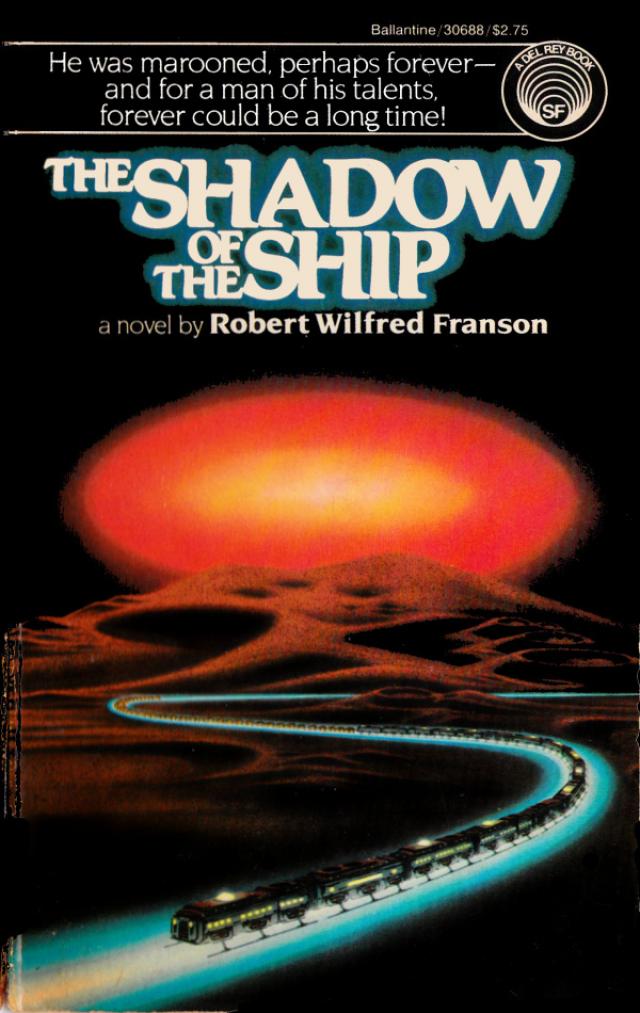
A god with two paintbrushes must have passed this way: the first stroke had made a bluish roadway twenty-some yards long, and wide enough that a couple of caravans could have passed abreast. A two-dimensional and softened sapphire, stretched into pavement. Then with the brush in his other hand the god swiped the still-wet roadway again, and left an inner aura along those twenty-plus yards, an unworldly radiance within the sapphire mist. The trail glowed with its own light, and was beautiful.
To a traveler, however, the trail segment that was visible would be inseparable in his mind’s eye from its vast length in both directions.
Waiting, Rheinallt thought nostalgically of the long familiar vistas where the trail—in his memory—was a blue so intense that it was hypnotic, back where the worlds of the Nation touched the trail and thereby visited with each other at only a few clockdays’ distance. Less hypnotic to the eye than the memory, though: he had not even reached the Ship yet, his goal and probable turnaround point, and already he was hankering to go back even to an adopted home and recent memories.
At the end of the visible trail a squeaker suddenly appeared, striding ponderously along without a care in the world. Three men were on its back, in safety harness but without a howdah structure.
Whitnadys flicked the binoculars’ focal point from the first to the second to the third of the riders, delaying only a couple of seconds on each. Then she shrugged and handed the binoculars to Rheinallt.
“I’m not sure if I recognize them or not,” she said. “They all look sort of familiar, but I can’t name them. Sure cold here.”
“My job, knowing passengers.” He scanned the three on the swaying golden back as quickly as had Whitnadys, nodded, then retraversed them leisurely. “The nearest one is Glenavet; the other two are his henchmen. Wirtellin, for one, and I’m pretty sure Tadako’s the drover.”
“Well, space them for bringing Duurs down here against my orders,” Whitnadys said vehemently, striking the boulder with a fist. “Duurs needs the rest.”
Rheinallt grinned inwardly, but not unsympathetically, at her concern for her cherished beastie. He was more curious about the men who had caused a squeaker to be broken out of traces to bring them here.
If Duurs felt disappointment at not being able to fill up his aircells with fresh planetary oxygen, he didn’t show it. The extra trek meant nothing special to him.
“Why do you call them henchmen?” Whitnadys asked aloud so suddenly that her helmet made a sharp click striking the side of his.
“Because I think they’re all with the Federated Trailmen. Assistants? Glenavet isn’t the only one on the caravan who brought along some personal muscle.”
His attention remained directed through the lenses.
“Hmm, really? I remember Glenavet now: kind of swarthy guy, looks like he’s been around.” She paused. “He gave our gang up front a kind of pitch once, garbled economics. But he didn’t strike me as a bad type.”
“Didn’t say he was bad; but he might be dangerous.”
“And you knew about him? Oh, Hendrikal. Couldn’t you have left him to cool his heels on Blueholm while we were still safe in the Nation? Or quietly dropped him off somewhere along trailside with ten light-years to walk to nowhere?”
“They’ve dismounted, and now one of them has found something,” he reported. “Something small on the ground—I can’t make it out. They’re handing it around, so it’s not just a sample rock.”
He looked aside at her briefly. “Darling, we have a whole caravan full of dangerous people. If we had winnowed the tough, the foolhardy, the armed, and the however otherwise dangerous types back on Blueholm, we wouldn’t have any adventurers left to be paying passengers. And we couldn’t have afforded this expedition, even with my invention royalties.”
After a few moments she said quietly, “I follow you.”
“Glenavet is interesting. I haven’t quite made him out yet. But one of his associates, Wirtellin, dropped some words once in my hearing, about how the anarchic conditions in the Nation would be tremendously improved if all the routes were licensed and policed by the Federated Trailmen. They’ve already got a chokehold on a few of the outlying branch trails, he intimated.”
“Damned monopolists.”
“Yes, I think they’re trying to set themselves up as the core of a state. Representing working folk is such a low priority for them that when they were nosing around among the people aboard from the Nation itself, they were asking about the Blue Army.” Rheinallt still held the lenses glued to his helmet.
“Whatever for?” Whitnadys asked. “That’s just the people armed, so to speak. It’s not something that could be taken over by outsiders.”
“Get up! A couple of them are coming this way.”
Quickly they edged away from visibility, back around another giant rock.
Whitnadys waved excitedly. Rheinallt turned to examine where she was pointing. There was a man—a body, he amended. Before he even squatted alongside he could see the desiccation. Obviously a human body, in an ordinary trail airsuit; it had received some kind of fireblast at close range directly into the faceplate. The wearer certainly had died instantly.
A few feet away Whitnadys was examining curiously a high-quality telescope on a portable tripod: a rarity in the Nation, the kind an astronomer might use, rather than a surveyor or military man. An excellent, beautiful instrument that would have been expensive in a more mechanically advanced human culture.
Rheinallt tapped Whitnadys on the shoulder, and again they moved farther into the jumble of gray-black masses, putting more rocks between them and the presumed Federated explorers.
How had the dead man gotten here? Why the telescope? Was he one of Trigotha’s decimated crew? As far as Rheinallt knew, and it matched what Ortelius had told him, never before Trigotha had human foot set upon Starved Rock. His own expedition was the second.
Trigotha’s much smaller expedition had been first, and that had been strictly a shot in the dark into unexplored and dubious territory. Trigotha had taken his long shot, apparently hit a jackpot, and then died before he could follow up his find or even spread the word as to exactly what it was. But the magical word starship had been whispered around: hence the Special Caravan.
Rheinallt had hunted for Trigotha’s scattered cohort in half a dozen worlds on the Blue, but all had dropped from sight. He didn’t even know how many companions of that ill-fated venture had come back alive. It made sense that one of those companions had fallen here. Yet the tuber’s body was not buried, the telescope not salvaged. What had happened?
Their route slanted deliberately through the rocks relative to the trail segment. After a few minutes he found what he wanted: a rock with enough loose rubble flanking it so he could climb, and positioned so he could see, from its top, the gap where the dead telescopist lay. If, Rheinallt thought, the dead man had indeed been the user of the telescope.
Rheinallt lay down across the top of the boulder, haywire convenient to hand. He beckoned Whitnadys up and appropriated her binoculars. He felt the icy cold of the boulder thrusting through his thin airsuit. He raised his body temperature, signing to Whitnadys to lie as much as possible on top of him rather than on the rock directly.
She scrunched over, letting their helmets touch also, but said nothing. He could hear her breathing softly.
After a moment of observation he told her, “They’re heading right for the telescope fellow.”
“Looks like it. We found it by coincidence.”
“Yeah.”
“It’s possible that they’re going to stumble over the body by coincidence too. How could they possibly know that tuber’s there? He’s not sitting on a beacon.”
“Don’t know. Don’t like it.” Slowly a revised opinion was growing in Rheinallt. “I’m afraid we’re getting a hint what kind of people took the trouble to follow us down. What remains is to find out what they’re planning to do right now. Maybe I can joggle their elbows.”
He handed the binoculars back to Whitnadys. “Can you see the body and the telescope clearly?”
She slid off him, twisted the focus. “Yes. The men are just arriving. One’s pointing. You’re right—they don’t act as surprised as we were.”
“Fine. I’ll confront them there.”
“What are you going to do? Be careful.”
“I’ll play it by ear. You cover me from here and I’ll be all right.”
She slid her haywire up and slipped her arm through the sling for the prone firing position. “Stay out of my line of fire.” Rheinallt bumped and slid down the rough back of the boulder and walked the short distance toward the little hollow where the fireblasted man and the telescope lay. It was a dark pocket, for being so near the trail.
Suddenly he realized that the telescope had been set upon its tripod in that particular patch of gravel because the man needed shielding from the trail glow if he was to see the stars at all clearly. Any place along the edge of the field of boulders would have done for watching the groundside trail, and the spot where Whitnadys and he had first stopped was far better for that. But for an undimmed starfield, the extra shadow behind the giant rock was likely the closest good viewpoint.
So why look at the stars from Starved Rock? Charting: a remote possibility, considering Trigotha’s circumstances. Could Trigotha’s man on the way back have been looking for the Ship in starspace? Did they have reason to expect to see it among stars? Or effects of its presence?
The silence was beginning to feel oppressive. Rheinallt resolved to ask the old singer Lhudesin for a public antidote back at the caravan, some cheerful airs.
Glenavet was startled to see Rheinallt emerge from behind a shadowed boulder. His attention had been on the telescope, his companion Wirtellin’s on the dead man; they both straightened abruptly when they saw Rheinallt.
With a minute shake of his head Rheinallt saw the faint gleam peeping from the outer edge of Wirtellin’s boot, a starlit reflection straight as a knife edge.
The haywire was under Rheinallt’s arm, his big hand wrapped around the trigger guard. It was pointing negligently between the two of them, and he waggled the barrel slightly in a gesture universally understood.
Unfortunately, Wirtellin took a chance. The delegate must really have been longing to attack him, Rheinallt thought, on more or less equal terms. Wirtellin leaped forward, with arms flung up to protect his helmet—the only mortally vulnerable target for a haywire dart. A dart in the body, especially in vacuum, might leave a nasty flesh wound but wouldn’t necessarily bleed all your air.
Rheinallt didn’t try for the helmet. As Wirtellin was in his second stride Rheinallt shot him in the torso with a dart, and with a sigh of bioelectrical release pumped five thousand volts down the wire.
Wirtellin stiffened convulsively, and a bright white arc flashed from his trailing foot down to the ground. He collapsed forward in a heap, but even most of his momentum had been neutralized by the total muscular contraction that had killed him.
Glenavet stood stock still. After a minute he asked in intersign, with fingers stumbling almost unreadably, “Is he dead?”
Rheinallt signed with his free hand, “I’m sure. Feel free to check.”
Glenavet moved forward, eyeing Rheinallt, and knelt by this new corpse added to this dead world. He peered into the helmet, felt through the thin airsuit at neck and wrist, and finally stood up.
“I see you’re not a fanatic,” Rheinallt signed.
Glenavet’s hands stayed visible, but motionless. He shrugged.
“I notice you not only kept your hands away from the knife on his belt,” Rheinallt explained, “but you also avoided coming close to that retractile blade in his boot. I think it’s melted anyway.”
Startled again, Glenavet’s eyes flicked to the fallen man’s feet. When he raised his look he stared at Rheinallt, then said slowly, “Are you human?”
It was a question he ought to have expected, but he had been more occupied with survival just then than with implication of how he survived. He was tempted to joke that he was more human than Glenavet, but that was not true, although in a philosophical discussion of human potential he might have claimed that.
Although difficult and dangerous, the advantage of electricity as a chosen subject for internal control is its intimacy to normal human functioning. Neural storage and pathways are basically electrical, as are many of the more mechanical processes. Rheinallt’s skill was extremely rare even among blood-sweaters.
“Certainly,” Rheinallt said with easy gestures. “Did you know that Whitnadys and I have a young son, back on Blueholm?”
“What did you do to Wirtellin, then?”
“It’s called electric shock. Perhaps now, Glenavet, you’ll tell me what you were doing here.” Rheinallt had tweaked off the wire at the rifle’s breech, and snapped it around the next dart in the clip.
Glenavet paused, considering. “Never heard of it.”
“Nor will you now. Go on.”
The other shuddered visibly in his airsuit. “Ah—did you know that Wirtellin actually was my superior in the Federated Trail men? Not in an administrative sense, but in a sort of ideological way. He was cadre, and I wasn’t, although I’ve had charge of more people.” Glenavet looked uncertain at whether this would be understood, or believed; his hands dropped from their signing. “Do you follow me?”
Sure. Church and State, Party and State; cadre and cannon fodder. There were lots of setups like that. “I’ve run into such before.”
“You have?” Glenavet seemed to exchange one uncertainty for another. Probably he thought his organization pioneering not only in virtue but in structure.
“Yes,” Rheinallt emphasized. That was part of the cause of his exile, but he wasn’t about to explain. “So Wirtellin was the fanatic then; truly.”
Glenavet was about to assert his own dedication with some bluff and hearty statement of commitment, but thought better of it.
Rheinallt’s feet were growing colder, and he didn’t want to prolong this. “Bury them,” he signed, pointing to the older corpse and the new. “Gravel’s all right. Drag them together and make a mound. I’m sorry we can’t have a farewell now; we’ll try it on the return trip. And be straight—you’re also covered at a distance.”
“I know. I saw a glint of starlight on metal, right after you came up. Another reason not to have jumped.”
While the other was burying, Rheinallt dismantled the telescope into its major components: main tube, small area-spotting scope, tripod, and universal mount between tube and tripod. Whitnadys had come down at his wave; she and Rheinallt each fastened one of the smaller pieces to their belts, then she shouldered the tripod and he the telescope. It wasn’t as heavy as it looked.
The three of them walked back to the trail segment, Glenavet in the lead.
Waiting for the squeakers to regather, Whitnadys signed, “They came for that telescope; they knew just about where it was. Could the Federated Trailmen have been gathering information back on Blueholm when you were?”
“Don’t know,” Rheinallt said thoughtfully. “Take your squeaker and briefly check out the opposite breakpoint, then come back here. I don’t think Starved Rock itself is a problem.”
“And the people on it?” she demanded.
“If all the people on the planet return aboard the caravan simultaneously, we’ll worry about them on the caravan. Glenavet hasn’t yet shown any homicidal inclinations, and I don’t think he will.”
Glenavet’s drover, Tadako, took in the changed situation stolidly, offering no comment as Rheinallt checked him for weapons. None: they hadn’t been expecting a conflict.
Whitnadys climbed onto the waybeast patiently awaiting her. The squeaker wheeled ponderously about, and trudged in a few long strides to the opposite breakpoint, and through.
“Your compartment is in Car Nine, isn’t it?” Rheinallt asked Glenavet.
“Yes,” he signed readily enough. “I take it you want more information?”
“You got it; I want it.”
“Are you putting me under arrest?”


