

The Chinese Maze Murders: A Judge Dee Mystery, page 1


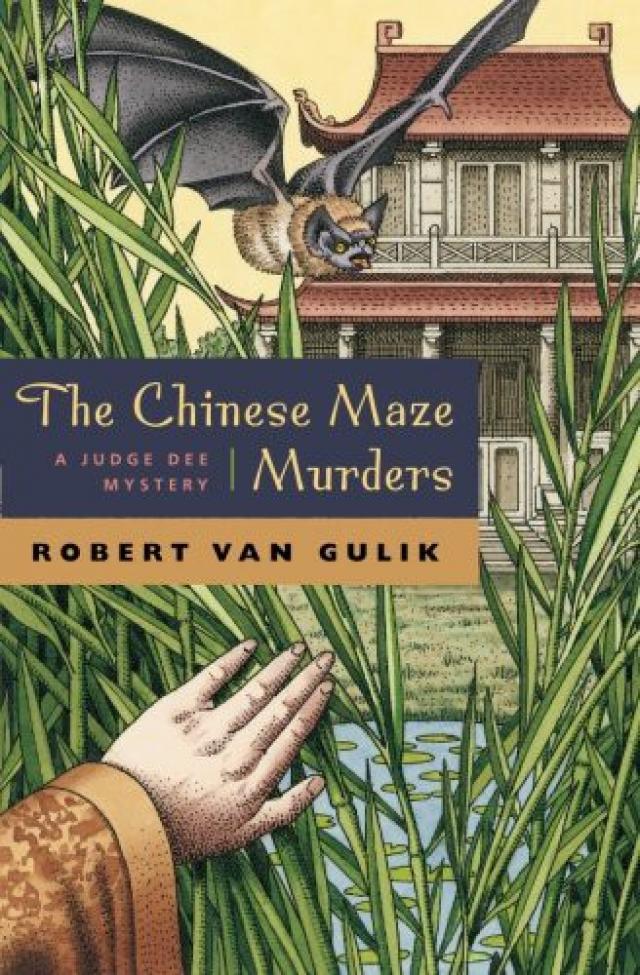
Judge Dee Mysteries Available from Chicago:
The Chinese Bell Murders
The Chinese Gold Murders
The Chinese Lake Murders
The Chinese Maze Murders
The Chinese Nail Murders
Judge Dee at Work
The Emperors Pearl
The Haunted Monastery
The Lacquer Screen
The Monkey and the Tiger
Murder in Canton
Necklace and Calabash
The Phantom of the Temple
Poets and Murder
The Red Pavilion
The Willow Pattern
THE CHINESE MAZE MURDERS
A Chinese detective story
suggested by three original ancient Chinese plots
by
ROBERT VAN GULIK
With nineteen plates
drawn by the author in Chinese style
THE UNIVERSITY OF CHICAGO PRESS
THE CASE OF THE MURDER IN THE SEALED ROOM
THE CASE OF THE HIDDEN TESTAMENT THE CASE OF THE GIRL WITH THE SEVERED HEAD
The University of Chicago Press, Chicago 60637 The University of Chicago Press, Ltd., London
Copyright © 1957 by N. V. Uitgeverij W. van Hoeve The Hague - Netherlands
All rights reserved. Originally published 1956 University of Chicago Press Edition 1997 Printed in the United States of America 03 02 01 6543 2
Library of Congress Cataloging-in-Publication Data
Gulik, Robert Hans van, 1910-1967.
The Chinese maze murders : a Chinese detective story suggested by three original ancient Chinese plots / by Robert Van Gulik ; with nineteen plates drawn by the author in Chinese style, p. cm. "A Judge Dee mystery." ISBN 0-226-84878-7 (alk. paper)
1. Dee Jen-Djieh (Fictitious character) —Fiction. 2. Judges-China—Fiction. I. Title. PR9130.9.G8C54 1997
823'.914-dc21 97-1028
CIP
© The paper used in this publication meets the minimum requirements of the American National Standard for Information Sciences —Permanence of Paper for Printed Library Materials, ANSI Z39.48-1984.
FOREWORD
After the appearance of my translation of the old Chinese detective novel 'Dee Goong An'* (* Dee Goong An, three murder cases solved by Judge Dee. An old Chinese detective novel translated from the original Chinese with an introduction and notes, by R. H. van Gulik, Litt.D.; one illustrated vol. publ. Tokyo 1949.) I was asked to search for other Chinese novels of that kind. However, such books are now rather scarce and moreover it proved difficult to find one that appeals equally to modern Chinese and Western taste. As a matter of fact, 'Dee Goong An' is an exception. As a rule style and contents of ancient Chinese crime and mystery stories differ so much from modern ones that they are of slight interest to the present-day Oriental reader, and even less to the Westerner.
On the other hand old Chinese crime stories contain many clever plots and much material relating to the detection of crime. I thought, therefore, that it would be an interesting experiment to write a Chinese-style detective story myself, utilizing plots found in Chinese stories from bygone times.
I engaged upon this experiment mainly in order to prove to present-day Chinese and Japanese authors that it is possible to write a detective-novel in traditional Chinese style that yet appeals to the modern Oriental reader. I thought this all the more worth while since at present the book-market in China and Japan is flooded with bad translations of third-rate foreign thrillers, while their own ancient crime novels are practically forgotten. When I had completed my English manuscript of 'The Chinese Maze Murders', it was translated into Japanese by Professor Ogaeri Yukio, and published in 1951 by the Kodan-sha in Tokyo, under the title Meiro-no-satsujin, with a preface by the well known Japanese mystery writer Edogawa Rampo. Then I myself prepared a Chinese version, which was published in 1953 by the Nanyang Press in Singapore, under the title Ti-jen-chieh-chi-an. Both editions were favourably received in the Chinese and Japanese press. Encouraged by this success I wrote two more 'Judge Dee' novels, 'The Chinese Bell Murders' and 'The Chinese Lake Murders', of which a Chinese and Japanese version is now in preparation.
Having thus attained my main object, it occurred to me that also Western readers might perhaps be interested in this new type of crime novel. Therefore I decided to publish my English text of 'The Chinese Maze Murders', an additional motive being that the Chinese element has been introduced so often by Western writers of detective stories that I thought that the reader might be interested in seeing how it looks in genuine Chinese garb.
For information on the background of the present novel and the Chinese sources utilized the reader is referred to my Postscript at the end of the book. Here it may suffice to say that I borrowed three plots from ancient Chinese sources, rewriting them as one continuous story centering round the famous ancient Chinese master-detective Judge Dee. I retained the typical features of old Chinese detective novels, such as the prologue which gives some idea of the main events of the story itself, the chapter headings in two parallel lines, the peculiar Chinese device of letting the
detective solve a number of cases simultaneously, etc., and in general tried to preserve as much as possible Chinese style and atmosphere.
The scene of my story is laid in Lan-fang, an imaginary border town of China during the seventh century A.D. The reader will find a Chinese map of that city on page xiv of the present publication. The plates were drawn by me in the style of book-illustrations of the Ming Dynasty.
All the credit of what may be found satisfactory in this novel must go to the ancient Chinese writers who evolved the plots. All its shortcomings must be blamed on the present author.
The Hague, spring 1956
Robert van Gulik
DRAMATIS PERSONAE
It should be noted that in Chinese the surname, here printed in capitals, precedes the personal name.
Main Characters:
DEE Jen-djieh, newly appointed magistrate of Lan-fang, a town district on the Northwest border of the Chinese Empire. Referred to as 'Judge Dee', or 'the judge'.
HOONG Liang, Judge Dee's confidential adviser and sergeant over the constables of the tribunal. Referred to as 'Sergeant Hoong', or 'the sergeant'.
Ma Joong *
Tao Gan *
Chiao Tai *
* the three trusted lieutenants of Judge Dee
Persons connected with ' The Murder in the Sealed Room':
DING Hoo-gwo, a General living retired in Lan-fang. Found murdered in his own library.
DING Yee, a Junior Candidate of Literature, his only son. Referred to as 'Candidate Ding', or 'Young Ding'.
Woo Feng, son of Commander Woo of the Board of Military Affairs in the capital. A Junior Candidate of Literature and amateur painter.
Persons connected with ' The Hidden Testament':
Yoo Shou-chien, an ex-Governor who died while living retired in Lan-Fang.
Mrs. Yoo, nee MEI, the Governor's young second wife.
Mrs. LEE, a painter, friend of Mrs. Yoo.
Yoo Kee, the Governor's eldest son by his first wife.
Yoo Shan, infant son of Mrs. Yoo.
Persons connected with ' The Girl with the Severed Head' :
FANG, a blacksmith. Later appointed headman of the constables of the tribunal, and hence referred to as 'Headman Fang' or 'the headman'.
White Orchid, his eldest daughter.
Dark Orchid, his second daughter.
His son.
Others:
CHIEN Mow, the local tyrant who usurped power in Lan-fang.
Liu Wan-fang, his eldest counsellor.
Corporal LING, a deserter from the regular army, reinstated by Judge Dee.
Orolakchee, an Uigur chieftain. His real name is Prince Ooljin. His false name 'Orolakchee' means agent or representative.
The Hunter, accomplice of Orolakchee.
Tulbee, an Uigur girl.
Occurs in Chapter XIX only:
Master Crane Robe, an old recluse.
LIST OF ILLUSTRATIONS
I Judge Dee attacked by two robbers
II Chien Mow's men invade the tribunal
III Ma Joong and Chiao Tai arrest a criminal
IV Governor Yoo's picture
V Three monks report a theft to the tribunal
VI Judge Dee in General Ding's library
VII Judge Dee in Woo Feng's studio
VIII The drinking bout in the Eternal Spring Wine shop
IX Yoo Kee welcomes Judge Dee to his mansion
X Woo Feng's strange encounter in the temple garden
XI Dark Orchid reports to Judge Dee
XII Ma Joong meets Tulbee
XIII Master Crane Robe and Judge Dee
XIV A criminal confesses his nefarious schemes
XV Judge Dee confronts a criminal with the evidence
XVI Plan of the Governor's maze
XVII Dark Orchid surprised while taking a bath
XVIII Judge Dee on the ramparts of Lan-fang
XIX A depraved criminal on the execution ground
CONTENTS
First Chapter
A strange meeting takes place on a lotus lake; Judge Dee is attacked on his way to Lan-fang
Second Chapter
Judge Dee opens the first session of the tribunal; He discovers in the archives an unsolved problem
Third Chapter
The judge witnesses a quarrel on the market; A young man forecasts his father's murder
Fourth Chapter
Tao Gan reports on a mysterious old mansion; An ingenious trap is set in the dark tribunal
Fifth Chapter
Twenty ruffians attack in the dead of night; Judge Dee sets out on a dangerous excursion
Sixth Chapter
Four guildmasters are received in the main hall; Mrs. Yoo visits the tribunal with an old picture
Seventh Chapter
Three roguish monks receive their just punishment; A Candidate of Literature reports a cruel murder
Eighth Chapter
An old General is murdered in his own library; Judge Dee goes to visit the scene of the crime
Ninth Chapter
Judge Dee ponders alone in a dead man's room; The autopsy brings to light the cause of death
Tenth Chapter
Judge Dee pays a visit to an eccentric young man; He presides an artistic meeting in the tribunal
Eleventh Chapter
Tao Gan has an adventure in an old temple; Ma Joong meets his match in a drinking bout
Twelfth Chapter
Judge Dee discusses the secrets of two pictures; A young girl discovers passionate love letters
Thirteenth Chapter
Yoo Kee entertains a distinguished guest to tea; Judge Dee decides to revisit the General's studio
Fourteenth Chapter
A strange clue is found in a dead man's room; Judge Dee sends his men to arrest a criminal
Fifteenth Chapter
Painter Woo reveals his secret in the tribunal; Judge Dee orders a search of the Eastern city
Sixteenth Chapter
Ma Joong investigates the licensed quarter; He is made a partner in a nefarious scheme
Seventeenth Chapter
Mrs. Yoo pays a second visit to the tribunal; A queer discovery is made in an old mansion
Eighteenth Chapter
Judge Dee decides to consult an old hermit; Ma Joong catches his man in the Drum Tower
Nineteenth Chapter
A recluse discourses on the purpose of life; Judge Dee learns the old Governor's secret
Twentieth Chapter
A rebel chieftain confesses under torture; A mysterious stranger is at last identified
Twenty First Chapter
Judge Dee closes the case of the murdered General; Chiao Tai relates the story of a military disaster
Twenty Second Chapter
Judge Dee explains the murder of General Ding; He reveals the secret of the scroll picture
Twenty Third Chapter
The judge leads his men to the heart of the maze; A gruesome discovery is made in a secret pavilion
Twenty Fourth Chapter
A young girl goes to visit a famous artist; A criminal is caught in an unexpected place
Twenty Fifth Chapter
Two depraved criminals suffer the extreme penalty; Judge Dee learns the secret of an abstruse couplet
SKETCH MAP OF LAN-FANG
1. Tribunal
2. Temple of the City God
3. Temple of Confucius
4. Temple of the War God
5. Bell Tower
6. Drum Tower
7. Pagoda
8. Northern Row
9. Southern Row
10. Chien Mow's Mansion
11. General Ding's Mansion
12. Eternal Spring Wineshop
13. Hermitage of the Three Treasures
14. Mrs. Lee's House
15. Former Yoo Mansion
16. Yoo Kee's Mansion
17. Watergate
18. Execution Ground
First Chapter
A STRANGE MEETING TAKES PLAGE ON A LOTUS LAKE;
JUDGE DEE IS ATTACKED ON HIS WAY TO LAN-FANG
Heaven created an immutable pattern for ten thousand ages, Regulating sun and stars above, mountains and rivers below; Thereafter the sages of old did model our sacred social order, Taking Heavenly Justice as warp, and man-made Law as woof.
A wise and honest judge is Heaven's unerring instrument, The people's father and mother, both compassionate and stern; In his court the oppressed obtain redress of all their wrongs, No criminal there escapes, despite base fraud and guile.
UNDER the present illustrious Ming dynasty, in the Yoong-lo era, our Empire is at peace, crops are plentiful, there are neither droughts nor floods, and the people are prosperous and content. This fortunate state of affairs is due entirely to the August Virtue of His Imperial Majesty. Naturally in this blessed time of peace crimes are few, so that the present provides scant material for the study of crime and detection. Rather than the present one must turn to the past for accounts of baffling crimes, and their marvellous solution by perspicacious magistrates.
Finding myself with ample leisure for the pursuit of my favourite study, I diligently search old records and dusty archives for famous ancient criminal cases, and I have made it a habit always to listen carefully to my friends and acquaintances when, gathered in the tea house, they start discoursing on the astounding crimes solved by famous judges of past centuries.
The other day, late in the afternoon, I strolled through the Western Park to admire the lotus flowers that were in full bloom. I crossed the carved marble bridge that leads to the island in the center of the lotus pond, and found myself an empty corner table on the open terrace of the restaurant there.
Sipping my tea and nibbling dried melon seeds I enjoyed the beautiful view over the lake all covered with lotus flowers. I observed the motley crowd and, as I often do, amused myself by trying to deduce from the appearance of some passers-by their personality and background.
My eye fell on two remarkably beautiful girls who passed by walking hand in hand. Their strong resemblance suggested at once that they were sisters. But evidently their characters were entirely different. The younger one was gay and vivacious who talked all the time. The elder, on the contrary, was reserved and shy who hardly answered the other. Here face bore an expression of deep sadness. I felt sure that somewhere there was a deep tragedy in her life.
As the two girls disappeared among the crowd I noticed that they were followed by an elderly woman; she had a slight limp, walked with a cane and seemed intent on overtaking the girls. I took her to be their duenna. But as she passed in front of the terrace I saw such an evil leer on her face that I hastily transferred my attention to a handsome young couple that came walking along.
The young man wore the cap of a Candidate of Literature, the girl was dressed demurely as a housewife. They walked apart but from the fond looks they gave each other it was clear that they belonged together. I concluded from their furtive air that theirs must be an illicit love affair.
Just when they were passing in front of me the girl made to take the young man's hand, but he hastily withdrew his and shook his head with a frown.
Letting my eyes rove over the guests assembled on the terrace I noticed a plump, neatly-clad man who was sitting alone just like myself. He had a round, pleasant face, I placed him as a member of the landed gentry. Since he seemed the talkative type I hastily averted my eyes fearing that he would mistake my intent gaze as an invitation to strike up an acquaintance. I preferred to be left alone with my own thoughts, all the more so since I had seen a glint in his eyes that made me wary. I reflected that a man with that cold, calculating look that so belied his friendly face might well be capable of committing a dark, premeditated deed of evil.
After a while I saw an old gentleman with a flowing white beard slowly come up the steps of the terrace. He was clad in a brown robe with wide sleeves seamed with black velvet, and a high cap of black gauze on his head. Although he wore no insignia of rank, he had a most distinguished appearance. He stood for a moment leaning on his crooked staff, surveying the crowded terrace with piercing eyes from under bushy white eyebrows.


