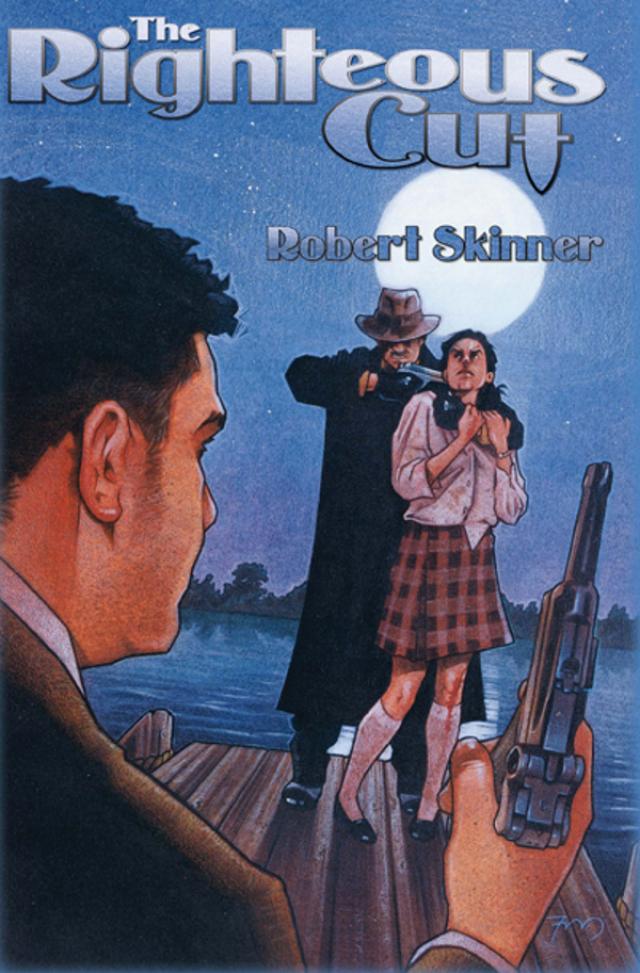
The Righteous Cut, page 13


“She knew me when my scruples were a lot more flexible than they are now. She figures I can’t be scared off—or pushed off the search.”
“You could have told her no.”
Farrell looked away. “I should have, but for some reason I couldn’t.” He paused. “Before she married Richards, she was my girlfriend. She left me for him.” He paused again, smiling ruefully. “None of that makes it any of my business. I’ll butt out now, if you say so.”
Casey snorted. “Not this time. I’ve kept the case alive by investigating the murders, but I want to find that girl a lot more than I want to jail a bunch of hoods for killing each other.” He opened a file folder on his desk and took out Jessica Richards’ photograph. “She’s a good-looking girl. Mature for her age.” He glanced up at Farrell, frowning. “If she were mine, I’d have a hard time playing this so close to the vest.”
Farrell grunted. “Richards is a pretty hard boy. Maybe he is worried, in his own way.” He folded his arms. “I don’t like this. I don’t have a single decent lead.”
“Don’t be so impatient. You’ve already picked up information we didn’t have. If you get any more hunches, play them. You’re working for me, as of now.”
Farrell let a grin steal over his face. “Do I get a tin badge, too?”
Casey blew a raspberry at him. “Not on your life. Who’s left on your list of enemies?”
“I’m going to see Neil Gaudain. He’s the nephew of old man Tarkington. Richards cheated him out of a sugar refinery years ago.”
“And used the proceeds to help Sheriff Tim Marerro win his first election. I just got word that Marerro’s detailed a squad of deputies to guard Mrs. Richards and his staff.” Casey snorted. “With Marerro in his pocket, Richards has all the police protection he wants without worrying about them snooping into things he doesn’t want looked at.”
Farrell raised an eyebrow. “You know, even if Gaudain or any of these others I’ve talked to are involved in this scheme, there’s still got to be somebody running the show. But who is he? Where did he come from?”
“That’s a good question,” Casey replied. “Whoever he is, he couldn’t just show up with a new gang. Everybody in town would know about it in a matter of a few days.”
“No. But he must be somebody strong enough that he could form an alliance with some locals.”
Casey leaned his forearms on the surface of his desk. “Aside from the forensic evidence, we’ve only got one decent clue. The Negro custodian who was killed during the kidnapping dragged a very fancy tie clasp off the killer’s shirt. We’ve learned that only a few Downtown stores sold it. I’ve been waiting for one of my men to call in with something.”
“Maybe we’d better skip that lunch,” Farrell suggested.
“My boy, one thing you need to know about police work is that it’s essential to eat whenever and wherever you can.” Casey keyed his intercom. “White. Are you there?”
“Yes, sir.”
“Do me a favor, go across the street to the delicatessen and get us sandwiches and some coffee.”
“Will do, Captain.”
Casey leaned back and put his feet up on the desk. “Well, kiddo. How do you like police work so far?”
Thinking of the étouffé they were missing, Farrell said, “I’m glad I’m a civilian.”
***
The loose bracket on Jessica’s bed proved to be a flat piece of metal about seven inches in length, tapering to a rounded point. It was a dubious proposition as a weapon, but as a tool it presented a number of possibilities.
Before going to sleep, she’d noticed a flat panel, about two feet square, near the floor of her closet. As the bed bracket came free in her hand, she found herself wondering if the panel might lead to an avenue of escape.
When she woke in the darkness, the panel was her first conscious thought. Seeing that light from the hall no longer seeped in from under the door, she got up, dressed, and turned on the closet light. She found that the panel was simply a piece of plywood, nailed to the wainscoting.
Retrieving the bracket, she inserted the rounded point into a crack between panel and wall, and gently exerted pressure. Little by little, the panel moved. The nails were rather short, and they came free noiselessly. She worked doggedly until she had pried all but one side free.
The sound of a key rattling in the lock gave her just enough warning to close the closet door, get back to the bed and pick up the movie magazine before the door swung open.
This time it was a dapper young man with narrow, fox-like features. His pale blue eyes slid along the contours of her body with undisguised lust. “Hello, babycakes.”
Feeling that she could not ignore his presence, she spoke warily. “Good morning.”
Like the big man the day before, this man carried a paper sack in his hand. A smear of grease discolored the brown paper on one side. He put it on the floor beside her feet, then stared down at her.
“Do—do you have any idea how long I’ll be here?” she asked, forcing herself to remain still, maintaining a vocal tone that was flat and without emotion.
“Depends.”
“Depends on what?”
“I might just decide to keep you here for a while. You are one juicy little broad, you know that?”
Her skin felt as though ants were crawling on it. She sensed that a wrong answer, a nervous laugh could spell disaster. “No. I—I didn’t. Is that why I was…brought here?”
His right hand fell into his trouser pocket and reappeared with something in it. His thumb moved and six inches of chromed steel seemed to explode from within his fist. He grinned, his pale blue eyes lost in a deep squint that gave his face a rapacious, inhuman cast. As the grin slipped from his face, she noticed for the first time that his pupils were so small as to be non-existent. She had read that certain narcotics would produce that effect. She gripped the edge of the bed as she fought off panic.
“No, sweetheart. You’re here because your old man is a cheap, four-flushing crook. You’re here to make him pay. Sweet, ain’t it?” He closed the knife, almost immediately snapping the blade back open. He repeated this, over and over as he leered at her.
A hot rush of anger drove the dizziness out of her. “Don’t you dare talk about my father!”
Without warning he grabbed her by the front of her blouse and snatched her to her feet, bringing her face to within a few inches of his. “No? And what’ll you do, you little bitch?” He threw his other arm around her waist, dragging her close to him. “You gonna tell somebody? You gonna scream or cry? I own you, and when I feel like it, I’m gonna show you how things are, get me?” He let go of her blouse and ran his hand slowly over her breasts and down her body, kneading her buttocks with his fingers. The heat radiating from his body sickened her.
Lying just beneath the revulsion and fear, however, she found rage festering. She wished she had the dull piece of steel in her hand. She wanted to hurt him.
When she didn’t respond to his taunts, he shoved her abruptly away from him. As she fell, the look of cruel amusement came back into his eyes before he left the room. When she heard the key turn in the lock, she dropped her face into her hands and shuddered.
But her rage was still there, growing stronger beneath the terror. Recognizing it as a weapon, she surrendered to the anger, letting it overwhelm the fear. Stiffening her spine, she climbed to her feet and went to the food. She consumed the contents greedily, not caring what they were. She needed all her strength to escape and this was the fuel.
***
Skeeter caught the Esplanade bus within minutes of speaking to his uncle. Finding it nearly empty, he quickly moved to the colored section at the rear. As the bus passed Mystery Street, Skeeter stared, wondering what Mabel was doing. He remembered again her touch against his body, her lips on his, the sight of her tears.
Skeeter had seldom thought much beyond what he might do to entertain himself. Not having had a real home since his mother died, his life in the street had begun as an antidote to loss. After years of juke joints and unfamiliar bedrooms, he’d forgotten there was any other way to live. He’d sometimes sensed unspoken longings in Mabel, but had been too wrapped up in his own pleasure to ask about them.
Now he had the cops after him, a pair of men who wanted to kill him, and Mabel didn’t want him around anymore. He recognized with a sense of wonder that those misfortunes carried an equal weight. Staying alive and out of jail didn’t mean quite so much if Mabel was lost to him.
He got off the bus at City Park and transferred to a Carrollton bus. This one had more people on it, forcing him to stand back in the colored section with the domestics, gardeners, and other working stiffs. He imagined what it would be like to share their sense of purpose, to enjoy the knowledge that he had a home waiting at the end of the day.
At Howard and Carrollton, he left the bus and headed past the campus of Xavier University to Gerttown. He studied each street as he moved from block to block, paying particular attention to parked cars. Finally reaching Olive Street, he paused. There was plenty of activity within Howard’s compound, but little happening on the street. Only a few cars were nearby, all of which appeared to be unoccupied. Holding his breath, he made a beeline for the office, walking steadily but without haste. Once through the door, he paused to peer back out at the street.
“You made good time,” Howard said behind him. “See anybody as you come in?”
“Nary a soul. I cut through Xavier and come down Pine. Made a roundabout to throw anybody off. Soon as I saw the street was clear I come on over.”
“Good,” Howard said, putting a grease-stained hand on his shoulder. “I had Lonnie get a car ready and some of the other boys been watchin’. Cops ain’t come back, and so far as I know, Frank Brown ain’t, neither.”
“This is the worst day of my life,” he said shakily.
Howard reached inside his overalls and pulled out a long-barreled .38 Colt revolver. “You ain’t lived very long yet, Skeeter.” He laughed as he spun the revolver on his trigger finger. “Things can always be worse than they is.”
Skeeter sank down in one of the office chairs. “I don’t need nothin’ worse, Unca Howard. I just want to get out from under this mess and get my life back.”
“You’ll be all right when you get to Houston,” Howard said, sliding his gun back out of sight. “I got friends in the Fifth Ward who’ll help you get on your feet. Change your name and nobody’ll ever find you.”
“I reckon.”
“You don’t sound too glad about it. Houston’s a hell of a town, lots of opportunity for a smart kid like you. I know two, three bruthas over there with garages where you can make good money. Give you a month and you’ll be livin’ high, wide, and handsome with a new life.”
“Guess I ain’t got used to givin’ up this life yet. Or some people…”
“Whoever she is, forget her,” the old man said bluntly. “There’s enough tail in Houston to keep a battleship fulla sailors happy.” Howard put his hand on his nephew’s shoulder again and spoke in a softer voice. “Boy, when white folk decide they want somethin’ of ours, all we can do is fight, if we can, or run if we can’t. This shit has ‘gang’ wrote all over it. You can’t fight no white gang—none of us can. So you run, and stay alive.”
Skeeter was too tired and dejected to argue with his uncle. “Reckon you’re right. What time we leavin’?”
“After dark. Six o’clock, maybe.” He went around to his desk and opened a drawer. “Here. You gonna need some money to get started, and you might feel better with this in your pocket.” He handed Skeeter a roll of bills and a .41 Colt Army Special with the barrel cut to two inches and the butt wrapped in brown tape. “I burnt the serial number off with acid and the tape won’t take your prints. If you have to use it, throw it in the first storm drain you come to.”
Skeeter put the bills and revolver into his pockets. “Thanks, Unca Howard. I know you’re goin’ out on a limb.”
Blessey waved a dismissive hand. “You’re the only kin I got. C’mon up to the house. You can lay up there, have somethin’ to eat before it’s time to go.”
“Yeah. I might could sleep a little.” He followed his uncle through a breezeway toward the faded blue cottage.
***
Easter Coupé sat quietly inside the old Plymouth, stoically chewing a wad of gum as he watched the street. He continued to catch his mind wandering. He found that nothing about this job really made sense to him anymore. Sure, he killed people for money, but usually they were people who needed killin’. Skeeter Longbaugh was just a dumb kid. Killin’ him was too much like going out of your way to step on a baby bird that had fallen from the nest.
It came to him that Skeeter and Patience had much in common. They were both young colored kids, neither had all the good sense they needed to get along, and circumstances had forced each of them into a seamy, dangerous existence. He shook his head violently to clear away those thoughts. How could he possibly confuse Patience with Skeeter?
He trained field glasses up the street and forced himself to watch patiently. Patience was a virtue. He had a lot of patience. Impatience was a liability.
Then it happened so fast he nearly missed it, the swift passage of a slender man across the deserted street. As Coupé focused the glasses on the man’s face, he saw that his quarry had arrived.
The boy stepped quickly through the office door and out of sight into the gloomy interior. Coupé took a deep breath and put the binoculars down on the seat beside him. The moment of truth had arrived. What had seemed abundantly clear two days before was now a hopeless muddle in his mind. His instincts, honed by years on the street and in prison, told him to go in with his silenced .22 and take care of business. He’d done it before, many times, but this time was different. He felt a desperate urge to go sit in Kate’s cool, dim bar and let her rub her thumb across his scarred knuckles again while he listened to the purr of her voice.
***
“Is that him?” Eddie Park asked, pointing at the figure walking quickly across the street ahead of them.
Merlin Gautier’s lean jaw stretched as a grin spread across his face. “That’s the pigeon.”
“We can be over there in front of him before he makes the office,” Park said, his voice tense with excitement.
“Hold your horses, sonny. We don’t want to fumble the ball now.” He pulled the microphone from the clip and keyed it. “Car Forty-six to Dispatch, come in, over.”
“Dispatch, go ahead Forty-six.”
“Alert Inspector Fifty-one that suspect just entered Blessey’s. Will maintain position until he arrives.”
“Roger, Forty-six. Wilco.”
Gautier replaced the microphone and sat back, grinning at Eddie Park’s nervous tension. “Relax, kiddo. We just about got this wrapped up in a pink ribbon.”
Park cast a glance at his partner, shaking his head. “Sometimes I think you got no nerves, Merle.”
“And you got too many. The boss has this figured. He’ll surround this place and then we’ll move in.”
Park exhaled an impatient breath. “Yeah, I reckon.”
Gautier chuckled, leaned back comfortably in his seat.
***
Farrell left police headquarters after sharing roast beef sandwiches with his father. The time with Casey had warmed him, and caused him to wonder if he would go back to Cuba after the first of the year. He didn’t know how many years his father had left, and that thought was sobering.
He paused at the corner newsstand as the headlines from the latest edition of the Times-Picayune caught his eye. Under Art Frizell’s byline, he read what little the reporter had learned about the murders of Jack Amsterdam and Butch Callahan. Art had dubbed the .22-wielding assassin “The Love-Tap Killer.” Grinning, Farrell left a nickel for the newsie and took the paper along with him.
He had left his car two blocks from Police Headquarters out of necessity, but walking down a sunlit street in his hometown seemed the purest form of recreation to him at that moment. He strolled with his hands in his pockets, his mind wandering. He was within sight of his car when the gleam of a lost coin on the sidewalk caught his eye. He slowed his pace, leaned a bit forward to get a better look. As his head moved, something like an angry bee hummed past his ear and swept the gray Stetson off his head. In a split second, Farrell’s subconscious recognized that bees didn’t knock a man’s hat off, knew a second bullet could be on its way, sent an order to Farrell’s muscles that flattened his body on the sidewalk. As he fell, the second bullet came, whining off the sidewalk at his shoulder. He rolled instinctively into the cover of a parked automobile.
He waited for a moment, then crawled to the rear of the pale green Oldsmobile that sheltered him. From his vantage point at the rear fender, Farrell had a good view of the street. Traffic flowed past him, but no single pedestrian was in sight across the broad avenue. Sweet shooting for a pistol. Too sweet, maybe. He scanned the area for a vantage point from which a man might use a rifle, and saw there were many. Most of the buildings across the street were one- and two-story flat-roofed commercial buildings. Easy to gain access to and easy to escape from. He saw his hat nearby and pulled it to him. Two very small holes in the crown—a .22 for certain. He looked again across the street, checking the parked cars. It was impossible to tell the direction from which the shot had come. The shooter might be gone already, or just waiting for another shot.
He clapped the hat back on his head, got to one knee. The sunlight still glinted off the quarter that had saved his life. He picked it up, polished it on his lapel. “You and I will never be parted, sweetheart, no matter how hungry I get.” He tucked it behind his show handkerchief.
Taking one last look over the trunk of the Oldsmobile, he got to his feet and sprinted down the street. Seconds later he was driving away, trying not to think about how close he’d just come to cashing in his chips.
Chapter 11
Jessica wasted no time prying the panel off the closet wall, but was disappointed to find it led only to another sparsely furnished bedroom. This one had a window, however, and she discovered that she was on the second floor of a rambling frame house in the midst of a meadow. The size of the property told her she must be somewhere at the edge of the city. Equally troubling was the sheer drop to a thick row of untamed and sharp-pointed shrubs.