

The Laxian Key, page 1
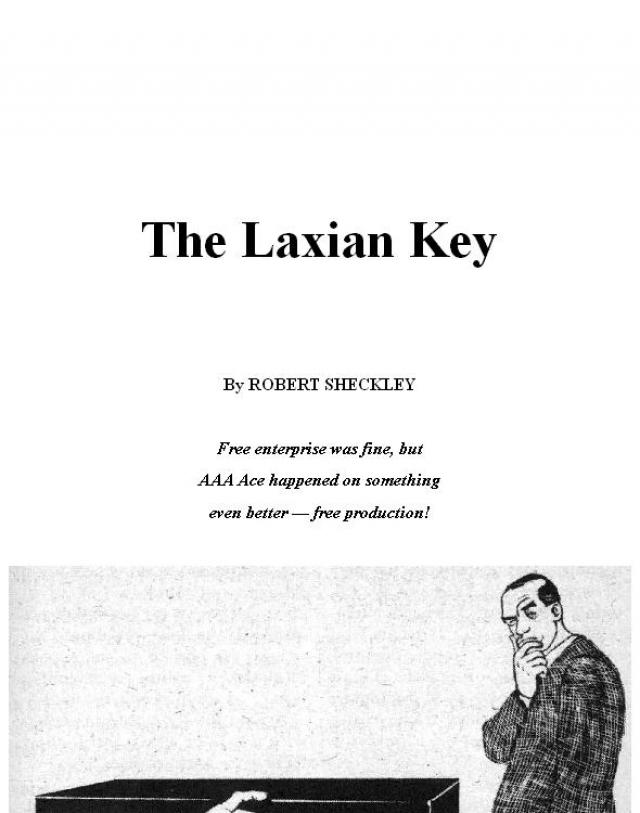


RICHARD Gregor was at his desk in the dusty office of the AAA Ace Interplanetary Decontamination Service. It was almost noon, but Arnold, his partner, hadn’t showed up yet. Gregor was just laying out an unusually complicated game of solitaire, when he heard a loud crash in the hall.
The door of AAA Ace opened, and Arnold stuck his head in.
“Banker’s hours?” Gregor asked.
“I have just made our fortunes,” Arnold said. He threw the door fully open and beckoned dramatically. “Bring it in, boys.”
Four sweating workmen lugged in a square black machine the size of a baby elephant, and dropped it in the middle of the floor.
“There it is,” Arnold said proudly. He paid the workmen, and stood, hands clasped behind his back, eyes half shut, surveying the machine.
Gregor put his cards away with the slow, weary motions of a man who has seen everything. He stood up and walked around the machine. “All right, I give up. What is it?”
“It’s a million bucks right in our fists,” Arnold said.
“Of course. But what is it?”
“It’s a Free Producer,” Arnold said. He smiled proudly. “I was walking past Joe’s Interstellar Junkyard this morning, and there it was, sitting in the window. I picked it up for next to nothing. Joe didn’t even know what it was.”
“I don’t, either,” Gregor said. “Do you?”
Arnold was on his hands and knees trying to read the instructions engraved on the front of the machine. Without looking up, he said, “You’ve heard of the planet Meldge, haven’t you?”
Gregor nodded.
MELDGE was a third-rate little planet on the Northern periphery of the Galaxy, some distance from the trade routes. At one time, Meldge had possessed an extremely advanced civilization, made possible by the so-called Meldgen Old Science. The Old Science techniques had been lost ages ago, although an occasional artifact still turned up here and there.
“And this is a product of the Old Science?” Gregor asked.
“Right. It’s a Meldgen Free Producer. I doubt if there are more than four or five of them in the entire Universe. They can’t be duplicated.”
“What does it produce?” Gregor asked.
“How should I know?” Arnold said. “Hand me the Meldge-English dictionary, will you?”
Keeping a stern rein on his patience, Gregor walked to the bookshelf. “You don’t know what it produces—”
“Dictionary. Thank you. What does it matter what it produces? It’s free! This machine grabs energy out of the air, out of space, the Sun, anywhere. You don’t have to plug it in, fuel or service it. It runs indefinitely.”
Arnold opened the dictionary and started to look up the words on the front of the Producer.
“Free energy—”
“Those scientists were no fools,” Arnold said, jotting down his translation on a pocket pad. “The Producer just grabs energy out of the air. So it really doesn’t matter what it turns out. We can always sell it, and anything we get will be pure profit.”
Gregor stared at his dapper little partner, and his long, unhappy face became sadder than ever.
“Arnold,” he said, “I’d like to remind you of something. First of all, you are a chemist. I am an ecologist. We know nothing about machinery, and less than nothing about complicated alien machinery.”
Arnold nodded absently and turned a dial. The Producer gave a dry gurgle.
“What’s more,” Gregor said, retreating a few steps, “we are planetary decontaminationists. Remember? We have no reason to—”
The Producer began to cough unevenly.
“Got it now,” Arnold said. “It says, ‘The Meldge Free Producer, another triumph of Glotten Laboratories. This Producer is indestructible, unbreakable, free of all defects. No Power Hookup is required. To start, press Button One. To stop, use Laxian Key. Your Meldge Free Producer comes with an Eternal Guarantee against Breakdown. If defective in any way, please return at once to Glotten Laboratories.’”
“Perhaps I didn’t make myself clear,” Gregor said. “We are planetary—”
“Don’t be stodgy,” Arnold said. “Once we get this thing working, we can retire. Here’s Button One.”
The machine began to clank ominously, then shifted to a steady purr. For long minutes, nothing happened.
“Needs warming up,” Arnold said anxiously.
Then, out of an opening at the base of the machine, a gray powder began to pour.
“Probably a waste product,” Gregor muttered. But the powder continued to stream over the floor for fifteen minutes.
“Success!” Arnold shouted.
“What is it?” Gregor asked.
“I haven’t the faintest idea. I’ll have to run some tests.” Grinning triumphantly, Arnold scooped some powder into a test tube and hurried over to his desk.
Gregor stood in front of the Producer, watching the gray powder stream out. Finally he said, “Shouldn’t we turn it off until we find out what it is?”
“Of course not,” Arnold said. “Whatever it is, it must be worth money.” He lighted his bunsen burner, filled a test tube with distilled water, and went to work.
GREGOR shrugged his shoulders. He was used to his partner’s hair-brained schemes for quick wealth. Ever since they had formed AAA Ace, Arnold had been looking for short cuts. The short cuts usually resulted in more work than plain old-fashioned labor, but Arnold was quick to forget that.
Well, Gregor thought, at least it kept things lively. He sat down at his desk and dealt out a complex solitaire pattern.
THERE was silence in the office the next few hours. Arnold worked steadily, adding chemicals, pouring off precipitates, checking the results in several large books he kept on his desk.
Gregor brought in sandwiches and coffee. After eating, he paced up and down, and watched the gray powder tumble steadily out of the machine.
The purr of the Producer grew steadily louder, and the powder flowed in a thicker stream.
An hour after lunch Arnold stood up. “We are in!” he stated.
“What is that stuff?” Gregor asked, wondering if, for once, Arnold had hit upon something.
“That stuff,” Arnold said, “is Tangreese.” He looked expectantly at Gregor.
“Tangreese, eh?”
“Absolutely.”
“Then would you kindly tell me what Tangreese is?” Gregor shouted.
“I thought you knew. Tangreese is the basic food of the Meldgen people. I believe an adult Meldgen consumes several tons a year.”
“Food, eh?” Gregor looked at the thick gray powder with new respect. A machine which turned out food steadily, twenty-four hours a day, might be a very good money maker. Especially if the machine never needed servicing and cost nothing to run.
Arnold already had the telephone book open. “Here we are.” He dialed a number. “Hello, Interstellar Food Corporation? Let me speak to the president. What? He isn’t? The vice-president then. This is important... Channels, eh? All right, here’s the story. I am in a position to supply you with an almost unlimited quantity of Tangreese, the basic food of the Meldgen people. That’s right. I knew you’d be interested. Yes, of course I’ll hold on.”
He turned to Gregor, beaming. “These corporations think they can push—yes? Yes, sir, that’s right, sir. You do handle Tangreese, eh? Fine, splendid!”
Gregor moved closer, trying to hear what was being said on the other end. Arnold pushed him away.
“Price? Well, what is the fair market price? Oh. Well, five dollars a ton isn’t much, but I suppose—what? Five cents a ton? You’re kidding!”
Gregor walked away from the telephone and sank wearily into a chair. Apathetically he listened to Arnold saying, “Yes, yes. Well, I didn’t know that. I see. Thanks.”
Arnold hung up. “It seems,” he said, “there’s not much demand for Tangreese on Earth. There are only about fifty Meldgens here, and the cost of transporting it to the Northern periphery is prohibitively high.”
Gregor raised both eyebrows and looked at the Producer. Apparently it had hit its stride, for Tangreese was pouring out like water from a high pressure hose. There was gray powder over everything in the room. It was half a foot high in front of the machine.
“Never mind, we’ll sell it,” Arnold said. “It must be used for something else.” He returned to his desk and opened several more large books.
“Shouldn’t we turn it off in the meantime?” Gregor asked.
“Certainly not,” Arnold said. “It’s free, don’t you understand? It’s making money for us.”
He plunged into his books. Gregor began to pace the floor, but found it difficult wading through the ankle-deep Tangreese. He slumped into his chair, wondering why he hadn’t gone into landscape gardening.
BY early evening, gray dust had filled the room to a depth of several feet. Several pens, pencils, a briefcase and a small filing cabinet were already lost in it, and Gregor was beginning to wonder if the floor would hold the weight. He had to shovel a path to the door, using a wastepaper basket as an improvised spade.
Arnold finally closed his books with a look of weary satisfaction. “There is another use.”
“What?”
“Tangreese is used as a building material. After a few weeks’ exposure to the air it hardens like granite, you know.”
“No, I didn’t.”
“Get a construction company on the telephone. We’ll take care of this right now.”
Gregor called the Toledo-Mars Construction Company and told a Mr. O’Too
“Tangreese, eh?” O’Toole said. “Not too popular as a building material these days. Doesn’t hold paint, you know.”
“No, I didn’t,” Gregor admitted unhappily.
“Fact. Tell you what. Tangreese can be eaten by some crazy race. Why don’t you—”
“We prefer to sell it as a building material,” Gregor said.
“Well, I suppose we can buy it. Always some cheap construction going on. Give you fifteen a ton for it.”
“Dollars?”
“Cents.”
“I’ll let you know,” Gregor said.
His partner nodded sagely when he heard the offer. “That’s all right. Say this machine of ours produces ten tons a day, every day, year after year. Let’s see...” He did some quick figuring with his slide rule. “That’s almost five hundred and fifty dollars a year. Won’t make us rich, but it’ll help pay the rent.”
“But we can’t leave it here,” Gregor said, looking with alarm at the ever-increasing pile of Tangreese.
“Of course not. We’ll find a vacant lot in the country and turn it loose. They can haul the stuff away any time they like.”
Gregor called O’Toole and said they would be happy to do business.
“All right,” O’Toole said. “You know where our plant is. Just truck the stuff in any old time.”
“Us truck it in? I thought you would—”
“At fifteen cents a ton? No, we’re doing you a favor just taking it off your hands. You truck it in.”
“That’s bad,” Arnold said, after Gregor had hung up. “The cost of transporting it—”
“Would be far more than fifteen cents a ton,” Gregor said. “You’d better shut that thing off until we decide what to do.”
Arnold waded up to the Producer. “Let me see,” he said. “To turn it off, I use the Laxian Key.” He studied the front of the machine.
“Go ahead, turn it off,” Gregor said.
“Just a moment.”
“Are you going to turn it off or not?”
Arnold straightened up and gave an embarrassed little laugh. “It’s not that easy.”
“Why not?”
“We need a Laxian Key to turn it off. And we don’t seem to have one.”
THE next few hours were spent in frantic telephone calls around the country. Gregor and Arnold contacted museums, research institutions, the archeological departments of colleges, and anyone else they could think of. No one had ever seen a Laxian Key, or heard of one being found.
In desperation, Arnold called Joe, the Interstellar Junkman, at his downtown penthouse.
“No, I ain’t got no Laxian Key,” Joe said. “Why you think I sold you the gadget so cheap?”
They put down the telephone and stared at each other. The Meldgen Free Producer was cheerfully blasting out its stream of worthless powder. Two chairs and a radiator had disappeared into it, and the gray Tangreese was approaching desk-top level.
“Nice little wage earner,” Gregor said.
“We’ll think of something.”
“We?”
Arnold returned to his books, and spent the rest of the night searching for another use for Tangreese. Gregor had to shovel the gray powder into the hall, to keep their office from becoming completely submerged.
The morning came, and the Sun gleamed gaily on their windows through a film of gray dust. Arnold stood up and yawned.
“No luck?” Gregor asked.
“I’m afraid not.”
Gregor waded out for coffee. When he returned, the building superintendent and two large, red-faced policemen were shouting at Arnold.
“You gotta get every bit of that sand outa my hall!” the super screamed.
“Yeah, and there’s an ordinance against operating a factory in a business district,” one of the red-faced policemen said.
“This isn’t a factory,” Gregor explained. “This is a Meldgen Free—”
“I say it’s a factory,” the policeman said. “And I say you gotta cease operation at once.”
“That’s our problem,” Arnold said. “We can’t seem to turn it off.”
“Can’t turn it off?” The policeman glared at them suspiciously. “You trying to kid me? I say you gotta turn it off.”
“Officer, I swear to you—”
“Listen, wise guy, I’ll be back in an hour. You get that thing turned off and this mess out of here, or I’m giving you a summons.” The three men marched out.
Gregor and Arnold looked at each other, then at the Free Producer. The Tangreese was at desk-top level now, and still coming steadily.
“Damn it all,” Arnold said, with a touch of hysteria, “there must be a way of working it out. There must be a market! It’s free, I tell you. Every bit of this powder is free, free, free!”
“Steady,” Gregor said, wearily scratching sand out of his hair.
“Don’t you understand? When you get something free, in unlimited quantities, there has to be an application for it.”
THE door opened and a tall, thin man in a dark business suit walked in, holding a complex little gadget in his hand.
“So here it is,” the man said.
Gregor was struck by a sudden wild thought. “Is that a Laxian Key?” he asked.
“A what key? No, I don’t suppose it is,” the man said. “It’s a drainometer.”
“Oh,” Gregor said.
“And it seems to have brought me to the source of the trouble,” the man said. “By the way, I’m Mr. Carstairs.” He cleared sand from Gregor’s desk, took a last reading on his drainometer, and started to fill out a printed form.
“What’s all this about?” Arnold asked.
“I’m from the Metropolitan Power Company,” Carstairs said. “Starting around noon yesterday, we observed a sudden enormous drain on our facilities. So much power was being siphoned off that we felt it wise to search out just where it was coming from.”
“And it’s coming from here?” Gregor asked.
“From that machine of yours,” Carstairs said. He completed his form, folded it and put it in his pocket. “Thanks for your cooperation. You will be billed for this, of course.” With some difficulty he opened the door, then turned and took another look at the Free Producer.
“It must be making something extremely valuable,” he said, “to justify the expenditure of so much power. What is it? Platinum dust?”
He smiled, nodded pleasantly, and left.
Gregor turned to Arnold. “Free power, eh?”
“Well,” Arnold said, “I guess it just grabs it from the nearest power source.”
“So I see. Draws power out of the air, out of space, out of the Sun. And out of the power company’s lines, if they’re handy.”
“So it seems. But the basic principle—”
“To hell with the basic principle!” Gregor shouted. “We can’t turn this damned thing off without a Laxian Key, no one’s got a Laxian Key, we’re submerged in worthless dust which we can’t even afford to truck out, and we’re probably burning up power like a sun gone nova!”
“There must be a solution,” Arnold said sullenly.
Gregor thought sadly of their diminishing bank account. They had made a small profit on their last two jobs, but it was being converted rapidly into gray sand. Still, there was nothing he could do about it. Arnold was his partner. They had gone this far, they might as well go the rest of the way.
Arnold sat down where the desk had been and covered his eyes. There was a loud knock on the door, and angry voices outside.
“Lock the door,” Arnold said.
Gregor locked it. Arnold thought for a few moments longer, then stood up.
“All is not lost,” he said. “Our fortunes will still be made from this machine.”
“Let’s just destroy it,” Gregor said. “Drop it in an ocean or something.”
“No! I’ve got it now! Come on, let’s get our spaceship warmed up.”
THE next few days were hectic ones for AAA Ace. They had to hire men, at exorbitant rates, to clear the building of Tangreese. Then came the problem of getting the machine, still spouting gray dust, into their spaceship. But at last everything was done. The Free Producer sat in the hold, rapidly filling it with Tangreese, and their ship was out of the System and moving fast on overdrive.
“It’s only logical,” Arnold explained later. “Naturally there’s no market for Tangreese on Earth. Therefore there’s no use trying to sell it on Earth. But on the planet Meldge—”


