

The Boy Who Died and Came Back, page 1


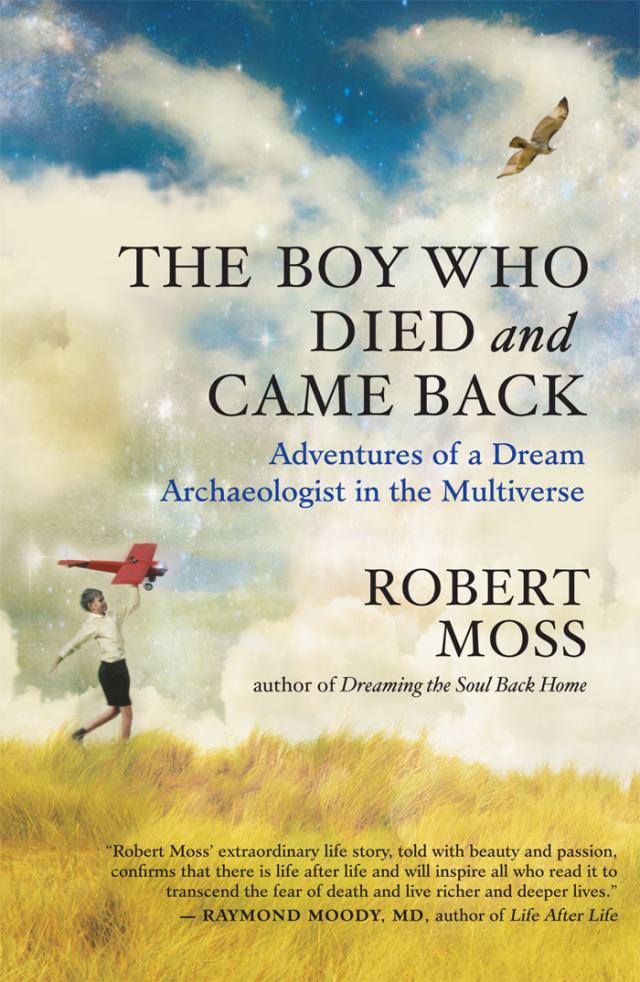
Praise for The Boy Who Died and Came Back
“This remarkable book traces the links between near-death experience, shamanism, and dreams. In a uniquely personal yet profoundly universal way, it takes readers into worlds that demonstrate the limitations of customary concepts of time and space.”
— Stanley Krippner, coauthor of The Voice of Rolling Thunder and Extraordinary Dreams and How to Work with Them
“In this fascinating tribute to the depths of the psyche, Robert Moss reminds us in the words of Shakespeare, ‘We are such stuff / As dreams are made on, / and our little life / Is rounded with a sleep.’ By unearthing these personal stories, we readers participate in an archaeology of the Self, across time, space, and dimensions, in which treasures abound.”
— Robert Waggoner, author of Lucid Dreaming: Gateway to the Inner Self
“In Plato’s Republic, Socrates asks an old man named Kefalos for his perspective on life. Kefalos replies that after spending most of his life engaged in making money as a businessman, he now sees death approaching, and questions of life and death have taken on a new urgency: What is this all about? What comes after death? As an unprecedented number of people around the world reach their own ‘Kefalos moments,’ Robert Moss’ brilliant book can help. Here he shows clearly how a person’s experiences of ‘dying and coming back’ can shape not just one person’s life but those of many others around them. I’ve seen this to be true over and over in my own work as a psychiatrist, and, knowing Moss’ work, I am sure the valuable tools he offers for exploring and understanding these experiences — as well as the many mysteries of dreams and synchronicity — will do a lot of good for many people. Robert Moss is truly a man who died and came back, bringing gifts from another world. His extraordinary life story, told with beauty and passion, confirms that there is life after life and will inspire all who read it to transcend the fear of death and live richer and deeper lives.”
— Raymond Moody, MD, author of Life After Life
“The indigenous peoples understand from direct experience of their dreaming that the world presents itself in two modalities — ‘the world of things seen’ and ‘the world of things hidden.’ In this extraordinary personal narrative, Robert Moss reveals himself as a master dreamer, as one of those modern mystics who can see into ‘the world of things hidden.’ He is also a gifted storyteller, and in reading his words, we discover (through direct experience) that ‘truth comes with goose bumps.’ I loved this book!”
— Hank Wesselman, PhD, anthropologist, author of
The Bowl of Light and the Spiritwalker trilogy,
and coauthor (with Sandra Ingerman) of the award-winning
Awakening to the Spirit World
ALSO BY ROBERT MOSS
Active Dreaming
Conscious Dreaming
The Dreamer’s Book of the Dead
Dreamgates: Exploring the Worlds of Soul, Imagination, and Life Beyond Death
Dream Gates: A Journey into Active Dreaming (audio)
Dreaming the Soul Back Home
Dreaming True
Dreamways of the Iroquois
The Secret History of Dreaming
The Three “Only” Things:
Tapping the Power of Dreams, Coincidence & Imagination
The Way of the Dreamer (video)
THE CYCLE OF THE IROQUOIS (Fiction)
Fire along the Sky
The Firekeeper
The Interpreter
POETRY
Here, Everything Is Dreaming: Poems and Stories
Text and drawings copyright © 2014 by Robert Moss
All rights reserved. This book may not be reproduced in whole or in part, stored in a retrieval system, or transmitted in any form or by any means — electronic, mechanical, or other — without written permission from the publisher, except by a reviewer, who may quote brief passages in a review.
Text design by Tona Pearce Myers
Library of Congress Cataloging-in-Publication Data is available.
First printing, March 2014
ISBN 978-1-60868-235-5
Printed in Canada on 100% postconsumer-waste recycled paper
New World Library is proud to be a Gold Certified Environmentally Responsible Publisher. Publisher certification awarded by Green Press Initiative. www.greenpressinitiative.org
10 9 8 7 6 5 4 3 2 1
Offering
Sing in me, creative spirit
of the boy who died and came back
and the man who flew through the black sun
and returned to walk the roads of this world
as the envoy of a deeper world;
and of how (being human)
he falls down and gets up, over and over,
forgets and remembers,
remembers and forgets.
Let me explain through his story
how the world is a playground, not a prison
when we awaken to the game behind the games.
Let this story help those who read it
to find their bigger and braver stories
and live them, and tell them well enough
to entertain the spirits,
win the indulgence of the gods
and bring through effortless healing.
Gore Mountain, April 27, 2013
CONTENTS
Introduction: Kiss of Death
PART I: THROUGH THE MOON GATE
1Death in a Teacup
2The Other Side of the Moon Gate
3Neither Folk nor Fairy
4Crumpet Time
5Serpent Staff in the Sky
6Kali Ma
7The Pilot’s Cap
8Night of the Hawk
PART II: THE YEARS OF WRITING DANGEROUSLY
9The Hawk and the Oak
10 Theater of Time
11 Heart of the Bear
12 Through the Black Sun
13 Seth Speaks
14 Making a Bear
15 The Incredible Shrinking Man
16 What Is Your Contract with God?
17 Dreams and the Art of Memory
18 Dream Archaeology in Johnson Country
19 The Hawk in the Hearth
PART III: THE RETURN JOURNEY
20 The Change in the Very Hungry Caterpillar
21 Saying Good-Bye to the Happy Hooker
22 The Drowning Boy and His Sister
23 Among Children
24 The Wrong Bus and the Right Gas Station
PART IV: AT HOME IN THE MULTIVERSE
25 The Time Is Always Now
26 We Are Sleeping till We’re Dreaming
27 The Place between Sleep and Awake
28 When the Universe Gets Personal
29 Practicing Death
30 Dancing with the Bear
31 The Double on the Balcony
32 At the Center of All Times
33 Entertaining the Spirits
PART V: ADVENTURES IN DREAM ARCHAEOLOGY
34 Where Dreams Are Passports
35 Return of the Ancient Deer
36 In the House of Time
37 Mutual Visioning with Yeats
38 Flights of the Simurgh
39 What Sings and Cries
40 Dreaming with the Goddess
41 The Shaman from the Eagle’s Nest
42 On the Magic Mountain
Epilogue: Ambassador of the Other Side
Acknowledgments
Endnotes
About the Author
INTRODUCTION
Kiss of Death
It is not more surprising to be born twice than once.
— Voltaire, The Princess of Babylon
I died for the first time in my present body when I was three years old. My mother’s aunt, the opera singer, saw my death in the tea leaves a few months before it happened. She would not talk about that until much later, because although she was a gifted psychic, she missed something. I died and came back.
I died again when I was nine. This time, I slipped through the window of a Melbourne hospital where my body was lying in an operating room. I thought I was going to have some fun at a theme park along the beach but ended up spending a whole lifetime in another world. It was very hard to have to come back to the body of a young boy, carrying all those memories.
During my boyhood, it was almost impossible to talk about these experiences. It was a conservative era in Australia, and I was in a military family. The first person who was able to confirm and validate my experiences of leaving my body dead in a hospital room while I entered other worlds was an Aboriginal boy from a traditional dreaming culture. “Oh yeah,” he said to me matter-of-factly. “We do that. When we get real sick, we go and live with the spirits. When we get well, we come back. Not always as the same person.”
We did not have terms like “near-death experience” (NDE) in Australia in that era, more than twenty years before Raymond Moody, MD, expanded our general understanding of how widespread that phenomenon is, in his bestseller Life After Life. I am glad to have that term, and use it as shorthand to describe what happened to me as a boy and often made me feel like a stranger in a strange land. I have read and heard hundreds of accounts of near-death experiences since I read Moody, and feel great sympathy for those who have been through them. But NDE is not my preferred term for my boyhood experiences, and still less for what happened to me in midlife, in a profound and protracted crisis of spiritual emergence that led me to transform my life. I like the phrase a doctor used
I think of myself that way, as a boy who died and came back. There are terms for someone like this in some cultures. In Tibet, the term is delog (pronounced “day-loak”), and it refers to someone who leaves the body seemingly dead, travels in other worlds, and comes back with firsthand knowledge of the geography and current conditions in those realms. I have had such knowledge since I was very young, but lacking elders and mentors and a context of understanding in my own society, I was required to be discreet about what I knew.
Nonetheless, I was able to use the gifts that come with what Western psychiatry may call dissociation but ancient and indigenous cultures respect as an engagement with the Otherworld and possibly a shamanic initiation. I could step in and out of time, visit the future, and receive visitors from other times and other dimensions. I did ridiculously well in my final school examinations — my photo was on the front pages of the newspapers — in part because I was able to preview the questions, in lucid dreams, before they were given to me in the exam rooms. My intimate connection, in nonordinary reality, with figures from the ancient world helped propel me into my first job, as a lecturer in ancient history at the Australian National University, at the ripe age of twenty-two. My ability to see what was going on behind the curtain walls of consensual reality served me well when I left academia and became a journalist, covering and often predicting major events in thirty-five countries from my base as a staff writer and editor for the Economist in London.
I used my dreams, as well as my adventures as a foreign correspondent, as materials for a series of thrillers published in the 1980s. Four of them made the New York Times bestseller list, and this gave me the freedom to say good-bye to employment and live as a full-time writer. I assigned some of my dreams to my fictional characters, especially Nikolsky, the boozy KGB philosopher in Moscow Rules, a novel that predicted the collapse of the Soviet Union, an event that followed six years after its publication. I followed my dreams and “far memories” of the 1930s in a historical spy novel, Carnival of Spies, set in Germany and Brazil in that era.
I started dating an American woman who had worked as a publicist on my first novel, after she told me she had dreamed the result of the Kentucky Derby the previous year. I promptly reached in my pocket, pulled out all the cash — sixty dollars — and asked her to put it on the winning horse in the next Kentucky Derby, which was being held the following Saturday. She did not dream the result this time, but after studying the form, she decided to put my money on a horse named Genuine Risk, the only filly in the field. At the last minute, she nearly turned back on her way to the betting shop, reflecting that wagering an author’s money on a horse named Genuine Risk might indeed be a risky proposition, especially since a little chemistry was already developing. Nonetheless, she put my money on Genuine Risk and her own on a horse called Withholding. Genuine Risk came in at 13:1, Withholding nowhere. I insisted on splitting the winnings with her, and we married three years later.
Now resident in the United States, I bought a big old house in Sag Harbor and walked my big black dogs on the beach. We vacationed at the Copacabana Palace Hotel in Rio de Janeiro and at the Palácio de Seteais, the Palace of Seven Sighs, in Sintra, the old royal capital of Portugal. When I got on a plane, I sometimes found half a dozen people reading my current novel. Not only able to live as a writer but able to live very well, I may have seemed to others to be living a dream. But this dream quickly palled. Something in my soul was clawing me to a greater purpose.
One year after my first novel reached the top of the bestseller lists, I was sitting on a mat on the floor of a house in the Caribbean while a babalawo (a high divination priest) of Ifa, the oracle of the Yoruba, made a reading for me. The reading was complex. “You were born with a box of mysteries,” he told me. “Your dreams will always guide you.” To his surprise, he found that the orishas — the deities of West Africa — required no offering from me except my love. “Your path is the same as mine,” he concluded.
“What does that mean?” I demanded.
“It means that if you are ready, I will arrange for you to go to a holy city in Nigeria to be trained and initiated as a babalawo of Ifa.”
I protested that I was a white man from Australia. “You want me to become an African witch doctor?”
He laughed. “You know this is a universal tradition, Robert. And you know that you are linked to it in many lifetimes. The choice is yours. There will be signs.”
There were indeed signs. One of them burned its way to my soul. He cast his opele — the chain of bronze medallions used by a high priest of Ifa to reveal the patterns of the oracle — again. He announced, “There is a fire growing close to you. You have not yet seen it, but soon you will feel the heat of its flames.” As I flew back from the Caribbean to New York, I asked myself what new drama might be about to erupt in my life with the emotional force of fire. But oracles, like dreams, can be very literal and specific. I had barely closed the front door to my apartment in Yorkville, on the Upper East Side of Manhattan, and set down my suitcase when I heard a whoosh from the side of the apartment where the windows overlooked a courtyard. I rushed to the window and saw a horizontal sheet of flame coming from an apartment in a building across the courtyard. Flames were licking the glass, and I could feel their heat.
Nonetheless, I decided not to accept the invitation to go to Africa to become a priest of Ifa. I called the man who had played go-between and told him, “I know that I have a deep soul connection with Africa and especially with the Yoruba tradition. I also know that I do not have to follow this tradition, with its ritual obligations, in this lifetime.”
He accepted this calmly. Then he offered this counsel: “The choice is yours, Robert. But there is something you must know. The spirits are like people. They fall in love. And because the spirits are in love with you, they will go on putting on different masks until you accept your full relationship with them.”
He was exactly right. A few years later, I decided to get off the commercial fast track and put down roots in my adopted country by moving to a farm in upstate New York. Here, on the edge of traditional Mohawk land, the spirits came after me in a different guise, and the shadow of other lives fell across me in ways I could not ignore. I came to accept (not without resistance, confusion, and backsliding) that I was required to do nothing less than transform my life. Eventually, I embarked on a path for which there is no career track in Western culture: the path of a dream teacher and dream archaeologist. Once again, I died and came back.
This is not an autobiography, but it is a book of memory. I borrow the phrase from Dante, who used it to describe his early work La vita nuova (The New Life). I was guided by a dream to reread his spiritual memoir as I was writing this one. Dante’s book of memory is woven from his dreams, visions, and poems with just a little connective narrative. He meets central characters in dreams, where he seems to be leading a parallel and continuous life. They include the guide who appears as a beautiful young man dressed in white but calls Dante “my son.” When the poet struggles to understand the nature of their relationship, the man in white tells him, “I am as the center of a circle, to which all points on the circumference bear an equal relation. With you, it is not so.” You will find similar figures in this book, and an account of my own efforts to understand our relationship with other personalities and intelligences within the multidimensional self.
To produce this book of memory, I have gone down again and again into a treasure cave. It is filled with my journals from many decades, which I have been required to sift and study and transcribe. There are fantastic dramas here, mythic trouble (and delight), times of terror and beauty and possible madness, and tremendous transtemporal adventures in which sometimes I enter the situation of my counterparts in other times, and sometimes they join me in mine. We bring each other gifts and challenges, allies and adversaries from other times and other worlds.
In the cave, reading over all these pages, I feel sympathy and compassion as I monitor how younger Roberts tried to make sense of all this while lacking any really helpful mentor in ordinary reality, and how they struggled to keep body and soul together on the roads of this world. I wonder, as I consider how “past” and “future” aspects of myself looked in on each other and sent each other mental texts, whether my present acts of observation are changing things in, say, 1987–1988. These journals are not really old; they confirm the idea that the only time is always Now and that all our pasts and futures and probable realities are accessible in the moment of Now, and can be re-visioned and revised for the better.


