

Death Beam, page 1


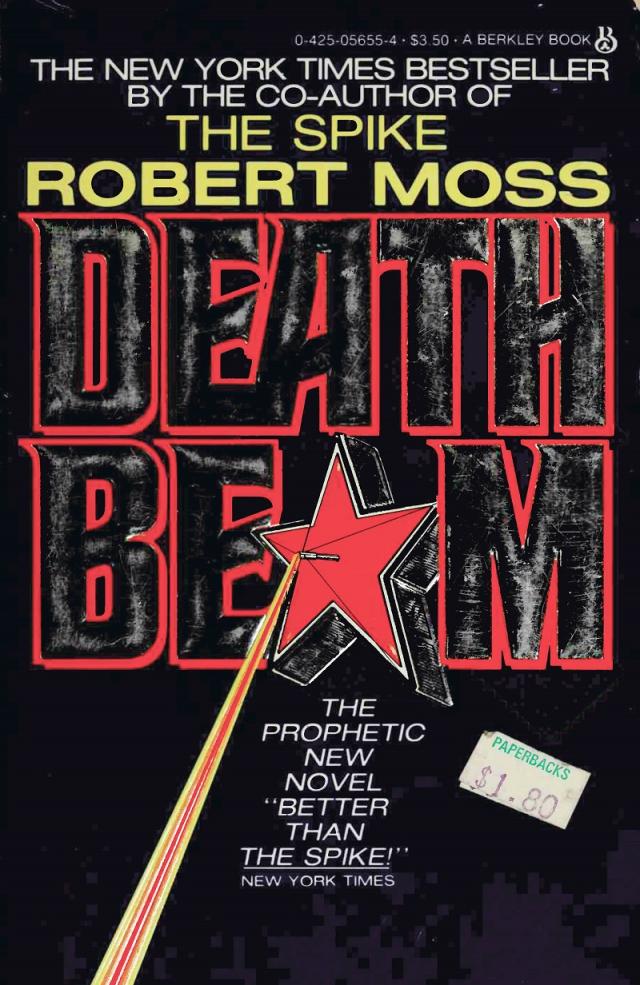
Contents
1
NEW YORK, September 6
2
MOSCOW, September 7
ZHUKOVKA, September 7
KHODINSK AIRFIELD, September 8
3
PARIS, September 8
4
LANGLEY, VA„ September 9
5
PARIS, September 9
PARIS, September 10
6
Hamilton, Bermuda, September 10
7
WASHINGTON, September 16
8
EAST BERLIN, September 17
9
NEW YORK, September 18
NEW YORK, September 19
10
LANGLEY, VA., September 20
11
NEW YORK, September 24
12
BAIKONUR COSMODROME, KAZAKHSTAN, September 28
13
LANGLEY, VA., September 30
ALEXANDRIA, VA., September 30
14
Washington, October 5
MOSCOW. Four years earlier
15
NEW YORK, October 8
16
Miami BEACH, October 13
17
MIAMI, October 13
18
MIAMI, October 14
19
ISRAEL, October 14
20
MIAMI BEACH, October 14
21
MIAMI, October 15
22
KIRTLAND AIR FORCE BASE, N. MEX., October 18
23
NEW YORK, October 19
24
WASHINGTON, October 21-22
25
ZHUKOVKA, October 23
26
NEW YORK, October 28
27
WASHINGTON, October 29
28
WASHINGTON, October 29
29
Jerusalem, November 1
30
East Berlin, November 3
31
BAIKONUR, November 4
32
EAST BERLIN, November 5
33
BAIKONUR COSMODROME, November 5
MOSCOW, November 6
34
WASHINGTON, November 7
35
LONDON, November 25
MUSCAT, November 27
NEAR AL-GHEIDDA,
PEOPLE’S DEMOCRATIC REPUBLIC OF YEMEN, November 29
CAMP OF THE MARTYRS, NEAR AL-GHEIDDA,
SOUTH YEMEN, November 29
36
WASHINGTON, November 29
37
VANDENBERG AIR FORCE BASE, CALIF., November 29
38
EAST HAMPTON, November 29
NEAR AL-GHEIDDA, SOUTH YEMEN, November 29
EAST HAMPTON, November 30
"IT IS REAL AND IT IS NOW. . .
.. superlative entertainment!”
—Kansas City Star
“NIGHTMARISH! A BLOODCHILLING
CONFRONTATION. . .
... between the two superpowers. A novel of the eighties that never slackens pace or lessens tension.”
—John Barkham Reviews
Turn the page for more rave reviews of this prophetic and controversial new bestseller...
"ROBERT MOSS HAS DONE IT AGAIN. . . "
... Just as Churchill warned of the rise of Nazi Germany on the eve of World War II,
Moss has charted the next road to Armageddon...”
—Major General George J. Keegan, Jr.
Former Chief, U.S. Air Force Intelligence
“THIS ONE WILL BE A BESTSELLER. . .
Moss writes with authority and... he has something to say!”
—Columbus Citizen Journal
“THERE IS AN AUTHENTICITY. . .
... about the book that reflects the author’s impeccable credentials.”
—National Review
“IN DEATH BEAM. . .
... Moss reveals again his intimate knowledge of the activities of the KGB and its western counterparts ... and fashions a vivid story of what may lie just ahead when the laser beam moves out of the realm of science fiction and becomes a reality!”
—Allen Drury,
author of
ADVISE AND CONSENT
“A STEP AHEAD OF THE HEADLINES!”
—Women’s Wear Daily
“AS USUAL, MOSS IS RIGHT ON TOP OF THE NEWS.”
—Los Angeles Herald-Examiner
We gratefully acknowledge permission to reprint the following:
Portions of the lyric of “You Go To My Head” by Haven Gillespie and J. Fred Coots © 1938 (Renewed) Warner Bros. Inc. All Rights Reserved.
Used by permission.
A verse from “The City” by C. P. Cavafy, translated by Edmund Keeley and Philip Sherrard. © 1975 Edmund Keeley and Philip Sherrard. Published by Princeton University Press and Chatto & Windus.
This Berkley book contains the complete text of the original hardcover edition.
It has been completely reset in a type face designed for easy reading, and was printed from new film.
DEATH BEAM
A Berkley Book / published by arrangement with Crown Publishers, Inc.
PRINTING HISTORY Crown edition published 1981 Berkley edition / December 1982
All rights reserved.
Copyright © 1981 by RMC Limited.
This book may not be reproduced in whole or in part, by mimeograph or any other means, without permission.
For information address: Crown Publishers, Inc.,
One Park Avenue, New York, New York 10016.
ISBN: 0-425-05655-4
A BERKLEY BOOK ® TM 757,375 Berkley Books are published by Berkley Publishing Corporation,
200 Madison Avenue, New York, New York 10016.
The Name “BERKLEY” and the stylized “B” with design are trademarks belonging to Berkley Publishing Corporation.
PRINTED IN THE UNITED STATES OF AMERICA
To the
DIVA
and the
LEANAN-SIDHE
1
NEW YORK, September 6
There was a line at the door to the Café Carlyle, but acquiring a good table was rarely a challenge for the tall Englishman. His steady gaze, his soft, rich voice and sure, understated gestures conveyed a definite air of command. He had the ageless, chiseled good looks that made some of the people waiting for the floor show look twice, uncertain if they had seen the face in a movie or a magazine. The man stood apart, but was not easy to place.
Lean and spare, with wings of gray in his thick brown hair, brushed straight back from a high, broad forehead, he might have passed for thirty-five or forty-five. The silk shirt and impeccably tailored blue suit spoke of money and power. But there was something about the man’s military bearing and the ironic set of his mouth that signaled that he did not spend his days contemplating stock-market quotations.
Recognizing him, the mâitre d’ sprang forward.
“Good evening, Mr. Canning. Nice to see you.’’
“I hope you have room for us tonight.’’ The quiet resonance of Charles Canning’s voice, even in a casual exchange, was arresting. It was the kind of voice, women had said, that wraps itself around you.
“For you, any time, Mr. Canning.”
The Englishman and his guests were whisked to a large table near the piano where Bobby Short usually held court. New York’s answer to Noel Coward was away on tour in Europe. Standing in for him was a rising star from New Orleans, a witchingly beautiful young black diva called Melanie Toussaint. To judge by the critics, she was taking Manhattan by storm. Her photographs and her haunting name intrigued Canning. The Café Carlyle, he had decided, was the perfect place to round out the evening.
His party included two striking and unattached women, one of them an artist who had won notoriety by sculpting wall friezes of plastic and foam rubber, obscenely reminiscent of the female sex organs; the other a model from Memphis, Tennessee, whose sinuous body and huge looking-glass eyes had made her the latest darling of the fashion photographers. There was Howard Pearlman, a financial wizard and dedicated humorist who seemed to know everyone in the city of New York. And there was an earnest, low-key man with glasses who had just escaped from an official banquet for the visiting first lady of the Philippines. His name was Winthrop Gage III, but Charles Canning and his friends addressed him as Trip. He was the National Security Adviser to the President of the United States.
Charles Canning’s guests were lively and diverse; they sparked off each other. As for their host, now engaged in sampling a bottle of Dom Perignon, not one of them could have easily explained what business occupied him on the island of Manhattan. In the space provided for such information on his British passport—which is to say, the passport under which he most frequently traveled—his occupation was described,as “landowner.” But New York was far removed from Canning’s hereditary acres in Norfolk. He was known to engage in unorthodox business deals and in commodity futures. He received telephone calls from places like Muscat, Guatemala City, and Kinshasa. It was said that he had organized a coup in at least one African state. But Canning’s past was obscure, and he did not invite questions about it. Trip Gage, who knew more than the others, respected the Englishman’s desire for discretion.
Canning’s lips grazed the long, perfectly sloping neck of the model from Memphis.
“I hope you enjoyed being had for lunch,” he whispered into the shell of her ear. Their “lunch” in his penthouse overlooking Gramercy Park had been protracted into the early evening.
Barbi was not letting herself be easily drawn. But her eyelids dipped and the contours of her lovely face shifted slightly.
“You look as if you’re blushing,” Canning teased the model as he took his place beside her. “But your color hasn’t changed.”
“Oh, ah never blush,” Barbi drawled. “Ah just flush all ovah. So it never shows in my cheeks.”
Canning was never quite sure whether her responses were a calculated put-on. He had discovered that there was a quick mind at work behind the Southern languors. The girl had a sense of self-parody, and he suspected that part of her style was a mask she assumed to amuse herself as much as those around her.
“Hey, Barbi.” Howard Pearlman, who had been flirting with her since they had met for dinner at Elaine’s, leaned across the table. “I love the way you talk. You sound just the way good ol’ Jack Daniel’s sour-mash sippin’ whiskey would sound if it could talk. ’ ’
“Ah know jus’ what you mean,” she accepted the compliment with the same insouciance. “Awfully smooth.”
“Did you see Barbi’s picture on the cover of Glamour?” inteijected the sculptress, Lauren Corder, in her throaty smoker’s voice. “The image of the virgin bride.” Lauren stabbed toward an ashtray, missed, and left a long charcoal scar across the tablecloth.
“Absolutely.” Canning smiled, patting the model’s shoulder, reflecting on how she remained disconcertingly silent in the act of love, even while thrashing around like a startled bird trying to escape through a closed window.
“You’ve gotta watch this guy,” Lauren admonished Barbi. “The English are irretrievably decadent. Capable of doing unspeakable things.”
“Ah know,” said the model. Her hand grazed Canning’s knee under the table.
Canning liked Lauren Corder. She was fun, as long as you steered clear of certain sensitive topics. One was drugs. Lauren seemed to think she had a God-given mission to bring about the legalization of all types of narcotics, and tended to get hysterical when people took issue with her. When she had arrived for dinner, Canning had noticed that she was already a little high; he guessed that she had been sniffing coke in her studio. Another taboo subject was Charles’s ex-wife, Sally Sherwin. That was harder to avoid, because Sally was a part-time artist who spent many of her weekends sculpting huge stylized animals in the studio she shared with Lauren Corder on Thompson Street in the Village. On workdays, Sally was employed as the personal assistant to Harry Schwab, the New York literary agent who had negotiated the highest advances in publishing history. Lauren talked about Sally as if she were a sainted martyr. This annoyed Canning, even though the pain of the divorce had receded and he and Sally had settled into being good friends.
Howard Pearlman was trying to find out from Trip Gage whether he believed the press reports that the Soviets were getting ready to send troops into Iran to support the Marxist faction in the civil war.
“I’ve got to tell my broker whether to buy or sell gold,’’ said Pearlman.
“It’s hard to read the Soviets right now,’’ the National Security Adviser commented. Trip Gage was being more than usually cautious. “We can’t tell who’s calling the shots in Moscow. The Soviet leaders are spending so much time fighting each other, I doubt whether they’re ready to take on another major foreign adventure. But I can tell you one thing,’’ he added. “If Marshal Safronov emerges as the new Soviet strongman, Iran will be the least of our worries.’’
“Safronov?’’ Lauren Corder tested the name. “Is he the head of the army?’’
“The Defense Minister,’’ Trip Gage corrected her. “He makes Stalin look like George McGovern.’’
“I still don’t know whether to buy or sell,’’ Howard Pearlman complained.
Canning was now engaged in studying the other patrons of the Café Carlyle. His eyes swiveled from left to right, scanning each table, pausing now and then to focus on an attractive woman or a man who, like himself, could not automatically be placed. His glance lingered on a party of three unaccompanied men who were assaulting a bottle of Chivas Regal. The most voluble of them was a fat, florid man with a red tie. As he cracked jokes, his horn-rimmed glasses kept shooting down his ski-jump nose. He would make a two-fingered stab at them to push them back up. Only one of his companions was joining in the laughter. He was an obvious bruiser, Canning thought. A thickset, bullet-headed tough with fair hair and high cheekbones. The third man, leaner and more elegantly dressed than the others, with black hair receding from a widow’s peak, sat silent and reserved. Only his eyes were mobile. They locked with Canning’s for a moment, but the stranger hastily looked away.
Canning did not need to be in range of the conversation to guess the nationality of the group. He could tell that from their clothes, their bone structure, and the way the fat man clicked his glass in toast after toast, egging his companions on to polish off the first bottle of scotch so they could call for another. Canning had seen identical scenes in the Hotel Rossiya and the Aragvi restaurant in Moscow. The strangers were Russians. And if they had a license to go boozing in the sophisticated Café Carlyle, they must be interesting Russians.
Thoughtfully, Canning took a Havana cigar out of a leather case, circumcised it with his cutter, and flipped open the lid of a handsome red-and-gold lighter. The gesture was out of character for a dedicated cigar smoker who insisted that a gas flame spoiled the savor of tobacco. But a lighter was an ideal place to conceal a mini-camera, and Canning was now occupied in taking a series of snapshots of the Russians on the other side of the room.
Barbi’s hand closed unexpectedly on top of his own. Canning clenched the lighter protectively in the hollow of his fist.
“That’s real pretty,’’ said the model. “Is it a Tiffany? Let me see.’’
An imperceptible twist of Canning’s thumbnail in the base of the lighter, and the minute lens cover on its side was sealed flush with the surface, hidden from any casual observer. The girl turned the lighter around in the palm of her hand like a Faberge egg, then amused herself by switching the flame on and off.
“Look, Charles,” Lauren Corder suddenly exclaimed. “There’s Sally.”
A striking blonde in a ruffled black chiffon cocktail dress and a white marabou jacket was taking her place at a table on the other side of the piano. Lauren rushed over and kissed her effusively on both cheeks.
“Excuse me,” Canning said to the model. He weaved his way through the tables at a leisurely pace to say hello to his ex-wife.
“We’re celebrating,” Sally Sherwin said, cool and composed, after Canning had briefly embraced her. She introduced the people at her table. Canning had already met her boss, Harry Schwab. There was a young man at the table with a California suntan and a girl on each arm.
“Meet Alvin Fiedler,” Sally introduced him. “We’ve just sold the paperback rights to his new book for one point five.”
“Million?”


