

1989 - The Wolf's Hour v4, page 1


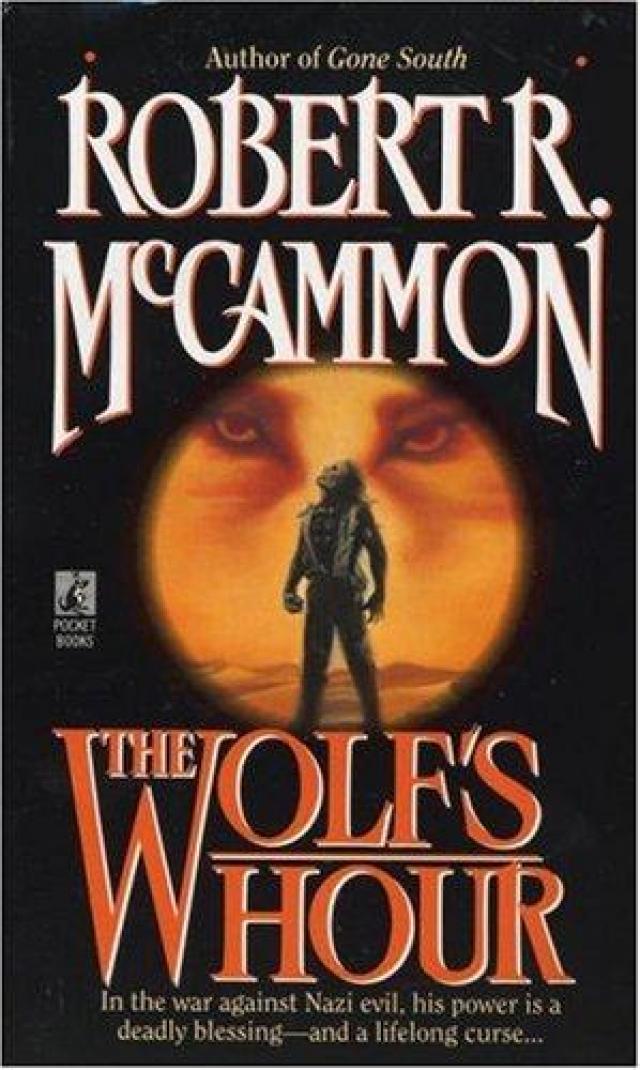
The Wolf's Hour
Published: 1989
* * *
SUMMARY:
A centuries-old curse has given master spy Michael Gallatin the power to turn from a man into a snarling wolf capable of shocking savagery. Against the looming apocalypse of World War II, Gallatin faces his most dangerous mission: to unravel the secret Nazi plan known as Iron Fist. And as D-Day draws nearer, Gallatin's curse becomes the Allies' only hope! Original.
About The Wolf's Hour
by Robert R. McCammon
I began The Wolf's Hour with the idea that I wanted to do a different kind of werewolf story, coupled with elements of romance and heroism. I wanted my werewolf to be a man who often enjoys being a creature who runs on all fours, with a keen sense of smell and vision. Sometimes, Michael Gallatin would much rather be a wolf than a human being.
I also wanted to do away with some of the conventions of the werewolf tale. I didn't see any need for werewolves to be restricted to the full moon in order to change, nor did it necessarily have to be night. I wanted to create creatures who had struggled to take control of their situation rather than being at the mercy of their circumstances. Which is not to say that a werewolf's life is easy; as one of the characters says, "A werewolf never dies of old age."
As much as possible, I wanted to try to make the development and life of these creatures as believable as possible. Which meant they would learn to endure extreme hardship, because how else could they live but in a wilderness environment? But I think there would be great joy in learning how to see the world as a wolf does, in learning---and it wouldn't be easy---how to run on all fours and use your tail as a rudder, how to hunt prey and kill it with your teeth and claws, and generally survive on a level that is at the same time both brutal and elegant.
The merging of brutality and elegance is what I was trying to accomplish, and I hope it succeeded reasonably well. The Wolf's Hour is set during World War II, and goes back and forth in time to show how Michael Gallatin became a werewolf and also follows his current mission in occupied France as a British secret agent. I've been asked why I chose World War II as my time frame, and not the modern era. My answer is that the period of the second World War appears to be---wrongly or rightly---a very romantic time in the history of the world. Romantic, that is, in the sense that one knew who wore the black hats and who wore the white hats. It was a period of apocalyptic decisions and events, and more surely the pivotal period of the twentieth century. It seemed right for The Wolf's Hour, which is basically the tale of nature versus technology.
I also grew up reading the Ian Fleming James Bond novels, and I wanted to create a character who loved life yet had no qualms about killing if the situation demanded it. Michael Gallatin is not a man who kills for pleasure, but he is certainly a dangerous man because he knows---like the wolf does---that killing is basic to his survival. I also wanted Michael Gallatin to be a compassionate man, in that his work and the nature of killing is not his entire focus for being. He is a professional at his craft, but he's certainly not a machine and I wanted him to have very human emotions.
The Wolf's Hour is a departure for me in that it's not necessarily a horror novel, though its basis is the werewolf tale. Not horror, at least, in the supernatural sense, but the horror in The Wolf's Hour is fashioned by human hands, with a "horror genre" figure as the hero. I wanted to turn around the popular culture idea of a werewolf being a dumb brute who in the light of the full moon is compelled to rend and destroy. In The Wolf's Hour, it's the world beyond the werewolves that is brutish and destructive, while the werewolves themselves kill not for pleasure, but for survival.
I enjoyed researching wolf behavior before I started the book, and I also enjoyed reading a lot of military history and data about the personalities of the era, some of whom make appearances in the book. The Wolf's Hour was fun to write, and I hope in the future to continue Michael Gallatin's story
THE WOLF'S HOUR
AMID THE SAVAGERY OF WAR, THERE IS A THIN LINE BETWEEN MAN AND BEAST…
WIKTOR: In the heart of the forest, the old man filled Michael Gallatin’s head with Shakespeare—and taught him to hunt on four legs. He left his pupil with one command, “Live free,” and one unanswerable question, “What is the werewolf, in the eye of God?”
CHESNA VAN DORNE: Known to the Allies as Echo, she was Germany’s Golden Girl, a propaganda film star who sipped champagne with the Nazi top echelon. Posing as her fiancé, Gallatin discovered a woman of rare, glorious passion—and found a precious clue to Iron Fist that put them both in the path of death…
HARRY SANDLER: An American big-game hunter, openly sadistic, he kept a pet hawk so bloodthirsty even his Nazi pals dared not cross him. Gallatin had an old score to settle with Sandler—and he would take his vengeance as a man, not a wolf…
COLONEL JEREK BLOK: Mastermind of Iron Fist, former commander of Falkenhousen concentration camp, and gleeful member of the Brimstone Club, he kept a vicious bodyguard everyone called “Boots.” Blok liked to think of himself as Chesna’s fond uncle—and he didn’t approve of her new beau, Gallatin…
MOUSE: A deserter from the German Army, he met Gallatin while picking pockets on the streets of Paris. Desperate to return to his homeland, the little man agreed to help the Allies—and learned a devastating lesson about true courage…
Books by Robert R. McCammon
Baal
Bethany’s Sin
Blue World
Boy’s Life
Gone South
Mine
Mystery Walk
The Night Boat
Stinger
Swan Song
They Thirst
Usher’s Passing
The Wolf’s Hour
Published by POCKET BOOKS
For orders other than by individual consumers, Pocket Books grants a discount on the purchase of 10 or more copies of single titles for special markets or premium use. For further details, please write to the Vice President of Special Markets, Pocket Books, 1230 Avenue of the Americas, 9th Floor, New York, NY 10020-1586.
For information on how individual consumers can place orders, please write to Mail Order Department, Simon & Schuster Inc., 100 Front Street, Riverside, NJ 08075.
POCKET BOOKS
New York London Toronto Sydney Tokyo Singapore
Dedicated to John Sanders Thanks also to John Hoomes for the technical research assistance.
The sale of this book without its cover is unauthorized. If you purchased this book without a cover, you should be aware that it was reported to the publisher as “unsold and destroyed.” Neither the author nor the publisher has received payment for the sale of this “stripped book.”
This book is a work of fiction. Names, characters, places and incidents are the product of the author’s imagination or are used fictitiously. Any resemblance to actual events or locales or persons, living or dead, is entirely coincidental.
An Original Publication of POCKET BOOKS
POCKET BOOKS, a division of Simon & Schuster 1230 Avenue of the Americas, New York, NY 10020
Copyright © 1989 by The McCammon Corporation
All rights reserved, including the right to reproduce this book or portions thereof in any form whatsoever. For information address Pocket Books, 1230 Avenue of the Americas, New York, NY 10020
ISBN: 0-671-73142-4
First Pocket Books printing March 1989
20 19 18 17 16 15 14 13 12 11
POCKET and colophon are registered trademarks of Simon & Schuster
Cover art by Rowena Morrill Printed in the U.S.A. The war went on.
Prologue
1
The war went on.
By February 1941, it had leaped like a firestorm from Europe to the shores of northwest Africa, where Hitler’s commander of German troops, a competent officer named Erwin Rommel, arrived in Tripoli in support of the Italians and began to drive the British force back to the Nile.
Along the coastal road from Benghazi through El Aghelia, Agedabia, and Mechili, the Panzer Army Africa’s tanks and soldiers continued to press across a land of torturous heat, sandstorms, gullies that had forgotten the taste of rain, and sheer cliffs that dropped hundreds of feet to flat plains of nothing. The mass of men, anti-armor guns, trucks, and tanks marched east, taking the fortress of Tobruk from the British on June 20, 1942, and advancing toward the glittering prize Hitler so desired: the Suez Canal. With control of that vital waterway, Nazi Germany would be able to choke off Allied shipping and continue the eastward march, driving into the soft underbelly of Russia.
The British Eighth Army, most of the soldiers exhausted, staggered toward a railway stop called El Alamein in the last scorching days of June 1942. In their wake the engineers frantically laid down intricate patterns of mine fields, hoping to delay the oncoming Panzers. There was rumor that Rommel was low on petrol and ammunition, but in their foxholes dug in the hard white earth the soldiers could feel the ground shake with the vibrations of Nazi tanks. And as the sun beat down and the vultures circled, columns of dust rose on the western horizon. Rommel had come to El Alamein, and he was not to be denied his dinner in Cairo.
The sun set, blood red in a milky sky. The shadows of June 30 crept across the desert. The soldiers of the Eighth Army waited, while their officers studied sweat-stained maps in tents and engineer teams continued to fortify the mine fields between them and the German lines. The stars came out, brilliant in a moonless sky. Sergeants checked ammunition
Several miles to the west, where recon riders on sand-scarred BMW motorcycles and troopers in armored scout cars rumbled through the dark on the edge of the mine fields, a small sand-colored Storch airplane landed with a snarl and flurry of prop wash on a strip bordered by blue flares. Black Nazi swastikas were painted on the aircraft’s wings.
As soon as the Storch’s wheels stopped turning, an open-roofed command car drove up from the northwest, its headlights visored. A German oberstleutnant, wearing the dusty pale brown uniform of the Africa Corps and goggles against the swirling grit, got out of the aircraft. He carried a battered brown satchel that was handcuffed to his right wrist, and he was smartly saluted by the car’s driver, who held the door for him. The Storch’s pilot waited in the cockpit, following the officer’s orders. Then the command car rumbled off the way it had come, and as soon as it was out of sight the pilot sipped from his canteen and tried to get a little sleep.
The command car climbed a small ridge, its tires spitting out sand and sharp-edged stones. On the ridge’s other side stood the tents and vehicles of a forward reconnaissance battalion, everything dark but for the meager glow of lanterns inside the tents and an occasional glint of shielded headlights as a motorcycle or armored car moved on some errand. The command car pulled to a halt before the largest and most central of the tents, and the oberstleutnant waited for his door to be opened before he got out. As he strode toward the tent’s entrance, he heard the rattle of cans and saw several skinny dogs rooting in the trash. One of them came toward him, its ribs showing and its eyes hollowed with hunger. He kicked at the animal before it reached him. His boot hit the dog’s side, driving it back, but the creature made no noise. The officer knew the nasty things had lice, and with water at such a premium he didn’t relish scrubbing his flesh with sand. The dog turned away, its hide bruised with other boot marks, its death by starvation already decided.
The officer stopped just short of the tent flap.
Something else was out there, he realized. Just beyond the edge of the true dark, past where the dogs were searching through the garbage for scraps of beef.
He could see its eyes. They glinted green, picking up a shard of light from a tent’s lantern. They watched him without blinking, and in them there was no cowering or begging. Another damned tribesman’s dog, the officer thought, though he could see nothing but its eyes. The dogs followed the camps, and it was said they would lick piss off a plate if you offered it to them. He didn’t like the way that bastard watched him; those eyes were cunning and cold, and he was tempted to reach for his Luger and dispatch another canine to Muslim heaven. Those eyes stirred ants of unease in his belly, because there was no fear in them.
“Lieutenant Colonel Voigt. We’ve been expecting you. Please, come in.”
The tent flap had been drawn back. Major Stummer, a rugged-faced man with close-cropped reddish hair and round eyeglasses, saluted, and Voigt nodded a greeting. Inside the tent were three more officers, standing around a table covered with maps. Lantern light spilled over the chiseled, sun-browned Germanic faces, which were turned expectantly toward Voigt. The lieutenant colonel paused at the tent’s threshold; his gaze wandered to the right, past the skinny, starving dogs.
The green eyes were gone.
“Sir?” Stummer inquired. “Is anything wrong?”
“No.” His answer was too quick. It was stupid to be upset by a dog, he told himself. He had personally ordered an “88” gun to destroy four British tanks with more composure than he felt at this moment. Where had the dog gone? Out into the desert, of course. But why had it not come in to nose amid the cans like the others? Well, it was ridiculous to waste time thinking about. Rommel had sent him here for information and that’s what he planned to take back to Panzer Army headquarters. “Nothing’s wrong except I have stomach ulcers, a heat rash on my neck, and I long to see snow before I go mad,” Voigt said as he stepped into the tent and the flap fell shut behind him.
Voigt stood at the table with Stummer, Major Klinhurst, and the other two battalion officers. His flinty blue eyes scanned the maps. They showed the cruel, gulley-slashed desert between Point 169, the small ridge he’d passed over, and the British fortifications. Inked-in red circles indicated mine fields, and blue squares stood for the many defensive boxes, studded with barbed wire and machine guns, that would have to be overcome on the drive eastward. The maps also showed, in black lines and squares, where the German troops and tanks were positioned. On each map was the recon battalion’s official rubber stamp.
Voigt took off his flat-brimmed cap, wiped the sweat from his face with a well-used handkerchief, and studied the maps. He was a big, broad-shouldered man whose fair skin had hardened to burnished leather. He had blond hair with swirls of gray at the temples, his thick eyebrows almost completely gray. “I assume these are up-to-the-minute?” he asked.
“Yes, sir. The last patrol came in twenty minutes ago.”
Voigt grunted noncommittally, sensing that Stummer was waiting for a compliment on his battalion’s thorough reconnaissance of the mine fields. “I don’t have much time. Field Marshal Rommel is waiting. What are your recommendations?”
Stummer was disappointed that his battalion’s work wasn’t recognized. It had been hard and heavy the past two days and nights, searching for a hole in the British fortifications. He and his men might have been on the edge of the world, for all the desolation around them. “Here.” He picked up a pencil and tapped one of the maps. “We believe the easiest way through would be in this area, just south of Ruweisat Ridge. The mine fields are light, and you can see there’s a gap in the field of fire between these two boxes.” He touched two blue squares. “A concentrated effort might easily punch a hole through.”
“Major,” Voigt said wearily, “nothing in this damned desert is easy. If we don’t get the petrol and ammunition we need, we’re going to be on foot throwing rocks before the week’s over. Fold the maps for me.”
One of the junior officers began to do so. Voigt unzipped his satchel and put the maps in them. Then he zipped up the satchel, wiped the sweat off his face, and put on his cap. Now for the flight back to Rommel’s command post, and for the rest of the night there would be discussions, briefings, and a movement of troops, tanks, and supplies to the areas Rommel had decided to attack. Without these maps the field marshal’s decision would be nothing more than a toss of the dice.
The satchel now had a satisfying weight. “I’m sure the field marshal would want me to say that you’ve done a remarkable job, Major,” Voigt finally said. Stummer looked pleased. “We’ll all toast the success of Panzer Army Africa on the banks of the Nile. Heil Hitler.” Voigt raised his hand quickly, and the others—all except Klinhurst, who made no bones about his distaste for the party—responded in kind. Then the meeting was over, and Voigt turned away from the table and walked briskly out of the tent toward the waiting car. The driver was already there to open the door, and Major Stummer came out to see Voigt off.
Voigt was a few strides from the car when he caught a quick movement to his right.
His head swiveled in that direction, and at once his legs turned to jelly.
Less than an arm’s length away was a black dog with green eyes. It had evidently darted around from the tent’s other side and had come up on him so fast that neither the driver nor Stummer had time to react. The black beast was not like the other starving wild dogs; it was as big as a bull mastiff, almost two and a half feet tall at the shoulder, and muscles, like bunches of piano wires, rippled along its back and haunches. Its ears were laid flat along its sleek-haired skull, and its eyes were as bright as green signal lamps. They stared up forcefully into Voigt’s face, and in them the German officer recognized a killer’s intelligence.


