

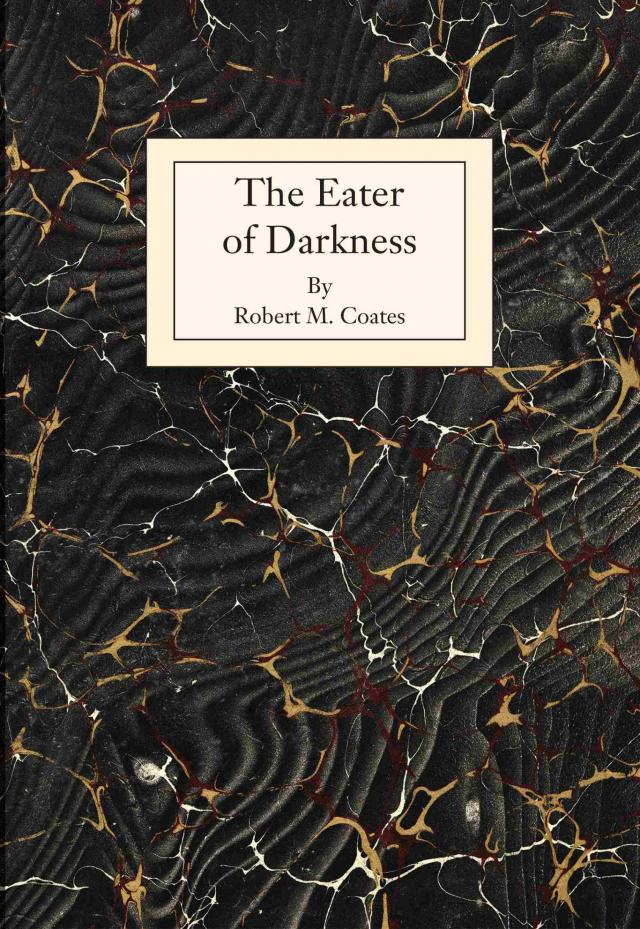
The Eater of Darkness, page 1


Publishing history:
Originally published by Contact Editions, Paris, 1926.
Reprinted by the Macauley Company, New York, 1929.
Published with a new introduction by the author by G.P. Putnam’s Sons, New York, 1959.
New edition copyright © David Wilk 2021
Foreword copyright © by Mathilde Roza 2021
Paperback ISBN 978-1-947951-23-5
eBook ISBN 978-1-947951-22-8
Cover and book design by Barbara Aronica-Buck
Published by
City Point Press
PO Box 2063
Westport CT 06880
(203) 571-0781
www.citypointpress.com
Contents
Introduction to the 1959 reprint by Robert M. Coates
Introduction to the 2021 Edition by Mathilde Roza
The Eater of Darkness
Editor’s Notes
Robert Myron Coates
Novels and Book-Length Works
Introduction to the 1959 reprint
I would be both a fool and a liar if I didn’t admit straightaway that I’m delighted to see this first book of mine re-published. If the first novel is like the first-born child—and it is, for it is always regarded a little more tenderly and forgivingly than the ones that follow—then it seems to me that the same novel, re-issued, is a little like the appearance of the first grand-child. There is the same sense of being at one remove, combining the pleasures of parenthood without its pains and anxieties, and the same respectful feeling that one is involved, despite one’s self, in the ancient processes of continuity; and the easy, irresponsible fondness—most of all, perhaps, the feeling of irresponsibility. “I didn’t write the thing,” the grandfather-author says. “If anyone’s to blame, blame him,” and ignoring the paradox in time he points to his spiritual son, that youngster in his twenties, back there.
There is also that grandfatherly tendency to lean back and reminisce. Can you spare me a moment or two while I light my pipe? Then I’ll tell you about the early and middle nineteen-twenties—or as we call them, the good old days.
To begin with, this book was written in what I am convinced were happier, more hopeful and confident times than we are likely to see again for many, many years. Every age, every generation, in its youth, has its problems, its trials, its triumphs and its uncertainties. We had ours. But apart from all this mine had also the glorious feeling that we were truly on the threshold of a Golden Age. We had it on the highest authority that the last great war, the War To End Wars, had been fought—hadn’t even President Wilson said so?—and we believed it. And not only we, but a good share of our elders believed it too; I can still remember the outcries of horror and condemnation that swept the world when Laurence Stallings published that massive compilation of war photographs, around 1925, and titled it “The First World War.” “First World War,” indeed! There was fighting going on here and there sporadically, of course: in the Riff, against Abd El Krim, and mysterious doings in Russia; the Japanese were beginning to throw their weight around in Manchuria. But that there would ever be another Great War-that was unthinkable; surely we had all learned our lesson about that!
Stallings was right, of course, and already there were forces slowly gaining strength and direction which would eventually justify his ironic prediction. But I won’t go into them here, for we didn’t know about them. The young men of my generation looked forward to peace, to peace timeless, unhurried and indestructible; I would suggest that you pause for a moment, as I sometimes do, to think about that, and compare the basic outlook it suggests with the mixture of frustration, anxiety and downright fear that lies in the back of every man’s mind nowadays when he picks up his morning paper or turns on the radio.
This fact, too, I think, had a great deal to do with creating the atmosphere of the period—a mixture of optimism, enthusiasm and feverish activity. It was a fine time to be young in, especially in Paris and for a bunch of kids from Pittsburgh, Cincinnati, Rochester, Dallas and other way stations who until the war had hardly known Europe existed. It was the Dada period, and for me Dada has always meant gaiety: the one artistic movement I know of whose main purpose was having fun. It was also a period of experimentation. There was indeed a ferment in all the arts, and in the field of literature we had three titans leading the way—Gertrude Stein, James Joyce and Ezra Pound—who in their separate fashions were manipulating the English language in ways that had never been done before; and if the headiness of all this made us sometimes a little punch-drunk or just plain silly it must, I think, be conceded that we were honestly so.
Unlike the present “beat” generation, which sometimes seems to me to be playing both ends against the middle, we felt that if we were in revolt, we could neither give quarter to the enemy nor accept it. We were so far out, as the saying goes now, that success distressed us. Our “little” magazines—Broom, Gargoyle, Secession, transition, and so on—remained determinedly little, eschewing anything so vulgar as wide circulation and financial profits; while a good review, if it came from one of the pooh-bahs of the period, was equally disturbing. Praise from such a quarter could only mean that you had slipped up somewhere, and I still remember my uneasiness when an early book of mine, “The Outlaw Years,” was successful: what had I done, I wondered, to deserve such loathsome encomiums? (One of the French Dadaists, Louis Aragon—now oddly enough, a leading figure in the Communist party over there, and presumably with no time for such nonsense—went so far as to write the book editors of the Paris papers individually, promising to horsewhip them if they so much as mentioned his new book. Most of us had our parents to support us, of course—or to help, as mine did, while I earned a little money on the side—and the cost of living, owing to the exchange, as almost embarrassingly low. My average income, from all sources, was about fifty dollars a month, and I certainly never felt deprived.)
This book, though it wasn’t an actual flop, had a gratifying lack of success in the proper quarters, and a pleasantly comforting succès d’estime elsewhere. The fact is that I’d honestly never expected to see it in published in the first place, so in a sense anything I got out of it was gravy. My attitude at the time was a confused, variable and thoroughly jejune mixture of Francois Villon (the medieval influence, and also general rascality, though a more law-abiding rascal than I was in those days could hardly be imagined); Sir Philip Sidney (the great sixteenth-century English poet, representing the aristocratic impulse) and Dada, or devil-may-careness. In this instance, it was largely Sidney’s influence that governed me.
Like many of his high-born contemporaries, he never stooped to seek out a publisher for his writings. He just had a fair copy of them made and circulated among his friends, and I figured that if that was the way Sidney did things, why, so would I. I was back in New York for a year, trying to recoup, or perhaps simply coup my finances (after all, I couldn’t depend on my family forever) when the early part of the book was written. But I finished it in Giverny, a lovely small Seine-side town about fifty miles down the river from Paris—having managed, more or less by the skin of my teeth, to get back to France again—and Giverny, though fundamentally a farm village, and a charming one, had been a resort for artists and writers ever since Claude Monet had settled there some fifty years earlier.
He was still living there, the patriarch of the place, as he was of the whole Impressionist movement; and so, by that time, was a grandson, another artist, half French and half American, named James Butler. Jim was also a dabbler in all sorts of handicrafts, and the purpose of this long digression, nostalgic as it is to me, is to say that when the book was finished I simply typed it off carefully, and with Jim’s help managed to bind it fairly neatly—and thought that would be the end of it. Or not quite the end, for there still remained the gentlemanly circularization of friends; and one of the friends, and a particularly dear one, whom I tapped in this manner, was Gertrude Stein. She read it, and liked it, and immediately set about getting it published. Though I may have yawned delicately at the prospect, I must admit now that I was pretty darned pleased at the way things were turning out. I can see now that a good deal of my disdain at the idea of mingling art with commerce, like a good many of our other attitudes of the period, was basically simply hedging: I wasn’t at all sure that anybody was going to want to publish the thing in the first place.
I have my reservations about parts of the book now, but have made relatively few changes. I have changed, or tried to clarify a few references that were so personal or so much of the period that they’d be needlessly cryptic now, but otherwise I have made no effort to “bring it up to date.”* There were Elevateds in New York then, and they did cost a nickel a ride; there was vaudeville, and the movies were silent and had captions; girls (God bless them) did wear a chemise; and Giverny (God bless it too) though now almost a suburb of Paris, was then so quietly rural at night that you could hear the old water mill on the river nearby throbbing “so soft it might be thunder in Constantinople.”
I have tampered with a couple passages that really grieved me, but I’ve left others that are equally improvable if they seemed to require more ambitious changes. Though it’s probably the most “personal” of all, I’ve left the voluminous dedication as it is, for sentimental reasons. It was intended, in a kind of grab-bag way, as a tribute to friends and other persons or organizations who had helped in one way or another in the book’s
As I’ve said, Gertrude Stein, who is also mentioned in the dedication, was the one who practically got the book published; but she was a help, a support and an encourager in ways that went beyond that. One wonderful thing about the nineteen-twenties in Paris, as I look back on them, was that the “great ones,” even the titans, were so accessible. You didn’t have to make an appointment, and a pilgrimage, to meet Léger, Picasso, Satie, Pascin, Juan Gris, Tristan Tzara or Brancusi, to mention a few names at random. You found them sitting at a table nearby on the terrasse of the Café du Dome, the Select or the Rôtonde, in the Montparnasse Quarter, or the Deux Magôts in the Saint-Germain, and as the evening wore on and mutual friends appeared you were likely to find yourself sitting at the same table with them, or as their table indefinitely rounded out, satellite, with other tables—and talking and drinking with them without the least self-consciousness on either side.
Brancusi was a great party-giver and so in those days was Pound, and at both their houses there was the same feeling of equality between the older and more established artists and the young newcomers. In a sense, the atmosphere has always seemed to me a little like that of the Cripple Creek gold-mining district, where I lived for a while as a boy: with everyone striving for new strikes or new discoveries, anyone might strike it rich, and meanwhile there was room for all.
James Joyce was an exception, being more retiring, and so was Gertrude Stein, who just didn’t like the randomness of café life. A big woman, calm, massive-faced, massive-bodied, with a brown Italian coloring that was accentuated by her habit of wearing loose-woven peasant-like skirts and blouses, and sandals, she lived with her life-long friend, Alice Toklas (darker, wirier and more active) in the famous apartment, 27 rue de Fleurus, off the Luxembourg Gardens, and in a sense presided there. I think now that she may have felt a certain frustration herself, for in her lifetime she never got (has not got even now) the recognition that was due her for her influence in introducing an almost mathematical lucidity (the classic influence, as distinguished from Joyce’s, the romantic influence) into the treatment of the English language.
At any rate, people came to her, not she to them— Sherwood Anderson, Thornton Wilder, Ernest Hemingway, among many others—and though a few of them, notably Hemingway, disavowed her later, I think most of us remember and treasure the warmth, the understanding and (again) the feeling of artistic equality we got from her.
I won’t go further into that, though, for I feel I’m in danger of getting soppy, and I’ve certainly talked enough about myself. Instead, I’d like to use the space remaining to me to add one more anecdote to the annals of Steiniana. I’ll make it as brief as possible. We’d got talking one day about Anthony Trollope, who was one of her great admirations, and when I’d confessed I’d never read him, she promised casually to send me some books of his. A few days later an expressman delivered, not a parcel, but a carton, a crate full, heavy with books—with Trollope, in short: the Barchester series, the Parliamentary series, practically all of him, and as you probably know all of Trollope means a great deal of reading indeed.
I was wading in Trollope for months, I was practically drunk with him, for I discovered that I loved him too. But I still feel that if you’re going to get to know Trollope, that’s the way to do it, and the way Gertrude handled the matter is typical of the largeness of her own nature, too.
Robert M. Coates, 1959
Drawing by Robert M. Coates, early 1920s. (Robert M. Coates papers, American Heritage Center, Laramie, WY)
Introduction to the 2021 Edition
Mathilde Roza
The Eater of Darkness, published in Paris in 1926, is a unique avant-garde novel. Since its appearance, it has been termed “one of the most unusual literary concoctions of the period,” a “melodramatic extravaganza of the most nonsensical sort,” “one of the cleverest tours de force ever contrived by the pen of a wit,” and “a hilariously misconstructed hurricane of happenstance, adventure and parody.”1 Most famously, following the publication of the novel in New York in 1929, The Eater of Darkness became known as the first Dada novel in English. Because of the occurrence of a futuristic and sinister x-ray machine in its plot, the novel is also recognized as an important early science fiction novel in encyclopedias of the genre. The novel, in short, has much to offer and deserves recognition as a rare and inspiring product of the spirit of creativity that ignited the early 1920s.
The book’s author was Robert Myron Coates, a young American who had come to the French capital five years before. Coates had been born in New Haven in 1897. He was the only child of Harriet Coates, a middle-class Victorian with feminist sympathies, and Frederick Coates, a machinist with a fascination for inventions. During his career Frederick gradually developed from a toolmaker to a designer of special machinery. The American literary critic Malcolm Cowley, thinking of Robert Coates’s strong drive toward literary experimentation, once linked him to the senior Coates, writing: “I think of [Robert Coates] as a craftsman, an inspired mechanic working with words as his father had worked with pieces of metal, choosing and calibrating, fitting together, then grinding and polishing in the hope of achieving some ultimate invention.”2 Frederick Coates’s career certainly had a significant impact on the author’s youth; between 1905 and 1915 the small family traveled the country, settling down in various gold-mining districts in Colorado and then in Seattle, Portland, Cincinnati, Springfield, Buffalo, New York City, Rochester, and other places. As a result, the young Coates never lived in one place for a long period of time. He attended countless different schools and always, as he wrote in his memoirs, he was “for a period at least, the new boy, the outsider.”3 In 1915 he enrolled at Yale University (Class of 1919) and became a frequent contributor to the Yale Literary Magazine, joining the magazine’s editorial board in his senior year. When World War I broke out, he enrolled in the Yale R.O.T.C. (Reserve Officers Training Corps) to become a pilot, but the war was over before he had obtained his wings. After graduation, Coates moved to New York. Drawn there by a great love and fascination for the city, he embarked on a career in advertising, but his heart was not in it; he longed to go abroad and become a writer.
Frederick Coates’s bicycle store, 1897. In New Haven, Frederick Coates provided for the family by running a bicycle store. Note the reference to “working up inventions.” (New Haven Museum and Historical Society, New Haven city directory, 1897)
Drawing by Robert Coates of himself in a Paris bar, 1921. From Paris, Coates sent a letter to his friend Reginald Marsh that included a drawing Marsh might have made of him, “This is you in Paris.” (Archives of American Art, Reginald Marsh Papers)
With money from his father, Coates sailed to France in 1921, at a time when expatriation was fast becoming a generational trend. As a result, the writer later complained, he “automatically became an ‘exile’ and a part of the ‘Lost Generation.’”4 In Paris, he found lodgings on 9 La Rue de la Grande Chaumière, just off the Boulevard du Montparnasse, in the heart of the bohemian American Quarter. He thoroughly enjoyed the Quarter’s boisterous and unpredictable café life, and especially loved the congenial artistic climate that he encountered there; in fact, Paris reminded him of the Cripple Creek gold-mining district in Colorado where he had lived as a boy. In both places, he later wrote in his memoirs, “with everyone striving for new strikes or new discoveries, anyone might strike it rich, and meanwhile there was room for all.”5 In France, he established meaningful contacts with literary figures such as Arthur Moss, Florence Gilliam, Matthew Josephson, Malcolm Cowley, Ernest Hemingway, Kathleen Cannell, Harold Loeb, Ford Madox Ford, and Laurence Vail, and published highly experimental prose sketches in the expatriate little magazines Gargoyle, Broom, and Secession. He developed a special relationship with Gertrude Stein, the matriarch of modernism, who owned the famous salon on 27 Rue de Fleurus. In fact, according to Stein’s biographer, Coates had been “a Rue-de-Fleurus favorite.”6


