The Scottish Novels, page 1


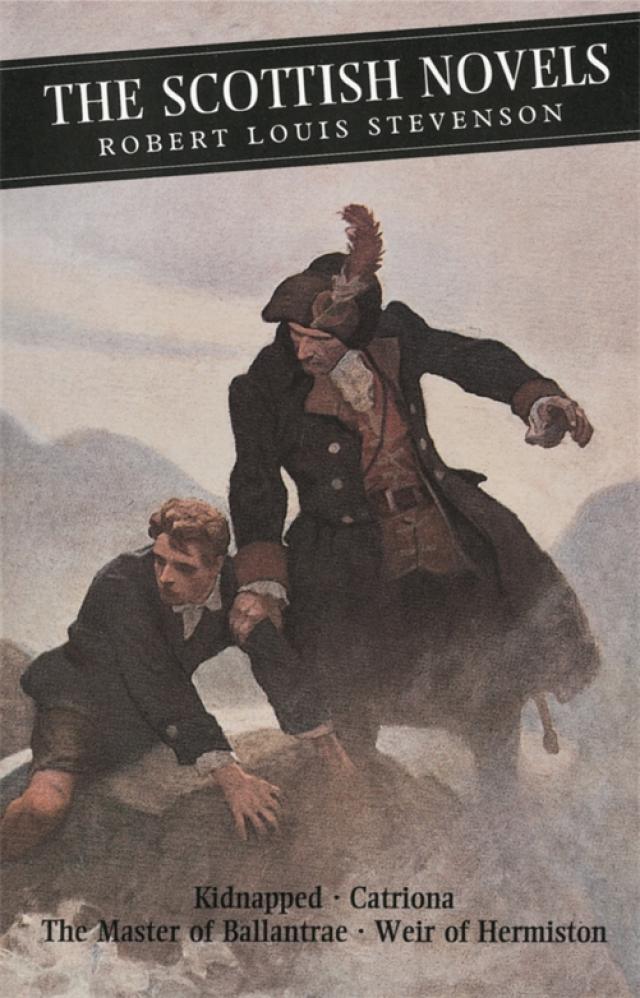
Robert Louis Stevenson
THE SCOTTISH
NOVELS
Kidnapped · Catriona
The Master of Ballantrae
Weir of Hermiston
Contents
Kidnapped
Catriona
The Master of Ballantrae
Weir of Hermiston
About the Author
Copyright
KIDNAPPED
BEING MEMOIRS OF THE ADVENTURES
OF DAVID BALFOUR IN THE YEAR 1751.
HOW HE WAS KIDNAPPED AND CAST AWAY;
HIS SUFFERINGS IN A DESERT ISLE;
HIS JOURNEY IN THE WILD HIGHLANDS;
HIS ACQUAINTANCE WITH ALAN BRECK STEWART
AND OTHER NOTORIOUS HIGHLAND JACOBITES;
WITH ALL THAT HE SUFFERED AT THE HANDS OF HIS UNCLE
EBENEZER BALFOUR OF SHAWS, FALSELY SO-CALLED:
WRITTEN BY HIMSELF, AND NOW SET FORTH BY
ROBERT LOUIS STEVENSON
Introduced by Jenni Calder
Contents
Introduction
Dedication
1. I set off upon my journey to the House of Shaws
2. I come to my journey’s end
3. I make acquaintance of my uncle
4. I run a great danger in the House of Shaws
5. I go to the Queen’s Ferry
6. What befell at the Queen’s Ferry
7. I go to sea in the brig Covenant of Dysart
8. The round-house
9. The man with the belt of gold
10. The siege of the round-house
11. The captain knuckles under
12. I hear of the ‘Red Fox’
13. The loss of the brig
14. The islet
15. The lad with the silver button: through
the Isle of Mull
16. The lad with the silver button: across Morven
17. The death of the Red Fox
18. I talk with Alan in the wood of Lettermore
19. The house of fear
20. The flight in the heather: the rocks
21. The flight in the heather: the Heugh of Corrynakiegh
22. The flight in the heather: the moor
23. Cluny’s Cage
24. The flight in the heather: the quarrel
25. In Balquidder
26. End of the flight: we pass the Forth
27. I come to Mr Rankeillor
28. I go in quest of my inheritance
29. I come into my kingdom
30. Good-bye!
Introduction
Kidnapped is an adventure story. But it is also a study of character, and that character relates to a particular time and place. The time is a few years after the Jacobite Rising of 1745, a time of painful disruption but also of reconstruction. The place is Scotland: the Lowlands, where life seems ordered and stable, and the Highlands, apparently anarchic and hostile.
Stevenson wrote Kidnapped in Bournemouth, confined to the south of England by his precarious state of health. Its publication in 1886 confirmed his reputation as a novelist. His Strange Case of Dr Jekyll and Mr Hyde, published earlier the same year, 1886, brought him popularity; Kidnapped brought critical respect. It is a delicately balanced book, expertly controlled, sharply focused, and written with an affectionate irony. It is perhaps the finest of Stevenson’s novels.
This adventure story has at its centre a young man who is not by nature adventurous. David Balfour is cautious and canny, his values shaped by a decent and limited upbringing. As the tale unfolds he experiences abduction, assault, shipwreck, destitution, and on several occasions is brought near to death. He is tricked, exploited and pursued as an outlaw. Yet he is not changed by these adventures. For him the ‘real’ world remains the secure territory of his belief in class and property, where authority banishes extremes and decency and hard work are rewarded. His encounter with a world of fierce loyalties and aggression, of treachery and violence, of raw emotion and idealism, does not reshape his views or values.
David’s adventure is framed by two symbols of authority and stability. It begins when he leaves his home, sped on his way by Mr Campbell, the local minister. It ends with David ‘at the very doors of the British Linen Bank’, ready to claim his inheritance. In between he encounters aspects of Scotland he had never imagined, and discovers that survival requires more than pragmatism and a belief in rational behaviour. He confronts people who behave in a way quite outside his own experience. He is drawn into a network of feelings and actions in which conventional morality is ineffective, or seen to be shallow.
It is like a nightmare. The innocent but shrewd David is almost killed by his Uncle Ebeneezer. He is rudely snatched away with the intention of removing him to the Colonies. He finds himself helping to defend the life of a Highlander with a price on his head. He nearly drowns, and then struggles for survival in an environment that he finds totally hostile. He is implicated in a murder. The Highlands that Stevenson describes are not romantically picturesque or heroically challenging. They are grim and merciless. Their inhabitants speak a language and behave in a manner that David does not understand. It is a country of savage mountains, of moors ‘lying as waste as the sea’, a fearful landscape ‘broken up with bogs and hags and peaty pools; some had been burnt black in a heath fire; and in another place there was quite a forest of dead firs, standing like skeletons’. Stevenson wrote this at a time when his contemporaries were increasingly admiring the scenic magnificence of the Highlands, but Stevenson clearly wrote his own experience into Kidnapped:
‘the rain driving sharp in my face or running down my back in icy trickles; the mist enfolding us like as in a gloomy chamber—or perhaps, if the wind blew, falling suddenly apart and showing us the gulf of some dark valley where the streams were crying aloud’.
The terrain itself is a major character in the drama and underlines the division between Lowland assumptions and aspirations and Highland experience. Bridging the gulf is the other dominant character in David’s adventure, Alan Breck Stewart. The friendship between David and Alan Breck is at the heart of the narrative. Alan Breck is generous and charming, childish and conceited. David finds him both attractive and exasperating, and the reader shares this response. The man who after the fight in the round-house boasts of his own prowess, forgetful of the fact that David has in effect saved his life, reveals a damaging self-pride. Yet there is something appealing about his frank self-congratulation, more appealing, as David himself almost realizes, than David’s own priggish superiority.
The richness of the friendship is developed through the counterpoise of character traits and behaviour. Alan is colourfully heroic, but David is courageous too, and has already displayed an ability to get himself out of trouble, before he meets Alan. As Cluny Macpherson says of David, he is ‘too nice and convenanting’, but he also has ‘the spirit of a very pretty gentleman’. And the boastful Alan, who considers himself a very much prettier gentleman, concedes defeat with grace and admiration when Robin Oig outdoes him in the piping contest. As Alan and David flee through the heather, the one to return to the safety of the burgh of Queensferry, the other to escape from Scotland altogether, the balance of their relationship constantly shifts. The climax of both the adventure and the relationship comes in Cluny’s hideout on Ben Alder. As David subsides into a fever of exhaustion, ‘a … black, abiding horror—a horror of the place I was in, and the bed I lay in, and the plaids on the wall, and the voices, and the fire, and myself’, Alan and Cluny gamble with greasy playing cards. When he recovers it is to find that Alan has lost all his money, and David’s too, to Cluny.
The quarrel that follows, each wrapped in his own pride, both polarizes them and highlights the reality of their friendship. Their reconciliation marks the beginning of the end of the story. The highest mountains and wildest moors are behind them. When they reach the Braes of Balquidder they are on the edge of a country that is more benign, and the presence of the landscape is less insistently felt. There are dangers still to be faced; the wild country has helped to protect them from the redcoats who are increasingly numerous as David and Alan make their way south. And even when David at last regains ‘the long street of Queensferry’ he is not yet safe, for he has to prove his identity as a loyal subject of King George. David Balfour has yet to ‘come to life again’. Happy as he is when the transformation is accomplished, it means also the inevitable parting with the outlaw and outcast who befriended and rescued him. Yet Mr Balfour is not quite the Whig and Hanoverian he once was. He and Alan part on Corstorphine Hill: ‘Neither one of us looked the other in the face…. But as I went on my way to the city, I felt so lost and lonesome, that I could have felt it in my heart to sit down by the dyke, and cry and weep like any baby.’ For Alan there is a ship that will take him into exile. For David the busy streets of Edinburgh, ‘a cold gnawing in my inside like a remorse for something wrong’, and the British Linen Bank.
The topography of David Balfour’s journey, from the Borders village of his birth to the House of Shaws, from Queensferry to the island of Erraid, from Appin to Ben Alder, from Rannoch Moor to the shores of the Forth, is much more than the configuration of place. It is a political and social map of Scotland in 1751. Through David’s responses Stevenson guides the reader’s attention to the divisions and contrasts that characterized the country and, in Stevenson’s view, continued to lie at the root of the Scottish character. The contrasts lie partly in the landscape itself. David leaves a pleasant vill
The wildness of the Highlands is not just in the mountains and the moors or the character of the people. It is perhaps even more forcefully in the lack of cultivation and the meagre dwellings, both of which suggest an altogether less substantial and ordered existence than David is used to. The inn at Kinlochaline is ‘the most beggarly vile place that ever pigs were styed in, full of smoke, vermin, and silent Highlanders’. The missionary Mr Henderland lives in a house of turf and can only offer porridge for supper. Cluny Macpherson lives in a hillside shack of wattle and moss. In such circumstances David finds Highland pride, at once courteous and fiery, both comic and irritating. He judges from appearances, and has to learn that they can be misleading. He encounters sullenness, aggression and distrust, but also generosity, warmth, loyalty and courage of a kind which are equally beyond his narrow view of human behaviour.
The ironic counterpart to David’s Highland adventures are those that belong to the Lowlands. In the Highlands family loyalty is intense; in the Lowlands David’s own uncle tries to get rid of him. In the Highlands it is behaviour that denotes a gentleman, not dress. When David returns to his own country his first thought is to get out of his ‘unseemly tatters’. At the beginning of Catriona, the sequel to Kidnapped, David’s first action is to acquire decent clothes, with the aim of looking ‘comely and responsible, so that servants should respect me’.
The irony of these contrasts centres on David himself, for he, so acute and self-possessed, so observant of the comportment of others, has certain blindspots when he looks at himself. Stevenson’s gentle exposure of these is one of the triumphs of the book. David is keenly aware of the childlike sensitivities of Alan Breck, quick to take offence and retreat into sulks, but does not recognize parallel inclinations in his own nature. The Highlander and the Lowlander remain irreconcilable, however strong the affection and the mutual debts that bind them. Alan Breck is as ill at ease in the environment that sustains David as David is in Alan’s native territory. Each in his way is an innocent, and neither has any wish to adapt.
These are themes that are explored further in Catriona, which, though written several years later and many thousands of miles from Scotland, begins exactly where Kidnapped ends, in Edinburgh’s High Street. And indeed Stevenson ends Kidnapped with a beginning, the beginning of a new life which fits David’s own idea of himself. Early in the novel he challenges his uncle with the words, ‘I was brought up to have a good conceit of myself’. This ‘good conceit’ carries him through his adventures if not with the panache of Alan Breck at least with confidence and courage. His adventures weaken him physically, and make him dependent, but they do not dent his confidence or undermine his very real courage.
Kidnapped has been criticized for not sustaining the narrative of adventure. But the adventure lies in the contrasts and confrontations, and the tensions that arise from these. In a sense the adventure lies in Scotland itself, in the physical and psychic divisions that, in the interpretation of Stevenson and others, delineate the country’s character. The difficulty David Balfour has in accepting a code which condones murder (as Alan Breck and his fellow clansmen accept the murder of the Red Fox), his problems with the tribal, rather than class, values of the Highlands, are not just inherent in David’s character: they are part of Scotland’s heritage.
Thus a novel of character and action has psychological and moral currents of some depth, though they are developed with a light touch. They are all part of the territory that fascinated Stevenson throughout his writing life. In later years he would write about other times and other places, but his mind and imagination never left Scotland. Kidnapped was part of his attempt to explain the country to himself. In the process he wrote with energy, conviction and clarity, to produce a tale that remains fresh and vivid, no matter how often one goes back to it.
Jenni Calder
Dedication
TO CHARLES BAXTER, WRITER TO THE SIGNET.
My dear Charles Baxter,
If you ever read this tale, you will likely ask yourself more questions than I should care to answer: as for instance how the Appin murder has come to fall in the year 1751, how the Torran rocks have crept so near to Earraid, or why the printed trial is silent as to all that touches David Balfour. These are nuts beyond my ability to crack. But if you tried me on the point of Alan’s guilt or innocence, I think I could defend the reading of the text. To this day you will find the tradition of Appin clear in Alan’s favour. If you inquire, you may even hear that the descendants of ‘the other man’ who fired the shot are in the country to this day. But that other man’s name, inquire as you please, you shall not hear; for the Highlander values a secret for itself and for the congenial exercise of keeping it. I might go on for long to justify one point and own another indefensible; it is more honest to confess at once how little I am touched by the desire of accuracy. This is no furniture for the scholar’s library, but a book for the winter evening school-room when the tasks are over and the hour for bed draws near; and honest Alan, who was a grim old fire-eater in his day, has in this new avatar no more desperate purpose than to steal some young gentleman’s attention from his Ovid, carry him awhile into the Highlands and the last century, and pack him to bed with some engaging images to mingle with his dreams.
As for you, my dear Charles, I do not even ask you to like the tale. But perhaps when he is older, your son will; he may then be pleased to find his father’s name on the fly-leaf; and in the meanwhile it pleases me to set it there, in memory of many days that were happy and some (now perhaps as pleasant to remember) that were sad. If it is strange for me to look back from a distance both in time and space on these bygone adventures of our youth, it must be stranger for you who tread the same streets—who may to-morrow open the door of the old Speculative, where we begin to rank with Scott and Robert Emmet and the beloved and inglorious Macbean—or may pass the corner of the close where that great society, the L. J. R., held its meetings and drank its beer, sitting in the seats of Burns and his companions. I think I see you, moving there by plain daylight, beholding with your natural eyes those places that have now become for your companion a part of the scenery of dreams. How, in the intervals of present business, the past must echo in your memory! Let it not echo often without some kind thoughts of your friend
R.L.S.
SKERRYVORE,
BOURNEMOUTH.
1.
I SET OFF UPON MY JOURNEY TO THE HOUSE OF SHAWS
I WILL BEGIN the story of my adventures with a certain morning early in the month of June, the year of grace 1751, when I took the key for the last time out of the door of my father’s house. The sun began to shine upon the summit of the hills as I went down the road; and by the time I had come as far as the manse, the blackbirds were whistling in the garden lilacs, and the mist that hung around the valley in the time of the dawn was beginning to arise and die away.
Mr Campbell, the minister of Essendean, was waiting for me by the garden gate, good man! He asked me if I had breakfasted; and hearing that I lacked for nothing, he took my hand in both of his and clapped it kindly under his arm.
‘Well, Davie, lad,’ said he, ‘I will go with you as far as the ford, to set you on the way.’
And we began to walk forward in silence.
‘Are ye sorry to leave Essendean?’ said he, after a while.
‘Why, sir,’ said I, ‘if I knew where I was going, or what was likely to become of me, I would tell you candidly. Essendean is a good place indeed, and I have been very happy there; but then I have never been anywhere else. My father and mother, since they are both dead, I shall be no nearer to in Essendean than in the Kingdom of Hungary; and to speak truth, if I thought I had a chance to better myself where I was going, I would go with a good will.’