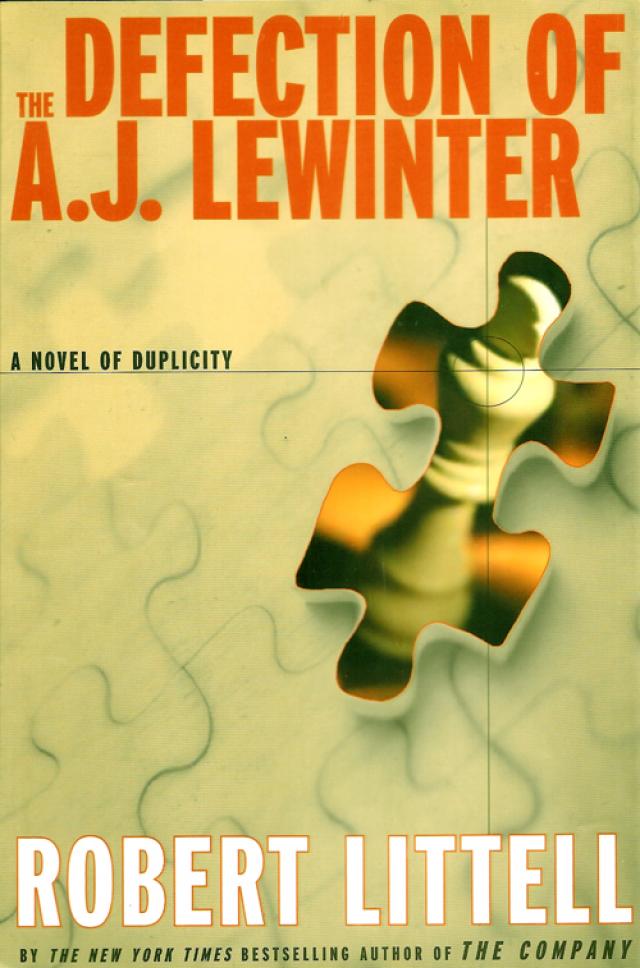
The Defection of A. J. Lewinter, page 1


ALSO BY ROBERT LITTELL
The Company
Walking Back the Cat
The Visiting Professor
An Agent in Place
The Once and Future Spy
The Revolutionist
The Sisters
The Amateur
The Debriefing
Mother Russia
The October Circle
Sweet Reason
Copyright
This edition first published in the United States in 2002 by
The Overlook Press, Peter Mayer Publishers, Inc.
Woodstock & New York
WOODSTOCK:
One Overlook Drive
Woodstock, NY 12498
www.overlookpress.com
[for individual orders, bulk and special sales, contact our Woodstock office]
NEW YORK:
141 Wooster Street
New York, NY 10012
Copyright © 1973 Robert Littell
All rights reserved. No part of this publication may be reproduced or transmitted in any form or by any means, electronic or mechanical, including photocopy, recording, or any information storage and retrieval system now known or to be invented, without permission in writing from the publisher, except by a reviewer who wishes to quote brief passages in connection with a review written for inclusion in a magazine, newspaper, or broadcast.
The paper used in this book meets the requirements for paper permanence as described in the ANSI Z39.48-1992 standard.
ISBN: 978-1-59020-908-0
For my mother and father
CONTENTS
ALSO BY ROBERT LITTELL
Copyright
I THE OPENING
II THE RESPONSE
III THE MIDDLE GAME
IV THE (GAMBIT)
V THE END GAME
VI THE PASSED PAWN
PART I
THE OPENING
1
THERE WAS a curtain of silence between the end of the play and the first ripple of applause. Distracted by the silence, Chapin let his attention drift from the balding American in the aisle seat.
It was his first lapse of the day.
Chapin was a fat man and he envied grace and poise the way a cripple admires athletic agility. He sat on the hard wooden chair breathing heavily, a massive form in the midst of the diminutive Japanese, and watched with almost sensual pleasure as the masked actors of the Kanze Noh Company glided soundlessly across the hashigakari bridge to the wings. Without understanding all its subtleties, Chapin was drawn to the Noh drama. He had never admitted that to anyone, for he recognized it as a strange obsession—especially for someone in his line of work. He wondered vaguely what had brought the American to the theater.
The American!
When Chapin glanced back at the aisle seat it was empty and his man was sprinting up the carpet toward the exit. Still caught up in the mood of the Noh, Chapin was reluctant to break the cobweb threads of imagination that bound him to the stage. Wearily, he pulled his bulky body over the legs of four Japanese and headed up the now jammed aisle toward the lobby. For a man of his size and age, he moved rapidly. But by the time he reached the front steps of the theater, the American had disappeared into the river of people flowing through the streets of downtown Tokyo.
Chapin stood on the steps and threaded his fingers through his thinning hair. It was his first “fadeout” in years and his professional pride was bruised. Control would be furious. As he turned to search for a telephone, something caught his eye: the familiar profile of a man, framed in a window of a taxi pulling away from the curb.
Chapin squeezed into another taxi and told the driver: “Ano kuruma o otékure.” In Japanese, Chapin thought, the phrase didn’t sound quite as ridiculous as it did in English.
The two taxis, 100 yards apart, swung past Toronomon and the black wrought-iron gates of the American Embassy and struggled up a steep hill, caught in a jagged mob of cars and buses and trucks noisily converging on Roppongi. The early evening breeze blew through the open window against Chapin’s face, and with it came the reddish dust from a torn-up stretch of road where a new subway line was being built. Chapin saw that his driver was enjoying the chase; with his forehead almost touching the steering wheel, he cut in front of a dump truck and put the car onto the rough bedding of the trolley tracks near the crest of the hill. Using only his left, white-gloved hand, he spun the wheel full left and broke into the small intersection of Roppongi Crossing. By now he was directly behind the other taxi. Chapin leaned forward and tapped the driver on the shoulder. “Kimi Wa, beteran no untenshu da né—That’s nice driving.”
At the far end of the crossing workmen wearing thick ocher-colored waistbands and bandannas on their foreheads strained against a stalled dump truck. Drivers leaned on their horns as the traffic piled up. In the taxi ahead of Chapin, the impatient passenger stepped out, paid the driver, and edged between the two cabs toward the curb. As his face came into full view, Chapin realized that he had been following an American—but the wrong one.
Chapin paid his driver and hurried to the telephone booth in front of the Kinokuniya Supermarket. Before dialing, he unwrapped a piece of dietary chewing gum, popped it into his mouth, and rolled the tin foil into a ball, which he toyed with throughout the conversation.
The number rang twice. A man’s voice said in Japanese: “Four-nine-nine-six-five-two-nine.”
Chapin read off his own number in English and hung up. Fifteen seconds later the phone rang.
“Hey, George, this is me,” Chapin said, wheezing nervously.
“Where the hell’ve you and Honeybucket been?” George said.
“In Marunouchi,” Chapin answered. He tried to make the rest sound like an afterthought. “Everything’s fine. Our friend just treated me to five and a half hours of Noh. Now we’re in Roppongi. Honeybucket’s across the street in an antique shop. I’ll stick with him through dinner and tuck him in at the hotel.”
2
LEWINTER HAD LIVED through the moment a hundred times in his imagination, but it had never occurred to him that the guard wouldn’t speak English. He looked across the glass-topped table at the obstinate, Slavic face and had to fight back the frustration and fear welling up inside him.
“Listen,” Lewinter said again, this time more patiently, more respectfully, “I’ve got to speak to the ambassador.” And he repeated the word three times, as if the mere repetition would make the guard understand. “I’m an American-ski,” he added.
The two Japanese cleaning ladies scrubbing the marble floor of the embassy lobby looked up, curious. The guard, new to his job and still unsure of himself, hesitated. Finally, with a shrug, he picked up the telephone and summoned the duty officer.
Watching him dial, Lewinter felt some of the tension drain away. At last he was getting somewhere. For the first time, he took in the surroundings: the Japanese women, by now hard at work; the uniformed guard concentrating on a Russian newspaper; the small portrait of Lenin in a too elaborate gilt frame; the cracks in the marble floor; the chandelier with its dusty black electric wire coiling up to the flaking ceiling. It was not what he had expected. Not at all.
Tiptoeing over the still-wet marble, the duty officer, a small, brooding Armenian with thick eyebrows, came over and planted himself directly in front of Lewinter.
“Yes,” the Armenian said, smiling and pointing at his watch, “since fifteen minutes, we are completed for the day.”
“I must speak to your ambassador,” Lewinter said, wondering how much English the Armenian understood. “I want to go to the Soviet Union.”
“It is misfortunate,” the Armenian said, “but the visa department completes at five. Re-try tomorrow after nine.” “You don’t understand me,” Lewinter said. “I’m an American. I want to go to the Soviet Union permanently—to live there.”
“Permanently?” the Armenian repeated, and searched for the meaning of the word. He found it, and understood it. He thought of a friend of his who once passed up an opportunity to buy some documents in Istanbul—and wound up franking stamps in Tbilisi. With a jerk of his head, the Armenian motioned to the American to follow him down the hall.
Left alone in a large, mildewy room jammed with overstuffed furniture, Lewinter settled into an easy chair with a broken spring and waited. In the last half-hour he had taken the most crucial step of his life, and yet the whole thing seemed ludicrous. He had planned the defection for months with his usual relish for detail—the trip to Japan, the pills, the shampoo, the X rays, the last-minute postcard to Maureen, even the book to read on the plane to Moscow. But somehow he had ended up on the set of a Hitchcock film—in a shabby embassy, in an antique room, in the midst of people who did not speak his language. He could almost see himself sitting there looking faintly uncomfortable, faintly ridiculous, staring at the high ceiling, crossing and uncrossing his legs, and wondering if he was being watched by someone other than himself.
Lewinter emerged from his thoughts and realized that he had been listening to the sound of men’s voices. The door opened. The man who entered looked as if he had strolled off an American college campus. He had everything except the pipe between his teeth; thin and stoop-shouldered, he wore a bow tie, a beige button-down shirt, an open Harris tweed sports jacket with suede elbow patches, rumpled slacks, and a pair of loafers. His kinky hair was long and bunched at the sides and back; that and his high forehead made him look like an intellectual. His eyes were khaki-colored and there was something about them that projected the man’s ironic cast of mind.
He smiled warmly and pulled up a chair next to Lewinter. “What high school did you go to?” he said in perfect English.
“What do you mean what high school did I go to?” Lewinter said, edging back his chair. He had a reflex suspicion of people who tried to strike up instant friendships. “First you keep me waiting half an hour, then you walk in with a question like that. Do you have the vaguest idea why I’m here?”
“Look, calm down,” the Russian said. “It’s only been twenty minutes. They had to get me back to the embassy. Anyhow, my question about the high school has a point. You can tell a lot about an American from the high school he went to. Take me, for instance. I went to Horace Mann. All the guys there were upper middle-class bourgeoisie—not exactly the kind of person you expect to see in a Soviet embassy after closing hours asking for political asylum. You see,” he said, tapping his forehead and laughing, “I do know why you’re here—and I’m always thinking. Watch out!”
Lewinter couldn’t help but warm to the Russian. “What were you doing at Horace Mann?” he asked.
“My father, good Communist that he was, worked his way up the Soviet Foreign Service to Riverdale,” he said. “He was attached to the UN Secretariat for six years. What high school did you go to?”
“Bronx High School of Science,” Lewinter said, surprised to find that he wanted to answer the question.
“Aha!” the Russian said, slapping Lewinter’s knee. He pointed a finger at him in mock accusation. “Petit bourgeois, intellectual, I.Q. of at least one thirty-five, not very good at sports, didn’t have sexual intercourse until you were in college—if then. I’d say you were Jewish, except you don’t look Jewish. How did I do?”
“Fine except for the sexual intercourse part,” Lewinter lied. He turned serious: “We could argue the merits of Bronx Science over Horace Mann all night—but I haven’t got all night. I’ve figured out my chances very carefully. Either I get out of Japan on your eight o’clock plane or I’m probably not going to get out at all.” He pulled out his pocket watch and clicked it open. “I’ve got two and a quarter hours left. I’ve got to speak to your ambassador.”
“I suspect that my ambassador is the last person you want to see,” the Russian said. A smile spread across his face. “He’s great at cutting ribbons, but he passes on his serious problems to me. If you’re a serious problem”—and here he put the palms of his hands flat against his chest—“I’m your man.”
Lewinter believed him.
The Russian took a small green notebook from his breast pocket and uncapped a felt-tipped pen. “Now that I’ve broken down your defenses with my spontaneous charm, it’s time, for the real Yefgeny Mikhailovich Pogodin—that’s my name—it’s time for me to reveal myself. Sitting before you is a man who is one-quarter Marxist, one-quarter humanist, and one-half bureaucrat.” His pen hovered over the notebook. “Your name?”
Lewinter felt as if he was in the hands of a painless dentist. “A. J. Lewinter. Initial A, initial J, capital L, small W.”
“What does the A stand for?” Pogodin asked.
“Augustus. The J’s for Jerome. But I only use the initials.”
“Well, Mr. initial A initial J Lewinter, age?”
“Thirty-nine.”
“Address?”
“Cambridge, Massachusetts.”
Pogodin looked up. “What do you do in Cambridge?”
“I’m an associate professor at M.I.T. and a specialist in ceramic engineering. For the last four years I’ve been working on ceramic nose cones for the MIRV Program.”
The Russian jotted down Lewinter’s answer in his notebook, then lingered over the page, rereading what he had written. Without looking up he asked: “What brought you to Japan, Mr. Lewinter?”
“The ecological symposium at Waseda University. I delivered a paper there yesterday. When I’m not working on nose cones, I’m a bug on ecology. A couple of years ago I developed a scheme for a national solid-waste-disposal system. Its potentials are fantastic. It involves collecting solid waste in regional centers for processing and recycling. Would you believe, with our problems in America, I couldn’t get a rise out of Washington—even though I proved on paper that the entire system would amortize itself in thirty-five years.” Lewinter paused. “Am I going too fast for you?”
But Pogodin had stopped writing.
“Why do you want to go to the Soviet Union?”
“How can I even begin to answer that question?” Lewinter said. “I could tell you about the deterioration of the American dream—the pollution, the crime, the political corruption, the isolation of intellectuals, the drugs, the repression of dissent. But there’s another reason. I’m part of that famous military-industrial complex. I’ve lived inside it. I know what I’m talking about. My country is in the process of constructing a first-strike nuclear arsenal. And as sure as we’re sitting here some general in Washington is going to suggest we use it. I want to give you parity so that they won’t be tempted. I want to give you MIRV.”
It suddenly occurred to Pogodin that he was dealing with an insane man. In Pogodin’s world, intelligence operations were long, tedious affairs in which hundreds of people labored over scraps of information, constructing a single piece of a jigsaw puzzle that might—perhaps—fit into some larger picture. Strangers didn’t walk in off the street and offer you the pot of gold at the end of the rainbow. And yet …
“Let me tell you what’s going through my mind,” Pogodin said. Having interrogated hundreds of people, he had long ago discovered that candor was a powerful weapon—more so because it was the last thing in the world people in Lewinter’s position expected. “If you have what you say you have, it would be an important break for us. And you would naturally find us very grateful. But people don’t walk in off the street with this grade of information. So I am obliged to consider the other possibilities. You may honestly believe that you have this information; but you may believe it because other people want you to believe it. Knowingly or unknowingly, you could be a plant, someone sent to make us swallow false information. Or you could be a class-A nut. There are other permutations, but they’re too complex to go into. So I put it to you: If you were in my shoes, what would you do?”
“If I were in your shoes,” Lewinter said, playing the game, “I wouldn’t pass up the possibility that I’m at least as important as I say I am—and maybe more so.”
“Yes, you could,” Pogodin said. “You don’t know the rules of this game.”
“What are they?”
“At this point in our relationship, you have to provide us with a token of your sincerity,” Pogodin said. “Defection”—the Russian stressed the word—”is a delicate matter. You have to give us something to chew on.”
The invitation dangled before Lewinter. He considered his laminated I.D. card, his M.I.T. faculty card, his passport. But he knew that none of these would get him on the eight o’clock plane to Moscow.
“Look,” he said, “I could give you the formula for the trajectory of one of the decoys in a MIRV. You can cable it to Moscow. Surely there must be someone there who can vouch for its value.”
Without a flicker of expression, Pogodin offered the green notebook to Lewinter.
“Do you need a pen?” he asked politely.
“No, thank you, I have my own,” Lewinter said, and he began to write in a precise hand.
3
“NOW, WAIT, here comes the important part,” Diamond said, and the tall, carved wooden doors of the Soviet Embassy opened. “That’s their K.G.B. station chief, Mickey Pogodin, in the back. The guy on the right is one of his Armenians. Lewinter’s the dumpy guy on the left. As soon as they pass the gate, the camera will zoom in on him. Now, right there, Mr. Lawson, would you freeze it right there.”
The face of A. J. Lewinter, grainy and slightly overexposed, filled the small screen at the end of the room. It was a curiously ambiguous portrait: his eyes had been caught, narrowed, darting apprehensively to the side; but his mouth, half open, relaxed in a confident smile.