

Operation Afterlight, page 6
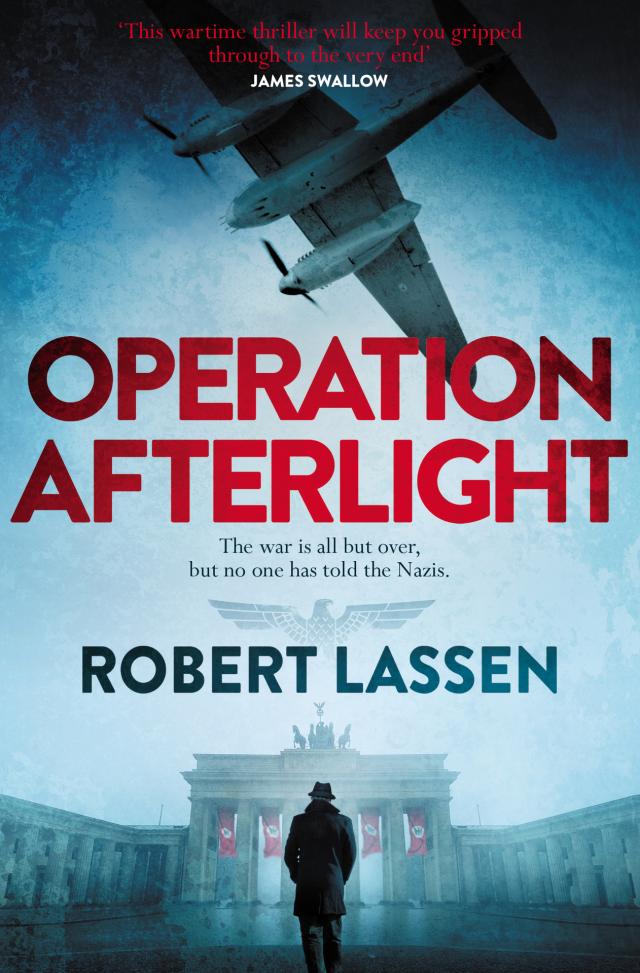


From twenty-eight thousand feet, the light of the waning crescent moon cast its dull glow across near-endless sheets of white cloud, broken intermittently by thinner patches through which the brighter, roiling light of the dying city rose. Below them, Durban could make out shadow after shadow of heavy bombers, powering across Europe in a concentrated stream of hate and destruction. Lancasters, hundreds of them. Halifaxes, too, even a few other squadrons of Mosquitoes. He’d long since lost count. This was the biggest raid he had ever seen, and he had seen too many. Maybe the biggest of the war. One by one, the lumbering behemoths disgorged their individual thousands of pounds of payload through the clouds into the city below. Incendiaries, to start a thousand fires that would, if the gods of devastation smiled this night, merge into a single firestorm like the one that had ravaged Hamburg. High explosive, to rupture buildings and streets, and to destroy the water mains that the firefighters needed to lessen the destruction.
As a junior pilot, Durban had hunted German bombers over London and seen the destruction they wrought on the city. He had known even then that this would only be the start. They have sown the wind, Churchill had said. Searching the skies near London night after night, scoring his first two kills, Durban had marvelled at the flames reflecting from the waters of the Thames and wondered how humanity could do this to itself.
This, below him, was so far beyond what he had seen back then that he struggled to comprehend it, even as he watched it unfolding.
Germany had truly reaped the whirlwind.
“One minute to the first aiming point,” Grant said. He looked utterly nauseated. Durban hoped it was airsickness. At the very least, he needed Grant to control his squeamishness long enough to see them to the target.
Giving the younger man a nod, Durban twisted in his seat to look behind them. 465 Squadron remained with him. He could only see the first couple of aircraft, vague in the darkness, but he knew the others would be close, concealed in the depths of the night. Fourteen of the squadron’s eighteen aircraft, with Barton leading A Flight and the Kiwi Kittinger leading B Flight. He felt a moment of relief. For low-level specialists like 465, this kind of navigation should be straightforward, but you never knew the measure of a new unit until you’d seen it in combat.
Not that this really counted as combat, he thought. Not compared to the bad days in 1942 and 1943, when a bomber crew’s life expectancy was measured in single digits of missions. Despite his lofty vantage point, he’d seen only one Lancaster hit and burn before spiralling out of sight below the cloud. Flak, most likely, bursting above the clouds in little flowering puffs of orange and grey that might have been lovely if they weren’t so deadly.
Germany was beaten, but no one had told the flak crews. Cued by the latest gun-laying radar, they continued to hurl their 88mm high explosive defiance into the skies.
“Mark,” Grant said. “Heading three-four-five. One minute to second aiming point.”
Durban shivered. He told himself it was the cold inside the cockpit, the heater unable to fully cope with the indicated outside air temperature of minus sixty Fahrenheit. He knew better, of course. No matter how many times he had been in this position, he had never grown used to it.
Brushing the rudder to correct course, he checked his radio was set to channel A, then thumbed his R/T transmit switch. “Colt Leader to all callsigns,” he said, hearing a slight crackle of reverberation in his headset. “Fifty seconds to second aiming point. Prepare to descend on my signal.”
No one replied. They didn’t need to. They knew their roles. It was the first time anyone had broken radio silence since crossing the Channel coast.
Forty-five seconds later, he gave the word and put the Mosquito into a shallow dive.
This was the dangerous moment.
From experience and the spread of the fires, Durban could see that the Pathfinders who had preceded the raid had marked a position close to the centre of the city with their Target Indicator flares. The first arriving bombers had doubtless dropped their bombloads close to this point, but with each subsequent wave there had been a slight creeping of the fire-struck area as some bombers dropped on the fires started by their predecessors, not the TI flares. It was a phenomenon as old as the bomber campaign, and Durban knew that despite all the new techniques and technologies – electronic bombing aids like Gee, H2S and Oboe, specially trained Pathfinder crews, even a very experienced crew flying as Master Bomber – it was a phenomenon that could never be fully erased.
All of which meant that, he saw with one practiced sweep of his gaze, the vast majority of the bombs had fallen on the centre and south of the city. Their target area stood on the northern edge of the city, right where the wall of flaming chaos faltered.
They could have dropped their bombloads from high altitude, of course, but while the Mosquito squadron they had replaced tonight flew the unarmed bomber variant, with four thousand pounds of explosives in their bay, the FB Mk VI could only manage two 500lb bombs in the rear of the shortened bomb bay. The four 20mm Hispano cannon took up the rest of the space beneath the aircraft. With no air intercept radar to take up space like in his old NF Mk XVIII night fighter, the FB VI also found room for four .303” machine guns in the nose, fired electro-pneumatically by a push switch on the control column. Durban didn’t expect to need them. Tonight, it was all about the bomb load.
One thousand pounds of high explosive per Mosquito scattered amidst the tens of thousands of tons raining down from the heavies would hardly make a difference. That same thousand pounds placed directly on the railway station by fifteen Mosquitoes one after the other could achieve plenty. Most importantly, it would give the squadron, and its commander, some valuable training. But it meant going beneath the cloud, into the teeth of the flak. If they were especially unlucky, it meant flying below that same stream of bombs dropping from on high, and Durban had seen more than once what happened when a fragile airframe found itself in the path of half a ton of fused and ready HE.
The cloud loomed ahead and their airspeed crept up as he kept the Mosquito in the pre-briefed dive. Throttling back, he watched the slow spin of the altimeter. He hoped he’d calculated their angle correctly. Too steep, and they risked damaging their airframes. Too shallow would leave them too high over the target. Their bombing would be less accurate, and worse, the gunners would find it much easier to track them. Durban expected the flak to focus on the easier heavy bomber targets, but the speed of their descent would add further protection if the gunners tried their luck.
Grant murmured something, barely audible over the engines and the whistle of air past the wings.
“Speak up,” Durban said shortly.
“Thirty seconds to release point,” Grant said, his voice louder this time but still tremulous.
Durban reached down with his right hand for the bomb door lever but didn’t pull it yet. He kept his hands steady on the controls as they reached the cloud layer and it obliterated the view ahead. For several seconds, they flew alone in a world of swirling grey and white, but already he could see a growing glow ahead, increasing with intensity with each second of their quickening descent.
Then the cloud parted. He heard Grant’s sharp intake of breath and blinked against the hellish glare of a city in the throes of immolation.
The possibility of picking out any individual landmark from the smoking wreckage below seemed remote, but he tried anyway. Beyond the outer edge of the fires just to the left of the diving Mosquito’s nose, arcing away between the grasping beams of two anti-aircraft searchlights, he could just make out the thin black lines of the canal docks and the Dortmund-Ems canal itself heading northwest. That put the station directly ahead of them. Grant’s navigation had been perfect. Now to see if his timekeeping was its equal.
“Ten seconds,” Grant said.
Durban pulled the lever in his right hand. The aircraft shuddered in protest as the bomb doors fell open into the slipstream. He kept his thumb poised over the bomb release, waiting for what seemed an eternity while the burning city grew larger, the aircraft shook, and he wondered whether Grant had forgotten what came next.
“Mark,” Grant said, his voice clear and firm and loud.
“Bombs gone,” Durban said into his R/T, feeling the aircraft rise, buoyant without its deadly payload. He pulled the Mosquito into a banking turn to port, still descending, accelerating as he closed the bomb doors and pushed the throttles forward. Behind him, the other Mosquitoes would release their own bombs, hopefully onto the same spot as his own. Not that he could know whether he’d struck the target. That was one for the battle damage assessment teams over the next few days, when reconnaissance photos became available. The priority now was to get clear of the target area before the flak crews found them.
A moment later, and he knew that it was too late for that.
The two massive beams of light swung their way with shocking speed. Durban saw a distant flash and heard the faint crump of the first anti-aircraft shell. A puff of smoke hung in the air off their nose before disappearing past the left wingtip. A marker shell, to help the gunners get their range. More followed, while the questing searchlights groped in the sky. If they found something, both searchlights would quickly cone it and keep it illuminated while every gun in the city turned like a hunting pack on the exposed prey.
The Mosquito gave a violent lurch as a shell erupted directly ahead. Even with his oxygen mask covering his face, Durban smelt the sour stench of cordite as they passed through what had, just a second earlier, been an expanding cloud of red-hot shrapnel. Then they were clear, leaving the searchlights sweeping across the base of the cloud, still forlornly searching for the attackers that had simply dived too fast and too steep for their beams to catch.
Durban glanced at Grant, pleased to see that he wasn’t watching the fires but was instead scanning the sky for night fighters. He tapped the young man’s knee. “Good job.”
“Thank you, sir.” Grant’s eyes still seemed a little too wide, but his breathing was calm. He’d tightened his straps properly this time, Durban noted.
“Fancy giving me a course for home?”
A smile. Forced. Somewhat sickly. “Yes, of course.” Grant checked compass and map with surprising speed. “Two-eight-five for thirty minutes.”
“Remember to pick us a course that avoids any other flak concentrations, won’t you, Grant?”
“Already done, sir.”
Behind them, the dying city faded from sight, though the glow on the horizon lingered longer.
Dawn was still several hours away when they landed at RAF Charney Breach. Grant’s course had brought them home ahead of the rest of the squadron, Durban noted with satisfaction. Shutting the aircraft down, he followed the navigator down the crew ladder, but did not walk straight to the waiting transport. Instead, he stood beneath the wing of his aircraft and watched the second Mosquito land. “You did well,” he said simply, his eyes on the sky.
“Are you ok, sir?”
“I’m fine, Grant. Just watching the boys home.” He zipped his jacket fully to the top against the cold night air. “It’s a tradition of mine since my first days on Pathfinders. Silly superstition, really, but I can’t help thinking if I’m not watching them home safely, who is?”
“That doesn’t sound silly at all to me, sir.”
Together they stood in the cool night air and counted aircraft in until fourteen more were safely on the airfield, with their crews streaming to the debrief. It was only when Durban followed them back that he learned that the missing crew were Charlie Broadley and Dougie Jeffries.
Chapter Eight
Zurich, 13 March
The café, a bustling place bedecked with pretty tablecloths and prettier Swiss students enjoying coffee and milkshakes, stood on the banks of the Limmat. From his comfy seat with his back to the wall and his eyes on the windows, Stahl could watch the traffic crossing the Münsterbrücke and admire the looming shape of the Grossmünster with its twin-towered twelfth-century splendour. As a young officer in the Ausland-SD he had spent many hours here, working but happy, watching the exiled German dissidents they had tasked him to monitor hold court and espouse their anti-Hitler views. Nostalgia was not why he had picked this place, though. Sometimes his orders had called for more than just watching and, more than once, he had used his knowledge of the city streets to the west and north to stalk a target or avoid the police when the work was done.
If today’s meeting did not go well, he might need that knowledge again.
He sipped his Kaffe-crème and looked down at the remnants of his Gipfeli. He hadn’t realised how hungry he was, but then he hadn’t eaten a meaningful meal since leaving Berlin. The Swiss border guards hadn’t fed him before they passed him on with typical efficiency to the police, who had likewise neglected his needs while they took a little longer to bring in the well-groomed gentlemen from the Bureau Ha. Normally, Stahl didn’t like people to know too much about him, but in this case, it had worked to his favour. Hans Hausamann may have only established the Swiss national intelligence agency at the outset of war, but he ran it with excellent sources and clockwork precision. Best of all, Hausamann owed Stahl a favour, and had let him make a phone call to the British Embassy in Bern.
Right on time, their man was crossing the Münsterbrücke and making his way to the front of the café, pausing only to hold the door with a smile for two giggling students who clearly found much to appreciate in his tousled blond hair and rangy form. The attraction was mutual, with the man admiring their departing shapes before striding across the room with pantherish grace.
“Hello, Stahl,” he said, placing his briefcase on the floor and adjusting his chair so that his back wasn’t to the window before sitting. “It’s been a long time.”
“Yes,” Stahl agreed. Not for the first time, he wished that someone had returned his Luger. By now, it was likely buried in a mass of triplicate paperwork in some Swiss militia armoury. “Too long, Anders.”
“I see you’ve brought a friend.” The killer he knew only as Major Anders settled into his seat and gave a nod to a thick-set man sitting on the far side of the room, pretending to read a novel.
“Not my friend,” Stahl said as the man coloured and stiffly returned the nod. “The Bureau Ha may have let me leave their custody, but they aren’t quite ready to allow me to wander the streets without a babysitter. Your own people took me a little longer to spot.” He waved at the seemingly married couple sharing a dessert a few tables away.
Anders laughed. “Guten Appetit,” he called to them. “The best I could find at short notice, I’m afraid,” he told Stahl. “Switzerland isn’t exactly a priority for British Intelligence anymore, not with the war winding down. The focus is already shifting to Moscow, Prague and Warsaw. How’s the coffee?” Without waiting for a response, he summoned the waiter and, in fluent French, ordered two more Kaffe-crème and four more croissants.
“The Swiss Germans call them Gipfeli,” Stahl observed mildly as the waiter hurried away.
“My French is better than my German,” Anders replied in perfect German. “How is the Admiral?”
“Doomed,” Stahl said simply.
Anders nodded. “There was some talk of offering a swap deal for Hess. Senior leadership decided that if Hitler knew just how close Canaris had become to us, it might have made things worse for him.”
“Worse?” Stahl grimaced. “It cannot get much worse. They will never let the Russians liberate him. It is only the Führer’s belief that Canaris has more insights into British plans that keeps him alive. If he only knew how completely you have abandoned him…”
“The war is winding down,” Anders repeated bluntly. “The British Government no longer sees much value in Canaris. It happens to us all in time.”
“I hope when your time comes,” Stahl said darkly in Danish, “they are a little less callous.”
“I guess we’ll find out,” Anders said. Major Anders, son of a noble Danish family, turned merchant navy sailor and adventurer. When Germany had conquered his homeland, he had stayed with his crew until they reached Liverpool, then ditched them and joined the British Commandos. A dozen clandestine raids and a Military Cross later, he had earned a bloody reputation and the attention of both British Intelligence and the Abwehr, who gave him the rare honour of a file of his own.
Anders had not changed a bit since Admiral Canaris had shown Stahl that first photograph back in 1943. They had met four times these last two years, always clandestinely, always at the behest of Canaris. If anything, Anders looked younger every time. The strains and terrors of war seemed to have no more effect on that youthful, open face than the blood he spilled for the British Government.
“Here,” the Dane said, passing a small brown envelope across the table. “You will want this back.”
From inside, Stahl drew out his wallet, confiscated by the Swiss intelligence officers. His ID remained, but his money had gone. Border crossing tax, he thought wryly. It mattered not. Reichsmarks were worth little outside Germany. All he really cared about was the small photograph that he found within, creased but intact. He stared at her slim face for a few seconds, as beautiful as ever, wondering if others saw the same sadness in her eyes that he did.
“You never mentioned a wife, Stahl.”
“My sister, Isobel,” Stahl said shortly. “Who are you representing today, Anders? MI6? MI5? SOE?”
Anders shrugged. “Perhaps I’m just here to enjoy coffee and a pastry with an old friend.”
“You know,” Stahl said, taking his fresh coffee from the waiter, “Canaris always said that the worst part of trying to deal with the British is that you never knew who you were actually dealing with.”
“A wise man,” Anders said. “How did you find the border crossing?”
“Distressing.”
The Dane’s brow twitched. “Well, I have arranged a more pleasant route out. Swissair hasn’t been able to operate at all since August, but I’ve arranged a Hudson to take us first to Paris, then onto England tomorrow. Tonight, we’ll share a drink on the Champs-Élysées again.” He paused, regarding Stahl with the same smile on his face, only now it sat below cold eyes, all bonhomie gone. “Assuming, of course, what you have to share is worth the airfare.”


