Saturn Rukh, page 38


“In a video game, when you get in trouble and ‘die,’ all you have to do is press the Restart button and you’re alive again,” said Chastity somberly. “It doesn’t work like that in real life.”
“Yeah ...” agreed Pete. His creative momentum lost, he closed down what he was doing and stored it. Chastity noticed the lengthy file title before it disappeared from the screen: TECHNICAL BACKGROUND FQR VIDEO GAME “CLIMBING SATURN’S RINGS.”
~ * ~
“Let’s go home, Chass,” said Rod, when they were finally ready. “Just follow the course Jeeves and I plotted. Slide Sexdent over sixty degrees from this Trojan point to Titan, drop into Titan’s gravity well and do a little perigee burn that leaves us falling inward toward Saturn, then in Saturn’s gravity well do a big perigee burn that drops us inward to the Sun—and home.”
“Can we delay our departure for just two hours?” asked Chastity.
“No problem,” said Rod. “It’s going to take us a few days to catch up to Titan, then another few days to reach Saturn. An hour or two different starting time doesn’t make any difference in the energetics, only the timing. But why?”
“I want to wave good-bye to a few friends.”
~ * ~
A week later, after a safe ring passage, Rod lit the candle over the dark side of Saturn. He kept the gee level of the burn at a quarter gee, while rotating the capsule at the same time, so the rest of the crew could sit on the windows of their habitats and look out at the gigantic orange and white clouds rolling past their viewports six hundred kilometers below them, illuminated by their twelve-gigacandle purple-red meta exhaust.
After the main burn ended, Chastity climbed up out of her habitat against the centrifugal gravity, sticking her stump out the hatch door for Rod to pull on to help her “up.” He switched ship control to her pilot console, and leaving her in command, dropped down into his own habitat. With her right hand in the throttle-hole, she tapped the icons on the touchscreen with the pinky on the end of her stump, and soon had a map of Saturn on the screen. Their perigee had occurred on the dark side of Saturn, below the equator. They were now coming up on the terminator, but they had passed over the equator and were now climbing upward over the mid-latitudes of the northern hemisphere. It was in this band, between the turbulent equatorial wind band and the bleak and cold northern cap, that the rukhs flocked. In that region, the display on the touchscreen showed a tiny blinking dot—a weak beacon signal coming from the radio transponder on the mechbot they had left on Peregrine. Their giant friend had been climbing to altitude all night, so as to get ready for the start of the next day’s hunting dive. It would be the astronomer half that would be awake at this time of the Saturnian day. Chastity only hoped that the sky was clear enough that Uppereye would be seeing the stars. Taking the throttle control in her fingers, Chastity raised it slightly three times, timing the burns with the slow rotation of the capsule, finishing off the last of the burn that Rod had started. Doing the burn this far from periapsis was slightly less efficient of fuel, but they now had fuel to spare. In the habitats, each crewmember in turn got to see the cloud patterns light up below. They had once lived there—and one of them had died there. Now they were going home to where you lived under the clouds, rather than in them.
~ * ~
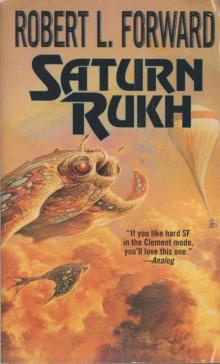
Down below, Petra could feel Petru getting tired and hungry. But soon it would be morning, and she could get some rest and let Petro fill the empty gizzard. The sky was clear of clouds above, and Petra could see Parent-and-Child rising over the horizon, soon to be followed by Bright. Parent was the home of the humans. The last she had seen of the humans was the brilliant purple-red light coming from the base of their strange wingless flyer as they entered one of the gigantic ravenous maws of the Swallower.
Just then, a light appeared in the sky above. Petra, with her long experience of gazing at the patterns of light in the sky, marked its position in her memory map of the heavens. The new light was brighter than any star and moving. At first, Petra thought it might be an incoming meteorite, but instead of coming downward and getting brighter, it went outward and stayed constant, until it stopped and faded away. She knew it wasn’t a meteorite when the light turned back on again. She now recognized the reddish-purple color of the light—it was the light emitted by the humans’ flyer!
Voices came out of the darkness around her from the rest of the flock. “Look up there!” “Did you see that?” “Is it a meteor?” “Strange color for a meteor.” “What is it?”
“That light is from the flyer of the humans,” Petra boomed out to the others around her. Seeing the humans leave, she felt a sense of loss, similar to what she felt when one of the flock entered into the death dive.
“Where are they going?” asked Hakra from below.
For a third time, the bright reddish-purple light glowed, then faded again. Petra was now able to determine the direction of travel of the pulsating light. It was headed in the direction of Parent-and-Child.
“They are going home.”
~ * ~
TECHNICAL BACKGROUND FOR VIDEO GAME
“CLIMBING SATURN’S RINGS”
by
Pete Stewart
~ * ~
BIBLIOGRAPHY
C. W. Allen, Astrophysical Quantities (Athlone Press, London, 1976), pp. 140, 141.
Tom Gehrels and Mildred Shapley Matthews, eds., Saturn (University of Arizona
Press, Tucson, 1984). Saturn data, p. 942. Satellite data, pp. 653, 655, 673. Ring data, pp. 473, 477,497, 523.
Patrick Moore and Garry Hunt, Rand-McNally Atlas of the Solar System, 2nded.
(Rand-McNally, 1984).
Carl Sagan and E. E. Salpeter, “Particles, Environments, and Possible Ecologies in
the Jovian Atmosphere,” Astrophysical Journal Supplement Series, Vol. 32, pp. 737-755 (December 1976).
E. C. Stone and E. D. Miner, “Voyager 1 Encounter with the Saturnian System,”
Science, Vol. 212, pp. 159-163 (10 April 1981), and following articles.
E. C. Stone and E. D. Miner, “Voyager 2 Encounter with the Saturnian System,”
Science, Vol. 215, pp. 499-504 (29 January 1982), and following articles.
~ * ~
ABOUT THE AUTHOR
Dr. Robert L. Forward writes science fiction novels and short stories, as well as science fact books and magazine articles. Through his scientific consulting company, Forward Unlimited, he also engages in contracted research on advanced space propulsion and exotic physical phenomena. Dr. Forward obtained his Ph.D. in gravitational physics from the University of Maryland. For his thesis he constructed and operated the world’s first bar antenna for the detection of gravitational radiation. The antenna is now in the Smithsonian Museum.
For thirty-one years, from 1956 until 1987, when he left in order to spend more time writing, Dr. Forward worked at the Hughes Aircraft Company Corporate Research Laboratories in Malibu, California, in positions of increasing responsibility, culminating with the position of senior scientist on the staff of the director. During that time he constructed and operated the world’s first laser gravitational radiation detector, invented the rotating gravitational mass sensor, published over sixty-five scientific publications, and was awarded eighteen patents.
From 1983 to the present, Dr. Forward has had a series of contracts from the U.S. Air Force and NASA to explore the forefront of physics and engineering in order to find breakthrough concepts in space power and propulsion. He has published journal papers and contract reports on antiproton annihilation propulsion, laser beam and microwave beam interstellar propulsion, negative matter propulsion, space tethers, space warps, and a method for extracting electrical energy from vacuum fluctuations, and was awarded a patent for a Statite: a sunlight-levitated solar-sail direct-broadcast spacecraft that does not orbit the Earth, but “hovers” over the North Pole.
In addition to his professional publications, Dr. Forward has written over eighty popular science articles for publications such as the Encyclopaedia Britannica Yearbook, Omni, New Scientist, Focus, Aerospace America, Science Digest, Science 80, Analog, and Galaxy. His science fact books are Future Magic, Mirror Matter: Pioneering Antimatter Physics (with Joel Davis), and Indistinguishable from Magic. His science fiction novels are Dragon’s Egg and its sequel Starquake; Rocheworld and its four sequels, Return to Rocheworld and Rescued from Paradise (with his daughter, Julie Forward Fuller), and Ocean Under the Ice and Marooned on Eden (with his wife, Martha Dodson Forward); Martian Rainbow, Timemaster, Camelot 30K, and now Saturn Rukh. The novels are of the “hard” science fiction category, in which the science is as accurate as possible.
Dr. Forward is a fellow of the British Interplanetary Society and former editor of the interstellar studies issues of its journal, associate fellow of the American Institute of Aeronautics and Astronautics, and a member of the American Physical Society, Sigma Xi, Sigma Pi Sigma, the National Space Society, the Science-Fiction and Fantasy Writers of America, and the Author’s Guild.
Robert L. Forward, Saturn Rukh