Napoleon's Rabbit Farmer, page 1


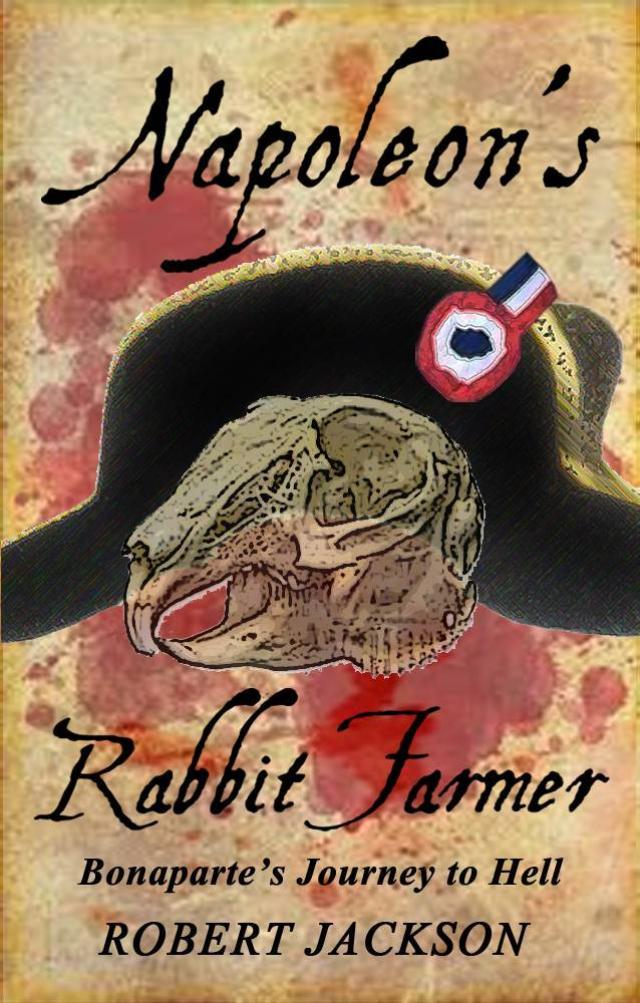
NAPOLEON’S
RABBIT FARMER
By
Robert Jackson
1st Kindle Edition
Copyright © Robert Jackson 2012
The Author asserts the moral right to be identified as the author of this work
All rights reserved.
No part of this publication may be reproduced, stored in a retrieval system, or transmitted, in any form or by any means, electronic, mechanical, photocopying, recording or otherwise, without the prior permission of the publishers.
Disclaimer: This book has been written for entertainment purposes only. All references to characters and countries should be seen in this light. The book is based on historical accounts but draws on conspiracy theories surrounding Napoleon Bonaparte. Any resemblance to actual living persons is purely coincidental.
Cover design: Ming Cheung
ebook by EBooks by Design
www.ebooksbydesign.co
Dedication
For Gordon and Rosalie
For Julie, Aidan, Ben and Elliot
And for David Brett
Contents
Prologue
Chapter 1
Chapter 2
Chapter 3
Chapter 4
Chapter 5
Chapter 6
Chapter 7
Chapter 8
Chapter 9
Chapter 10
Chapter 11
Chapter 12
Chapter 13
Chapter 14
Chapter 15
Chapter 16
Chapter 17
Chapter 18
Chapter 19
Chapter 20
Chapter 21
Chapter 22
Chapter 23
Chapter 24
Chapter 25
Bibliography
About the Author
Prologue
St Helena
14-15 October 1840
The corpse was perfectly preserved. There was no sign of the horrors of death, only the expression of a long, restful sleep. Swelling had restored a roundness to the face and a delicate hand with claw-like nails was clasping a black, folded three-cornered hat. The green jacket with red collar was slightly faded, the buttons tarnished and the gold epaulettes and decorations had lost their lustre, but the famous uniform was still fit for the coming parade.
Crowded around the coffin that had just been broken open after 19 years buried in the sub-tropical soil were some of those who had been at Napoleon’s passing. They had travelled 5,000 miles to take their Emperor home.
The French party gazed upon the body in awe. Napoleon’s head was resting gently on a cushion, his eyelids closed and there was a bluish-grey stubble on his chin. Three, bright white incisors could be seen through a receding upper lip and the skin of the nose hung upon the bone. The Emperor’s knee-high black boots had split, revealing the twisted nails of the smaller toes on each foot. But these were the only remarkable changes to a corpse which had not been embalmed. Next to his body were two silver jars containing his heart and stomach.
British army sappers had started work to open the grave in Geranium Valley at midnight, directed by a captain of the Royal Engineers. They laboured under a constant drizzle by torch and lantern light. Sentries had been posted on the surrounding rocky slopes and the French officials, not mixing with their British counterparts, stayed to watch every swing of the pick, collecting discarded flowers from the graveside as souvenirs. First to be pulled aside were the iron railings and three slabs of stone, six inches thick, which guarded the plot at the foot of two weeping willows. Then, in three hours, the clay and stones that filled the vault were shovelled out. The six bare-headed soldiers removed seven feet of spoil before they hit the solid concrete sealing the tomb. Sparks flew from their picks as they tried to crack the one-foot-thick barrier that had been strengthened with iron rods to prevent intrusion. After four and half hours of back-breaking toil, the soldiers finally cracked it, exposing a large slab of stone that had been cemented to the walls of the vault. This join had to be broken before ropes could be attached to the slab for it to be lifted with block and tackle. When this was done, the muddy wood of the outer coffin was exposed. All those watching removed their hats and a French priest came forward to sprinkle holy water before looking to the grey sky and reciting De profundis. The working party rested under the trees in the damp morning light while the leader of the French party, Count Rohan Chabot, took measurements of the tomb. At 10.20am, hooks and straps were attached to the casket and it was raised by the rope and pulley of the crab winch and carried to a blue and white-striped tent which had been turned into a chapel with large crucifix.
The priest with two young choristers took up position at the foot of the coffin and the assembled party of French officials, English soldiers and black labourers removed their hats while he conducted a mournful service in Latin.
At its completion, two engineers took saws to the ends of the outer mahogany casket. This gave access to a second lead coffin. Two British officers entered the tent and were acknowledged by Chabot before the sappers began to cut through the metal joins. Smoke filled the humid canopy as another mahogany casket was revealed with damaged screws. After some time, these were removed to reveal the final tin chamber containing the Emperor’s remains. It was 1.15pm and the tension built when the engineers started to remove the tin lid. To gasps from the audience a white, ghost-like cloud emerged from inside. But this was not the spectre of the warrior who had once ruled Europe, just the coffin’s satin lining which had become detached and was now shrouding the body.
Louis Marchand, Napoleon’s chief valet de chambre during his exile on this black, rocky South Atlantic outcrop, broke down and cried at the sight of his master. Marchand, who had been a young man of 24 when he had travelled with the Emperor to his island prison, whispered to his companions: ‘It is more like him than at his death. He is at peace.’
The French had arrived at St Helena on the frigate la Belle Poule, commanded by King Louis Philippe’s third son, the Prince de Joinville. It was escorted by the corvette la Favorite and joined by L’Oreste. Among the party standing before the opened coffin were Napoleon’s companions, the generals Bertrand and Gourgaud, and the ship’s surgeon Remy Guillard.
The prince had stayed away, as the British had insisted on managing the exhumation which was being carried out on the anniversary of the Emperor’s arrival at St Helena in 1815. The prince had visited the island’s governor, Major General George Middlemore, to gain a final assurance that the British were willing to surrender their prisoner and then went to see for himself the peaceful valley and spring that was Napoleon’s resting place. He also made the climb to Longwood House, the former farm where the Emperor had spent his final years. A windmill had been built there and a threshing machine installed in the room where he had died.
The ship’s surgeon examined the body from head to foot, prodding Napoleon’s face and torso for two long minutes. ‘The eyeballs have lost little of their fullness and form,’ said Dr Guillard. ‘His cheeks are very white. He picked up the first silver vessel containing the preserved heart and proposed it be opened for inspection. This sparked an angry reaction from Gourgaud, who could take no more. ‘Guillard, you are going too far,’ he snapped. ‘Close the coffin. Shut it now. You must show respect for His Majesty.’
The doctor nodded, replacing the satin lining and spraying it with creosote to keep the humidity out. He put back the tin and mahogany lids and called for the engineers to reseal the lead coffin with molten metal. The French had brought with them an elaborate ebony coffin, made in Paris, and bearing the inscription Napoleon in golden letters, and a rich purple velvet pall embroidered with golden bees.
The Emperor’s remains were placed inside the new coffin and this was in turn put in an oak sarcophagus. Making a combined weight of 2,600 pounds, it needed 43 gunners to lift it on to the hearse, the converted carriage of a former governor which had been decorated with plumes of black feathers at each corner. The procession to the quay at Jamestown did not start until 3.30 in the afternoon and in the heavy rain, the four black horses struggled to get the load moving. It was headed by a detachment of the local militia, soldiers of the 91st Regiment and the gunners from the Royal Artillery. Following them were the priest and the choristers, bearing a crucifix in front of the hearse. Holding the four corners of the pall were Bertrand, Gourgaud, Marchand and Baron Emmanuel de Las Cases, who was a teenager when the Emperor was exiled. Napoleon’s servants Saint Denis, Noverraz, Pierron, Archambaud and Coursot walked behind. To the sound of minute guns, the frail and poorly governor Middlemore led a large number of French and English officers on the three-and-a-half-mile journey. Both sides of the road were lined with soldiers of the garrison, their arms reversed, along with crowds of residents and visitors. The hearse was so heavy that on the steep descents to the harbour, soldiers had to hold it back with chains. It took nearly three hours for the procession to reach Jamestown, a scattering of buildings tightly-squeezed between two mountains. Alternate gun salutes fired from the island batteries and la Belle Poule, at anchor several hundred yards off shore, greeted the hearse. As there was no harbour the French ships lowered their launches into the water, with one commanded by the Prince de Joinville, who had been waiting in full uniform for the official hand over.
He was met on the wharf by Middlemore and the brief ceremony that was to seal a new accord of peace between the countries was conducted in French
It was now the turn of a party of French sailors to lower the giant coffin into the Prince’s gilded launch. The boat bobbed in the waves, with a young midshipman anxiously barking orders. ‘Steady men, steady! We did not come all this way to lose the Emperor to the sea.’
The ships in the harbour all fired a final salute. Within an hour Napoleon’s remains were resting inside a candlelit chapel filled with military trophies at the stern of la Belle Poule. The outer oak sarcophagus had been removed and the sailors on board divided this between themselves as keepsakes, along with willow wood taken from the valley of the tomb. The next day, as the frigate readied to leave, its band played on the deck and the officers of the party were presented with commemorative medals. But as la Belle Poule finally set sail for France, no toast was made to a notable absentee from the mission, the Marquis de Montholon, a faithful servant and friend of the Emperor who had shared every year of his exile and was there at the death.
Chapter One
18 June 1815, Battle of Waterloo
‘One last push, one more and we shall dine in Brussels,’ shouted Napoleon leading five battalions of his beloved Guard, ‘the immortals’, to the foot of Mont Saint-Jean. ‘The English line will break. They will run.’ The veterans were poised to seal another famous victory and cheered their leader with roars of ‘Vive l’Empereur’.
The battle had been raging for more than seven hours when the elite infantry of the Imperial Guard formed into a huge blue battering ram at the bottom of a slope littered with the mutilated bodies of hundreds of men and horses. Cannon and musket smoke obscured the red-coated enemy spread across the top of the ridge, a barrier of steel which that afternoon had defiantly turned back the 12 massed cavalry charges of Marshal Ney. Wave upon wave of horsemen had thundered up the hill through fields of green rye, which had grown to three feet. The squadrons of cuirassiers, with their shining silver breast plates and long straight swords, had been followed by the lancers of the Guard but incredibly they had failed to make the decisive breakthrough on the sodden, heavy ground.
At the centre of the slope, black plumes of smoke drifted from the grey-tiled roof of the fortress farm of La Haye Sainte, which had been defended by five companies of the King’s German Legion. It had finally fallen to the French after hours of bitter fighting, opening the way for the Middle Guard’s frontal assault on the centre of the British line.
‘Time now is our only enemy. The sun is going down,’ Napoleon shouted to his staff officers as he reined in La Desiree, his famous grey mare. ‘The Prussians are pressing on our right. The Young Guard will hold them. Let us claim our greatest victory here.’ The Emperor turned to an exhausted and bloodied Ney, who had had five horses shot from under him leading the charges of 10,000 cavalry against a chessboard formation of 16 British squares, four ranks deep and bristling with bayonets.
‘Take the Guard, Ney,’ said Napoleon, to the hatless, sweating Marshal, whose sword had been broken. ‘History is yours. Smash the English centre and make them run for Ostend.’
The order for the advance was given and the proud column of 3,000 in dark greatcoats moved in order up the left hand side of the Brussels road, drummers sounding the pace. In the fading daylight they were greeted by a blinding flash of cannon fire from a curve of batteries that had been pulled into place moments earlier. The French cavalry had failed to spike the guns when they overran them in their futile charges. The gunners had sheltered inside the unbroken British squares and were back in action.
Shells packed with lead and iron balls scythed down the front ranks of the French column in a red mist. Round shot tore big holes, indiscriminately ripping off heads and limbs. Still they pushed forward, sixty-men abreast. Near the top, the column divided into three forces to push home the attack, the drummers signalling the charge.
Two battalions closed on the first line of the British and their Brunswick and Nassau allies, smashing the ragged defenders with volleys and bayonet. But their success was short lived. Artillery again opened fire into their flank with a murderous cannonade. They were then overwhelmed by a fresh Dutch division. The column faltered and broke.
To the west, an ambush lay in wait for two battalions of Chasseurs, the second prong of the Imperial Guard’s attack. More than 1,500 soldiers of the British Foot Guards had been lying down in a field of corn, sheltering from the French artillery that had been brought up the slope after the fall of the Haye Sainte farm buildings. The British rose like scarlet phantoms out of the ground and ripped into the French with point-blank volleys. Through the dense smoke, they launched a bayonet charge that scattered the Chasseurs.
The third prong of the French attack moved in support of the Chasseurs and was having some success driving the British guards back when they too were devastated by repeated volleys of musket fire. The 52nd Light Infantry had quickly wheeled in line onto their flank and also pushed home a bloody bayonet charge.
The last of the Imperial Guard fell back, causing panic to spread like wildfire through the French lines. The British and their allies, now scenting victory, poured down from the crest of the hill, throwing themselves on the retreating French who were streaming up the opposite side of the shallow valley. Napoleon was with generals Soult, Drouot, Bertrand and Gourgaud close to a battalion of line infantry which was hurriedly forming a square next to three cannons. Charging straight at them was a regiment of British light dragoons, who had among them some green-jacketed riflemen. They came within 900 feet when Napoleon ordered the artillery officer Gourgaud to drive them away with the three field pieces. The efficient young general rallied the crews and they blazed into action, a shot screaming into the attacking cavalry and taking the leg of their commander. The Emperor placed himself at the head of the infantry and wanted to charge the British.
‘I must die on the field of battle, I must die on the field,’ he shouted, but he was held back by Soult, who grabbed his bridle. ‘You will not be killed, Sire, but taken prisoner by their tirailleurs.’ The other staff officers joined Soult in persuading Napoleon to leave the field.
The Emperor moved quickly to rally his troops behind two battalions of the Old Guard, his personal bodyguard, at La Belle Alliance, the inn where he had set up his headquarters at the start of the day. The veterans formed two squares to protect themselves against the attacking cavalry with Napoleon and his staff at the centre of one. But as an ordered retreat towards France turned into a rout, the Emperor was again persuaded to flee.
The valiant Old Guard yielded ground foot by foot, refusing to surrender, and delaying the fierce pursuit of Napoleon. Surrounded on all sides, their general was called upon to lay down arms. ‘The Guard dies but does not surrender,’ came the reply, and the veterans fell where they stood.
Thousands of men, wagons and horses fled south in a state of confusion, blocking the road that climbed to Le Cailliou. The Emperor’s guard cleared the way for him with blows from the flat of their swords. At the small town of Genappe, Napoleon’s hopes of rallying his forces vanished when his troops fought among themselves to cross the single bridge over the river Dyle. It took him more than an hour to pass through and with Prussian dragoons and Dutch uhlans closing in, Napoleon gave up La Desiree and mounted a faster troop horse, presented to him by his page Gudin. Seventy-eight French guns and 2,000 prisoners were taken by the Prussians, who harried the broken army until 11pm. When they reached Genappe, they found Napoleon’s carriage containing a coat with diamonds hidden in the lining and his personal campaign equipment. The Emperor had reached the road leading to Charleroi, where again it was not possible to make a stand with the remnants of his army. By 9am on the following day, Napoleon and his guard of Chasseurs had lost all contact with the pursuers and made haste to Paris.
***
A rabbit breeder by trade, Sergeant Francois Robeaud had become a soldier during the revolution and had risen to Napoleon’s inner circle. This was not a result of successive promotions for valour, although he was a fearless veteran. The sergeant was the Emperor’s double, so close in looks and stature at five foot six inches, that it was almost impossible to tell him from the Corsican. Their soft grey-blue eyes, thin Latin noses and chestnut brown hair were identical. He even had the same reckless and slapdash riding style. An hour before the 80 guns of the French artillery opened the hostilities at 11.25, the sergeant had dressed in the Emperor’s uniform and mounted his gentle Arab La Desiree. He then cantered along the two-and-a-half mile French line of 70,000 troops, raising cheers and salutes from every unit he passed. Napoleon had gone for a sleep while waiting for the rolling farmland of Mont St Jean to dry after a night of torrential rain. The Emperor had inspected the battlefield three times during the downpour and had breakfasted with his generals, including his brother Jerome, at dawn. ‘I will bring my artillery into play, I will order my cavalry to charge, and I will march with my Old Guard,’ he had told them. Sergeant Robeaud was the last of four doubles employed to impersonate Napoleon who, being fond of practical jokes, would take advantage of being in more than one place at once. But the role was deadly serious. The army could be lifted to victory by seeing the general in the thick of the fighting, or leading the advance. The sight of Napoleon was said by his enemies to be worth an additional 40,000 men on the battlefield.