Frameshift (UC), page 1


Scanned by Highroller.
Proofed by .
Made prettier by use of EBook Design Group Stylesheet.
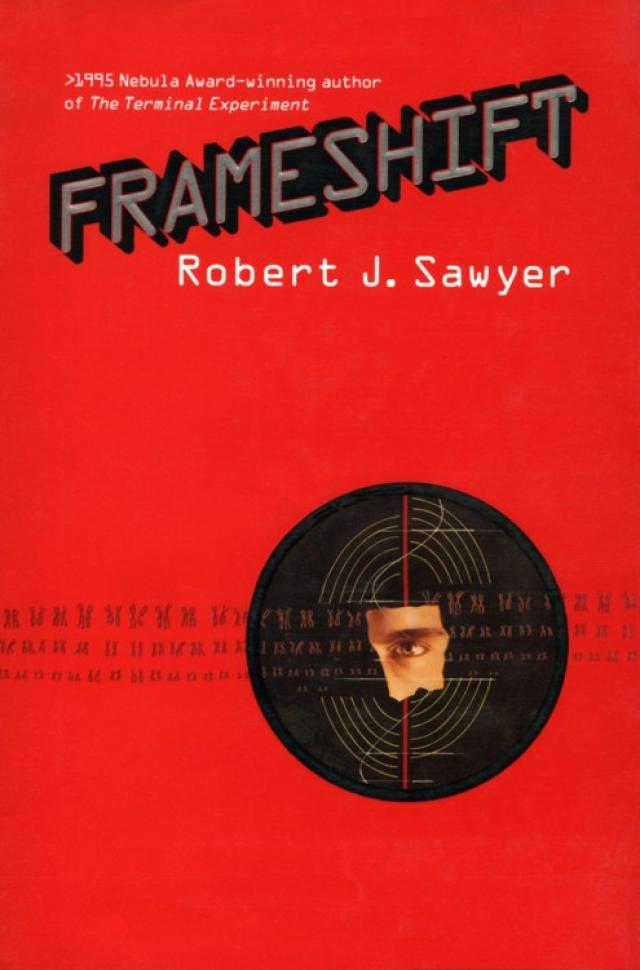
Frameshift by Robert J. Sawyer
Prologue
It is better to be hated for what you are than to be loved for what you are not.
—Andre Gide, winner of the 1947 Nobel Prize in literature
Berkeley, California
The Present Day
It seemed an unlikely place to die.
During the academic year, twenty-three thousand full-time students milled about the well-treed grounds of the University of California, Berkeley. But on this cool June night, the campus was mostly empty.
Pierre Tardivel reached out for the hand of Molly Bond. He was a good-looking, wiry man of thirty-three, with narrow shoulders, a round head, and hair the same chocolate brown as his eyes. Molly, who would turn thirty-three herself in a couple of weeks, was beautiful—stunningly so, even without makeup. She had high cheekbones, full lips, deep blue eyes, and naturally blond hair parted in the center and cut short up front but tumbling to her shoulders in back. Molly squeezed Pierre's hand, and they began walking side by side.
The bells in the Campanile had just chimed 11:00 p.m. Molly had been working late in the psychology department, where she was an assistant professor. Pierre didn't like Molly walking home alone at night, so he'd stayed at the Lawrence Berkeley National Laboratory, poised on a hilltop above the campus, until she'd phoned saying she was ready to leave. It was no hardship for him; on the contrary, Molly's usual problem was getting Pierre to take a break from his research.
Molly had no doubts about Pierre's feelings for her; that was one of the few good things about her gift. She did sometimes wish he would put his arm around her as they walked, but he didn't like doing that. Not that he wasn't affectionate: he was
French-Canadian, after all, and had the demonstrative nature that went with the first part of that hyphenate, and the desire to cuddle against the cold that came with the second. But he always said there would be time for helping to hold him up later, with her arm around his waist and his around hers. For now, while he still could, he wanted to walk freely.
As they crossed the bridge over the north fork of Strawberry Creek, Molly said, "How was work today?"
Pierre's voice was richly accented. "Burian Klimus was being a pain," he said.
Molly laughed, a throaty sound. Her speaking voice was high and feminine, but her laugh had an earthy quality that Pierre had said he found very sexy. "When isn't he?" she said.
"Exactly," replied Pierre. "Klimus wants perfection, and I guess he's entitled to it. But the whole point of the Human Genome Project is to find out what makes us human, and humans sometimes make mistakes." Molly was pretty much used to Pierre's accent, but three utterings of "yooman" in one sentence was enough to bring a smile to her lips. "He tore quite a strip off Shari's hide this afternoon."
Molly nodded. "I heard someone do an imitation of Burian at the Faculty Club yesterday." She cleared her throat and affected a German accent. " 'I'm not only a member of the Herr Club for Men—I'm also its chancellor.' "
Pierre laughed.
Up ahead there was a wrought-iron park bench. A burly man in his late twenties wearing faded jeans and an unzipped leather jacket was sitting on it. The man had a chin like two small fists protruding from the bottom of his face and a half inch of dirty-blond hair. Disrespectful, thought Molly: you come to the very home of the 1960s hippie movement, you should grow your hair a little long.
They continued walking. Normally, Pierre and Molly would have swerved away from the bench, giving the resting fellow a generous berth—Molly took pains to keep strangers from en-tering her zone. But a lighting standard and a low hedge sharply denned the opposite edge of the path here, so they ended up passing within a couple of feet of the man, Molly even closer to him than Pierre—
About fucking time that frog showed up.
Molly's grip tightened, her short unpainted fingernails digging into the back of Pierre's hand.
Too bad he's not alone—but maybe Grozny will like it better this way.
Molly spoke in a quavering whisper so low it was almost lost on the breeze: "Let's get out of here." Pierre's eyebrows went up, but he quickened his pace. Molly stole a glance over her shoulder. "He's up off the bench now," 'tshe said softly. "He's walking toward us."
She scanned the landscape ahead. A hundred feet in front of them was the campus's north gate, with the deserted cafes of Euclid Avenue beyond. To the left was a fence separating the university from Hearst Avenue. To the right, more redwoods and Haviland Hall, home of the School of Social Welfare. Most of its windows were dark. A bus rumbled by outside the fence— the last bus for a long time, this late. Pierre chewed his lower lip. Footfalls were approaching softly behind them. He reached into his pocket, and Molly could hear the soft tinkle of him maneuvering his keys between his fingers.
Molly opened the zipper on her white leather purse and extracted her rape whistle. She chanced another glance back, and—Christ, a knife! "Run!" she shouted, and veered to the right, bringing the whistle to her lips. The sound split the night.
Pierre surged forward, heading straight for the north gate, but after eating up a few yards of path, he looked back. Perhaps now that the man knew the element of surprise was gone, he'd just hightail it in the opposite direction, but Pierre had to be sure that the guy hadn't taken off after Molly—
—and that was Pierre's mistake. The man had been lagging behind—Pierre had longer legs and had started running sooner—but Pierre's slowing down to look gave the man a chance to close the distance. From thirty feet away, Molly, who had also stopped running, screamed Pierre's name.
The punk had a bowie knife in his right hand. It was difficult to make out in the darkness except for the reflection of street-lamps off the fifteen-inch blade. He was holding it underhand, as if he'd intended to thrust it up into Pierre's back.
The man lunged. Pierre did what any good Montreal boy who had grown up wanting to play on the Canadiens would do: he deked left, and when the guy moved in that direction, Pierre danced to the right and bodychecked him. The attacker was thrown off balance. Pierre surged forward, his apartment key wedged between his index and middle fingers. He smashed his assailant in the face. The man yowled in pain as the key jabbed into his cheek.
Molly ran toward the man from the rear. She jumped onto his back and began pummeling him with clenched fists. He tried to spin around, as if somehow he could catch the woman on top of him, and, as he did so, Pierre employed another hockey maneuver, tripping him. But instead of dropping the knife, as Pierre apparently thought he would, the man gripped it even tighter. As he fell, his arm twisted and his leather jacket billowed open. The weight of Molly on his back drove the blade's single sharpened edge sideways into his belly.
Suddenly blood was everywhere. Molly got off the man, wincing. He wasn't moving, and his breathing had taken on a liquid, bubbling sound.
Pierre grabbed Molly's hand. He started to back away, but suddenly realized just how severe the attacker's wound was. The man would bleed to death without immediate treatment. "Find a phone," Pierre said to Molly. "Call nine-one-one." She ran off toward Haviland Hall.
Pierre rolled the man onto his back, the knife sliding out as he did so. He picked it up and tossed it as far away as he could, in case he was underestimating the injury. He then tore open the buttons on the attacker's light cotton shirt, which was now sodden with blood, exposing the laceration. The man was in shock: his complexion, hard to make out in the wan light, had turned grayish white. Pierre took off his own shirt—a beige McGill University pullover—and wadded it up to use as a pressure bandage.
Molly returned several minutes later, panting from running. "An ambulance is coming, and so are the police," she said. "How is he?"
Pierre kept pressure on the wadded shirt, but the fabric was squishing as he leaned on it. "HeXdying," he said, looking up at her, his voice anguished.
Molly moved closer, looming over the assailant. "You don't recognize him?"
Pierre shook his head. "I'd remember that chin."
She kneeled next to the man, then closed her eyes, listening to the voice only she could hear.
Not fair, thought the man. / only killed people Grozny said deserved it. But I don't deserve to die. I'm not a fucking—
The unspoken voice stopped abruptly. Molly opened her eyes and then gently took Pierre's blood-covered hands off the drenched shirt. "He's gone," she said.
Pierre, who was still on bended knee, rocked slowly backward. His face was bone white and his mouth hung open slightly. Molly recognized the signs: just as the attacker had been moments ago, Pierre himself was now in shock. She helped him move away from the body and got him to sit down on the grass at the base of a redwood tree.
After what seemed an eternity, they at last heard approaching sirens. The city police arrived first, coming through the north gate, followed a few moments later by a campus police car that arrived from the direction of the Moffit Library. The two vehicles pulled up side by side, near where the stand of redwoods began.
The city cops were a salt-and-pepper team: a wide black man and a taller, skinnier white woman. The black man seemed to be the senior officer. He got a sealed package of latex gloves out of his glove compartment and snapped them onto his beefy hands, then moved in to examine the body. He checked the body's wrist for a pulse, then shifted its head and tried again at the base of the neck. "Christ," he said. "Karen?"
His partner came closer and played a flashlight beam onto the face. "He got a good punch in, that's for sure," the woman said, indicating the wound Pierre's keys had made. Then she blinked. "Say, didn't we bust him a few weeks ago?"
The black man nodded. "Chuck Hanratty. Scum." He shook his head, but it seemed more in wonder than out of sadness. He rose to his feet, snapped off his gloves, and looked briefly at the campus cop, a chubby white-haired Caucasian who was averting his eyes from the body. He then turned to Pierre and Molly. "Either of you hurt?"
"No," said Molly, her voice quavering slightly. "Just shaken up."
The female cop was scanning the area with her flashlight. "That the knife?" she said, looking at Pierre and pointing at the bowie, which had landed at the base of another redwood.
Pierre looked up, but didn't seem to hear.
"The knife," she said again. "The knife that killed him."
Pierre nodded.
"He was trying to kill us," said Molly.
The black man looked at her. "Are you a student here?"
"No, I'm faculty," she said. "Psychology department."
"Name?"
"Molly Bond."
He jerked his head at Pierre, who was still staring into space. "And him?"
"He's Pierre Tardivel. He's with the Human Genome Center, up at the Lawrence Berkeley Lab."
The officer turned to the campus cop. "You know these two?"
The old guy was slowly recovering his composure; this sort of thing was a far cry from getting cars towed from handicapped parking spots. He shook his head.
The male cop turned back to Molly and Pierre. "Let me see your driver's licenses and university IDs," he said.
Molly opened her purse and showed the requested cards to the officer. Pierre, chilled without a shirt on, still shaken by the death of the man, arms covered to the elbows with caking blood, managed to get out his brown wallet, but just stared at it as if he didn't know how to open it. Molly gently took it from him and showed his identification to the policeman.
"Canadian," said the cop, as though that were a very suspicious thing to be. "You got papers to be in this country?"
"Papers…" repeated Pierre, still dazed.
"He's got a green card," said Molly. She leafed through the /allet, found it, and showed it to the officer. The male cop lodded. The female cop had retrieved^Polaroid camera from cruiser and was taking photos of the scene.
Finally the ambulance arrived. It came through the north gate, )ut couldn't get down the path to where they were. All the vehicles had turned off their sirens once parked, but the ara-xilance left its rotating roof light on, making orange shadows dance around the scene. The air was filled with staticky calls over the police and ambulance radios. Two attendants, both male, hurried to the downed man. A few spectators had arrived is well.
"No pulse," said the male cop. "No signs of respiration."
The attendants did a few checks, then nodded at each other. "He's gone all right," said one. "Still, we gotta take him in."
"Karen?" said the male officer.
The female cop nodded. "I've got enough shots."
"Go ahead," said the man. He turned to Pierre and Molly. "We'll need statements from both of you."
"It was self-defense," said Molly.
For the first time, the cop showed a little warmth. "Of course. Don't worry; it's just routine. That guy who attacked you had quite a record: robbery, assault, cross burning."
"Cross burning?" said Molly, shocked.
The cop nodded. "Nasty fellow, that Chuck Hanratty. He was involved with a neo-Nazi group called the Millennial Reich. They're mostly across the Bay in San Francisco, but they've been recruiting here in Berkeley, too." He looked around at the various buildings. "Is your car here?"
"We were walking," said Molly.
"Well, look, it's after midnight and, frankly, your friend seems a bit out of it. Why don't you let Officer Granatstein and me give you a lift? You can come by headquarters tomorrow to make a report." He handed her a card.
"Why," said Pierre, finally rallying a bit, "would a neo-Nazi want to attack me?"
The black man shrugged. "No big mystery. He was after your wallet and her purse."
But Molly knew that wasn't true. She took Pierre's blood-encrusted hand and led him over to the police car.
Pierre stepped into the shower, cleaning the blood from his arms and chest. The water running down the drain was tinged with red. Pierre scrubbed until his skin was raw. After toweling off, he crawled into bed next to Molly, and they held each other.
"Why would a neo-Nazi be after me?" said Pierre, into the darkness. He exhaled noisily. "Hell, why would anyone go to the trouble of trying to kill me? After all…" He trailed off, the English sentence already formed in his mind, but deciding not to give it voice.
But Molly could tell what he had been about to say, and she drew him closer to her, holding him tightly.
After all, Pierre Tardivel had thought, I'll probably be dead soon anyway.
Book One
Let us live in the harness, striving mightily; lei us rather run the risk of wearing out than rusting out. I
—Theodore Roosevelt, winner of the 1906' Nobel Peace Prize
Chapter 1
August 1943
The screams came like popcorn popping: at first there were only one or two, then there were hundreds overlapping^ then, finally, the quantity diminished, and at last there were npne left and you knew it was done.
Jubas Meyer tried not to think about it. Even most of the bastards in charge tried not to think about it. Only forty meters away, a band of Jewish musicians played at gunpoint, their songs meant to drown out the cries of the dying, the rumble of the diesel engine in the Maschinehaus insufficient to fully mask the sound.
Finally, while Jubas and the others stood ready, the two Ukrainian operators heaved the massive doors aside. Blue smoke rose from the opening.
As was often the case, the naked corpses were still standing. The people had been packed in so tightly—up to five hundred in the tiny chamber—that there was no room for them to fall down. But now that the doors were open, those closest to the exit toppled over, spilling out into the hot summer sun, their faces mottled and bloated by the carbon-monoxide poisoning. The stench of human sweat and urine and vomit filled the air.
Jubas and his partner, Shlomo Malamud, moved forward, carrying their wooden stretcher. With it, they could remove a single adult or two children in each load; they didn't have the strength to carry more. Jubas could count his own ribs easily through his thin skin, and his scalp itched constantly from the lice.
Jubas and Shlomo started with a woman of about forty. Her left breast had a long gash in it. They carried her body off to the dental station. The man there, an emaciated fellow in his early thirties named Yehiel Reichman, tipped her head back and opened her mouth. He spotted a gold filling, reached in with blood-encrusted pliers, and extracted the tooth.
Shlomo and Jubas took the body off to the pit and dumped it in on top of the other corpses, trying to ignore the buzz of flies and the reek of diseased flesh and postmortem bowel discharges. They returned to the chamber, and—
No—
No!
God, no.
Not Rachel—
But it was. Jubas's own sister, lying there naked among the dead, her green eyes staring up at him, lifeless as emeralds.
He'd prayed that she'd gotten away, prayed that she was safe, prayed—
Jubas staggered back, tripped, fell to the ground, tears welling up and out of his eyes, the drops clearing channels in the filth that covered his face.
Shlomo moved to help his friend. "Quickly," he whispered. "Quickly, before they come…"
But Jubas was wailing now, unable to control himself.
"It gets to us all," said Shlomo soothingly.
Jubas shook his head. Shlomo didn't understand. He gulped air, finally forced out the words. "It's Rachel," he said between shuddering sobs, gesturing at the corpse. Flies were crawling across her face now.
Shlomo placed a hand on Jubas's shoulder. Shlomo had been separated from his own brother Saul, and the one thing that had kept him going all this time was the thought that somewhere Saul might be safe.