The Downloaded, page 1
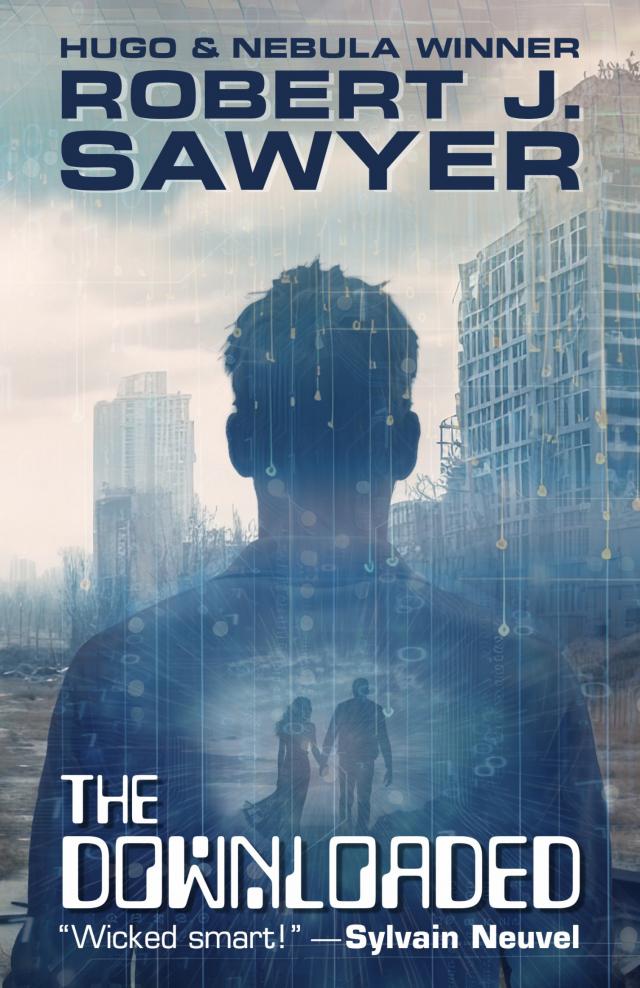


Praise for The Downloaded
“Robert J. Sawyer’s new novel is a potent distillation of everything that makes science fiction so addictive. In the space of a concise and tightly plotted story, The Downloaded explores a broad swath of future history and absolutely sizzles with fascinating ideas. You want space travel, a ruined Earth, virtual worlds, a cast of relatable characters, and a glimpse into the labyrinth of human destiny? Look no further: this book has all that and more.”
—Robert Charles Wilson, Hugo Award-winning author of Spin
“In The Downloaded, Robert J. Sawyer proves he’s not just a master of using science fiction to address social issues but also a master of devious plot twists and diverse character voices.”
—James Alan Gardner, Theodore Sturgeon Award-winning author of Commitment Hour
“No one does the end of the world quite like Robert J. Sawyer. The Downloaded is a wicked-smart thrill ride from start to finish. The interview format brings genuine intimacy to this action-packed story that also raises questions about consciousness, society, and the very nature of humanity. I loved it.”
—Sylvain Neuvel, bestselling author of
A History of What Comes Next
“Robert J. Sawyer is well known for big-concept original SF and rigorous research. While The Downloaded continues in this vein, it’s also a wonderful demonstration of another aspect of this impressive author: his deep understanding of—and compassion for—people, regardless who or what they are, or even what they have done. It’s a rare and potent humanity that elevates Sawyer’s work high above the rest.”
—Julie E. Czerneda, Aurora Award-winning author of
To Each This World
“One of the best SF novels I’ve read in years. The Downloaded is a tightly-written SF story that will hold your attention, but it’s more than just that. Sawyer has given us an advance look at a technology that we may have someday if we’re fortunate, but also a near-future world that we may get, too, and God help us if we do. The juxtaposition of the two makes this a fascinating tale.”
—Allen Steele, Hugo Award-winning author of Coyote
“Extraordinarily well done. Sawyer gives just enough science to make the story’s logic utterly plausible—and then he instantly moves on, making the story’s focus far more on the emotional impact on the characters rather than on world-building. The Downloaded stays honed to the human interest throughout.”
—Hugo and Sturgeon Award finalist Paddy Forde
Praise for Robert J. Sawyer
“A new Robert J. Sawyer book is always cause for celebration.”
—Analog Science Fiction and Fact
“Sawyer not only has an irresistibly engaging narrative voice but also a gift for confronting thorny philosophical conundrums. At every opportunity, he forces his readers to think while holding their attention with ingenious premises and superlative craftsmanship.”
—Booklist
“Can Sawyer write? Yes—with near-Asimovian clarity, with energy and drive, with such grace that his writing becomes invisible as the story comes to life in your mind.”
—Orson Scott Card
“Robert J. Sawyer is by any measure one of the world’s leading (and most interesting) science-fiction writers. His fiction is a fascinating blend of intellectually compelling big ideas and humane, enduring characters.”
—The Globe and Mail
“Sawyer, an articulate fountain of ideas, is the genre’s northern star—in fact, one of the hottest SF writers anywhere. By any reckoning Sawyer is among the most successful Canadian authors ever.”
—Maclean’s: Canada’s National Magazine
“Robert J. Sawyer is a writer of boundless confidence and bold scientific extrapolation.”
—The New York Times
“Sawyer is Canada’s answer to Michael Crichton.”
—The Toronto Star
“Sawyer’s books—always rich in science, action, and profound thinking—never fail to surprise, delight, and cause us to transcend our ordinary thinking. I’ve read Crichton, Asimov, Heinlein, Clarke, King, and Koontz—and Sawyer outdoes them all.”
—Clifford A. Pickover
“A polished, exciting writer. Sawyer writes with the scientific panache and grandeur of Arthur C. Clarke and the human touch of Isaac Asimov.”
—Quill & Quire
“Cracking open a new Robert J. Sawyer book is like getting a gift from a friend who visits all the strange and undiscovered places in the world. You can’t wait to see what he’s going to amaze you with this time.”
—John Scalzi
“No reader seeking well-written stories that respect, emphasize and depend on modern science should be disappointed by the works of Rob Sawyer.”
—The Washington Post
“Sawyer is a terrific writer. He can write about the most sophisticated science while giving readers the room to understand what’s happening and follow the plot.”
—Winnipeg Free Press
THE DOWNLOADED
By Robert J. Sawyer
Copyright © 2024 by Robert J. Sawyer.
All rights reserved.
The Downloaded is also available as an Audible Original with a full cast.
All characters and events in this book are fictitious.
Any resemblance to persons living or dead is coincidental.
The scanning, uploading, and distribution of this book via the Internet or any other means without the permission of the publisher is illegal and punishable by law. Please purchase only authorized electronic editions of this book, and do not participate in or encourage electronic piracy of copyrighted material.
Cover and interior design: Bibliofic Designs
SFWRITER.COM Inc.
Mississauga, Ontario, Canada
ISBN 978-1-988415-73-4
Printed in Canada
First Edition: May 2024
Books by Robert J. Sawyer
NOVELS
Golden Fleece
End of an Era
The Terminal Experiment
Starplex
Frameshift
Illegal Alien
Factoring Humanity
FlashForward
Calculating God
Mindscan
Rollback
Triggers
Red Planet Blues
Quantum Night
The Oppenheimer Alternative
The Downloaded
The Quintaglio Ascension Trilogy
Far-Seer
Fossil Hunter
Foreigner
The Neanderthal Parallax Trilogy
Hominids
Humans
Hybrids
The WWW Trilogy
Wake
Watch
Wonder
COMPLETE SHORT FICTION
Volume 1: Earth
Volume 2: Space
Volume 3: Time
For book-club discussion guides, visit sfwriter.com
Dedication
For
Eric Greene
A good and wise
Acknowledgments
As always, Carolyn Clink was the guiding light through this project, one that was created in trying times indeed. Huge thanks to Chris Lotts for structuring a complex deal for this novel, and to Jolise Beaton, Anna Gecan, and dramaturge extraordinaire Gregory J. Sinclair at Audible Canada.
Many thanks to Alisha Souillet, who was my number-one beta reader. Thanks, too, for help from Gregory Benford, Denise Bérubé, Craig Bobchin, Stephanie Bradfield, C.A. Bridges, Matt Campbell, Jon Caruana, Stuart Coxe, Gerald Cuccio, Nancy T. Curriden, Irene Dutchak, Andrew Fink, Paddy Forde, Michael S. Jäger, Herb Kauderer, Mike Lazaridis, W. Thomas Leroux, John Manley, Amanda Potter, N.R.M. Roshak, Alex Shvartsman, Peter Spasov, Lou Sytsma, Douglas Tindal, Gord Tulloch, and Bret Wiebe. I borrowed the term “corpsicle” from my friend Larry Niven.
Many thanks to my Patreon supporters (all of whom had the chance to beta-read this novel) including, most generously, Christopher Bair, Keith Ballinger, Kelly Barratt, Judith Bemis, Jennifer Blanchard, Ronda Bradley, Bill Brooks, Wayne Brown, James Burns, Matt Campbell, Matt Ceccato, James Christie, Phillip Clark, Christine V. Connell, Nancy T. Curriden, Robert M. David, Genevieve Doucette, Allison Dubarry, Hugh Gamble, Gordon Getgood, Joe Karpierz, James Kerwin, Gregory Koch, Archie Kubacki, Matthew LeDrew, Adam Leon, Joel Lee Liberski, Kathe Lopez, Gillian Martin, Catharine McKeever, Cary Meriwether, Lisa Mishchenko, Christina Dawn Monroe, Arioch Morningstar, Kel N., Anna Nelson, Shane P. Newton, The Nolan Family, Andrew Olsen, Carolyn Collins Petersen, Ian Pedoe, Bo Prince, Ken Ray, Carol Richards, Saul Rhymes, Fiona Reid Roma, Rahadyan Timoteo Sastrowardoyo, Robin Schumacher, Timothy W. Spencer, Aaron Suarez, Andrew Tennant, Douglas Tindal, Miss R-Laurraine Tutihasi, Kurt Weingarten, Scott Wilson, Joshua Paul Wolff, Brian Wright, and Len Zaifman.
If you’d like to join them in supporting my work directly,please visit patreon.com/robertjsawyer.
Chapter 1
Any civilization’s collapse begins the moment its people start to ask themselves “Does this bring me joy?” rather than “Does this bring others joy?”
—James Kerwin
Interview with Dr. Jürgen Haas
So you’re the . . . the person who wants to interview each of us? I know it’s hot out, but you should be wearing a coat, don’t you think? A mackinaw? As in deus ex machina? Thank you, thank you, I’m here—well, for the next seven years, at least. Try the five-hundred-year-old veal, and don’t forget to tip your robot.
Nothing? Crickets? Talk about a tough room! Anyway, yeah, sure, I’m glad to be interviewed. But I bet some of the others will refuse. No, no—not any of us, but some of them. Go ahead, though; fire away.
Oh, don’t bother calling me “Dr. Haas.” “Jürgen” is fine, thanks. What? Sorry; I’m having trouble understanding your accent. When did I first realize something was wrong? Let’s see. It was nighttime. Why? Because I like nighttime. Heck, sometimes I let the night last for—well, for what seemed like days, if you get my drift.
There was a full moon. In movies, it’s always a full moon, isn’t it? Used to bug the heck out of me. And if they showed a dark night sky, it was just some random spattering of stars, never any recognizable constellations. But I made sure my sky was correct: Ursa Major in the north, mighty Orion in the south—although I did cheat on the planets, like they used to in planetariums. Instead of untwinkling points, each showed a small disc. I could see the cloud bands on Jupiter, the rings around Saturn, and hints of geography on Mars.
But, yeah, I guess I like the full moon as much as the next guy, so it usually was full for me. I know the glare should have banished most of the stars, but in the Jürgenverse the very heavens bent to my will.
A megalomaniac? Moi? That’d only be true if they were delusional fantasies. But the moon was indeed full and the stars were blazing; even the ones right by the lunar disc were visible, while the Milky Way arched gloriously from horizon to horizon. And, no, there weren’t any clouds. I’ve looked at clouds from both sides now—a perk of the job, see?—and unless they resemble a dragon or something else cool, I’ve got no use for them.
So, yeah, a perfect night sky. All it needed were streamers of northern lights, like in a Yukon tourism ad, and—voilà!—there they were: rippling green and gold sheets. Gorgeous. But it wasn’t freezing; screw that. It was as warm as an old-time August night in Toronto, but with none of that damn humidity.
Now, a night like that, you gotta do something special, right? Like, say, bodysurf over Niagara Falls. As a kid, I once saw the falls long after sunset, when they lit them up with different colors. My version was like that, too: foaming sheets of pink and magenta, green and teal.
I had the Niagara River raging toward the precipice, a wild torrent, kicking up spray that diffracted the moonlight into rainbows. On the shores were beds of white trilliums, the goddamn provincial flower, which I’d seen precisely once in the wild. But they are beautiful, so what the heck: millions were as easy as one.
And, sure, body surfing in the dark is insane, but that’s what made it worth doing. Now, a stunt like that needed an audience, and so I conjured one up: Letitia, dreadlocks down her back, long shapely legs quickly closing the distance between us, a huge, warm smile across her gorgeous face.
Don’t look at me like that. She is gorgeous, and I am not objectifying her. I’m just telling you how I saw her, all right? Give me a break.
Sure, it wasn’t the real Letitia. She was off in her own silo just like I was in mine. I hadn’t seen her in the flesh for—God, had it really been four years? Time flies when you’re having fun—or, I suppose, when your system clock is running fast.
But, actually, the clock there was running slow. Yes, from my point of view, just four years had passed in that simulated reality, so it was now 2063 as far as I was concerned, but five centuries had slipped by in the outside universe. That made it sometime in the mid-2500s, meaning we should have been getting close to our destination.
The last time I’d seen the real Letitia, she’d been thirty-eight. I was a year older—still am, subjectively—but got my astronaut’s wings a year after she did; medical school takes time.
Anyway, there was no need to wear clothes; nothing could hurt me, and the temperature was always whatever I found comfortable. Still, I summoned up a pair of swim trunks in ANSA blue and gold. For her part, Letitia was wearing—well, that was odd. She was in her astronaut’s jumpsuit. But at least its light tan color made her visible in the dark.
I looked back to make sure Letitia was paying attention, then braced myself on the trillium-covered north bank—the Canadian side—and bent down in a low crouch, then leapt up, up, up into the air. At the pinnacle, I swung my arms over my head, ready to pierce the raging waters as my trajectory started angling downward. When I hit, the water was warm—no need to suffer, after all!—and I remained submerged for a full minute before rising to the surface, my body sluicing along the top of the frothing river, barreling (but not in a barrel!) toward the sheer cataract of Niagara Falls.
Just before I reached the rocky lip, I realized that I could have even more spectators if I added the Maid of the Mist sightseeing boat, with its crowd of tourists clad in yellow slickers, and—ta-da!—there it was, up ahead and far below, as I shot over the precipice like I had a booster rocket up my bum. I must have been flying forward ten meters for every one I dropped in altitude, and I soon realized that by the time I hit the Niagara River, Letitia would be far behind.
I’ve got a silly fondness for superhero movies, so I pulled my right arm back against my body, the way Superman does when executing a turn, and started arcing back toward her. The air whipped my hair and flung moisture from my body. I imagine from Letitia’s point of view I was a silhouette against the night, backlit by the moon. To rectify that, I made three spotlights on rotating mounts appear along the south bank and let their beams converge on me as I continued to swoop down toward her.
Letitia should have been applauding wildly and grinning from ear to ear, but she was doing neither. Instead, she just stood there, arms folded across her chest, shaking her head. The system usually knows what I want to see, but I could always override its choices through an effort of will and I made an effort then, telling the Letitia simulation to let out a cheer and then come running toward where I was about to land.
But nothing happened. She just stood there, looking pissed. I spread my arms as though they were brakes and came down gently about three meters from her. As I walked toward her, I noticed something startling. Her dreadlocks were longer than I’d ever seen them, but that didn’t bother me; the more the merrier, says I. But from the top of her head down to the middle of her bottom, they were interspersed with red beads, like cranberries strung along twine. Beads I don’t mind, but I hate the color red—yeah, strange for a doctor, I know—and there’s no way I’d have conjured up a vision of her looking like this.
I blinked rapidly three times—my usual trick for correcting glitches—but nothing changed. “Jesus, Letitia,” I said, hearing my own voice for the first time in ages. “That was pure athletic gold right there. Why the resting bitch face?”
Anger shone through her normally charming Jamaican lilt. “I’d forgotten what a little boy you can be, Jürgen. Maybe I should turn to Dr. Chang instead.”
Chang. That bastard. One of the best things about going into my own silo had been leaving other people behind—certain ones, at least. “Simulation override phi chi psi omega,” I said. “Reset Letitia.”
But Letitia remained exactly as she had been, standing among the trilliums, glaring at me. “Conjure up some more clothes, doofus,” she said. “We need to talk.”