

Operation Ice Breaker, page 18
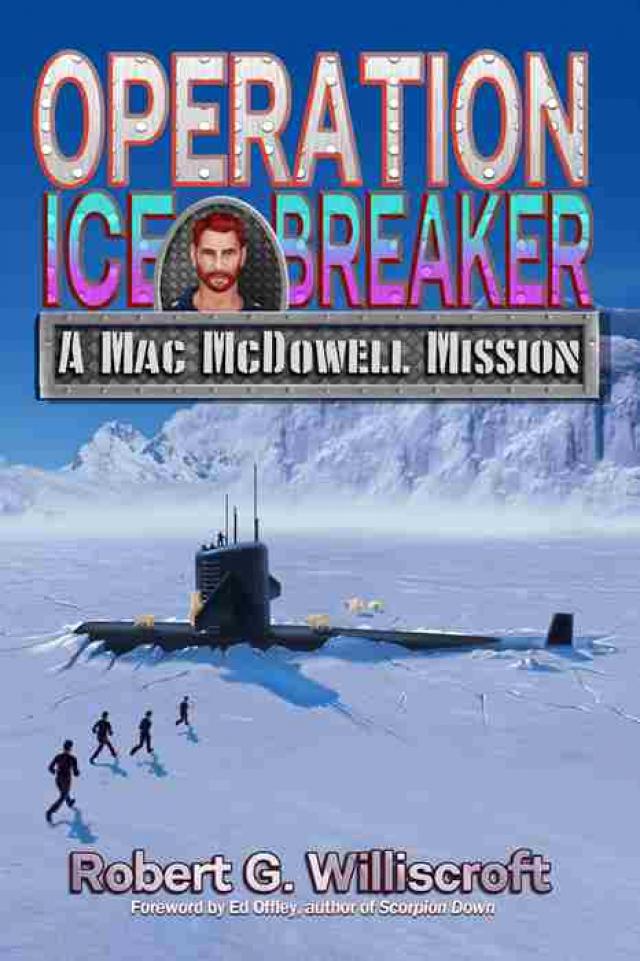


Franklin dropped us down to ninety feet, which put us fifty feet over the bottom on average all the way to Point Hope. We had taken this track twice before, and the SINS was on the mark, so following our track a third time was relatively easy. Ahead lay 445 nautical miles of Chukchi Sea that funneled everything headed south through the forty-three-nautical-mile-wide Bering Strait. It was a near certainty that the Soviets had at least one, and probably two or three subs patrolling the waters north of Bering Strait. Our southward route took advantage of the deepest waters between Point Barrow and Point Hope. This trough was ten to fifteen nautical miles wide, which meant that any other sub at our latitude would be relatively close to us.
South of Point Hope the bottom dropped down another forty feet on average, which would give us more speed latitude, and spread out across most of the width of the strait, which would give us more room to remain hidden.
The skipper set our speed to Point Hope at eight knots. This meant we would be crawling along for nearly two days, taking our hourly baffle-clearing into account.
When we arrived off Point Hope again, Doug and Franklin were back on watch with their team. As recommended by Juby, Franklin set a course of 188 degrees, heading for a point forty nautical miles just slightly west-of-north from Cape Prince of Wales—our side of Bering Strait, and set turns for thirteen knots at ninety feet. That point was the beginning of a narrow shipping lane that headed due south between Cape Prince of Wales and Little Diomede Island—our half of the two islands that marked the middle of the strait. Since this channel lay along the deepest part of the strait, the skipper wanted to keep to the bottom of the lane until it opened out into the Bering Sea.
Shortly after we arrived at the head of the shipping lane, Barry and Waverly took over. They turned due south to follow the lane. I was in Sonar reviewing intel on the Alfas when they conducted our first baffle clear. Benny Simms had the Sonar Watch, but King was with me reviewing the intel. Benny picked up a faint contact directly astern of us.
“Conn, Sonar,” he said, “I have a new contact bearing due north, directly astern, designate Sierra-twelve.”
“Whatcha got, Benny?” King asked, reaching for a set of headphones.
“It’s gotta be a sub, right?” Benny asked. “It’s all ice back there.”
“Chances are…” King said. “Let’s figure out what it is.”
King broke out a volume that illustrated the waterfall display patterns for Soviet subs. Benny compared them with what he picked up from Sierra-12.
“Shit, Man! That’s a Sierra-I!” Benny’s excitement was palpable.
We didn’t know very much about Sierra-Is. Probably a titanium alloy hull. Deep diving. Not so automated as the Alfa—but this was speculation. Better sonar and more weaponry than the Alfa. Noisier, too. That was why we detected this one.
The skipper stepped into Sonar and listened to the Sierra. “He doesn’t really concern me,” he said. “I just want to know if he follows us into the Bering or if he remains in the Chukchi.”
USS TEUTHIS—BERING SEA
The north end of the Bering Sea is like a great river delta. Relatively shallow water in the Bering Strait spreads out in a great 300-nautical-mile-arc across the Bering Sea and then continues down the eastern side for another 200 nautical miles. The relatively shallow water terminates in a steep drop-off into the Bering Sea Basin, where depths exceed 12,000 feet.
The Aleutian Islands stretch in a southwesterly curve from the Alaska mainland nearly to the Kamchatka Peninsula in Soviet Russia, cutting through the north end of the Bering Sea Basin. The Aleutian trench, on the south side of the island chain, drops down to 22,000 feet or more.
After passing through Bering Strait, we split the difference, passing east of St. Lawrence Island, and then veering west toward St. Mathews Island and the Pribilofs, St. Paul and St. George Islands. This way, the depth averaged about 240 feet, allowing us to transit at 140 feet and twenty knots in safety. We would more than compensate for the extra miles with our added speed. For the initial 175 nautical miles after transiting Bering Strait, we remained at thirteen knots and ninety feet. To our good fortune, it appeared that the Sierra-I had remained in the Chukchi Sea. Then we dropped down to 140 feet and kicked the speed up to twenty knots.
We took nearly two and a half days to travel from Bering Strait to Unimak Pass that cuts through the Aleutians. I had the watch with Zeb as we approached the pass. By this time, he was conducting the watch entirely without input from me. I was there because I had to be, legally. We were about ten miles out from Unimak Pass when Zed pointed to the under-ice sonar.
“It looks like we have broken ice above us,” he said.
I checked. We did.
USS TEUTHIS—UNIMAK PASS
“Conn, Sonar, we have a contact dead ahead, designate Sierra-thirteen. This guy is a tanker, deep draft, moving at a good clip, fifteen to twenty knots at least.”
“What the fuck?” Zed said to me. “What’s that all about?”
“Come here,” I said, walking to the chart table. I pulled out a chart that covered the entire North Pacific. “These guys regularly transit from here,” I pointed to Puget Sound, “to here.” I pointed to Japan. “Tankers and container cargo ships, twenty-four hours a day, every day. The great circle route passes through here,” I pointed to Unimak Pass, “and here,” I pointed further out along the island chain.
“I’ll be damned,” Zeb said. “I guess I never thought about it.” He passed his finger along the route. “Doesn’t ice ever hinder their passage?”
“Occasionally,” I said, “but they have hardened bows. The ice has to be pretty heavy to stop them. If necessary, they’ll hire an icebreaker to open things up.”
We went back to the periscope stand. “This guy’s got a hefty draft,” I told Zeb. “Check with Sonar to see where we need to be in case he runs overhead.”
Zeb talked with King and then came back to me. “He could have a sixty-foot draft. Call us sixty-five feet with a safety margin…that’s a hundred twenty-five feet. If we’re at one hundred forty feet, that’s a fifteen-foot margin.” He looked at me with a slight frown. “That’s not enough, is it?”
“What’s the depth?” I asked.
“Shit! It’s twelve hundred feet.”
“What’s the shallowest depth in Unimak Pass?”
“Uh…one hundred fifty-six feet. That sucks.”
“What do you want to do?”
Zeb was silent for a minute considering his options. “I’m going to drop to two hundred feet to let the tanker pass. Then I’ll track the bottom, staying as deep as possible, but less than two hundred. If we’re clear of transiting big guys, I’ll push past the shallow hump and drop down on the other side. It gets pretty deep real fast.”
“I agree,” I said. “Let’s do it.” I turned to find the skipper smiling at us and nodding his head. I guess he concurred.
That’s what we did, and three hours later, the bottom dropped from under us to 13,590 feet.
“Come to periscope depth long enough to send a burst message to CINCPACFLT announcing our arrival,” the skipper told Zeb, not ignoring me, but giving Zed the feel of actually running the sub as OOD.
No need to give the details. Zeb did it right, as he should have by that time. Fifteen minutes later, we were on our way back to depth.
USS TEUTHIS—TRANSIT TO KODIAK ISLAND
For the first time in a long time, we had the luxury of running deep and fast. Before we turned over the watch, the skipper told Zeb to take it to 700 feet and flank speed. Al set a track that kept us over the edge of the Aleutian Trench. It quickly drops down to 22,000 feet—that’s over four miles down. Even that extreme depth is still a couple of miles shallower than the deepest oceanic trenches. At 700 feet, we were just skimming the surface.
We were traveling around the north edge of the Alaska Gulf, one of the stormiest pieces of ocean on Earth. As Zeb and I and our team turned over the watch to Bert and Seth and their watch section, the under-ice sonar gave us a picture of the surface above us. It was a chaotic, jumbled mess. Instead of running in one direction with the wind, the waves were running into each other creating unpredictable peaks and troughs. The peaks sometimes exceeded twenty feet. I was glad we weren’t up there on the surface, having to deal with that shit.
For the next eighteen hours—during Bert’s, Barry’s, and Doug’s watches—we were pedal-to-the-metal, slowing down roughly every hour, of course, to do a baffle clearing. Sonar picked up several tankers and container ships running for Japan and points west. By the time Zeb and I came back on watch, Sierra-20 was fading behind us.
The surface turbulence had subsided somewhat, but the waves were still ten feet or so. We turned left toward Woman’s Bay, came up to 200 feet, and slowed to fifteen knots. At this depth, Teuthis was rocking around with the topside wave activity. It was tolerable but uncomfortable.
Four hours later, we arrived at the outer bounds of Chiniak Bay. The sea surface had quieted because of the protection offered by fingers of land embracing the bay. Although we were still several miles from the pilot pickup buoy, it was time to surface.
“Sonar, Conn, give me your contacts,” Zeb ordered.
“Conn, Sonar, we just detected Sierra-twenty-one dead ahead several miles. It’s a small vessel. I believe it’s the pilot craft.”
“Make your depth six-five feet,” Zeb ordered. “Ahead slow, make turns for five knots.”
As we reached sixty-five feet, Zeb swung the attack scope around while I followed suit with the nav scope. The skipper arrived in Control just then, so I turned the nav scope over to him.
As Zeb passed the bow, he said, “Mark.”
I checked the bearing and called it out. “Three-zero-one. Designate Victor-three.”
“Chief-of-the-Watch,” I said, “Raise the radar mast.”
As soon as the radar mast was up, I asked, “Al, what’s Victor-three’s range?”
“Four miles, Sir., bearing three-zero-one.”
“Very well,” I said. “Sierra-twenty-one and Victor-three are the same contact—the pilot craft. Designate Mike-one.”
The skipper picked up the 1MC mike. “This is the captain. We are a few miles off Kodiak Island. We will be surfacing and setting the Maneuvering Watch. We will be here for the day, remain the night, and the next day and night, and get underway the following afternoon. Each of you should have a few hours ashore but stay close by. It’s bitter cold and stormy. I don’t want to send a search party out looking for you.”
I turned to the skipper. “Request permission to surface, Sir.”
He nodded.
I looked at Zeb. “Get the people who will be topside ready for the foul weather. When they’re standing by, surface the sub.”
Seamen Jackson and Abele joined the skipper and me on the Bridge, bundled for the sub-zero, early morning temperature. We were still on East Coast time—a five-hour difference. When we docked, we would set our clocks back four hours to Pacific Standard, ignoring the hour difference to Alaska Time. That way, when we finally arrived at our homeport, Mare Island in Vallejo, California, we would not have to adjust to a new time zone.
The pilot buoy with the pilot boat standing off several yards was clearly visible through the dawn light. We had not yet called for a pilot, so apparently, someone in our chain of command arranged for his presence, or he spent his daylight hours, as few as they were, at the buoy. I suspected the former. It was too cold and the weather too stormy for anyone to spend any unnecessary time out here.
Radio hailed the pilot. He had received word of our arrival two hours earlier through the local Coast Guard commander. Sometimes the system worked better than expected.
“Station the Maneuvering watch,” the skipper told me. “Make sure everyone topside has a lifejacket and is tethered—NO exceptions.”
I understood the skipper’s concern. The deck was slippery with half-frozen slush, and anyone who fell into the water had about three minutes before serious hypothermia set in. That was a problem we simply didn’t need.
I brought Teuthis to a slow glide with the buoy and pilot boat just off our port bow. The COB, Brock Davis, dropped a couple of bumpers over the port side, and the boat skipper skillfully brought it alongside without actually touching them. Two deckhands on the boat slid a gangway with a single lifeline across to our deck. The pilot clipped a safety line to his harness and gingerly crossed to Teuthis. The COB grabbed him, and as soon as he unclipped himself from the pilot boat, fastened his harness to one of our tethers. The gangway slid back to the pilot boat, and it peeled away from us.
“Never done this for a sub before,” the pilot told the COB. “Where do we go?”
The COB, walked him to the port side of the sail, gestured with his thumb. “Up the ladder, Sir,” he said. “Once they clip you in up there, unfasten this tether and toss it to me.”
As the pilot clambered over the sail into the bridge well, I took a good look at him. He was short, dressed in foul-weather gear, wearing a woolen watch cap. His weathered face made guessing his age difficult. I made him for sixty-plus. His close-cropped full blond beard was peppered with grey, and his crinkled eyes showed permanent smile lines. He held out a weathered hand to the skipper.
“Master Pilot Sven Jakobsen,” he said in a vaguely northern European accent, raising his voice above the whistling breeze.
“Commander Fred Roken, Commanding Officer,” the skipper replied. He turned to me. “Lieutenant Commander Mac McDowell, my Officer-of-the-Deck.”
The pilot shook my hand. “How deep is your draft?”
“Thirty feet,” I responded, fudging by six inches.
“That’s cutting it a bit close in the channel. It’s dredged to twenty-eight feet, but mostly it’s deeper. Can you raise her up a bit?”
I glanced at the skipper.
“Matter of fact, yes,” the skipper said, and turning to me, “Have the Chief-of-the-Watch pump out as much ballast as possible.”
I passed the order on, and in five minutes, we were pulling a draft of twenty-seven feet. That gave us a foot; not much, but the pilot seemed satisfied.
“I never handled a sub before. Mind if I take her in a figure eight? To get the hang of how she handles?”
“No problem, Sir,” I said. I spoke into the squawk box, “Master Pilot Jakobsen has the Conn.” I turned back to him. “We have one screw astern center. We can lower two extendable maneuvering thrusters from the bow and stern. They take two feet. Ahead speeds are slow, one third, two thirds, full, and flank. Same in reverse, except it’s back emergency, not back flank. You’ll have a slight delay between order and execution—one second or so.”
The pilot took Teuthis through her paces in a figure eight. “Ungainly beast, isn’t she?” he said. “I’ll bet she’s way better underwater.”
“That’s her home,” the skipper said. “Would you like to take an underwater ride?”
“Can I?” The pilot’s excitement was palpable.
“I’ll clear it with my superiors, and when you pilot us out, we’ll take some time to give you a dive.”
The pilot didn’t use a chart to bring us in. Al followed our track carefully from Control, using radar fixes, and two of his quartermasters taking continuous visual sights.
At one point right near the start of the twenty-eight-foot channel, the pilot said, “Sensitive to current, isn’t she?”
From what I could tell, he had already compensated for what he expected from our nearly fully submerged hull. This guy definitely knew his stuff.
Two hours later, we moored port side to the main cargo dock. Woman’s Bay is a nearly perfect natural rectangle a nautical mile long and a quarter wide, lying southwest to northeast in a protected cove on the northeast side of Kodiak Island. The cargo dock is halfway along the southeastern side of the bay, dredged to twenty-eight feet at lower low tide. The dock is on a quarter mile-wide peninsula that separates Woman’s Bay from the incoming channel. Across the bay from the cargo dock, Old Woman’s Mountain rises fourteen hundred feet of steep, slippery-sloped shale to a plateau that runs the full length of the bay beyond the rectangle. The northeastern end of the bay housed a Coast Guard facility and the Kodiak Airport.
The pilot left as soon as the deck gang pushed the brow across to the dock. Immediately thereafter, the Commanding Officer of the Coast Guard Station boarded, accompanied by Captain George Jackson, the former CO of the Halibut, and a Navy lieutenant I didn’t know but whose breast insignia I did—the Deep Submergence pin. They were followed by five men, four civilian DIA specialists, and another man out of the past I knew very well, Sergyi Andreev.
On the dock was something I had half-expected but wasn’t sure that enough time had elapsed to make it happen—the small, cylindrical mini-sub formally known as the Deep Submergence Rescue Vessel-1 (DSRV-1) or Mystic as she was informally called. The lieutenant, clearly, was her pilot.
CHAPTER FOURTEEN
Kodiak Island
KODIAK—WOMAN’S BAY—MYSTIC
During Operation Ivy Bells on one of our underwater operations from the Halibut in the Sea of Okhotsk about two years back, we captured Ukrainian saturation diver Sergyi Andreev. He ended up saving my life, and over time, we became fast friends6F7. At the end of the Halibut operation, Sergyi was snatched up by the NSA for a thorough debriefing. Apparently, when the NSA heard about the Alfa, he was detailed back to Teuthis and my team because of his extensive knowledge of Soviet equipment and operations. So, there Sergyi was, standing on the foredeck of Teuthis in remote Kodiak, Alaska, waving at me. I looked at the skipper, and he nodded.
“Set the inport watch,” I said to the Chief-of-the-Watch over the squawk box.
Then I clambered over the sail edge and down the rungs on the port side. I walked up to Sergyi, grinning from ear to ear. He looked at me, snapped to attention, and saluted.
“I see you have been promoted,” he said, his eyes twinkling. Then he reached out to me with both arms and gave me a bear hug.





