

The Silverberg Business, page 1


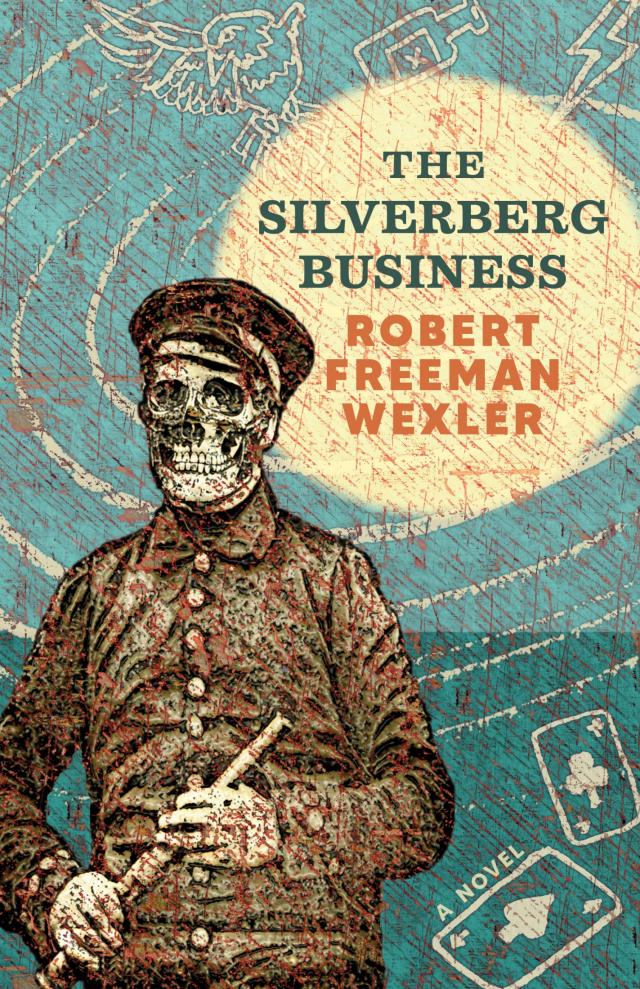
the
silverberg
business
also by robert freeman wexler
In Springdale Town
Circus of the Grand Design
Psychological Methods to Sell Should Be Destroyed
The Painting and the City
Undiscovered Territories: Stories
the
silverberg
business
Robert
Freeman
Wexler
Small Beer Press
Easthampton, MA
This is a work of fiction. All characters and events portrayed in this book are either fictitious or used fictitiously.
The Silverberg Business copyright © 2022 by Robert Freeman Wexler (robertfreemanwexler.com). All rights reserved.
Small Beer Press
150 Pleasant Street #306
Easthampton, MA 01027
smallbeerpress.com
weightlessbooks.com
bookmoonbooks.com
info@smallbeerpress.com
Distributed to the trade by Consortium.
Excerpt from The Wind-Up Bird Chronicle by Haruki Murakami, copyright © Haruki Murakami, reprinted by permission of Amanda Urban/ICM Partners; excerpt from The Education of a Poker Player by Herbert O. Yardley, copyright © 1957, administered by the estate of Herbert O. Yardley; lyrics from “Home” by Jon Dee Graham, Lucky Moon Music (BMI) copyright © 2001 Jon Dee Graham, administered by Bug.
Library of Congress Cataloging-in-Publication Data
Names: Wexler, Robert Freeman, author.
Title: The Silverberg business : a novel / Robert Wexler.
Description: First edition. | Easthampton, MA : Small Beer Press, [2022] |
Summary: “In 1888 in Victoria, Texas, for a simple job, a Chicago
private eye gets caught up in much darker affairs and ends up in the
poker game to end all poker games”-- Provided by publisher.
Identifiers: LCCN 2021051418 (print) | LCCN 2021051419 (ebook) | ISBN
9781618732019 (paperback) | ISBN 9781618732026 (ebook)
Subjects: LCGFT: Detective and mystery fiction. | Novels.
Classification: LCC PS3623.E955 S55 2022 (print) | LCC PS3623.E955
(ebook) | DDC 813/.6--dc23/eng/20211022
LC record available at https://lccn.loc.gov/2021051418
LC ebook record available at https://lccn.loc.gov/2021051419
First edition 1 2 3 4 5 6 7 8 9
Set in Parkinson Electra Pro.
Printed on 30% PCR recycled paper by the Versa Press, East Peoria, IL.
Author photograph by Regina Brecha.
Cover illustration “The Sea Captain” © 2022 Jon Langford (yarddog.com). All rights reserved.
For Rebecca and Merida
Part I
Victoria, Texas, 1888
Everything was intertwined, with the complexity of a three-dimensional puzzle—a puzzle in which truth was not necessarily fact and fact not necessarily truth.
—Haruki Murakami,
The Wind-Up Bird Chronicle
1
The Business
I woke from another swimming on land dream, the kind where I’m walking, no hurry . . . until . . . I can’t remember how. By the end, I’m on my stomach, unable to move. At least it hadn’t been the other kind of dream, where I’m after someone, or someone is after me—or some Thing; it’s almost on me and I can’t shoot my gun. No, that’s not it: shooting is complicated. The trigger, I don’t know how to use it. I scream the bullets out; they either miss or have no effect. They don’t stop what’s after me. I always wake up yelling. Embarrassing when you’re not alone.
Morning sun slashed through the window. I had gone to bed without closing the curtains. Rolling away from the glare didn’t help. Sleep would not come back. I worked to recall where I was: floral wallpaper, chipped washbasin—the room I took last night in the Delmonico Hotel, Victoria, Texas.
I got out of bed, splashed my face at the washbasin, pissed in the pot, and dressed, ending with a brown cotton sack-coat to cover the Bulldog revolver in its shoulder harness. I carried my hat, a brown derby, down to the hotel’s restaurant. From the doorway, I studied the room—one quick glance—as I’ve done in many rooms for the last ten years. Single diner, man, dressed for town, dark vest over white shirt with detachable collar. The shirt looked new. He wasn’t heavy and he wasn’t thin.
I didn’t need to examine him, or anyone in the hotel, but that’s what I do. Studying a room is a practice I can’t stop. Because there are times when doing it keeps me alive.
The waitress was small, with dark hair and a smile that told me nothing except that she was awake and doing what she needed to do. Which at this moment was take me to a table. As I passed the man we exchanged nods. The waitress sat me near a window; I watched the flow of pedestrians: a stout woman and two children, a grinning old man covered in soot, a young redheaded woman with a man who had the weathered face of a rancher.
A man glanced in; he wasn’t old, but his eyebrows and hair were bone-white. His rusted eyes stared into mine—I froze, unable to act, unable to save myself . . . a wave crashed the shore, then another, waves that towered, that smote the sand with unknowable force. I tried to run, couldn’t, tried to crawl, couldn’t. The hammer of wave crushed my shell . . . millions of tiny crystal shards mixed with spray-clouded air. Daylight faded. The spent wave departed, leaving sand sculpted into fantastic spirals, and . . . a stench . . . rot . . . the kind of rot you get after a storm passes and the sun bakes whatever the waves dredged from the depths.
Another scent came to me . . . earthy, earthy and pleasing—my hand touched warmth. A mug. The blessed waitress had brought coffee. I drank. Unease receded, waves subsided to harmless foam. The dining room was clean and dry. Outside the windows, sunshine and no white-haired man.
The waitress returned to refill my coffee cup and take my order. Stupidity began to lift. My stomach reminded me that yesterday I had eaten little. I hadn’t meant to drink whiskey, not so much anyway. The problem was Galveston—childhood home left long ago. I had been there for a cousin’s wedding, also attended by ghosts from the past, particularly one in a green dress. Seeing her had made me wistful, made me reflect on my life in Chicago, the crime investigations and frequent travel to towns where people often resented my presence. She looked happy enough with her husband and three children. To her, my life no doubt appeared adventuresome. Which enforced her belief that she had made the correct decision—women may have romantic notions about adventure, but they choose domestic stability. I can’t blame her for being sensible.
My waitress had also brought the local paper, Victoria Advocate, dated Saturday, October 27, 1888. Today was Monday the twenty-ninth. I perused a section called “The Outside World, An Interesting Jumble of Both Foreign and Domestic News for Victoria Readers,” in which I discovered that the champion boxer John L. Sullivan, at twenty-nine years of age, has made and spent $300,000 in the last three years but is now broke and incapable of fighting; the many dog farms of frozen Manchuria provide us with splendid fur to make our coats, and:
L. Herman, a New York money changer and banker, has disappeared with $5,000 belonging to Polish Jews. The money had been entrusted to his care and was to have been sent to England.
That last item . . . I had been hired to investigate a similar crime. Sometimes, fraud is so apparent yet unrecognized that the intelligence of the whole of humanity becomes questionable. And yet, humanity somehow continues to advance, inventing and creating, as if there’s a wall between intelligence and gullibility, so that no matter how educated or experienced a man might be, there’s a fraud to which he will fall victim. By that logic, I would have to be included as one of the eventually gullible, but I haven’t fallen yet. Unless I was so unaware that I didn’t recognize it at the time and still don’t.
This is the thinking that keeps a detective awake at night.
I ate my eggs and beef and flapjacks. The other man, his breakfast over, lingered to roll a smoke. A family entered, a man and woman accompanied by miniature versions of themselves.
What brought me to Victoria was a group calling themselves the Romania-America Relocation Movement. They solicited donations from East Coast Jews to pay for moving Romanian Jewish refugees to a new colony on the Texas coast. Money accumulated in an account in New York. Nathan Silverberg—the man who presented the plan to donors—had been sent to Victoria, carrying a bank draft. On arrival, Silverberg was to open an account, look at property with local representatives and purchase land for the colony. But the settlement was a sham. My job was to find Silverberg and the money.
Silverberg was a well-known and respected member of the Jewish community in New York. Which didn’t mean he wasn’t part of the swindle, but it was more likely that the swindlers used him to get the money. Either way, I would have to find him. Rabbi Henry Cohen, of Galveston, had hired me. I met him at the wedding and agreed to help. I had things I wanted to get back to in Chicago, but I didn’t think this Silverberg business would take me long.
My boss, Arthur Llewelyn of the Llewelyn Detective Agency in Chicago, allows me to take jobs without getting approval from him. I’ve been with him long enough that he knows I won’t say yes to the wrong things. I sent him a te
Breakfast over, I got up, leaving the newspaper for the next diner. I set the derby on my head and went outside. Steady rainfall had accompanied my train, and the morning sun steamed the puddled residue. I can’t say I enjoy Chicago winter, but I do like a pleasant autumn. I like that there is an autumn. Growing up on the Gulf of Mexico, I hadn’t known such a thing existed.
I crossed the street, avoiding mud and the swarm of horses and wagons. Victoria’s population, I’ve been told, is approaching 4,000, but it still has the feel of a frontier town. Seeing the sign for a barber’s, I stopped and went in for a shave and a mustache trim. Next stop was Sibley and Sons Bank, where Silverberg was to have deposited the check. I entered and approached the clerk, a thin man with gray eyes and beard, and gave him my Llewelyn Detective Agency card.
“I sent a telegram that I would be coming,” I said.
“You sure don’t look Irish, Mr. Shannon,” he said. He went to find the manager.
I’ve been told I don’t look Jewish either. No doubt some people can see the secret marks on my forehead, but most take me as a regular American. I don’t feel like one; I doubt Jews will ever feel they belong with the regular Americans. No matter how much freedom there may be here, compared to most of Europe, someone will eventually come along to shove us back into our ghetto.
The family name was Chanun. Changed for convenience by the bilge rats in charge of immigration when my grandparents arrived in New York.
The clerk returned and led me into an office larger than an entire Chicago tenement apartment. A fleshy man in a well-made jacket stood to greet me. He was about my size (five foot eight inches). Beneath his soft exterior, roughness hinted, indicating a different occupation prior to assuming the desk. Probably railroad construction or mining boss. And the scars on his knuckles said brawler.
“Bert Wilson, what can I do for you, Mr. . . . ”—he glanced down at the card—“ . . . Shannon. What brings you to Texas?” I shook Wilson’s pudgy but not weak hand, then sat. He kept talking. “We don’t get many detectives around here. Did have to call in the Pinkertons last June. Trade union agitators disrupted railroad construction around Stockton. I suppose you know about that kind of thing, up in Chicago. They catch all them bombers?”
“They caught some people. Maybe the right people.” Two years had passed since the bombings in the Haymarket. Four men had been hung, others remained in prison.
“Make an example, I say. Don’t know how you do things, but down here we string ’em up good.” He smacked his desk, rattling the inkpot.
The problem with the kind of thinking you get from the Wilsons of the world is that it ignores the idea of uncovering truth and giving someone a fair trial. He wouldn’t know anything besides bombs and anarchists. What happened was, some lunatic brought a bomb to what was supposed to be a peaceful meeting. They were radicals, sure, but that doesn’t mean they can’t get together in public. The mayor had even been there. After he left, the police moved in to disperse everyone. The bomb-thrower probably thought he was defending his brethren from an illegal attack by the police. That doesn’t make it okay, but it also doesn’t make it a conspiracy or premeditated act by the entire group.
When the bomb exploded, the police ran away, firing wildly and mostly at each other. They returned, angry and looking for revenge, shooting and clubbing as they came. Most of the wounded police were injured in a manner indicating they were fired on by other police, and the bullets dug out of them were the same caliber that the police used. Despite reports of killed and wounded agitators numbering far more than the police, no one ever discovered what happened to them. They sure weren’t in morgues or hospitals. I know because I looked.
Next, hysteria, plots and counter-plots ferreted out by brave policemen, frenzied claims in the press of bombs that would never have worked being found in unlikely places. Then, arrests. The prosecution lied and didn’t prove anything. They convicted some of the meeting’s organizers, but they couldn’t show that there had been anything illegal about the meeting. Maybe some of the people arrested were actually guilty of favoring violence, but that’s not the same thing as committing violence. The whole thing stunk, and thinking about it made me angry.
Truth is always a juxtaposition of facts.
I pushed the subject back to my visit. “I need information about money that was deposited here.” I gave him Silverberg’s name, approximate dates, and the amount of money. Wilson bellowed for the clerk. The gray eyed man reappeared, left to retrieve the ledger that Wilson told him to find, and returned with a leather-bound book.
“Mr. Shannon . . . ”—Wilson’s eyes remained downcast at the ledger—“was this money to be used by legitimate interests? What I mean to say is, what can you tell me about it—who are you after?”
“Let’s see what your records tell us, Mr. Wilson. I’m sure your bank did nothing unlawful.” I wasn’t sure, but didn’t see a reason to say so. The office showed me that the bank was prospering. The size (though size in Texas means less than it does in a city like Chicago), the furnishings—mahogany desk, leather-cushioned chairs, gas lighting. Sometimes prosperity comes honestly, sometimes from active unlawfulness, sometimes from allowing things to happen. Not long ago, I read about a bank in Wharton, Texas, that had recently made a profit by selling notes to railroad workers, mostly Mexican, guaranteeing them seventy-five cents for each dollar owed them by their employer. The railroad paid every ninety days, and workers needed their money sooner. It wasn’t illegal—but it took advantage of the workers and made money for the bank.
“Ah, account opened September fifth, closed on the twelfth.” He shut the ledger. “Anything else I can assist you with?”
“I need to talk to whoever handled the opening and closing.”
Wilson made a noise in his throat, like he had things he would rather do than help me. He started humming “The Yellow Rose of Texas” and reopened the ledger, making a production of it. Ignoring him, I opened my notebook and jotted the information he had given me so far. His humming stopped.
“Here we are. Looks like it was Owens, Joshua Owens, but he’s away. Gone to Goliad to see an ailing sister.”
“I’ll need addresses for both.”
With the Wilson business ended, I found the telegraph office and sent a message to Goliad for Joshua Owens or his sister, asking Owens to let me know how much longer he would be there. I didn’t want to leave for Goliad if he was on his way back. Next, I went to Levi Bank and asked to see the manager. Levi was Jewish. My client, Rabbi Cohen, had mentioned him. A real plan for resettling Jews would have used Levi’s bank. The clerk I talked to said Mr. Levi was busy. I gave him a calling card and said I could wait. Which I did. My profession involves a fair amount of waiting. I don’t mind. Waiting gives the brain a chance to work out problems. Crime solving, thief-taking, depends on the brain. Sure, there’s rough stuff, but that’s a small part of it. I wouldn’t recommend the job to a person who’s shy about banging someone around, or getting banged around, but I prefer a thinker over a brawler.
To occupy my time, I took out a pamphlet that the rabbi had given me and glanced through the sea of words that painted a fantasy. After a while, the clerk came to get me. This banker’s office was smaller, more sedate, and the man who greeted me was a lot more savory than Wilson. He said he was Abraham Levi, the owner. He shook my hand. I told him who I was working for and gave him the pamphlet. One of Rabbi Cohen’s Eastern correspondents sent it to him after the rabbi had started asking questions about the settlement scam.
“I received a letter from Rabbi Cohen, with a description of this,” Levi said. He spoke with an accent that I thought was French. He was in his sixties, not stout, not thin, with a neat white beard. I gave him time to read through the material.
“The situation in so much of Eastern Europe is deplorable,” he said when he finished. “We all want to help. The way this pamphlet is put together, everything sounds wonderful. To someone who doesn’t know the area.”


