

Archias the Exile-Hunter, page 1


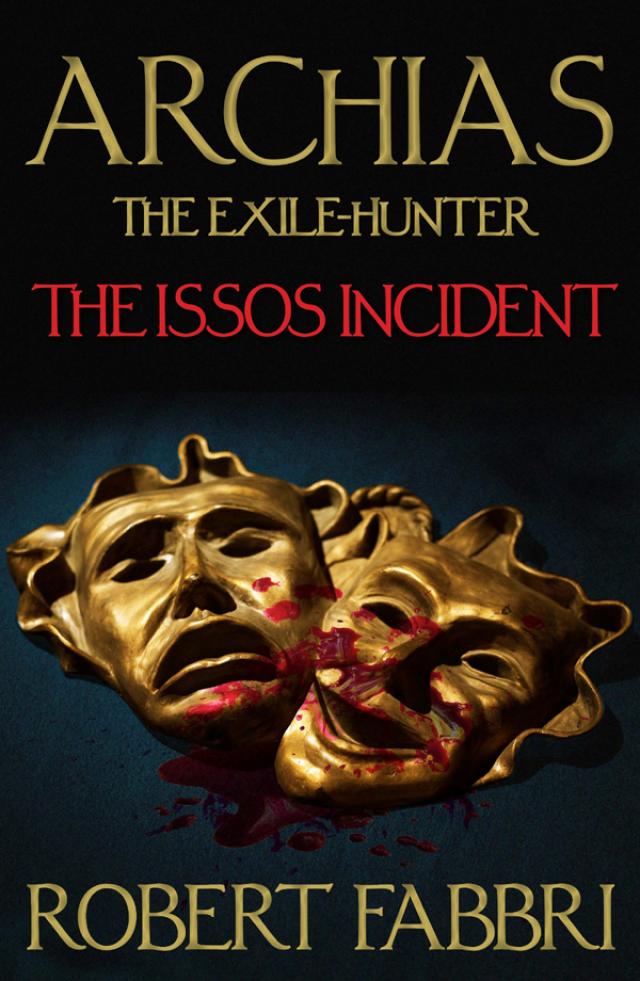
The Issos Incident
An Archias the Exile-Hunter short story
Robert Fabbri
Also by Robert Fabbri
Alexander's Legacy
To the Strongest
The Three Paradises
The Vespasian Series
Tribune of Rome
Rome's Executioner
False God of Rome
Rome's Fallen Eagle
Masters of Rome
Rome's Lost Son
The Furies of Rome
Rome's Sacred Flame
Emperor of Rome
Magnus and the Crossroads Brotherhood
Stand-alone novels
Arminius - the Limits of Empire
Published in e-book in Great Britain in 2021 by Corvus, an imprint of Atlantic Books Ltd.
Copyright © Robert Fabbri, 2021
The moral right of Robert Fabbri to be identified as the author of this work has been asserted by him in accordance with the Copyright, Designs and Patents Act of 1988.
All rights reserved. No part of this publication may be reproduced, stored in a retrieval system, or transmitted in any form or by any means, electronic, mechanical, photocopying, recording, or otherwise, without the prior permission of both the copyright owner and the above publisher of this book.
This novel is entirely a work of fiction. The names, characters and incidents portrayed in it are the work of the author’s imagination. Any resemblance to actual persons, living or dead, events or localities, is entirely coincidental.
10 9 8 7 6 5 4 3 2 1
A CIP catalogue record for this book is available from the British Library.
E-book ISBN: 9781838952945
Corvus
An imprint of Atlantic Books Ltd
Ormond House
26–27 Boswell Street
London
WC1N 3JZ
www.corvus-books.co.uk
The Issos Incident
‘So, old friends, what truths will we discover together this morning?’ Archias held two theatrical masks before him, contemplating the roles he was due to play in the rendering of Aeschylus’ tragedy The Eumenides. Carved of cedar, eyes wide and mouths open, gurning downwards, they could not be described as objects of beauty, but to Archias they were the most pleasing of sights. They were the instruments of his art. One, white faced with rouged cheeks, lips and eyelids, and raven hair piled high and tied in a bow, a couple of curled locks falling to either side, represented the dead Clytemnestra whose ghost comes from Hades to find the Furies asleep rather than hounding her matricidal son, Orestes. The second, Orestes’ embodiment, was as colourful but more masculine: a cascade of brown ringlets fell from a high forehead to frame a round face whose staring eyes were accentuated by triangles of black paint to either side of a long and prominent nose, meeting at its bridge. Along with the downturned, gaping mouth, his expression was one of constant and heightened worry. Very suitable for a man who has killed his mother and is being hunted by the Furies, the female chthonic deities of vengeance, Archias mused, the poetry he would declaim running through his mind.
He smiled at the beauty of the language and the enjoyment that it would give him as he delivered his lines on the stage, facing a towering audience in the high, semi-circular theatron. He had been enamoured of the spoken word since his first utterances. It had been this love of language that had persuaded his reasonably well-to-do parents to send him from his native Thurii, one of the Greek colonies in far-off southern Italia, to study rhetoric under Anaximenes of Lampsacus in Athens, as well as the music, athletics and arithmetic taught by the sophist Lacritus. When Anaximenes had received the summons from Philip, King of Macedon, to go north to Pella to aid Aristotle in the training of the heir to the throne, Alexander, Archias gave up his studies, for he had developed a passion for the theatre and spent all his free time – and much of his meagre allowance – watching plays during the many festivals of the Athenian calendar. With his trained voice he was soon taken into the chorus of one of the more prestigious companies that vied for work in Athens and beyond; he was quick to learn his trade and, with his encyclopaedic memory, in a short while had most of the tragic canon at his command. He rose from the chorus to become the main actor of the company and then, after a few years and a stint of compulsory military service, its manager as well.
But that had been seven years ago, and whilst he enjoyed his work, he had failed to make any significant amount of money through it. To be blunt, he was in his early thirties and heavily in debt – a struggling actor. And so he sat, in the theatre at Rhosos, overlooking the port, in what had been the Persian satrapy of Cilicia, contemplating his masks and waiting for the performance to begin. The parallels between the hunted Orestes and himself were painfully obvious, for although it was not the three Furies who pursued him, his creditors were equally as fearsome and, being seven in number, more numerous.
However, the world was changing and the evidence of that was to be seen in the theatron. Not for the first time in Archias’ experience of playing in the Greek cities of the crumbling Persian empire, there were no Persians in the audience; it was made up mainly of Macedonian and Greek officers. In just a few months, Alexander had led his army across the Hellespont, south along its coast, up through central Anatolia, back down to Tarsus and then south, here, to Rhosos and then on to face Darius’ army at Myriandrus on the Syrian border. But a great storm had prevented contact and the armies had moved apart. Now Alexander’s was encamped north of Rhosos, between the coast and the Amanus Mountains.
It had been chance that had brought Archias to the city – chance or, perhaps, fate – at the same time as the Macedonian advance. He had been touring his company, consisting of him and two other actors – all equally anxious to be away from Athens for a good while – south along the coast since his arrival in Ephesus at the beginning of the sailing season, eighteen months previously. His arrival had coincided with Alexander bringing his army across the Hellespont. For a time, Archias had followed the Macedonians along the Anatolian coast, taking advantage of the business they brought. However, when Alexander had turned his army back north, Archias had decided not to head inland with it but remain, instead, on the more Greek-oriented seaboard. But now Alexander had caught up with him again.
Archias had come to Asia in the hopes of losing the men, seven Thracian brutes, who tailed him for his outstanding debt – a debt they had purchased at a favourable rate from the original creditor. The ploy seemed to have worked: there had been no sign of Sitalces and his crew for the year and a half they had played to the theatres of the Greek cities of Anatolia. Now winter was drawing in for the second time of his exile, he had planned to sail with his companions to the island of Rhodos once they had finished this last performance. Archias hoped if he could remain undetected there until spring, he might be able to slip back unnoticed to Athens once the sea-lanes reopened. But then the Macedonian army and navy had appeared and now, with uncertainty hanging in the air, the price of passage west would be at a premium, even if one could be found in the port below now crammed with Macedonian warships.
He sighed, and, setting down the mask of Clytemnestra, tied on that of Orestes while the priests of Apollo performed the ritual sacrifice on the altar. Apollo himself – or, rather, Archias’ colleague Leonidas – his mask golden and his robes purest white, looked down from on high, suspended from the mechane or crane, for he was one of the main characters of the play.
Standing, Archias stretched his arms, rolling his shoulders, and looked down over the port out to the glittering azure of sea, enjoying the warm breeze. He took a series of deep breaths and then walked to the back of the paraskenia, the stone construction two storeys high which formed the backdrop or scenic wall of the theatre. Here, in the shadow of the right-hand entrance, he waited, studying the audience. It was disappointingly meagre, less than half full, he surmised; however, he was used to that. But with the city paying his and his two fellow actors’ fees, it made no difference how many two-obol tickets were sold. It was all one to him, for the chorus were always local actors and the men who operated the machinery were, in general, slaves. It was the lack of atmosphere he found depressing, but then, what could he expect from communities so far from the heart of the theatrical world in Athens.
The sacrifice complete, Apollo was pulled back into the paraskenia; the chorus, masked as the Furies, took position asleep on the ground as Pythia, the high priestess of Apollo, played by Paris, the third of the group, walked on stage, ready to offer up the play’s opening prayers to the gods. But nothing came from the actor’s mouth. Archias peered around the corner to see Pythia rigid, staring at the five men making their way to the very centre of the front row. His heart jumped: leading the group was a young man of medium stature and visage of a god, with long blond hair flowing from beneath a high helm, bronze glinting in the morning sun. Alexander, the third of that name to sit on the throne of Macedon, took his place at the very centre of the row; his party settled around him. To his right, also in uniform, sat a man of a similar age and equal, carved good-looks and lush hair, whom Archias recognised as Hephaestion, Alexander’s very close companion. Archias did not know the other two soldiers, but the fifth, a civilian in a white robe and a white beard of extravagant length, he did. It was his one-time teacher of rhetoric, Anaximenes of Lampsacus. That he had joined Alexander for his expedition, Archias was aware; but what did take him by surprise was that he was so high in the young king’s estimation as to visit th
Once all were seated, Alexander gestured to Pythia and the opening lines finally came from behind the mask. Archias put from his mind the presence of his former teacher, and took another series of deep breaths in preparation for his entrance.
Pythia, delivered of a rousing speech, retired to the audience’s murmured approval. Archias took his place amid the sleeping Furies, as the god on the mechane, Apollo, was once more pushed back out of the paraskenia and suspended above him. There was a short pause as Pythia’s mask was replaced by that of Hermes, before Apollo looked down on Orestes to tell him he had beaten down the Furies with sleep.
And on the play went. Archias, lost in the beauty of the words, changed from Orestes to Clytemnestra – who wakes the Furies – and then back again. Chased by the three female instruments of vengeance and forced to seek sanctuary by clinging to Athena’s statue, Orestes appeals to the goddess, thus causing her to set up a trial. And it was as Orestes was on trial for the murder of his mother, Clytemnestra, that the messenger arrived in the theatre. Bounding down the steps, three at a time, he called Alexander’s name as soon as he spotted him, interrupting Archias’ favourite speech in the play; he never finished it.
It took one sentence whispered in the king’s ear for him to spring into action. ‘Return to your units!’ he shouted as he leaped up the steps, his helmet under his arm. ‘Darius has got behind us and is coming south to the plain of Issos.’
What to do next? Archias knew not, for there was no chance of a ship now for many a day; as he looked down into the port he could see only the powerful triremes that had shadowed Alexander’s army south. There was no room to spare for commercial shipping, all of which had been evicted, much to the despair of the local merchants.
‘We could try going south,’ Leonidas, still in Apollo’s long robes, said, coming to stand next to Archias.
‘No merchant ships will be moving until the outcome is decided.’
‘And when will that be?’ Paris, the third of the actors, asked, still holding Athena’s spear. Sweat ran down his forehead; he wiped it away with the back of his hand.
Archias shrugged.
‘It might not take long at all, if the rumours are true,’ Leonidas said.
Archias, an enthusiastic frequenter of taverns, had heard most rumours but was always ready to hear a new one. ‘What rumours?’
‘Darius’ army is over a quarter of a million strong at least and Alexander fields no more than forty thousand.’
‘Oh, that rumour; well, even if it were true it would make no difference.’
‘No difference?’ Paris was incredulous. ‘Being outnumbered by more than two hundred thousand makes no difference? You must have done your military service; surely you can understand just what a difference that will make?’
‘Of course I did my service. As a metic, I was, like Leonidas here and all other foreign residents, obliged to serve in the Athenian army. I fought in the front rank at the battle of Chaeronea, as did Leonidas. We’ve both faced a Macedonian phalanx, we were in the same unit. So yes, Paris, I can safely say being outnumbered, by even that many, won’t make any difference. In fact, it will be an advantage for Alexander, which I suspect he recognised immediately, judging by the speed with which he left the theatre. He won’t want Darius to realise his mistake and turn back.’
‘Turn back? Why would he do that?’
‘Because he’s leading two hundred and fifty thousand men onto a plain, between the Amanus Mountains and the sea, which is only two thousand five hundred paces wide; you’ve seen it, we came that way from Tarsus. Do the arithmetic.’
Paris thought for a few moments, his eyes widening as he worked out the implications. ‘Darius’ frontage will be two thousand five hundred files, one hundred men deep, and Alexander’s will be two thousand five hundred files sixteen men deep.’
‘And how many men in a Macedonian phalanx file? I’ll tell you because I’ve felt the weight of one: sixteen. Darius has lost this battle before it’s even started; his units won’t have room enough to manoeuvre and will end up disordering each other, whereas Alexander has just the right number for the ground. No wonder he was in such a hurry and didn’t even give me time to finish my favourite speech. “The wound is fresh now; with time the pain will ease”.’
‘Euripides,’ said Leonidas.
‘Indeed, and very apt too, if a touch melodramatic. But I would have loved nothing more than for my old teacher to hear me declaim that speech.’
‘My noble lords,’ came a voice from behind them.
Astounded at being referred to thus, all three actors turned as one to come face to face with a dark-skinned, hook-nosed man. Sunken, twinkling dark eyes looked out from beneath a white headdress, matching his ankle-length robe. He grinned, to reveal red-stained teeth, and touched his forehead and then his chest. ‘Noble lords, I wish to speak to Orestes.’
Confused, Archias looked at his fellows and then back to the stranger. ‘And why would you wish to speak to Orestes?’
‘That is for me to say, noble lord, and for him to hear. Suffice it to say it will be to that brave man’s advantage.’
Having nothing better to do, Archias took the man by the arm and led him away. ‘I played Orestes.’
‘And what a fearless man you must be, your grandness.’
Archias frowned; he looked sidelong at the man but could see no guile on his face. ‘What makes you say that?’
‘Well, any man who is willing to face the wrath of the gods must be brave in the extreme.’ The man stopped and faced Archias, touching his fingertips to his forehead and then his heart again, before inclining his head. ‘My name is Babrak, great sir, and I am honoured to make your acquaintance. To be in the presence of such heroic courage thrills me like looking into the eyes of one’s desire as you fold the boy in your arms for the first time.’
‘Indeed,’ Archias muttered, raising his eyebrows at the image. ‘“That is as clear as a white line on snow”.’ Then realising that Babrak’s knowledge of Sophocles might be less than adequate, he clarified: ‘What I mean is: I don’t know what you are talking about.’
‘About you, most noble sire. You, a man so valiant, so full of self-belief that you would kill your own mother and then stand before the gods and the world and tell of it.’
‘I did what?’
‘You admitted it and without a plea for mercy. Most magnificent grandee, I am but a humble Pathak merchant. I come from a country far to the east, beyond the reach even of the King of Kings of the Persian empire. I have travelled through many lands but this is the first time I have had the privilege to visit one of your theatres and I was amazed. That the ghost of your mother should appear, crying out for vengeance, and yet you were so brave as to stand your ground. And then you speaking to the gods and asking for their help, accepting a trial in their presence was more than I ever dreamed I would see in my life. No, your magnitude, I have seen what you are capable of and that was enough to convince me you are the man who could bring me justice, for I have been grievously wronged.’
Archias could no longer contain his mirth; it was sudden and it was loud.
Babrak’s face crumpled into a countenance of wounded non-comprehension. ‘The noble lord finds me amusing, or mocks me? But why, when I have done nothing but praise him?’
‘Babrak,’ Archias managed to splutter as he got himself under control. ‘Babrak, it’s a play. It wasn’t real. We wear masks, we act those parts – that is, we pretend to be those people. I played Orestes, but I also played Clytemnestra. I portray the characters on the stage; I am not really them.’
Babrak shook his head, unable or unwilling to understand. ‘But, great hero, I saw these things with my own eyes. Your modesty does you credit but it cannot diminish the facts of the case: you are a man who is unafraid to commit murder. Having murdered your own mother is ample evidence of that assertion and enough for me to offer you a very lucrative job.’
For a moment Archias was going to attempt to correct Babrak’s misapprehension but then closed his mouth, thinking better of it, his creditors coming to mind. ‘Go on,’ he said after a pause.


