

The Early Adventures of El Borak, page 1


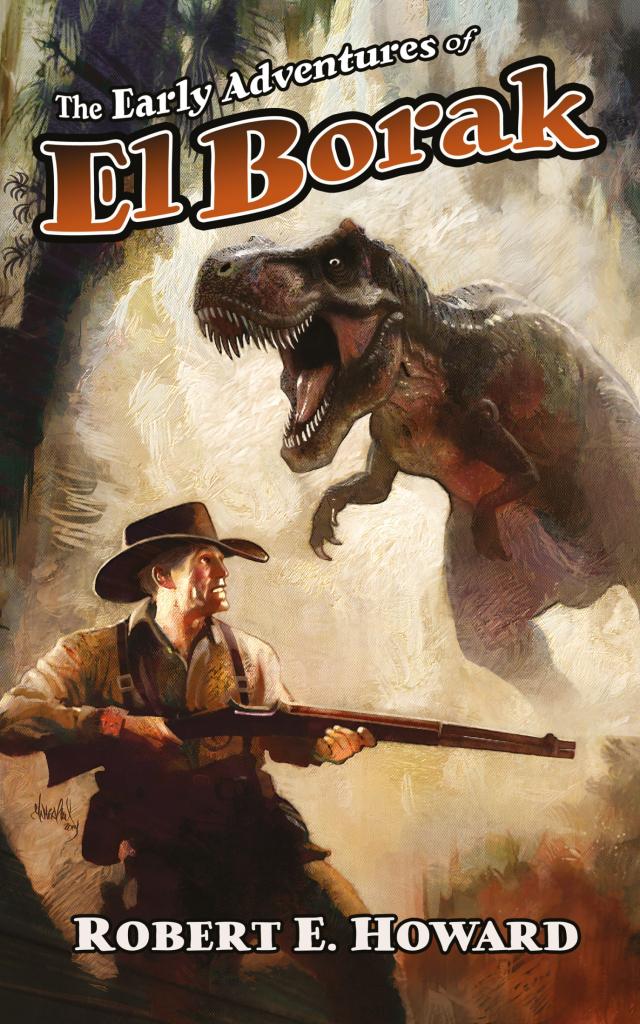
For Glenn Lord (1931-2011), preserver of Howard’s typescripts and manuscripts, godfather of Howard studies, and the greatest fan that ever lived.
Copyright © 2010, 2024 Robert E. Howard Properties Inc. Robert E. Howard™ and related logos, names, characters and distinctive likenesses thereof are trademarks or registered trademarks of Robert E. Howard Properties Inc. unless otherwise noted. All rights reserved.
ISBN: 978-1-955446-21-1 (Paperback)
ISBN: 978-1-955446-11-2 (Hardcover)
ISBN: 978-1-955446-32-7 (eBook)
Published by the REH Foundation Press, LLC by arrangement with Robert E. Howard Properties Inc.
https://rehfoundation.org
https://rehfpress.com
Cover illustration copyright © 2024, Mark Wheatley.
https://markwheatleygallery.com
Book prepared for publication by Ståle Gismervik, Savage Studios.
Version 2.0 - Ultimate Edition.
In loving memory of our friend and colleague
Steven Tompkins
1960 - 2009
Contents
Acknowledgments
The Making of El Borak - introduction by David A. Hardy
The Coming of El Borak
The Iron Terror
“Gordon, The American” (untitled and unfinished)
The Coming of El Borak (unfinished)
Khoda Khan’s Tale (unfinished)
El Borak (unfinished)
“I emptied my revolver...” (untitled and unfinished)
The Land of Mystery (unfinished)
The Shunned Castle (unfinished)
The White Jade Ring (unfinished)
A Power Among the Islands (unfinished)
North of Khyber (unfinished)
Intrigue In Kurdistan (unfinished)
Lal Singh Oriental Gentleman
The Sword of Lal Singh (original draft untitled)
The Tale of the Rajah’s Ring
The Further Adventures of Lal Singh (unfinished)
Lal Singh, Oriental Gentleman
The Adventures of Yar Ali Khan
The Song of Yar Ali Khan
The Lion Gate (unfinished)
The Sword of Yar Ali Khan
(originally untitled)
“When Yar Ali Khan crept”
(untitled and unfinished)
“Two men were standing” (untitled and unfinished)
Steve Allison: The Sonora Kid
The Sonora Kid—Cowhand
The Sonora Kid’s Winning Hand (unfinished)
Red Curls and Bobbed Hair
“Madge Meraldson” (untitled and unfinished)
“The Hades Saloon” (untitled and unfinished)
“A blazing sun” (untitled and unfinished)
“The way it came about” (untitled and unfinished)
“The hot Arizona sun” (untitled and unfinished)
“Steve Allison” (untitled and unfinished)
Brotherly Advice (unfinished)
Desert Rendezvous (unfinished)
The West Tower (unfinished)
Miscellanea
“Drag” (unfinished)
Under the Great Tiger by Robert E. Howard & Tevis Clyde Smith (unfinished)
“A Cossack and a Turk” (untitled)
Spears of the East (unfinished)
“…that is, the artistry” (untitled and unfinished)
“Thure Khan gazed out” (untitled and unfinished)
Blood of the Gods (untitled synopsis)
Maps, Sketches and Lists
Possibly for “Blood of the Gods”
For an unidentified story
Found on the back of typescript pages for “Three-Bladed Doom”
Found on the back of typescript pages for “Three-Bladed Doom”
Acknowledgments
All of the Howard stories, poems, letters and portions thereof contained in The Early Adventures of El Borak come from Howard’s original typescripts, manuscripts, and carbons. Virtually all of the original REH papers were scanned from the Glenn Lord collection, now at the University of Texas, Austin; the Robert E. Howard collection at Texas A&M University; and the typescript collection at Cross Plains Library.
CHANGES FROM THE FIRST EDITION: In this Ultimate Edition, “Drag” has been added. Transcriptions of Howard’s typescripts or previously edited versions of “The Further Adventures of Lal Singh,” “Red Curls and Bobbed Hair,” Untitled (“Madge Meraldson”), Untitled (“The Hades Saloon”), and “The West Tower” have been restored to typescript. In the first edition, a handwritten first draft was used for “The Tale of the Rajah’s Ring”; this edition uses an incomplete typed second draft, finished with the text from the handwritten first draft. Accordingly, all texts are now from REH typescripts except “Under the Great Tiger,” which is from first publication.
“The first character I ever created was Francis Xavier Gordon, El Borak, the hero of “The Daughter of Erlik Khan” (Top-Notch), etc. I don’t remember his genesis. He came to life in my mind when I was about ten years old.”
- Robert E. Howard
The Making of El Borak - introduction by David A. Hardy
There is a myth that Athena was born from Zeus’s head, arriving in a shower of blood, armed and ready for battle. Francis X. Gordon, known as El Borak, is also a born warrior. One might be forgiven for thinking that he sprang straight from Robert E. Howard’s head like Athena, to fight his way through “The Daughter of Erlik Khan” in the pages of the December 1934 issue of Top Notch. But neither stories nor writers come into being without work, practice, false starts, and experiments.
El Borak’s gestation in Howard’s imagination was a long one indeed. Howard described the origin of Gordon and other characters to Alvin Earl Perry: “The first character I ever created was Francis Xavier Gordon, El Borak, the hero of ‘The Daughter of Erlik Khan’ (Top Notch), etc. I don’t remember his genesis. He came to life in my mind when I was about ten years old” (“A Biographical Sketch of Robert E. Howard,” 1935). Writing of Bran Mak Morn, Howard added, “Physically he [Bran Mak Morn] bore a striking resemblance to El Borak.” That is a telling comment, for in some sense it means that the Scotch-Irish Gordon is recapitulating the globe-wandering of the Picts and Celts that so filled Howard’s fantasies.
But it was not until 1922 that Howard began to write of Gordon. The stories of that era show just how many variations Howard tried on Gordon. Several are about quests for lost treasure in unexplored Africa. H. Rider Haggard’s “Lost Race” romances have a strong influence here. In “Khoda Khan’s Tale” Gordon reveals his destination is a ruin called “Valooze.” This is of course related to Valusia, the pre-historic empire ruled by Howard’s Sword & Sorcery character Kull, created in 1928.
In “The Iron Terror,” Gordon is plotting a revolt in Arabia in order to build a personal empire. It may be a bit of homage to George Allan England’s airship-adventure The Flying Legion, where a group of renegade aviators plot a gold-heist from Mecca.
The theme of the usurper who wins a throne by dint of his indomitable will to power is also a uniquely Howardian one. Both Kull and Conan come to power that way; indeed, it is central to their identities. Gordon meets with an arms-dealer to purchase weapons for his rebellion. There is a brief exchange that might serve to describe many Howard heroes.
“I am no soldier,” says Gordon.
The arms dealer replies, “No, you are a conqueror.”
Howard’s conquerors are not men who direct others from behind a desk, nor are they uniformed servants of the state. They are utterly free, wild, and ferocious in their drive to dominate their world or be destroyed in the attempt. When Howard was writing “The Iron Terror” he was struggling to find his own road. Becoming a full-time writer in the face of his parents’ reservations required much determination on Howard’s part. Howard was no one else’s soldier; he followed a lonely road to conquer the life he wanted.
Although clearly fascinated by self-willed men who imposed their rule on the world, Howard regularly raised existential questions about conquest and imperial glory. The arms dealer says, “Like all conquerors. They came, they saw, they conquered! Where are they now? Here is the dagger that was carried by Genghis Khan. But where is Genghis Khan? So all conquerors go!”
Yet for all the ambition of this Gordon, in later stories Gordon would be an opponent of the sorts of adventurers who sought to build themselves a throne atop the corpses of others.
Howard gave the theme of empire building a twist in a piece titled “Intrigue in Kurdistan.” The setting is a Turkish castle with an elaborate network of secret passages, a motif that would recur in several El Borak stories. Gordon instigates a Kurdish revolt, ostensibly to forge an empire with himself as ruler. Gordon’s true motive is revenge for Turkish atrocities, rather than self-aggrandizement. The shift may seem a subtle one, but it is no doubt significant for the later development of the El Borak stories. The motif of building an empire on the slaughter of entire races would return in the last, and most ferocious of the El Borak Stories, “The Son of the White Wolf” (Thrilling Adventures, December 1936).
“The Coming of El Borak” concerns an English woman kidnapped by Afghan tribesmen. The fragment’s protagonists are Khoda
The story has one of the strongest Western-genre themes at its core: the rescue of a white woman from hostile tribesmen. Gordon is described as a gunfighter, a motif related to the waning of the frontier. But the captive-rescue motif harks back to a much earlier type of Western, exemplified by James Fenimore Cooper’s frontier-hero Natty Bumppo, known as Hawkeye, and the epic captive-rescue novel The Last of the Mohicans. Gordon has much in common with Bumppo. Hawkeye has close affinities with Indian culture, yet retains his loyalty to the settlers. Like Bumppo, Gordon has one foot in the “civilized” world of Western culture and one foot in the tribal world of the Afghans, though in the later Gordon stories his loyalty to colonialist goals is sometimes tested. Like Bumppo, Gordon even has a special nickname bestowed on him by the natives. He is El Borak, the swift, indicating his fast-draw speed just as Hawkeye pays tribute to Bumppo’s skill with the long-rifle.
While the captive-rescue motif is a time-honored one, Howard may have found his inspiration elsewhere. In 1923, about the time Howard was writing the early El Borak stories, Afghan tribesmen kidnapped a British girl named Mollie Ellis. The story was reported in The Dallas Morning News and Howard may well have read of it at the time. Admittedly, Miss Ellis was not rescued by a grim-faced American gunslinger. Instead, the British employed a medical missionary, Mrs. Lillian Starr, and a local civil servant, Kuli Khan.
The supporting characters from “The Coming of El Borak” are integral to the El Borak tales. Both Khoda Khan and Yar Ali Khan appear in several other unfinished stories, as does Lal Singh, a Sikh warrior. All three would re-appear in later El Borak tales. Howard also wrote a few pieces with Lal Singh as the leading protagonist. Lal Singh is a merry Sikh thief who relishes trickery as much as swordplay. Perhaps there is a bit of homage to Douglas Fairbanks’s role in the 1924 film Thief of Bagdad.
Howard had a real affection for these characters. In addition to bringing them back in the later El Borak stories, Khoda Khan shows up in “Names in the Black Book,” a story Howard wrote in 1934 during his brief fling with the detective genre. But Howard’s underworld has no gangsters as such, instead it is full of swaggering swordsmen from the Jebal Druse and the Hindu Kush. “Names in the Black Book” culminates in a rousing sword-battle more typical of an El Borak story than a detective tale.
The idea of a Western gunslinger blazing trails in Asia so captivated Howard that he had to create another Texan to accompany El Borak. Steve Allison, the Sonora Kid, is a leading character in his own right. Just as there is more than one Gordon, there is more than one Steve Allison. There is the Sonora Kid, cowboy, outlaw, and gunslinger; then there is the decidedly more domesticated version of Steve Allison, jewel-thief, bon vivant, and doting elder brother.
The domesticated Steve Allison is part of a large family, consisting mostly of sisters. They emerge in a cycle of vignettes and fragments: “Brotherly Advice,” “Desert Rendezvous,” and “Red Curls and Bobbed Hair.” These stories revolve around the indiscretions of the Allison girls, such as getting a bobbed hairdo or falling in love with an insincere “sheik.” Steve alternates between the soft-touch big brother and the stern disciplinarian. Underneath the domesticity there is a subtext of titillation.
One should not read too much into these stories. The pulps had a boundless appetite for the risqué and taboo. The settings, whether New York or a large family of girls, were equally exotic to Howard’s own life.
The wild side of Steve Allison is more properly called the Sonora Kid. This is the cowboy Steve, developed in “The Sonora Kid-Cowhand” as a man ready to fight ranch-hand bullies and wild broncs. Along with his partner, Bill “Drag” Buckner, the Sonora Kid is a gambler (“The Sonora Kid’s Winning Hand”), explorer of Southwestern mysteries (“A Blazing sun in a Blazing Sky”), and evidently a wanted man (“The Hades Saloon”).
Cowboy Steve and domesticated Steve begin to merge in “The West Tower,” where our heroes are transmuted into highsociety jewel thieves, sort of cowboy versions of Sir Charles Lytton and Alexander Mundy. The business at hand is a party in a haunted castle hosted by a decadent, rape-obsessed German junker. Steve’s sisters are nowhere in evidence; a bad hair-do is one kind of family crisis, being wanted by the police on two continents is another.
Finally there are hints of Eastern adventures, the aforementioned sheik being one example. Gazing on the Rio Grande, Steve thinks of a Malay kris and Arab war-cries. In his New York penthouse Steven studies ancient Assyrian art under trophies of Arab scimitars. The fragment “The Mountains of Thibet” puts the Sonora Kid and an un-named narrator (probably Bill Buckner) right on the Roof of Asia.
In the fragment “North of Khyber” jewel-thief Steve and Bill Buckner travel to Afghanistan (one step ahead of the law) to help El Borak deal with an incipient jihad. Howard later used a very similar concept in “Country of the Knife” (Complete Stories, August 1936), with gentleman-gambler Stuart Brent taking Allison’s place. In both tales Howard holds El Borak back until the last possible moment.
Steve and El Borak share a few Lost Race treasure hunts. Fantastic elements such as living dinosaurs and a cursed ruin appear in a couple of the fragments. In one fragment titled “A Power Among the Islands” Gordon appears as a sailor nicknamed “Wolf Gordon,” echoing Jack London’s “Wolf Larsen” from The Sea Wolf.
A fragment simply titled “El Borak” details how Allison and Gordon met. It is one of the starker Sonora Kid tales; there are no sisters or rustic sidekicks. Steve is a broken man on the beach in Oman, degraded enough to accept a job as a killer-forhire. This sets up the Texans for a classic fast-draw shoot-out, with Oman substituting for El Paso.
Interestingly Gordon acquires a new nickname: Diego Valdez. This appears to be a reference to the Kipling poem “The Song of Diego Valdez.” Valdez tells how he found his ease in adventure on the high seas. But when he becomes High Admiral of Spain the demands of authority deprive him of the wild and free life of an adventurer. The tension between duty to others, and the desire to seek adventure for its own sake, is a motif in some of Howard’s best Conan stories, such as “Black Colossus” and Hour of the Dragon. Was this how Howard conceived of Gordon? When El Borak re-appeared in the ’30s, he was no longer a treasure hunter or a man seeking a crown, but a very different character.
The El Borak that emerges in the stories of the mid-1930s is a man strongly devoted to others. His resemblance to Bran Mak Morn is more than physical; El Borak becomes a tribal warrior motivated by loyalty and a powerful determination to fight long odds when committed to a cause. These early fragments were Howard’s proving ground for El Borak. Look at them closely for the ultimate product was a good one. El Borak may not have leapt from Howard’s head like Athena, but like other mythic characters he has stood the test of time.
The Coming of El Borak
The Iron Terror
Outside the wind roared, snatching up the snow, whirling the flakes high in the air. The streets were deserted except for a few belated pedestrians hurrying home, heads bowed against the gale. Further up, in the business-proper part of town, even the crowds were scattered and few. Traffic had almost stopped. In a section where the streets were entirely bare, a house reared, bleak and dark among its lesser neighbors.
“At last!” A laboratory filled with weird contrivances. A withered old man seated at a table.
“At last!” What cared he for the wind and the cold outside? He scarcely knew of it, one of the worst blizzards that had ever swept New York.
“At last!” He rubbed his hands and chuckled.
A taxi drew up in front of the tall house that loomed so dark and forbidding.
A man alighted and made his way through the whirling snow to the door. The taxi whirled away.
The clang of an old-fashioned knocker rose above the shriek of the storm.


